Contents of this chapter
– [Introduction]
– Much more than lobbying
– What, really, is the EU and how does it work?
– ‘Strategy’, ‘tactics’, ‘political process’, ‘public interest’…
– Ready, set, go!
– Notes and references
You are a director or an executive at a company that operates in Europe and is making a healthy profit by selling reputable goods and services. People keep buying your products and the free market is working like a fine-tuned machine. The company owners or shareholders are happy, and you’re looking into a substantial bonus by the end of the year.
And then, boo! Policy-makers at the European Commission or in a national government propose a new regulation that threatens your profits or would cost you money by forcing you to change your business model.
Maybe it’s a law proposal in response to your product being harmful to people or the environment. Or a measure to recover money your company received when taxpayers bailed you out. Or it’s a windfall tax after your industry made huge profits by benefiting from war or a humanitarian crisis. Perhaps it’s a new rule to prevent your company from abusing people’s personal data.
Who cares what it’s about!
It’s not up to policy-makers in the European Union (EU) to meddle in your business by deciding whether your company is harmful. Consumers should know what’s best for them and remain free to keep using your product and services. The point is not whether taxpayers bailed you out or your company is a war profiteer. It’s thanks to the wealth produced by corporations that the state can function and countries can pay for and then recover from conflict. As for privacy and data protection, only those with something to hide should be concerned.
Your company is not a charity: your job is to make money, as much as possible. You need to operate free from restrictions to fulfil your sacred mission to maximise corporate profits. Regulations are an attack on the free market and the economy! When your company’s profits grow, society as a whole benefits because money is supposed to trickle down to workers and the poor, is it not? Regulators should leave you alone to do as you please, and not interfere with your business by introducing yet more legislation.
So here’s a question: what can you do to prevent annoying policy-makers from intruding on how your company makes money?
Well, look around: do you see big, renowned corporations losing money because of an irritating new EU regulation? On the contrary, big companies in Europe and beyond only seem to keep increasing their profits!
And now the question is: how do the people running those big businesses manage to prevent rules that would threaten their profits?
If you want to learn how they do it, if you would like to become a powerful corporate executive who doesn’t care about the law because you can influence how regulations are made, then continue reading: The Guide to Corporate Influence in Europe will tell you everything!
Much more than lobbying
It all started in a private meeting in a big room full of men in suits, in a plush Manhattan hotel in New York, in December 1953. The gathering brought together the men running the biggest tobacco companies in the United States (US). At the time, word was getting out that tobacco caused cancer, government regulation restricting the sale of cigarettes might be impending. It was an emergency for the tobacco industry.
In fact, since at least 1946, tobacco executives had known there was enough evidence to presume that “the use of tobacco contributes to cancer development”. Wisely, the companies had kept silent about that. However, by 1953 more and more scientific studies were showing a link between smoking and cancer (and other illnesses). And not only scientific journals, but that year even Life and Time magazines published articles about tobacco and cancer, and sales of cigarettes were decreasing. The corporate profits of tobacco companies were at stake: what could the big tobacco bosses do?
In that private meeting in New York, the executives of the American tobacco companies called on public relations (PR) firm Hill and Knowlton for help. Together, they realised that, instead of ignoring the debate or plainly denying that smoking caused cancer, tobacco companies should generate doubt about the science. This is what they would do: in public, tobacco executives would say they cared and were committed to establish the facts about smoking and reduce harm. While, behind closed doors, the tobacco companies would devise ways to produce research calling into question the link between cigarettes and cancer, and keep using all sorts of PR techniques to make people start smoking and keep them addicted. Their aim was also to prevent any regulation that might reduce the tobacco companies’ profits or force them to change their business models.
And the plan worked! Despite the growing body of public evidence showing that smoking caused cancer, the strategy implemented by the tobacco industry, based on abusing science and exploiting weak PR regulation, made sales of cigarettes rebound and increase again after 1953. As importantly, the strategy kept strict regulation of tobacco at bay for a number of years, which in turn helped cigarette consumption continue to grow for decades. In fact, most of the tobacco industry would not start publicly admitting that smoking caused cancer until the late 1990s. The strategy was a complete success!
Reaping the fruits of corporate influence
Today’s tobacco executives and shareholders must be really thankful to the pioneers who, back in the 1950s, started developing the corporate strategy to influence public affairs, and used it to convince people that it wasn’t proved that smoking caused cancer.
For example, in 2019, tobacco “was responsible for 8.71 million deaths” globally, out of which 2.5 million deaths were due to cancer. During that year, tobacco was responsible overall for 229.77 million DALYs, which stands for “disability-adjusted life years”, and is a measure of the years of life lived with disability or of life lost because of early death.
But who cares about that when, one year earlier, in 2018, the world’s six biggest tobacco companies had declared profits before income taxes of 55 billion US dollars? Which means tobacco executives and shareholders would get hefty bonuses and dividends. Hell yeah!
After seeing the US tobacco industry successfully protecting corporate profits and delaying strict regulation for decades, companies from other sectors and countries started adapting and using those tactics, which evolved and combined to become The Strategy: the perfect toolset to influence, not only which regulation gets made, but the whole political process and other aspects of public life. From what people talk about, to what gets discussed in political circles, to what kind of policy gets approved or not. All in the service of maximising corporate profits regardless of everything else!
Fossil fuel corporations have been using The Strategy to deny the climate crisis. The chemical industry uses it to keep selling products shown to be toxic. Companies making processed food have used it to keep supermarket shelves full of unhealthy and addictive stuff. Agricultural corporations use it to keep exhausting soil and plants and squeezing animals until nothing is left. The financial industry basically made The Strategy its default modus operandi. And Big Tech has followed suit, aiming to become too big to be regulated.
And now you can learn everything about it!
The Guide to Corporate Influence In Europe (The Guide, for short) will show you how corporations use The Strategy to keep getting richer, and how your company too can follow The Strategy to influence public life and continue making money — even when your product is harmful! And you will learn how to keep such strategic behaviour under the radar and make consumers believe that you have their best interests at heart!
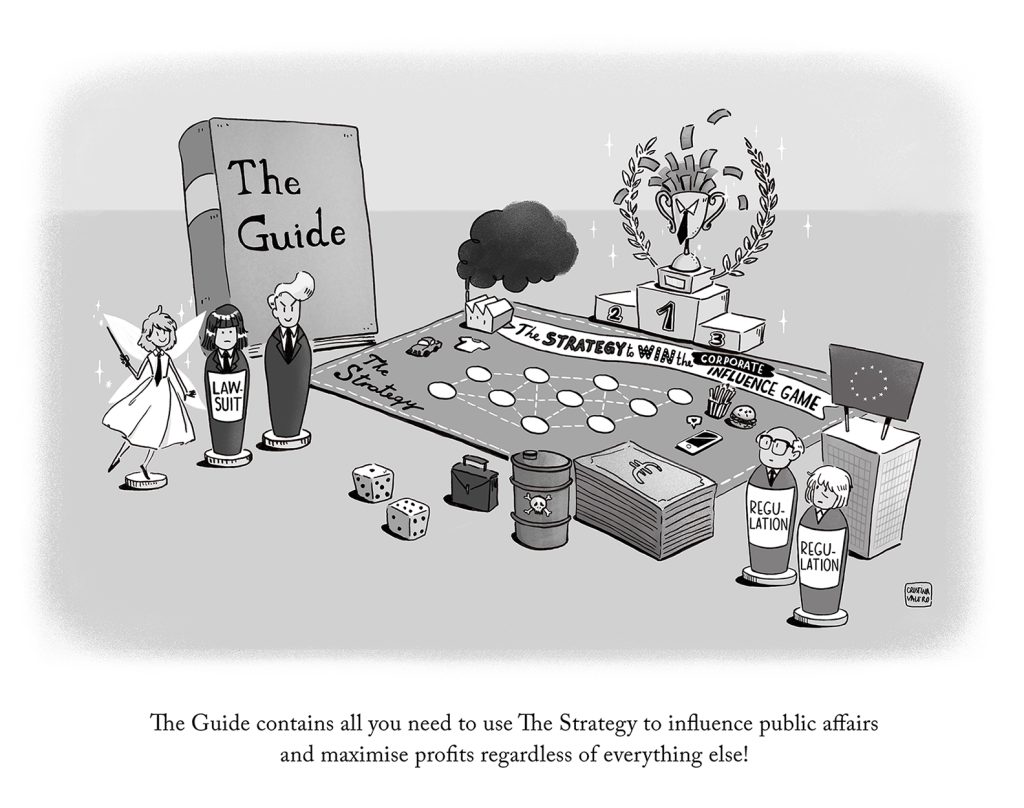
Illustration: Cristina Valero
And now you may be thinking: “OK, but isn’t that what lobbying is about?”
Well, no! The Strategy goes well beyond what is commonly understood by “lobbying”.
You see, while your company does need to engage in conventional lobbying (having official meetings with policy-makers, sending them white papers about what your company does…), such recognisable lobbying activities are a small part of how corporate interests act very strategically to affect, not only policy, but the whole public sphere.
And that’s where The Strategy comes in, as it includes a whole set of tactics for your company to influence all the different aspects of public life_
► the public conversation and debate: how people, the media, experts and politicians talk about corporations and the market, as well as about health, technology, the environment and other relevant topics;
► the political process: what gets seen as political priorities and what are the alternatives discussed and negotiated by elected representatives and government officials;
► and policy-making itself: what laws, norms and regulations get written and approved, and how they are implemented.
Each field supports the next one: the public conversation influences the political process, which then influences policy-making.
If you become consistent at following The Strategy, then your company’s conventional lobbying will be the cherry on top of your strategic cake when it comes to influencing the act of policy-making itself.
And while The Strategy originated and was first successful in the US, big companies have adjusted the tactics to the distinct way in which laws and regulations are made in Europe, where the political process and policy-making are divided and intertwined between EU institutions and national governments. And by reading The Guide, now you can learn how it’s done!
What, really, is the EU and how does it work?
To know how to influence the EU, you need to know what the EU is and understand how it works — yes, nobody said playing the influence game was easy. But fear not! The Guide is here to tell you in a few words what the heck the EU is and how it functions.
► Who are the big guys?_
The three big guys are the Parliament, the Council, and the Commission.
► The European Parliament (EP) approves laws along with the Council. The EP is made of 720 elected members (known as MEPs, for “Members of the European Parliament”), which are selected every five years in the European elections by voters in all EU countries. The latest elections were in June 2024, and right-wing parties have a majority in the Parliament. MEPs are supposed to represent the general interest of all the people living in the EU.
► The Council of the European Union (known as “the Council”) approves laws along with the Parliament. The Council doesn’t have permanent members. Instead, it consists of periodic meetings of government ministers from each EU country. Depending on the topic of the meeting (agriculture, security, finance, technology…), each national government sends one or another minister, who is expected to defend their own country’s interests at the Council.
► And the European Commission (EC) is the one who proposes laws to the Parliament and the Council. The EC is made up of 27 members: one from each of the current 27 countries that are part of the EU. One of these members is the president of the Commission, which is nominated by the governments of EU countries and approved by the Parliament. The current president is German politician Ursula von der Leyen, who was reelected in July 2024 after having been in the job since 2019. The other 26 members of the Commission are like EU ministers, each one of them in charge of a different policy area: Agriculture, Climate Action, Technology, Defence… This is how they are selected: EU national governments suggest aspiring commissioners, the Commission’s president-elect makes a list of 26 of them — each one from a different country — and presents it to the Parliament, which reviews each candidate and votes on the whole list. Once a final list is approved, the 26 people officially become EU commissioners along with the president of the Commission.
Fun fact!
As you just read, one of the big guys is the Council of the EU, known simply as “the Council”. But because the EU likes to be confusing, there is also the European Council, which actually is like the other side of the coin of the Council of the EU. They even share the same website! The difference is that the European Council has a fixed set of members: the heads of state or government of the EU countries and the president of the European Commission, as well as the president of the European Council itself. The European Council’s job is to define “the EU’s overall political direction and priorities”, and “it does not negotiate or adopt EU laws”.
► How do the big guys make laws?_
Making EU law is actually a lot of fun, as it involves EU officers from the three big guys sending each other proposals and revised proposals, on and on and back and forth — like three people who just started a love triangle and can’t decide on the details of what to do next.
► First, the Commission makes a legislative proposal to the Parliament, who reviews it and maybe makes amends to it, and sends it to the Council.
► The Council receives this revised version and, if it likes it and adopts it, then we have a new EU law! But if the Council doesn’t like this version, then it makes its own amends to the law proposal and sends it back to the Parliament.
► Now, if the Parliament likes the Council’s version and adopts it, then we have a new EU law! But if the Parliament doesn’t like that version at all, then it’s game over: the process finishes and there’s no new law. And if the Parliament doesn’t like the Council’s version too much but thinks it’s not beyond repair, then the Parliament can make more amendments to it and send it yet again back to the Council.
► If the Council does like this version and adopts it, then we have a new EU law! But if the Council doesn’t like this version of the law proposal, then the Conciliation Committee is convened.
► The Conciliation Committee is like couples therapy: it brings together an equal number of Council representatives and MEPs, so that they can spend quality time cosily discussing and trying to agree on the legislative proposal. If after several weeks there’s no conciliation, then it’s game over: the process finishes and there’s no new law. But if the MEPs and Council representatives manage to agree on a version that everyone likes, then such version goes back to the plenaries of the Parliament and the Council.
► The whole Parliament and the Council receive the version agreed at the Conciliation Committee and vote on it. If this version gets approved by a majority in both the Parliament and the Council, then we have a new EU law! Otherwise, it’s game over: the process finishes and there’s no new law.
Didn’t we tell you it was fun to make law at the EU?
► OK, so we have a new EU law… and then what?_
Once we do have a new EU law, then it’s up to the national government of EU countries to implement it in their territories. There may be national differences in how EU laws are implemented, monitored and enforced, which — as The Guide will show you — provides nice opportunities for you to play the influence game and prevent EU norms from getting in your way to making more and more money.
► But how does all that relate to The Strategy and the influence game?_
Because of all the back and forth, law-making at the EU is slow and complex, and approving a particular norm may take three or four years (and sometimes as many as ten!). Your company needs to follow The Strategy in order to influence the whole process; so that, during all that time, the public conversation and political debate across Europe are biased in your favour, and so that you can influence which and how policy is in the end written.
Knowing how the EU works, you should aim for your influence to reach EU commissioners, because the Commission is the one that makes law proposals. And you should also try to influence MEPs in the European Parliament and officials in EU national governments, because both the Parliament and the Council (which is made up of ministers from EU countries) will discuss, negotiate and approve — or not — every law proposal.
Particular tactics of The Strategy will help you exert your influence during the different stages of the policy-making process. And when EU laws are approved, The Strategy will help you influence how national governments adapt and implement those norms as part of their national policy.
For instance, if your company is in the Agri-Food business, you should steer the public conversation towards focusing on food security and describe your toxic products as the way ahead. That way, politicians will want to be seen as saviours in their countries, and their national government officials will use the Council to influence EU law to your benefit.
If you make money from people being hooked to their phones, you need to influence Commission officials and MEPs to make them believe that tech companies should be free to innovate without annoying regulations, because that will in turn help the EU remain “innovative”.
If you are an executive in the fossil fuel sector, you need to influence the public conversation so that people believe that oil and gas are part of the solution to the climate crisis, instead of the main contributors to it. And you need to take advantage of any opportunity, such as a war, to scare EU and national government politicians into approving big public investment into more fossil fuel infrastructure in Europe.
Thankfully, The Guide is here to tell you how to do all that — so that your company can prevent restricting regulations and remove any obstacle to increasing corporate profits at the expense of anything else!
Is there anything else you should know about the EU?
If you want to become a proficient follower of The Strategy and reap the maximum benefit for your company, then you also need to know about the EU decentralised agencies.
Why? Because these agencies “contribute to the implementation of EU policies” and “support cooperation between the EU and national governments by pooling technical and specialist expertise and knowledge from both the EU institutions and national authorities”.
That means you want your influence to reach these agencies and the people working there.
For example, if your company is part of Big Pharma, you need to know about the European Medicines Agency, which is responsible for “authorising and monitoring medicines in the EU”. If your company makes and sells ultra-processed food, then you have to know about the European Food Safety Authority, whose advice “informs European laws, rules and policymaking” regarding food in the EU.
Other important agencies for companies interested in following The Strategy are the European Chemicals Agency, the Agency for the Cooperation of Energy Regulators, and the European Banking Authority.
But there are others — so don’t be lazy and go and see the list and write down which ones your company may be most interested in influencing!
‘Strategy’, ‘tactics’, ‘political process’, ‘public interest’…
Before jumping to the next chapters to learn about The Strategy and the tactics you can use to influence public life, there are some key concepts that you need to know about, so that you can get the maximum benefit from The Guide.
► Strategy and tactics_ The Guide uses both terms as they are normally used in military, corporate and other organisational contexts. A “strategy” is the overall plan to achieve some broad goals, and the “tactics” are the actions to accomplish short-term objectives. Here, The Strategy’s general goal is to keep the political and regulatory field as favourable as possible to your company, by preventing regulation that might threaten your profits. The tactics describe activities intended to help you reach that overall goal.
► Politics and policy-making_ In The Guide, by “politics” we mean the set of discourses, conventions, norms and institutions that frame how people, groups and organisations defend and promote their particular interests in society. And “political process” refers to the decisions and steps taken by the actors involved in establishing such a frame and operating inside it. By “policy-making”, we mean the activities, both public and private, that result in the elaboration and implementation of laws and other regulations. And “policy-making process” refers to the decisions and steps taken by the actors involved in producing policy.
► The European Union (EU)_ By reading this chapter of The Guide, you’ve become an expert on the EU, and now you know about its different bodies and how they make law. But when it comes to using the expressions “European Union” or “EU” throughout The Guide, we will generally mean either the EU as a territory, or its key governing institutions: the Commission, the Parliament and the Council, along with the national governments of its 27 member states.
► Corporate interests_ By “corporate interests”, we mean the corporations, people and organisations that defend the priorities of several types of firms: big companies in different industries (technology, energy, food, chemicals…), the banking and financial sector, and also smaller companies — especially start-ups — willing to be aggressive enough to follow The Strategy. It is understood that these companies’ ultimate interest is to maximise their profits, even when that conflicts with the public interest.
What about small companies?
We generally understand that corporate interests don’t include small and medium-sized companies or enterprises (often known as SMEs). That is because the interests of big corporations will frequently clash with the interests of smaller companies; and because there are differences between the public perception of big corporations (which some people dislike) and of smaller companies (which many people regard as nice and quaint). In fact, several tactics of The Strategy are about how corporations can pretend to represent the interests of smaller companies, even if actually smaller businesses are hurt by unfair corporate practices.
► Your adversaries_ As you follow The Strategy, you will find that your real adversaries are not other corporations but investigative journalists and other researchers, NGOs and activists, and even engaged citizens. They say they represent the so-called public interest and will keep snooping around your company’s behaviour. Luckily, the playing field is already tilted in your favour: the political and policy-making processes are complex, and good investigative research happens after the fact, is expensive and usually takes months to get published — and then few people take much notice. For most individuals in the general public, it’s hard to see the big picture and follow your company’s long-term strategic behaviour. That all gives you time and the opportunity to play the influence game to advance your corporate interests without much trouble. And as The Guide will show you, The Strategy can even help you convince consumers and politicians that your company is actually the good guy and your adversaries are the evil ones!
► The public interest_ The Guide understands the “public interest” as a set of values and objectives to promote the lasting wellbeing of the whole of society. That may sound innocent enough. But the problem for corporations is that, in practice, people defending the public interest will demand that companies respect the human and civil rights of communities affected by their business (even including workers’ rights, can you believe it!), that corporate behaviour not undermine democratic practices, that regulators be cautious when it comes to potentially harmful products, that our societies should aim to reduce economic inequality… Such crazy demands will often threaten your company’s profits or could force you to change your business model. But have no fear! The Guide will show you how corporations may advance their own interests and keep making as much money as possible regardless of this so-called public interest thing!
Ready, set, go!
Now you know why your company needs to be ruthless when playing the influence game: you must prevent annoying regulation and defeat your adversaries — so that you can keep making more and more money even if your products harm people or destroy the environment.
Now you know about The Strategy: the masterfully adjusted toolset for your company to influence the public conversation, the political process and policy-making in favour of corporate interests.
And now you know what the EU really is and how it works, and why you need corporate influence to reach the EU institutions and European national governments.
Now you are ready!
In the next chapter, The Guide unveils The Strategy and introduces you to the 10 tactics to influence public life and the entire democratic process in Europe. So that policy-making maintains corporate privilege and regulation doesn’t threaten your business!
Because money is the measure of all things, and nothing — neither people’s health nor keeping the planet liveable — should interfere with your sacred mission to maximise corporate profits!
This chapter was last reviewed and published on 6 September 2024.
This chapter was updated on 11 September 2024. Some lines were added to explain how EU commissioners are selected (from “This is how they are selected…” to “…along with the president of the Commission”). The second-to-last paragraph was slightly edited to briefly describe the next chapter and embed a link to it. And the illustration was replaced with a newer version where the writing in the image is clearer. See here the archived version of this chapter as it was originally published.
This chapter was updated on 22 September 2024. The underlining to mark the phrases that the endnotes refer to was removed. Instead, and with the aim of making the text more readable, now the The Guide has “invisible” endnotes, as described here by The Chicago Manual of Style.
Notes and references
– In the list below, the lines in bold are the phrases in this chapter of The Guide that the ensuing note refer to. When I consider the title or headline of a reference clear and informative enough to support the corresponding statement in the text of this chapter, I only include here the information about the citation and a link to the reference. When the reference is a long document, and/or when particular paragraphs from the reference are clearly related to the corresponding statement, then I quote such paragraphs here. I have minimally edited those quotes to delete the spaces between paragraphs in the original source, so that here they appear as one single (if long) paragraph. For the sake of simplicity, I have also removed embedded links and superscript citation numbers from the quoted paragraphs; those links and citations can be seen and followed in the text in the original reference source. When I use quotes in the text of the chapter, I may re-stylise the initial lower or upper case letters of some quotes to make them fit with their place in the paragraphs in the text.
– Or it’s a windfall tax
– A windfall tax is “an extra tax that a government charges a company when it makes a large unexpected profit, especially if they have been helped by economic conditions”.
– Cambridge Dictionary of English. (2024). Windfall tax. Cambridge University Press & Assessment, 2024. Available on https://dictionary.cambridge.org/dictionary/english/windfall-tax and on the Internet Archive (last visited on 14 August 2024)
– big companies in Europe and beyond only seem to keep increasing their profits!
– “Speaking to the EU Parliament’s economic committee on Monday (5 June), the President of the European Central Bank (ECB), Christine Lagarde, acknowledged the role of increased corporate profits in worsening inflation, calling for better data on corporate profits and closer scrutiny from competition authorities.”
– Allenbach-Ammann, J. (2023). ECB-Lagarde says corporate profits contributed to inflation. Euractiv, 6 June 2023. Available on https://www.euractiv.com/section/economy-jobs/news/ecb-lagarde-says-corporate-profits-contributed-to-inflation/ and on the Internet Archive (last visited on 14 August 2024)
– “Some economists have argued that corporations have actively accelerated inflation by using supply bottlenecks as a pretence to hike up prices across Europe – and then using that inflation to increase prices even further. (…) Astronomic rises in the profit margins of oil and gas companies, supermarkets, banks, pharmaceutical companies and others during the past couple of years has been subject to intense scrutiny. Some have said that profiteering accusations are simplistic and merely business bashing, but market monopolisation of these key industries has precipitated record profits, reaching highs not seen since 1950.”
– Blair, A. (2023). Corporate profits responsible for almost half of Europe’s inflation: IMF report. Investment Monitor, 3 July 2023. Available on https://www.investmentmonitor.ai/news/corporate-profits-responsible-for-almost-half-of-europes-inflation-imf-report/ and on the Internet Archive (last visited on 14 August 2024)
– “Due to disruptions in global supply chains and higher energy prices, firms have been faced with sharp cost hikes over the last three years. Overall, corporates appear to have weathered these challenges showing recent profit margins increasing to historic highs. Higher profit margins helped reduce firms’ financial vulnerabilities by strengthening their balance sheets and eventually supporting financial stability. But they simultaneously contributed to the rise in inflation.”
– Capolongo, A., Kühl, M. & Skovorodov, V. (2023). Firms’ profits: cure or curse? European Stability Mechanism blog, 12 May 2023. Available on https://www.esm.europa.eu/blog/firms-profits-cure-or-curse and on the Internet Archive (last visited on 14 August 2024)
– “A permanent tax on European companies’ excess profits could generate more than €100 billion per year, or over half of the EU’s annual budget, according to a new report commissioned by the European Parliament’s Left Group. Drawing on a technical definition of “excess profits” proposed by the OECD, the study published on Thursday (16 May) estimates that businesses made roughly €2 trillion in excess profits globally in 2022, of which €310 billion originated in the EU.”
– Moller-Nielsen, T. (2024). EU excess profits tax could generate over €100 billion per year, study finds. Euractiv, 16 May 2024. Available on https://www.euractiv.com/section/economy-jobs/news/eu-excess-profit-tax-could-generate-over-e100-billion-per-year-study-finds/ and on the Internet Archive (last visited on 14 August 2024)
– Oxfam International. (2023). Big business’ windfall profits rocket to “obscene” $1 trillion a year amid cost-of-living crisis; Oxfam and ActionAid renew call for windfall taxes. Oxfam.org, 6 July 2023. Available on https://www.oxfam.org/en/press-releases/big-business-windfall-profits-rocket-obscene-1-trillion-year-amid-cost-living-crisis and on the Internet Archive (last visited on 12 August 2024)
– For a more nuanced view on the issue, which assumes that corporate profit would be reduced because wages were due to increase, see: “In other words, Europe’s businesses have so far been shielded more than workers from the adverse cost shock. Profits (adjusted for inflation) were about 1 percent above their pre-pandemic level in the first quarter of this year. Meanwhile, compensation of employees (also adjusted) was about 2 percent below trend. This is not the same as saying that profitability has increased, as discussed in our paper.”
– Hansen, N-J., Toscani, F. & Zhou, J. (2023). Europe’s Inflation Outlook Depends on How Corporate Profits Absorb Wage Gains. IMF Blog, Chart of the Week, 26 June 2023. Available on https://www.imf.org/en/Blogs/Articles/2023/06/26/europes-inflation-outlook-depends-on-how-corporate-profits-absorb-wage-gains and on the Internet Archive (last visited on 14 August 2024)
– The gathering brought together the men running the biggest tobacco companies in the United States (US). At the time, word was getting out that tobacco caused cancer
– “By late 1953, the tobacco industry faced a crisis of cataclysmic proportions. Smoking had been categorically linked to the dramatic rise of lung cancer. Although health concerns about smoking had been raised for decades, by the early 1950s there was a powerful expansion and consolidation of scientific methods and findings that demonstrated that smoking caused lung disease as well as other serious respiratory and cardiac diseases, leading to death. These findings appeared in major, peer-reviewed medical journals as well as throughout the general media.”
– “By the early 1950s, the emerging science on tobacco’s harms documented in the elite peer-reviewed literature, especially the causal linkage to lung cancer, threatened to undo more than a half century of unprecedented corporate success. With considerable anxiety and rancor within the tobacco industry, the industry’s highly competitive CEOs came together in December 1953 at the Plaza Hotel in New York City to map a strategy. They realized that the threat they now faced was unprecedented and would require new, collaborative approaches and expertise.”
– Brandt, A.M. (2011). Inventing Conflicts of Interest: A History of Tobacco Industry Tactics. American Journal of Public Health, 102, 1:63-71, 1 January 2012. Available on https://ajph.aphapublications.org/doi/full/10.2105/AJPH.2011.300292 and https://doi.org/10.2105/AJPH.2011.300292 (last visited on 12 August 2024)
– since at least 1946, tobacco executives had known there was enough evidence to presume that “the use of tobacco contributes to cancer development”
– “Teague was not the only tobacco insider conceding a hazard. Harris Parmele, Lorillard’s director of research, in 1946 had commented privately on how ‘Certain scientists and medical authorities have claimed for many years that the use of tobacco contributes to cancer development in susceptible people. Just enough evidence has been presented to justify the possibility of such a presumption’.”
– Proctor, R.N. (2012). The history of the discovery of the cigarette–lung cancer link: evidentiary traditions, corporate denial, global toll. Tobacco Control, 2012, 21:87-91, 16 February 2012. Available on https://tobaccocontrol.bmj.com/content/21/2/87 and https://doi.org/10.1136/tobaccocontrol-2011-050338 (last visited on 12 August 2024)
– “A few years later [in 1946], H.B. Parmele, a scientist working for the Lorillard Tobacco Company, wrote a report to the company’s manufacturing committee observing that, “Certain scientists and medical authorities have claimed for many years that the use of tobacco contributes to cancer development in susceptible people. Just enough evidence has been presented to justify the possibility of such a presumption… benzpyrene is presumed to be a combustion product of burning tobacco and, by animal experiments, it has been shown to possess definite carcinogenic properties”.”
– Cummings, K.M., Brown, A. & O’Connor, R. (2007). The Cigarette Controversy. Cancer Epidemiology, Biomarkers & Prevention, 16, 6:1070-1076, 1 June 2007. Available on https://aacrjournals.org/cebp/article/16/6/1070/260310/The-Cigarette-Controversy and https://doi.org/10.1158/1055-9965.EPI-06-0912 (last visited on 12 August 2024)
– Parmele, H.B. (1946). “Cigarette cause cancer”, message to Riafner, A. Lorillard, 29 July 1946. Published by Truth Tobacco Industry Documents on 15 January 2003. Available on https://www.industrydocuments.ucsf.edu/docs/ztvv0061 and on the Internet Archive (last visited on 12 August 2024)
– And not only scientific journals, but that year even Life and Time magazines published articles about tobacco and cancer
– sales of cigarettes were decreasing. The corporate profits of tobacco companies were at stake
– “In 1953, a great deal of attention was given to an experiment by Ernst Wynder, Evarts Graham and Adele Croninger, showing that tumours could be generated by painting cigarette smoke tars onto the shaved backs of mice. Life magazine devoted several pages to the story, and Time cited Graham’s conclusion that the case against tobacco had now been proved ‘beyond any doubt’. Public confidence in tobacco was shaken, and stock prices of American cigarette manufacturers plummeted.”
– Proctor, R.N. (2012). The history of the discovery of the cigarette–lung cancer link: evidentiary traditions, corporate denial, global toll. Tobacco Control, 2012, 21:87-91, 16 February 2012. Available on https://tobaccocontrol.bmj.com/content/21/2/87 and https://doi.org/10.1136/tobaccocontrol-2011-050338 (last visited on 12 August 2024)
– “In the early 1950s evidence implicating smoking as a cause of lung cancer began to appear more frequently in medical journals and the popular press. Cigarette sales declined in 1953 and the first part of 1954, but quickly rebounded as manufacturers rushed to introduce and market “filtered” cigarettes to allay health concerns.”
– Cummings, K.M. & Proctor, R.N. (2014). The Changing Public Image of Smoking in the United States: 1964–2014. Cancer Epidemiol Biomarkers Prev., January 2014, 23(1):32–36. Available on https://aacrjournals.org/cebp/article/23/1/32/158084/The-Changing-Public-Image-of-Smoking-in-the-United and https://doi.org/10.1158/1055-9965.EPI-13-0798 (last visited on 18 August 2024)
– the executives of the American tobacco companies called on public relations (PR) firm Hill and Knowlton for help
– “With considerable anxiety and rancor within the tobacco industry, the industry’s highly competitive CEOs came together in December 1953 at the Plaza Hotel in New York City to map a strategy. They realized that the threat they now faced was unprecedented and would require new, collaborative approaches and expertise. Not surprisingly, given their history, they turned again to the field of public relations that had served them so well in the past. They called upon John W. Hill, the president of the nation’s leading public relations firm, Hill & Knowlton.”
– Brandt, A.M. (2011). Inventing Conflicts of Interest: A History of Tobacco Industry Tactics. American Journal of Public Health, 102, 1:63-71, 1 January 2012. Available on https://ajph.aphapublications.org/doi/full/10.2105/AJPH.2011.300292 and https://doi.org/10.2105/AJPH.2011.300292 (last visited on 14 August 2024)
– tobacco companies should generate doubt about the science
– Their aim was also to prevent any regulation that might reduce the tobacco companies’ profits or force them to change their business models
– “The goal, according to Hill, would be to build and broadcast a major scientific controversy. The public must get the message that the issue of the health effects of smoking remains an open question. Doubt, uncertainty, and the truism that there is more to know would become the industry’s collective new mantra. (…) Individual tobacco companies had sought to compile information that cast doubt on the smoking–cancer connection even before Hill & Knowlton became involved. One R.J. Reynolds official announced to other industry executives in November 1953 that the company had formed a bureau of scientific information to “combat the propaganda which is being directed at the tobacco industry.” At the same time, American Tobacco began to collect the public statements of scientists who had expressed skepticism about the research findings indicting tobacco. The company’s own public relations counsel understood that it would be critical to create questions about the reliability of the new findings and to attack the notion that these studies constituted proof of the relationship of smoking to cancer.”
– “The industry campaign worked to create a scientific controversy through a program that depended on the creation of industry–academic conflicts of interest. This strategy of producing scientific uncertainty undercut public health efforts and regulatory interventions designed to reduce the harms of smoking. (…) The industry–science connection was the foundation of Hill’s public relations architecture; it was crucial to the ability of the industry to influence the media, public opinion, policy, regulation, and the law. (…) Hill & Knowlton had successfully produced uncertainty in the face of a powerful scientific consensus. So long as this uncertainty could be maintained, so long as the industry could claim “not proven,” it would be positioned to fight any attempts to assert regulatory authority over the industry. Without their claims of no proof and doubt, the companies would be highly vulnerable in 2 crucial venues: regulatory politics and litigation.”
– Brandt, A.M. (2011). Inventing Conflicts of Interest: A History of Tobacco Industry Tactics. American Journal of Public Health, 102, 1:63-71, 1 January 2012. Available on https://ajph.aphapublications.org/doi/full/10.2105/AJPH.2011.300292 and https://doi.org/10.2105/AJPH.2011.300292 (last visited on 14 August 2024)
– “Devised in the 1950s and ‘60s, the tobacco industry’s strategy was embodied in a script written by the lawyers. Every tobacco company executive in the public eye was told to learn the script backwards and forwards, no deviation allowed. The basic premise was simple — smoking had not been proved to cause cancer. Not proven, not proven, not proven — this would be stated insistently and repeatedly. Inject a thin wedge of doubt, create controversy, never deviate from the prepared lines. It was a simple plan, and it worked.”
– Kessler, D. (2001). Question of Intent: A Great American Battle with a Deadly Industry. Public Affairs (p. xiii). Information about the book is available on the publisher’s site on https://www.hachettebookgroup.com/titles/david-kessler/a-question-of-intent/9780786731022/ and on the Internet Archive (last visited on 12 August 2024)
– made sales of cigarettes rebound and increase again after 1953
– “In 1961, Hill & Knowlton celebrated its successes on behalf of its tobacco client. The total number of cigarettes sold annually had risen from 369 billion in 1954, the company’s first full year of service to the industry, to 488 billion. Per capita consumption had risen from 3344 a year in 1954 to 4025 in 1961, the highest ever. “From a business standpoint,” Hill & Knowlton crowed, “the tobacco industry has weathered this latest spate of health attacks on its products.” In less than a decade, the industry had been stabilized and was thriving.”
– Brandt, A.M. (2011). Inventing Conflicts of Interest: A History of Tobacco Industry Tactics. American Journal of Public Health, 102, 1:63-71, 1 January 2012. Available on https://ajph.aphapublications.org/doi/full/10.2105/AJPH.2011.300292 and https://doi.org/10.2105/AJPH.2011.300292 (last visited on 14 August 2024)
– “On December 14, 1953, at the Plaza Hotel in Manhattan, CEOs of the six largest tobacco manufacturers in the USA (all but Liggett) met to plan a response. The outcome was a far-reaching plan to refute the accumulating evidence, using adverts, ‘white papers’, press releases and corporate schmoozing with popular science writers and journalists. Support for (industry-friendly) science was a vital part of this enterprise: cigarette manufacturers called for ‘more research’ to resolve a purported ‘controversy’, and set out to reassure the public that the companies were taking charge. That campaign was by and large a success, judging from the fact that per capita consumption rebounded from its dip in 1953. Cigarette consumption in the USA would in fact continue to grow throughout the 1960s and 1970s, peaking at about 630 billion sticks in 1982 before starting to decline.”
– Proctor, R.N. (2012). The history of the discovery of the cigarette–lung cancer link: evidentiary traditions, corporate denial, global toll. Tobacco Control, 2012; 21:87-91. Available on https://tobaccocontrol.bmj.com/content/21/2/87 and https://doi.org/10.1136/tobaccocontrol-2011-050338 (last visited on 16 August 2024)
– most of the tobacco industry would not start publicly admitting that smoking caused cancer until the late 1990s
– “In an unprecedented admission by a tobacco company, Liggett Group acknowledged Thursday that smoking causes cancer and heart disease, nicotine is addictive and the industry markets its products to underage youths. The historic concession came as the renegade cigarette maker settled lawsuits by 18 states seeking to recoup billions of dollars spent treating sick smokers. In a separate agreement, Liggett said it had settled about 20 huge class-action suits as well as individual claims seeking damages for smoking-related ailments. The watershed agreements call for Liggett, the industry’s weakest player financially, to make settlement payments and to actively assist attorneys general and private lawyers across the country in prosecuting dozens of massive lawsuits against the $50-billion-a-year industry.”
– Levin, M. & Stolberg, S. (1997). Tobacco Company Admits Smoking Leads to Cancer. Los Angeles Times, 21 March 1997. Available on https://www.latimes.com/archives/la-xpm-1997-03-21-mn-40672-story.html and on the Internet Archive (last visited on 14 August 2024)
– “Philip Morris is acknowledging that scientific evidence shows that smoking causes lung cancer and other deadly diseases, after decades of disputing the findings of the United States Surgeon General and other medical authorities. (…) The move by Philip Morris is part of a trend among tobacco producers to try to put health-related issues behind them after agreeing in the last two years to pay $246 billion to settle lawsuits brought by states seeking to recover their Medicaid costs for treating ill smokers. By making more disclosures about smoking risks, producers also want to make it harder for those who start smoking now to sue by contending they were unaware of the dangers. The Brown & Williamson Tobacco Company created a Web site with information on health issues last year, and the R. J. Reynolds Tobacco Company is creating one. (…) Asked why Philip Morris had not changed its stance earlier, he [Steven Parrish, a senior vice president at Philip Morris] said, ”That is all water under the bridge.” (…) Last year, Brown & Williamson Tobacco, a division of B.A.T. Industries P.L.C., revised its Internet site to reflect its stance on smoking and health issues. On it the company states it ”believes that it is appropriate for the public health community to conclude and warn the public that cigarette smoking causes certain diseases.”
– Meier, B. (1999). Philip Morris Admits Evidence Shows Smoking Causes Cancer. The New York Times, 13 October 1999. Available on https://www.nytimes.com/1999/10/13/us/philip-morris-admits-evidence-shows-smoking-causes-cancer.html and on the Internet Archive (last visited on 14 August 2024)
– in 2019, tobacco “was responsible for 8.71 million deaths” globally
– tobacco was also responsible overall for 229.77 million DALYs
– “Tobacco was responsible for 8.71 million deaths and 229.77 million DALYs globally in 2019.”
– Hairong He & al. (2022). Health Effects of Tobacco at the Global, Regional, and National Levels: Results From the 2019 Global Burden of Disease Study, Nicotine & Tobacco Research, vol. 24, 6:864–870. Available on https://academic.oup.com/ntr/article-abstract/24/6/864/6470875 and https://doi.org/10.1093/ntr/ntab265 (last visited on 14 August 2024)
– 2.5 million deaths were due to cancer
– “Globally, in 2019 there were an estimated 2.5 million cancer-related deaths (95% UI: 2.3 to 2.7) and 56.4 million DALYs (51.3 to 61.7) attributable to smoking.”
– Safiri, S. & al. (2022). Global, regional, and national burden of cancers attributable to tobacco smoking in 204 countries and territories, 1990–2019. Cancer Medicine, 2022, 11:2662-2678. Available on https://onlinelibrary.wiley.com/doi/10.1002/cam4.4647 and https://doi.org/10.1002/cam4.4647 (last visited on 14 August 2024)
– the world’s six biggest tobacco companies had declared profits before income taxes of 55 billion US dollars
– “These profits are as addictive as the tobacco that generates them, as manufacturing and selling tobacco products like cigarettes is astonishingly profitable, even with tobacco excise duty to pay. In 2018, the most recent year for which figures are reported, the world’s six largest cigarette manufacturers made profits (before income taxes) of more than US$55 billion. That is more than the combined profits (US$51 billion) of, for example, Coca-Cola, Pepsico, Nestle, Mondelez, Fedex, General Mills, Starbucks, Heineken, and Carlsberg, who collectively own many household brands with global appeal.”
– Branston, J.R. (2021). Industry profits continue to drive the tobacco epidemic: A new endgame for tobacco control? Tobacco Prevention & Cessation, vol. 7, 45. Available on https://www.tobaccopreventioncessation.com/Industry-profits-continue-to-drive-the-tobacco-epidemic-A-new-endgame-for-tobacco,138232,0,2.html and https://doi.org/10.18332/tpc/138232 (last visited on 14 August 2024)
– aiming to become too big to be regulated
– All the statements made in that paragraph, in the text above in this chapter, will be illustrated through The Guide with real-life examples coming out of journalistic, academic and other investigations. Still, these are some documentary sources to back up the claims in that whole paragraph.
– Noor, D. (2024). Big oil privately acknowledged efforts to downplay climate crisis, joint committee investigation finds. The Guardian, 30 April 2024. Available on https://www.theguardian.com/us-news/2024/apr/30/big-oil-climate-crisis-us-senate-report and on the Internet Archive (last visited on 14 August 2024)
– “The chemicals industry is engaging in an intensive influencing campaign to oppose EU attempts to ban ‘forever chemicals’ (PFAS). Corporate Europe Observatory’s new research explores the key PFAS polluters; their complex web of lobbyists and allies; and some of the strategies they’re using to weaken the proposal for an EU-wide universal PFAS (uPFAS) restriction to ban the manufacture, sale, and use of up to 10,000 PFAS.”
– Corporate Europe Observatory (CEO). (2023). Toxics industry fights back against proposed ‘forever chemicals’ ban. Corporate Europe Observatory, 12 July 2023. Available on https://corporateeurope.org/en/2023/07/toxics-industry-fights-back-against-proposed-forever-chemicals-ban and on the Internet Archive (last visited on 14 August 2024)
– “The market strategies (n=21) and related practices of dominant processed food manufacturers identified in the documents were categorised into a typological framework consisting of six interconnected strategic objectives: i) reduce intense competition with equivalent sized rivals and maintaining dominance over smaller rivals; ii) raise barriers to market entry by new competitors; iii) counter the threat of market disruptors and drive dietary displacement in favour of their products; iv) increase firm buyer power over suppliers; v) increase firm seller power over retailers and distributors; and vi) leverage informational power asymmetries in relations with consumers.”
– Wood, B. & al. (2021). Market strategies used by processed food manufacturers to increase and consolidate their power: a systematic review and document analysis. Globalization and Health, 17, 17. Available on https://globalizationandhealth.biomedcentral.com/articles/10.1186/s12992-021-00667-7 and https://doi.org/10.1186/s12992-021-00667-7 (last visited on 14 August 2024)
– “We also show how Big Food has entrenched its presence within MICs [middle income countries] through establishing global production and hyper-local distribution networks, scaling up its marketing, challenging government policies and scientific expertise, and co-opting civil society.”
– Moodie, R. & al. (2021). Ultra-Processed Profits: The Political Economy of Countering the Global Spread of Ultra-Processed Foods – A Synthesis Review on the Market and Political Practices of Transnational Food Corporations and Strategic Public Health Responses. International Journal of Health Policy and Management, December 201, 10(12), 968–982. Available on https://pubmed.ncbi.nlm.nih.gov/34124866/ and https://doi.org/10.34172/ijhpm.2021.45 (last visited on 14 August 2024)
– Clapp, J. (2002). “The rise of big food and agriculture: corporate influence in the food system”. In Sage, C. L. (ed.). A Research Agenda for Food Systems. Edward Elgar Publishing, 2022.Available on https://www.elgaronline.com/edcollchap-oa/book/9781800880269/book-part-9781800880269-11.xml and https://doi.org/10.4337/9781800880269.00011 (last visited on 14 August 2024)
– WHO / Europe Press Office (2024). Just four industries cause 2.7 million deaths in the European Region every year. New WHO report highlights how big industry fuels chronic diseases, obstructs health policy and targets vulnerable people. World Health Organization (WHO) News, 12 June 2024. Available on https://www.who.int/azerbaijan/news/item/12-06-2024-just-four-industries-cause-2.7-million-deaths-in-the-european-region-every-year and on the Internet Archive (last visited on 14 August 2024)
– “The financial industry has become a crucial and influential player in the economy, holding sway over corporations as well as people’s lives. Banks, investors, and insurance companies can determine how corporations, citizens, and governments are financed. Our research at SOMO focuses on increasing the capacity of civil society to tackle the many problems created by the financial sector. Its business models, practices, financial products, and even political power allow various financial players to extract value from the economy, corporations, people, and the planet. Particular attention is paid to the financial sector’s role in, and impact on, the Global South.”
– SOMO. (2024). Watching over the Financial industry. SOMO.nl. Available on https://www.somo.nl/our-work/sectors/financial-sector/ and on the Internet Archive (last visited on 14 August 2024)
– Milmo, D. (2022). Tech firms becoming ‘too big to govern’, says Uber whistleblower. The Guardian, 2 November 2022. Available on https://www.theguardian.com/business/2022/nov/02/tech-firms-becoming-too-big-to-govern-says-uber-whistleblower and on the Internet Archive (last visited on 14 August 2024)
– Windsor, R. (2024). Is Big Tech getting too big? The Week, 26 June 2024. Available on https://theweek.com/tech/is-big-tech-getting-too-big and on the Internet Archive (last visited on 14 August 2024)
– For a pro-Big Tech and against regulation view, see: Ladd, T. (2023). The Ignorance And Danger Of Proposals To Regulate ‘Big Tech’. Forbes, 15 August 2023. Available on https://www.forbes.com/sites/tedladd/2023/08/15/the-ignorance-and-danger-of-proposals-to-regulate-big-tech/ and on the Internet Archive (last visited on 14 August 2024)
– The European Parliament
– European Parliament. (2024). About Parliament. European Parliament site, 2024. Available on https://www.europarl.europa.eu/about-parliament/en and on the Internet Archive (last visited on 17 August 2024)
– The Council of the European Union
– European Council / Council of the European Union. (2024). The Council of the European Union. European Council / Council of the European Union site, 2024. Available on https://www.consilium.europa.eu/en/council-eu and on the Internet Archive (last visited on 17 August 2024)
– And the European Commission
– European Commission Directorate-General for Communication. (2024). European Commission. European Commission site, 2024. Available on https://commission.europa.eu/index_en and on the Internet Archive (last visited on 17 August 2024)
– German politician Ursula von der Leyen
– European Commission Directorate-General for Communication. (2024). Ursula von der Leyen. European Commission site, 2024. Available on https://commissioners.ec.europa.eu/ursula-von-der-leyen_en and on the Internet Archive (last visited on 17 August 2024)
– each one of them in charge of a different policy area
– European Commission Directorate-General for Communication. (2024). Departments and executive agencies. European Commission site, 2024. Available on https://commission.europa.eu/about-european-commission/departments-and-executive-agencies_en and on the Internet Archive (last visited on 17 August 2024)
– there is also the European Council
– General Secretariat of the Council. (2024). European Council. Council of the European Union. What’s the difference? European Council / Council of the European Union site, 2024. Available on https://www.consilium.europa.eu/en/european-council-and-council-of-the-eu and on the Internet Archive (last visited on 17 August 2024)
– They even share the same website!
– “This website is the official website of the Council of the EU and the European Council. It is managed by the General Secretariat of the Council, the body of staff responsible for assisting the Council of the EU and the European Council.”
– General Secretariat of the Council. (2024). European Council. Council of the European Union. What’s the difference? European Council / Council of the European Union site, 2024. Available on https://www.consilium.europa.eu/en and on the Internet Archive (last visited on 19 August 2024)
– The European Council’s job is to define “the EU’s overall political direction and priorities”, and “it does not negotiate or adopt EU laws”
– General Secretariat of the Council. (2024). European Council. European Council / Council of the European Union site, 2024. Available on https://www.consilium.europa.eu/en/european-council and on the Internet Archive (last visited on 17 August 2024)
– Making EU law is actually a lot of fun
– European Commission Directorate-General for Communication. (2024). How EU policy is decided. European Union site, 2024. Available on https://european-union.europa.eu/institutions-law-budget/law/how-eu-policy-decided_en and on the Internet Archive (last visited on 18 August 2024)
– European Council / Council of the European Union. (2024). The ordinary legislative procedure. European Council / Council of the European Union site, 2024. Available on https://www.consilium.europa.eu/en/council-eu/decision-making/ordinary-legislative-procedure/ and on the Internet Archive (last visited on 17 August 2024)
– Once we do have a new EU law, then it’s up to national government of EU countries to implement it in their territories
– European Commission Directorate-General for Communication. (2024). Implementing EU law. European Commission site, 2024. Available on https://commission.europa.eu/law/application-eu-law/implementing-eu-law_en and on the Internet Archive (last visited on 18 August 2024)
– if your company is in the Agri-Food business, you should steer the public conversation towards focusing on food security and describe your toxic products as the way ahead
– “Although the pesticides industry has pretended to embrace the EU Green Deal goals and the Farm to Fork targets – such as the pesticide reduction target in the SUR – it has in fact worked very hard to delay and derail them. Corporate Europe Observatory (CEO) has tracked the attacks on the Farm to Fork Strategy, and notably the pesticide reduction law, since the start of the Von der Leyen Commission in 2019 (see here, and here). Their campaign started by an old lobby tactic to cause delays: calling for more impact assessment for the sake of ‘food security’. They used both the Covid-crisis and the Russian invasion on Ukraine to amplify their calls. This report is a roundup of lobby evidence from 2022 and 2023, serving as a follow up to CEO’s 2022 report ‘A Loud Lobby for a Silent Spring’. It is based on hundreds of documents obtained through Freedom of Information (FOI) requests to the European Commission and the 27 permanent representations, submissions to EU consultation, the monitoring of lobby events and corporate-sponsored media content, and personal communication with the actors involved.”
– Corporate Europe Observatory (CEO). (2023). Sabotaging EU Pesticide Reduction Law (SUR). CEO site, 19 November 2023. Available on https://corporateeurope.org/en/2023/11/sabotaging-eu-pesticide-reduction-law-sur and on the Internet Archive (last visited on 18 August 2024)
– “Since the Russian invasion of Ukraine, “food security” is back on the political agenda. Conventional agricultural organisations and the agricultural input industry have put forward concerns over food security to advocate against some environmental legislation initiatives in the European Union (EU), and to defend the status quo, as the recent attacks on the proposed laws for a “sustainable use of pesticides” (SUR) on the proposed Nature Restoration Law, as well as on the Farm to fork strategy and the 25% organic farmland target made it clear. Food security has different dimensions: availability, access, stability over time, and utilisation. In the current European context, only accessibility and stability are of concern. Food supply or availability is not at stake in the EU despite the ongoing war in Ukraine, but soaring food prices mean low-income households struggle to access it, with access depending primarily on economic (purchase) power. While utilisation is not an issue of concern in Europe, where diets generally provide sufficient energy and essential nutrients, stability, i.e., lasting, sustainable food security, is threatened by some intensive farming practices, which might produce higher yields in the short term but come with huge environmental and societal costs and so undermine the very bases of production as well as long-term food security.”
– Gernert, M., Segarra Valenzuela, M. & Moeskops, B. (2023). Organic and agroecological farming: Safeguarding long-term food security. TP Organics, 5 September 2023. Available as a PDF file on https://tporganics.eu/wp-content/uploads/2023/09/TPO_RnI_food_security_policy_brief_202309.pdf and on the Internet Archive (last visited on 18 August 2023)
– If you make money from people being hooked to their phones, you need to influence Commission officials and MEPs to make them believe that tech companies should be free to innovate without annoying regulations
– “Google, Twitter and Facebook workers who helped make technology so addictive are disconnecting themselves from the internet. (…) The techniques these companies use are not always generic: they can be algorithmically tailored to each person. An internal Facebook report leaked this year, for example, revealed that the company can identify when teens feel “insecure”, “worthless” and “need a confidence boost”. Such granular information, Harris [Tristan Harris, former Google employee turned vocal critic of the tech industry] adds, is “a perfect model of what buttons you can push in a particular person”. Tech companies can exploit such vulnerabilities to keep people hooked; manipulating, for example, when people receive “likes” for their posts, ensuring they arrive when an individual is likely to feel vulnerable, or in need of approval, or maybe just bored. And the very same techniques can be sold to the highest bidder. “There’s no ethics,” he says. A company paying Facebook to use its levers of persuasion could be a car business targeting tailored advertisements to different types of users who want a new vehicle. Or it could be a Moscow-based troll farm seeking to turn voters in a swing county in Wisconsin.”
– Lewis, P. (2017). ‘Our minds can be hijacked’: the tech insiders who fear a smartphone dystopia. The Guardian, 6 October 2017. Available on https://www.theguardian.com/technology/2017/oct/05/smartphone-addiction-silicon-valley-dystopia and on the Internet Archive (last visited on 18 August 2024)
– “As the EU’s new flagship tech laws, the Digital Services Act and the Digital Markets Act, are coming into full application, Big Tech is working hard to shoot them down. As of today, the Digital Markets Act (DMA) becomes fully applicable, following its counterpart the Digital Services Act (DSA) on 17 February. However, as the EU’s new tech laws are coming into full application, tech corporations like Apple, Amazon, Meta and TikTok are already undermining them at every turn. To subvert these new regulations, tech corporations have filed a number of lawsuits against the European Commission and attempted to weaken the rules with malicious compliance that protects their profits at the expense of their users. Malicious compliance pretends to follow the letter of the law in such a way that ignores or otherwise sabotages the law’s intent. That’s why civil society organisations like EDRi are holding tech corporations to account for their actions and support the European Commission in fully utilising its oversight authority. The DSA regulates how social media platforms deal with potentially illegal online content uploaded by their users, without unduly limiting people’s freedom of expression. The DMA contains powerful obligations and prohibitions to prevent those tech firms from monopolising key markets like smartphones, chat apps, app stores, and more.”
– Penfrat, J. (2023). Euroviews. Delay, depress, destroy: How tech corporations subvert the EU’s new digital laws. Euronews, 6 March 2024. Available on https://www.euronews.com/next/2024/03/06/delay-depress-destroy-how-tech-corporations-subvert-the-eus-new-digital-laws and on the Internet Archive (last visited on 18 August 2024)
– “Big Tech’s new narrative relies on publicly supporting new rules, but only soft rules, shaped by themselves. This is then combined with attempts to reframe regulation as a threat, not to their own profits but to SMEs [small and medium enterprises] and consumers. The final component is stoking up geopolitical fears by warning that regulation will cause Europe to fall behind the United States and, above all, China. Underlying this narrative is still the belief that regulation stifles innovation.”
– Corporate Europe Observatory (CEO). (2021). The lobby network: Big Tech’s web of influence in the EU. CEO site, 31 August 2021. Available on https://corporateeurope.org/en/2021/08/lobby-network-big-techs-web-influence-eu and on the Internet Archive (last visited on 18 August 2024)
– “Anti-competitive practices reveal that big tech companies no longer have any qualms about using their dominant position to oust competitors, preventing innovative firms from entering the market and thus consolidating their hegemony at the expense of the rest of society. A vicious circle is clearly at work, whereby their huge cash reserves highlighted in the first section of this paper increase in proportion to these barriers to competition, while also facilitating them. This alarming picture hints at the antitrust authorities’ chronic inability to act in a sector whose business models evade their usual analytical framework. Tougher, adjusted competition policy is needed to restore the conditions of an environment that is conducive to innovation in the tech industry. In addition to such changes, the administrative authorities’ resources and powers must be strengthened, as they are too often bamboozled by increasingly technical and complex anticompetitive practices. Finally, proactive policies such as measures on interoperability and opening-up of industrial property rights would be useful additions to the antitrust strategy, which is most of the time reactive.”
– Hyppolite, P-A. & Michon, A. (2018). Big Tech Dominance (2): A Barrier to Technological Innovation? Fondation pour l’innovation politique, December 2018. Available as a PDF file on https://www.fondapol.org/app/uploads/2020/06/136-geants-numerique-ii-eng-2019-07-11-w-3.pdf and on the Internet Archive (last visited on 18 August 2024)
– “In addition, users should not be reduced to sources of data or be deliberately manipulated by platform firms to prevent them from making legitimate decisions or making decisions contrary to their interests. In broad agreement with the DSA, the report recommends that platforms should not design interfaces and services that aim to manipulate users into restricting their choices, to mislead them, or to elicit addictive behaviour. Users’ privacy should also be respected. In agreement with the DSA, it is recommended that platforms must offer users a real choice on the use of data, including which data for which application, from which sources, and related to the combination of data. The report extends the DSA proposals in suggesting that this should also extend to inferred data and platforms should offer users the right to reasonable inferences, and to curtail or eliminate the generation of ‘high-risk inferences’, that are privacy-invasive, reputation-damaging, and have low verifiability in the sense of being predictive or opinion-based. (…) The report ends in suggesting that a new mode of regulation for the platform economy is needed, one that will combine ex-ante robust yet flexible regulation, stronger ex-post enforcement, and enrolling the active participation of online platform firms and their ecosystem members. It also calls for supporting fundamental research into platforms’ and ecosystems’ behaviour. Existing economic theories based on foundational notions of ‘markets’ and ‘firms’ (which lead to regulation) may not be sufficient to interpret the behaviour of online platforms correctly. As digitalisation enables the generation of data-driven complementarities across products, services, and sectors, a better unit of analysis than the market might be that of an ecosystem that can cut across markets or sectors. More research is needed on platforms’ behaviour in ecosystems over time and on how ecosystems develop, coalesce, compete, and evolve. Further development and cross-fertilisation of economic theory, management theory, and social science theories will be needed.”
– Gawer, A. & Srnicek, Nick. (2021). Online platforms: Economic and societal effects. European Parliamentary Research Service. Scientific Foresight Unit (STOA), March 2021. Available as a PDF file on https://www.europarl.europa.eu/RegData/etudes/STUD/2021/656336/EPRS_STU(2021)656336_EN.pdf and on the Internet Archive (last visited on 18 August 2024)
– If you are an executive in a the fossil fuel sector, you need to influence the public conversation so that people believe that oil and gas are part of the solution to the climate crisis, instead of the main contributors to it
– “These developments have led invariably to an assumption that we are “done” with fossil fuels across the energy system, that there is no need for further development of new resources, and that we have to stop using them as soon as possible. This assumption has also led to a perception of “good” renewables-based technologies in global energy systems today, on the one hand, and “bad” fossil fuels-based technologies, on the other. The reality is that this debate is much more nuanced and requires more thorough investigation. Carbon capture and storage (CCS) technology and managing methane emissions throughout the fossil energy value chain can help meet ambitious CO2 emission reduction targets, while fossil fuels remain part of the energy system. This will thereby allow fossil fuels to become “part of the solution”, rather than remain “part of the problem”. All technologies have a role to play in an energy system guided by rational economics.”
– Foster, S. & Elzinga, D. (2015). The Role of Fossil Fuels in a Sustainable Energy System. United Nations (UN) Chronicle, December 2015. Available on https://www.un.org/en/chronicle/article/role-fossil-fuels-sustainable-energy-system and on the Internet Archive (last visited on 18 August 2024)
– “ To achieve the goal set by the Paris Climate Agreement of seeking to limit the average global temperature to 1.5 degrees Celsius above the pre-industrial level, the international community is striving for climate neutrality in the second half of this century. For this to happen, global energy systems will have to largely phase out fossil fuels, which, however, remain the dominant energy source. The fact that at present, a complete phase-out of fossil fuels cannot be expected is often lost in climate policy debates; in most countries, it is neither politically desired nor envisaged in long-term climate strategies. However, a speedy and orderly phase-down would have major benefits, such as providing the right investment incentives and supporting the necessary socioeconomic transformations in fossil-fuel producing countries. Today there is an urgent need to further develop the relevant policy and governance instruments as time is running out. The latest Synthesis Report of the Intergovernmental Panel on Climate Change (IPCC) reinforces the fact that if the international community wants to achieve its declared goals of limiting the increase in global temperature to well below 2 degrees Celsius and achieving climate neutrality in the second half of the century, global greenhouse gas emissions must fall drastically before 2030 (see SWP Comment 25/2023). However, the opposite is currently the case: emissions continue to rise. The main reason for this is the use of fossil fuels. Oil, natural gas and coal currently account for about 80 per cent of total global energy supplies.”
– Thielges, S. (2023). The Global Shift Away from Fossil Energy. Stiftung Wissenschaft und Politik (German Institute for International and Security Affairs). SWP Comment, 13 July 2023. Available on https://www.swp-berlin.org/10.18449/2023C38 and https://www.doi.org/10.18449/2023C38 (last visited on 18 August 2024)
– “Even under today’s policy settings, global demand for both oil and gas is set to peak by 2030, according to the latest IEA projections. Stronger action to tackle climate change would mean clear declines in demand for both fuels. If governments deliver in full on their national energy and climate pledges, demand would fall 45% below today’s level by 2050. In a pathway to reaching net zero emissions by mid-century, which is necessary to keep the goal of limiting global warming to 1.5 °C within reach, oil and gas use would decline by more than 75% by 2050. Yet the oil and gas sector – which provides more than half of global energy supply and employs nearly 12 million workers worldwide – has been a marginal force at best in transitioning to a clean energy system, according to the report. Oil and gas companies currently account for just 1% of clean energy investment globally – and 60% of that comes from just four companies.”
– International Energy Agency (IEA). (2023). Oil and gas industry faces moment of truth – and opportunity to adapt – as clean energy transitions advance. IEA News, 23 November 2023. Available on https://www.iea.org/news/oil-and-gas-industry-faces-moment-of-truth-and-opportunity-to-adapt-as-clean-energy-transitions-advance and on the Internet Archive (last visited on 18 August 2024)
– “Fossil fuel industry influence has been front and center in the UN international climate negotiations—the 28th Conference of the Parties (COP28)—in Dubai, United Arab Emirates. This is alarming but not surprising, given that the nations of the world are finally working toward an agreement to phase out fossil fuels. They know it’s the end of the fossil fuel era, and they’re showing up in force because they’re scared. Vested interests of the fossil fuel industry are pulling out all the stops by co-opting leadership roles, flooding the official negotiating space with lobbyists to water down text, and attempting to distract negotiators with bogus voluntary initiatives. Clearly, talk of a fossil fuel phaseout is striking a nerve.”
– Mulvey, K. (2023). Overcoming Unprecedented Oil and Gas Industry Influence at UN Climate Talks. Union of Concerned Scientists. The Equation, 5 December 2023. Available on https://blog.ucsusa.org/kathy-mulvey/overcoming-unprecedented-oil-and-gas-industry-influence-at-un-climate-talks/ and on the Internet Archive (last visited on 18 August 2024)
– to scare EU and national government politicians into approving big public investment into more fossil fuel infrastructure in Europe
– “If Europe is to meet its ‘carbon neutral’ target by 2050, it must reduce its fossil fuel consumption. This is a given. But is switching from one form of fossil fuel (oil or coal) to another — gas — really the best way to do this? Based on data from the US-based organisation, Global Energy Monitor (GEM,) Investigate Europe can demonstrate that the industry is either currently building or planning investments of at least €104 bn in gas infrastructure. (…) So, the question, in light of this statement, is how did so many gas projects, which might not even be needed, come to be on the list in the first place? To answer that is to try and unravel a dense network of industry influence at all political levels. From the EU parliament and Commission to national governments, questions are raised about energy security, and the need for a ‘transition’ fuel, while gas as a geopolitical instrument of power plays out a different game whose rules are neither ecological nor economic. Fossil fuel lobbying in the EU is a big deal, with industry giants employing hundreds of highly-paid — to the tune of around €250 million over the last decade — lobbyists. Corporate Europe Observatory came up with this figure in their report, ‘Green (or grey) Deal‘, and one of the report’s authors Pascoe Sabido explained this is how they “buy access and influence”.”
– Ferguson, J. (2020). The Gas Trap: how Europe is investing €100bn in fossil fuel infrastructure. Investigate Europe, 15 October 2020. Available on https://www.investigate-europe.eu/posts/the-gas-trap-report and on the Internet Archive (last visited on 18 August 2024)
– “Vast amounts of new infrastructure must be built to receive LNG imports designed to replace Russian pipeline gas, putting at risk the EU’s net-zero target for 2050 or leaving the terminals stuck as stranded assets.”
– Keating, D. (2022). Europe’s rush for energy security through LNG risks fossil fuel lock-in. Energy Monitor, 12 April 2022. Available on https://www.energymonitor.ai/decarbonising-gas/europes-rush-for-energy-security-through-lng-risks-fossil-fuel-lock-in and on the Internet Archive (last visited on 18 August 2024)
– “Europe, and Germany in particular, have quickly ramped up liquefied natural gas (LNG) imports to partially offset the loss of Russian pipeline gas deliveries. While many observers rightly applaud this historical achievement, there are also concerns that LNG decisions taken in the face of the crisis can lead to new, risky path dependencies incompatible with climate safeguards. This paper seeks to build bridges and inform more nuanced deliberations. It does so by exploring in detail relevant aspects along the LNG supply chain, guided by the principal assumption that both climate goals and energy security must be achieved. It has been informed by extensive stakeholder engagement, including a workshop bringing together different experts. We find that the development of new LNG export terminals that have not yet reached a final investment decision poses the biggest risk of violating climate targets. In contrast, European import terminals can act as back-up capacities for crisis times. For this, their use needs to be restricted during non-crisis periods. In terms of LNG market balancing, large new export projects currently under development are already set to enter operation before 2027, significantly easing currently tight markets. Additional export capacity beyond this cannot contribute to easing the current supply crunch at scale given long development times and risks ending up as stranded assets. Europe should therefore refrain from supporting new upstream projects, including through long-term contracts that enable such projects, and instead focus contracting efforts on the growing amount of uncontracted volumes from expiring legacy contracts, portfolio players, and from export projects that have already reached final investment decisions. Short- and medium-term contracts could decrease uncertainties resulting from excessive spot market exposure while limiting climate risks. There may be a role for governments to enable such contracts. Lastly, there are two no-regret strategies. In the short term, tackling methane emissions can deliver significant climate and energy security benefits. In the long term, only phasing out natural gas by transitioning to efficient renewable energy systems ultimately reconciles energy and climate security.”
– Heilmann, F. & al. (2023). LNG, Climate and Energy Security: Towards a Comprehensive Approach for Europe. Dezernat Zukunft. Institute for Macrofinance, 17 May 2023. Available on https://dezernatzukunft.org/en/lng-climate-and-energy-security-towards-a-comprehensive-approach-for-europe/ and on the Internet Archive (last visited on 18 August 2024)
– “Russian President Vladimir Putin’s war in Ukraine has upended decades of energy policy and a long-term dependence on Russian gas. Across Europe, governments are scrambling to find alternate energy supplies for the coming winter. This investigative series looks at how the energy and climate crises intersect, with a focus on Italy and Germany, the European countries traditionally most reliant on Russian gas. We examine the close ties between the gas industry and government in these countries, and how these relationships are evolving at this critical juncture. As governments bail out energy companies and fast-track liquefied natural gas (LNG) terminals, fossil gas is fast gaining a new status as the necessary fuel for ‘energy security’, while at the same time, being promoted as a ‘green’ fuel and part of the solution to the climate crisis. This series examines whether there is a broader coordinated push to exploit the current crisis to lock in gas for the long term – and who might be behind it.”
– DeSmog, (2023). How the Gas Lobby Aims to Lock in Europe’s Fossil Fuel Addiction. DeSmog, 2023. Series of reports available on https://www.desmog.com/how-the-gas-lobby-aims-to-lock-in-europes-fossil-fuel-addiction/ and on the Internet Archive (last visited on 18 August 2024)
– EU decentralised agencies
– “contribute to the implementation of EU policies” and “support cooperation between the EU and national governments by pooling technical and specialist expertise and knowledge from both the EU institutions and national authorities”
– European Commission Directorate-General for Communication. (2024). Types of institutions and bodies. European Union site, 2024. Available on https://european-union.europa.eu/institutions-law-budget/institutions-and-bodies/types-institutions-and-bodies_en and on the Internet Archive (last visited on 18 August 2024)
– the European Medicines Agency, which is responsible for “authorising and monitoring medicines in the EU”
– European Commission Directorate-General for Communication. (2024). European Medicines Agency (EMA). European Union site, 2024. Available on https://european-union.europa.eu/institutions-law-budget/institutions-and-bodies/search-all-eu-institutions-and-bodies/european-medicines-agency-ema_en and on the Internet Archive (last visited on 18 August 2024)
– the European Food Safety Authority, whose advice “informs European laws, rules and policymaking”
– European Commission Directorate-General for Communication. (2024). European Food Safety Authority (EFSA). European Union site, 2024. Available on https://european-union.europa.eu/institutions-law-budget/institutions-and-bodies/search-all-eu-institutions-and-bodies/european-food-safety-authority-efsa_en and on the Internet Archive (last visited on 18 August 2024)
– European Chemicals Agency
– European Commission Directorate-General for Communication. (2024). European Chemicals Agency (ECHA). European Union site, 2024. Available on https://european-union.europa.eu/institutions-law-budget/institutions-and-bodies/search-all-eu-institutions-and-bodies/european-chemicals-agency-echa_en and on the Internet Archive (last visited on 18 August 2024)
– Agency for the Cooperation of Energy Regulators
– European Commission Directorate-General for Communication. (2024). Agency for the Cooperation of Energy Regulators (ACER). European Union site, 2024. Available on https://european-union.europa.eu/institutions-law-budget/institutions-and-bodies/search-all-eu-institutions-and-bodies/agency-cooperation-energy-regulators-acer_en and on the Internet Archive (last visited on 18 August 2024)
– European Banking Authority
– European Commission Directorate-General for Communication. (2024). European Banking Authority (EBA). European Union site, 2024. Available on https://european-union.europa.eu/institutions-law-budget/institutions-and-bodies/search-all-eu-institutions-and-bodies/european-banking-authority-eba_en and on the Internet Archive (last visited on 18 August 2024)
– don’t be lazy and go and see the list
– European Commission Directorate-General for Communication. (2024). Search all EU institutions and bodies. EU organisation type: Decentralised agency. European Union site, 2024. Available on https://european-union.europa.eu/institutions-law-budget/institutions-and-bodies/search-all-eu-institutions-and-bodies_en?f%5B0%5D=oe_organisation_eu_type%3Ahttp%3A//publications.europa.eu/resource/authority/corporate-body-classification/AGENCY_DEC and on the Internet Archive (last visited on 18 August 2024)
– even if actually smaller businesses are hurt by unfair corporate practices
– Amazon. (2024). Empowering small business. Amazon News, 2024. Available on https://www.aboutamazon.eu/news/empowering-small-business and on the Internet Archive (last visited on 18 August 2024)
– “Amazon has been eager to portray itself as a supporter of European small and medium enterprises (SMEs). A top Amazon official in Europe recently claimed that SMEs and Amazon are “stronger together”.3 But a growing number of competition investigations probing Amazon’s potential abuses of its power towards sellers tell a different story. As a British seller told SOMO: “Amazon is no friend of the small business.” Sellers are locked into the platform. This, in turn, has allowed Amazon to get away with extracting monopoly rent from them, pushing them into acquiring extra services, and continuously increasing the fees it charges them. By tracing Amazon’s complex structure in Europe, studying service prices over the years, and analysing the findings from competition investigations, SOMO can now show that: Amazon’s income from sellers’ fees has tripled in the past five years (…) Amazon’s advertising revenue in Europe has exploded since 2017 (…) Amazon’s cut of sellers’ income is increasing (…) Charges extracted from sellers grow faster than Amazon’s own sales (…) Amazon sellers are locked in and vulnerable to abuses (…) Amazon’s monopoly power is a structural problem that needs a structural solution”
– Silva, M. & al. (2023). Amazon’s European chokehold. SOMO, June 2023. Available as a PDF file on https://www.somo.nl/wp-content/uploads/2023/06/Rapport-Amazon.pdf and on the Internet Archive (last visited on 18 August 2024)
– ““This company [French dairy giant Lactalis] reported turnover of €28 billion in 2022 and is making a profit. At its head you have two brothers and a sister who are billionaires. It is a company that doesn’t agree to pay its farmers properly, to pay them a price that covers the cost of production, wages and social protection, but which is raking in record profits,” he [Stéphane Galais, a dairy farmer in Brittany and representative of the Confédération Paysanne, a left-leaning farmers’ union that organized the demonstrations against Lactalis] told POLITICO at the Confédération’s stand, which was decked out with posters attacking big food groups and free trade deals.”
– Leali, G. & Ford, A. (2024). European farmers say they’re being screwed by Big Food. Is a price floor the answer? Politico, 6 March 2024. Available on https://www.politico.eu/article/milk-lakes-poor-revenues-european-union-farmers-fight-against-fallouts-free-market/ and on the Internet Archive (last visited on 18 August 2024)
– “Companies like Facebook and Uber say they’re supporting small businesses while squashing them. Major corporations really want you to know how much they care about small businesses — as long as those small businesses don’t compete with them or cause them too much trouble. (…) What can get lost in this is that small businesses already are at a competitive disadvantage, often because of the bigger players that purport to support them. Large corporations are happy to invoke small business when convenient, especially when it helps them keep power. It’s essentially reputational laundering. But what can be less obvious is that these same entities are constantly finding new ways to stunt small-business growth to keep new entrants and potential competitors at bay. They also create roadblocks and find ways to extract money and power from small businesses in order to maintain their positions and increase profits.”
– Stewart, E. (2021). How big business exploits small business. Vox, 30 June 2021. Available on https://www.vox.com/the-goods/22550608/how-big-business-exploits-small-business and on the Internet Archive (last visited on 18 August 2024)