Contents of this chapter
– [Introduction]
– The 10 tactics of ‘The Strategy’
– What you get by following ‘The Strategy’
– General rules when implementing ‘The Strategy’
– Start playing the Corporate Influence Game!
– Notes and references
You already learnt about The Guide, and now we’ll introduce you to The Strategy. But first, a short reminder of what the Corporate Influence Game is about.
You and your company are here to make money. You make or sell things and people choose to buy them. That’s how the free market works — at least in a supposedly liberal region like Europe. Corporations will strive to sell more, to become the biggest and the wealthiest, in a race towards ever-increasing profits, in which executives are the ship captains and directors their lieutenants. The company owners or shareholders receive the riches created, and the race makes our societies tick and our economies advance: the market regulates itself through competition for profits!
That is why your job as an executive or director is to maximise your company’s profits. And that is why the problem here is when the European Commission or a national government want to introduce legislation that interferes with your business and with how much money you can make.
Whether your product makes consumers sick or degrades the environment is not the question here. Sure, people’s health and a liveable environment are important — after all, workers need to be healthy enough to keep working, and consumers need to be alive to keep consuming. But that’s not reason enough for policy-makers to tell you how to go about your business!
It’s actually the other way around: it is the free market — where corporations and consumers are free to do as they like — that teaches the government how things should work. It is the free market that will provide us with a range of brand new products and shiny technological solutions to cure people’s and the world’s ills!
Laws, norms and regulations are an attack on the free market and on your company’s profits. Government interference is harmful. However, because in Europe we live in democracies and it’s the job of elected representatives and governments to legislate, your company must behave very strategically to influence the public debate, the political process and, in the end, policy-making; so that norms and regulation that get approved actually work in your favour.
And because conventional lobbying will only get you so far, you need to know and follow all the tactics in The Strategy to win the Influence Game and affect all of public life across Europe. That’s what big and successful corporations do, and that’s what The Guide will teach you to do: how to follow The Strategy to become a powerful corporate executive or director unstoppable by regulation in your sacred mission to maximise profits!
The Influence Game is not a conspiracy
Don’t make the mistake of taking the Corporate Influence Game for anything like a conspiracy. Sadly, there’s nothing like a secret cabal of powerful corporate people dictating how things work. If only!
Actually, the opposite is true: there are many companies, organisations and people with different interests and resources, all playing the Influence Game to try and affect public life and the political process. Other companies will simply compete with you in the free market. But government officials and regulators will try to restrict your business by introducing annoying legislation. And your adversaries — journalists, researchers, activists and engaged citizens defending the public interest — will try to prevent you from making money by pointing at any little harm done by your products.
There is no conspiracy: playing the Corporate Influence Game is not easy, it requires hard work, and there’s no guarantee of success. But thanks to The Guide, you will learn all the secrets of The Strategy and the best corporate tricks to win the Influence Game!
The 10 tactics of ‘The Strategy’
The Guide presents The Strategy as a list of 10 tactics. The first ones have rather general aims — influencing the public conversation, benefiting from working together with other corporations, silencing critics. Then, as one advances through The Strategy, the tactics get more focused on affecting the political process; and they culminate in helping you determine how policy is written.
However, that doesn’t mean that your company should simply follow the tactics one by one and step by step. Life is complicated and so is the Influence Game. Our world has become like a fun fair where anything can happen; and, as it happens, wars, disasters and other crises are nice opportunities to increase corporate profits. But you also need to constantly watch out for regulators looking at ways to interfere with how you can make money. And you need to be aware of your adversaries trying to annoy you with their investigations and reports. The Influence Game never stops. Companies that want to be successful at achieving influence need to use the different tactics of The Strategy in parallel, in proactive and reactive ways, responding to crises and also planning and deploying long-term influence campaigns — so that you make true the cliché and turn every crisis into a business opportunity. And by reading The Guide, you will learn how all that can be done.
Now, behold! The 10 tactics of The Strategy!
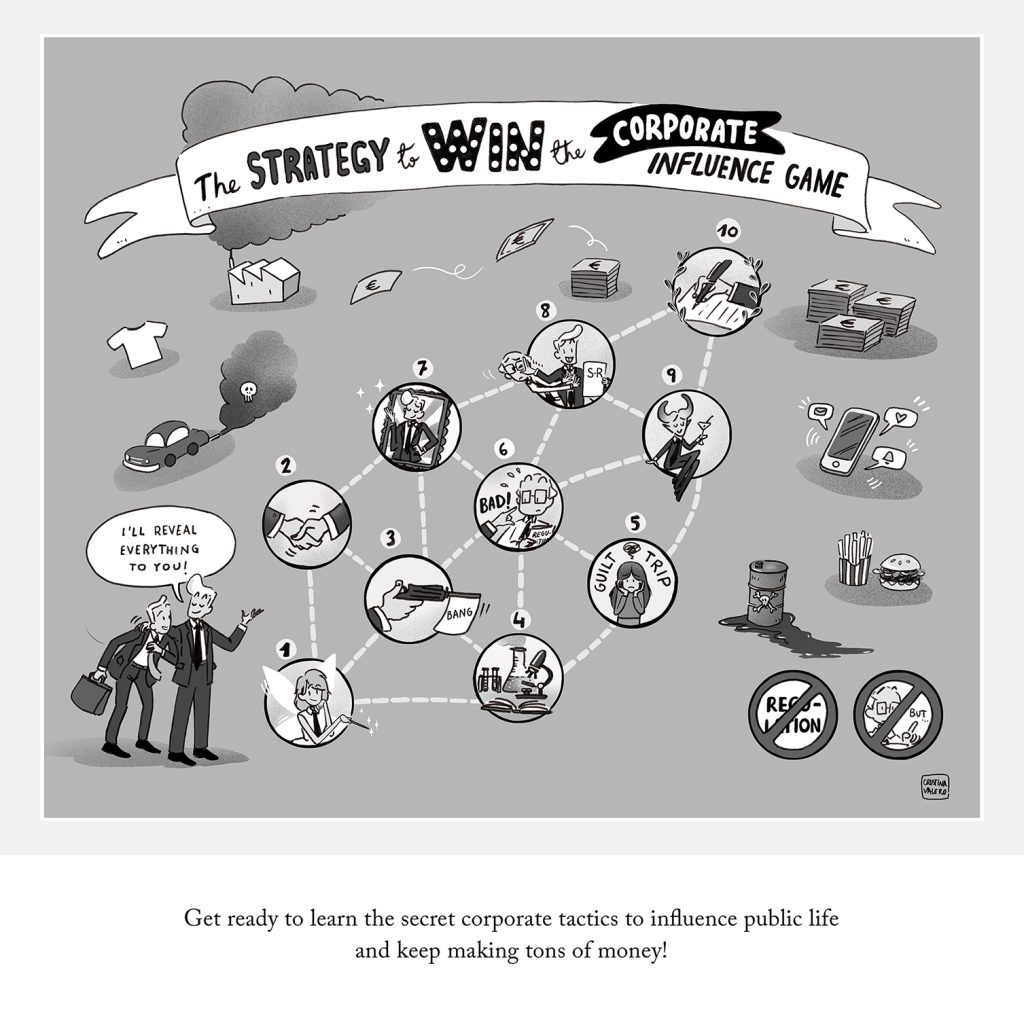
Illustration: Cristina Valero
01. Exploit Weak PR Regulation
The PR Fairy will make your bullshit look like gold!
02. Collaborate with your Competitors
Regulation is the common enemy of corporations!
03. ‘Shoot’ the Messenger
Frighten your critics into silence! (don’t actually shoot them, though)
04. Abuse Science
If science shows your product is harmful, just twist or make up your own facts!
05. Focus on Individual Responsibility
Because it’s all the consumer’s fault!
06. Frame Government as Bad for Markets
Regulators will break the free market if they play with it!
07. Portray Yourself as Good, Legitimate and the Adult in the Room
Your company is the nicest, coolest and smartest guy around!
08. Call for Self-Regulation
You should only follow your own rules — or not even those ones!
09. Look for the Devil in the Details
Respecting the spirit of the law is for losers!
10. Infiltrate the Regulatory Process
Sneak in and write the key points of regulation yourself!
What you get by following ‘The Strategy’
The overall social, economic and political context in Europe is already favourable to corporate interests. And the first and most general aim of The Strategy is to help you keep things that way by influencing the public conversation and debate. Then, as you keep following The Strategy, your influence will reach the political process and allow you to have a hand in steering — or even writing yourself — the policy that will affect how your company can do business.
If you keep playing and winning the Influence Game, you will achieve that coveted dream situation: corporate capture of the political field in Europe! That will make you realise your ultimate goal: for your company to be free to do whatever it takes to make money, not caring for any possible harm done by your products or services.
This is what corporate capture of public life looks like in the European Union (EU) and across Europe when you follow The Strategy:
► The public conversation and debate are framed in ways that benefit corporate interests: big companies are good, corporate harm hasn’t been proved, regulation is counterproductive, people should be free to choose, technology will save the world…
► The political process and the policy debate pick up on the public conversation and become equally framed in industry’s interests. Topics that are awkward for corporations are not discussed: worsening job conditions, increase in social inequality, plundering of the environment, socialisation of costs and privatisation of profits… The way discussed topics are defined is through keywords and concepts coined by corporate interests: technological solutionism, innovation, better regulation, competitiveness, cost-benefit assessment…
► Complex and structural issues of public relevance are stripped of any nuances, and the only realistic alternatives presented in the political debate are: if it benefits corporate interests, good; if it doesn’t, bad. Issues that are not of public relevance but could favour corporate interests are given political relevance and urgency.
► A well-informed, responsible and in-depth public and political debate in the public interest — i.e. an inclusive conversation about structural issues like the improvement of conditions for the worse-off, a liveable environment and the long-term wellbeing of society — is pushed away to the margins or simply disappears.
► Corporate interests have and maintain privileged access to decision-makers at every stage of the political and policy-making processes. In addition to formal and official opportunities, there are more effective informal forums and channels where you and your corporate colleagues can mingle with policy-makers. Such cosy relationships are not transparent.
► Corporate interests become mandatory data and expertise providers during the policy-making process. So much so, that companies become quasi-official partners of legislators in writing policy; while organisations defending consumers’ interests or other issues not aligned with corporate interests are left out.
► Revolving doors between corporate types and elected representatives, government officials and other policy-makers become the norm. You can go from corporate executive to EU commissioner or high-level officer. While politicians can enjoy early and golden retirements by sitting at corporate boards, or even by trying their hands at real and very well-paid corporate jobs.
► Thanks to corporate capture of policy-making, most of what your company does is legal (or at least not explicitly illegal). And if your adversaries say that what you do is illegitimate and abusive, that may actually have beneficial effects for corporations. Your legal-but-abusive actions and your critic’s accusations can contribute to undermine “public trust in democratic decision-makers” and to delegitimise liberal democracy, which will in effect make it harder for government officials to impose annoying regulation on your business.
► And the virtuous circle is closed: thanks to The Strategy and corporate capture, the way the political and policy-making processes work remains very much in favour of corporate interests. That results in your company having a free rein to do anything necessary to decrease costs, increase revenue and maximise profits — even when that has negative impacts on the public interest and the common good.
General rules when implementing ‘The Strategy’
Before moving to the next chapters of The Guide to learn about each tactic and read how great corporations use them to influence public affairs, here are the general rules your company needs to follow for a successful implementation of The Strategy.
► Keep The Guide confidential_ By following The Strategy, your company can influence politics to keep making money regardless of everything else, while keeping such behaviour under the radar, and even making people believe that you have their best interests at heart. That’s why the general public should not know about The Guide.
► Confound regulators and your adversaries to undermine their work_ Say you agree with the general aim of the policy being discussed — but work privately to undermine it. Say you support scientific research — but fund biased or partial studies to remove the focus from the harmful effects of your product. Say you are in favour of transparency and accountability — but release only vague and incomplete information and data about your company, and publish them in formats that researchers cannot easily handle. Say that you work in the public interest and the betterment of the world — but pursue maximum profits without caring about the effects on society or the common good.
► Exploit people’s dislike of uncertainty and ambiguity_ We all want to feel certain about things, and that’s why people don’t feel comfortable with uncertainty: is this good or is this bad?, what may happen if I do this or if I do that? People don’t like nuance, complexity or ambiguity; people don’t want answers like, “it depends”, or “well, it’s complicated”. People want simple explanations about what’s good and what’s bad, and people like to feel reassured about the future. You can use those facts to your company’s advantage. Scientific and expert reports criticising your company will often be long and complicated, and may use statistics and talk about probabilities. Disregard such type of reports and instead use short and clear statements to tell people that your product is good and will make their lives better. Ignore complex questions and issues and just give simplistic explanations, which are the ones people will understand and want to believe.
► Take advantage of the complex and multi-dimensional way in which policy is made in the EU_ Be strategic when choosing which political institution and regulatory authority to target, at both national and EU levels, to achieve your desired influence. Support politicians in national governments that oppose EU regulation that’s damaging to your company. And then support EU politicians that promote policies that will make it easier for your company to operate across European countries. Remember that electioneering and politicians’ selfishness and short-termism can be exploited to your company’s advantage.
► Always try to buy time when working on preventing regulation_ Any delay counts as a success; it gives you time to go on making money as the current situation remains unchanged, and you can use that time to water down or force changes into the regulations under discussion. While you delay a policy, a change in government can make a regulatory agency friendlier to your interests. And when undesired regulation is unavoidable, delaying it allows you to start manufacturing alternatives to the products that are to be restricted, so that you’ll be ready to flood the market again.
► Keep people uninterested in how the political and regulatory processes actually work_ The Strategy exists and succeeds thanks in part to the fact that most people don’t have the time or energy to get into the details of how policy is actually made and implemented. In Europe, the EU institutions add an extra level of complexity to that of national governments and administrations. It’s not that people are stupid, and if they were to read The Guide, they would easily recognise most tactics and understand how your company is setting aside the public interest and degrading democracy. But most people are busy, tired after long working hours, worried about money and the bad news in the media — and at the end of the day they just want to rest a little and be entertained. Your company should work hard to keep people entertained and uninterested in politics: the less the public is invested in the political process and policy-making, the more space there is for your company to influence politics by neglecting truth and the public interest in the service of maximum profits.
► Use the ‘good times’ to prepare for the next crisis — and exploit emergency situations to your advantage_ The question about the next crisis is not whether it will happen but when it will happen — crises are inseparable from capitalism. And when circumstances get shaky, as it’s the case now with climate chaos, wars and disrupting technology, then crises of all kinds are even more likely. That’s why your company needs to use the calm times to prepare to react quickly in times of crisis to exploit them to your advantage. During emergencies, it’s often possible to make governments approve exceptional measures to make it easier for your company to reduce costs (maybe by laying off people or reducing safety measures) and increase revenue (maybe you can get public subsidies or get tax exemptions), therefore helping you maximise your profits thanks to the crisis. And when things go back to normal, sometimes those measures will remain in place.
► Make use of the corporate services industry_ By reading The Guide you will see that The Strategy is in principle easy to understand and it’s clear how useful it can be. However, implementing some of the tactics can get laborious — and that’s why a whole industry has grown and flourished to help companies like yours play the Influence Game. Do you need help with your PR tactics or want to outsource them to someone with less scruples than you? You’ll find many PR firms willing to do the job. After all, one of today’s international giants, Hill & Knowlton, was there helping the US tobacco companies when The Strategy was born. Would you like a better understanding of how best to benefit from corporate and international law? There are many law firms who will happily put their top corporate lawyers to your service, like Dentons, Clifford Chance and Linklaters. And what you discuss with a law firm will normally be protected by client confidentiality, which makes them particularly useful to corporate interests. Maybe what you need is more general advice about implementing The Strategy? Then you have a buffet of international consultancies to choose from, including big names like McKinsey & Co. and Boston Consulting. And what about accounting, that boring and ungrateful job which nevertheless can make or break your company? You can get assistance from the Champions League of international accounting firms, EY, KPMG, Deloitte and PwC. It is true that companies in the corporate services industry can be very pricey — but isn’t it better to give money to other corporations rather than to pay taxes or be willing to make a little less profit?
Start playing the Corporate Influence Game!
Now that you have a proper overview and understanding of The Strategy, and of what blissful corporate capture of the political process and policy-making looks like, and now that you know the general rules to follow when playing the Corporate Influence Game, you are finally ready to learn, one by one, about the 10 tactics that make up The Strategy. Once The Guide shows you how well-known corporations have been using these tactics for decades to make money regardless of the harm they cause, then you too will be able to influence public life so that your company can make millions and billions at the expense of the public interest and the common good!
In the next chapter, The Guide unveils the first tactic of The Strategy: how to take advantage of the PR Fairy to turn bullshit into beautiful public communications — and influence what people talk about and how!
This chapter was last reviewed and published on 13 September 2024.
This chapter was updated on 22 September 2024. The underlining to mark the phrases that the endnotes refer to was removed. Instead, and with the aim of making the text more readable, now the The Guide has “invisible” endnotes, as described here by The Chicago Manual of Style.
Notes and references
– In the list below, the lines in bold are the phrases in this chapter of The Guide that the ensuing note refer to. When I consider the title or headline of a reference clear and informative enough to support the corresponding statement in the text of this chapter, I only include here the information about the citation and a link to the reference. When the reference is a long document, and/or when particular paragraphs from the reference are clearly related to the corresponding statement, then I quote such paragraphs here. I have minimally edited those quotes to delete the spaces between paragraphs in the original source, so that here they appear as one single (if long) paragraph. For the sake of simplicity, I have also removed embedded links and superscript citation numbers from the quoted paragraphs; those links and citations can be seen and followed in the text in the original reference source. When I use quotes in the text of the chapter, I may re-stylise the initial lower or upper case letters of some quotes to make them fit with their place in the paragraphs in the text.
– the market regulates itself through competition for profits
– it is the free market — where corporations and consumers are free to do as they like — that shows the government how things should work
– In my opinion, that’s a myth maintained by corporate interests. See some supporting references below (many more exist). While regulation per se is not the only available answer; and while there are many challenges to produce, implement, monitor and enforce good regulation; the idea is that regulation can be the result of proper democratic processes that are open to revision.
– “Oreskes described the big myth as having three parts. First is the idea of the free market as something that exists unto itself, as opposed to markets “being a human institution and a tool that people develop with rules we create according to how markets should operate.” The second part of the myth is the idea that markets have wisdom. “If you leave markets alone, then the invisible hand of the marketplace will solve our problems. Government is meant to get out of the way, or it might distort the marketplace.” These myths are often echoed in business and political circles; however, a growing chorus of influential voices is beginning to offer a counter argument. At a recent CASI event on Environmental, Governance, and Sustainability (ESG) issues, Tariq Fancy, BlackRock’s former chief investment officer for sustainable investing, was asked whether rules inhibit the functioning of markets. Fancy was quick to respond that “the greatest hoax is the free market hoax.” “Ask any lawyer. A market is just a collection of rules,” he said. “You can change those rules and you’ll get different outcomes, all of which can be considered market outcomes.” The third part of the myth is one Oreskes thinks is less well-known and less well-understood. “We show in the book that throughout the 20th century, and particularly from the mid-century onward, market fundamentalists pushed forward the idea, not just that markets are an efficient means to deliver goods and services, but that they’re a bulwark of freedom.” The notion was that “Economic freedom protects political freedom and if you compromise economic freedom, you’re on a slippery slope to totalitarianism.” Oreskes said that while it is reasonable to argue about what the rules for markets should be, “this third part of the myth is just a complete falsehood, a complete misrepresentation of the facts of history.””
– Butterfield, L. (2023). Exposing the Big “Free Market” Myth with Author Naomi Oreskes. Stanford University, Graduate School of Business, Corporations and Society Initiative, 19 May 2023. Available on https://casi.stanford.edu/news/exposing-big-free-market-myth-author-naomi-oreskes and on the Internet Archive (last visited on 22 August 2024)
– “A common misconception about market economies is that unregulated free market capitalism is the most efficient form of capitalism. This view comes from the belief that markets are self-regulating and that government intervention, as a rule, disturbs the delicate balance. While the appeal of this argument is understandable — and unregulated markets sometimes do work well — it overlooks important realities about markets and the essential and often hidden role of government regulation. Here are four ways in which free markets often fall short. 1. Unchecked market power (…) 2. Unaccounted for externalities (…) 3. Undelivered public goods (…) 4. 4. Unequal access to information”.
– Schneider, H. (2023). The Case for Market Regulation. Smith School of Business, Business Insight, 16 October 2024. Available on https://smith.queensu.ca/insight/content/The-Case-for-Market-Regulation.php and on the Internet Archive (last visited on 22 August 2024)
– De Grauwe, P. (2017). “The Utopia of Self-Regulation in the Market System”, in The Limits of the Market: The Pendulum Between Government and Market. Oxford University Press, January 2017. Information about this book chapter available on https://academic.oup.com/book/9268/chapter-abstract/155979722 and https://doi.org/10.1093/acprof:oso/9780198784289.003.0005 (last visited on 22 August 2024)
– “Economists and policymakers have historically debated how open or restrictive economic and trade policy should be. Free markets are theoretically optimal, with supply and demand guided by an invisible hand to allocate goods efficiently. Free markets can be subjected to manipulation, misinformation, and asymmetries of power and knowledge, and can foster wealth inequality. Regulation aims to balance the virtues of free markets against their pitfalls. (…) Disadvantages of a Free Market Economy. A competitive environment creates an atmosphere of survival of the fittest, leading businesses to disregard the safety of the public to increase the bottom line. Wealth is not distributed equally. Greed and overproduction cause the economy to have wild swings ranging from times of robust growth to cataclysmic recessions.”
– Seabury, C. (2023). The Cost of Free Markets. Investopedia, 1 December 2023. Available on https://www.investopedia.com/articles/economics/08/free-market-regulation.asp and on the Internet Archive (last visited on 22 August 2024)
– Don’t make the mistake of taking the corporate influence game for anything like a conspiracy
– As a simple definition in English of “conspiracy theory”, I like this one: “a theory that explains an event or set of circumstances as the result of a secret plot by usually powerful conspirators (…) Also: a theory asserting that a secret of great importance is being kept from the public”.
– Merriam-Webster. (2024). conspiracy theory. Merriam-Webster dictionary, 2024. Available on https://www.merriam-webster.com/dictionary/conspiracy theory and on the Internet Archive (last visited on 22 August 2024)
– For longer definitions and reflections on conspiracy theories, see the next references.
– Lawton, G. (2024). Conspiracy theories. New Scientist, 2024. Available on https://www.newscientist.com/definition/conspiracy-theories and on the Internet Archive (last visited on 22 August 2024)
– Pauly, M. (2024). Conspiracy Theories. Internet Encyclopedia of Philosophy, 2024. Available on https://iep.utm.edu/conspiracy-theories and on the Internet Archive (last visited on 22 August 2024)
– and wars, disasters and other crises are always opportunities to increase corporate profits
– “Inflation and profiteering. The report also analyses research on inflation and profiteering by leading institutions and companies. High profits, as realised by the agricultural commodity traders in the last three years, can be partially explained by profiteering. Considering the strong and dominant market power of the agricultural commodity traders and their clear track record with regard to anti-competitive behaviour, the potential correlation with the recent extraordinary profits is not to be underestimated. “We do not have a food crisis; we have a price crisis. The food corporations are shamelessly exploiting their monopoly power to artificially inflate prices. This greedflation must finally be put to a stop. We must break up these ruthless corporations, stop mega-mergers and tax their windfall profits.” Martin Schirdewan, Member of the European Parliament”
– Kiezebrink, V. & Hietland, M. (2024). Hungry for profits. How monopoly power tripled the profits of global agricultural commodity traders in the last three years. SOMO, 30 January 2024. Available on https://www.somo.nl/hungry-for-profit and on the Internet Archive (last visited on 23 August 2024)
– The report that press release refers to is this: Hietland, M. (2024). Hungry for profits. SOMO, January 2024. Available as a PDF file on https://www.somo.nl/download/46527/?tmstv=1724407299 and the on Internet Archive (last visited on 23 August 2024)
– “Many large international companies were able to comfortably increase prices during the global inflation period, protecting or even driving up their profit margins, while ordinary families saw their real incomes wither away, according to a new report from IPPR and Common Wealth. Energy companies like ExxonMobil and Shell, mining firms such as Glencore and Rio Tinto, and food and commodities giants like Kraft Heinz, Archer-Daniels-Midland and Bunge all saw their profits far outpace inflation in the aftermath of Russia’s invasion of Ukraine. Because energy and food prices feed so significantly into costs across all sectors of the wider economy, this exacerbated the initial price shock – contributing to inflation peaking higher and lasting longer than had there been less market power, the report argues. Firms in other sectors such as tech, telecommunications and finance also saw high profit increases. Such companies have been able to protect their profit margins or even increase them – setting prices higher than are socially and economically beneficial, and so generating ‘excess profits’ – through a combination of high market power and global market dynamics, the report says.”
– IPPR. (2023). Revealed: How powerful companies are amplifying inflation through their profit margins. Institute for Public Policy Research (IPPR), 7 December 2023. Available on https://www.ippr.org/media-office/revealed-how-powerful-companies-are-amplifying-inflation-through-their-profit-margins and on the Internet Archive (last visited on 22 August 2024)
– The report that press release refers to is this: Jung, C. & Hayes, C. (2023). Inflation, profits and market power: Towards a new research and policy agenda. Institute for Public Policy Research (IPPR) & Common Wealth, 7 December 2023. Available as a PDF file on https://ippr-org.files.svdcdn.com/production/Downloads/1701878131_inflation-profits-and-market-power-dec-23.pdf and on the Internet Archive (last visited on 22 August 2024)
– “Speculation-Driven Price Surge: The study uncovers that food price increases are not a result of natural market forces but are driven by rampant speculation, leading to “greedflation.” Corporate Profits at the Expense of Consumers: Major corporations, including Nestlé and Danone, are reaping extreme profits amid the crisis. Nestle, for example, disbursed a total of €20.1 billion to shareholders in 2022. The study exposes their role in exploiting market conditions to the detriment of consumers. Rigged Food System: The food system is a racket, benefiting massive corporations and hedge funds while adversely affecting consumers and farmers.”
– Schirdewan, M. (2023). Study exposes corporate profiteering from food price crisis. The Left in the European Parliament, 18 December 2023. Available on https://left.eu/study-exposes-corporate-profiteering-from-food-price-crisis and on the Internet Archive (last visited on 22 August 2024)
– The report that press release refers to is this: Van Huellen, S. & Ferrando, T. (2023). Who is profiting from the food crisis? Speculation, rent-seeking and rent-extraction in our food sector. The Left in the European Parliament, 18 December 2023. Available as a PDF file on https://left.eu/app/uploads/2023/12/Food-Crisis-Web-RGB-1_compressed-1-1.pdf and on the Internet Archive (last visited on 22 August 2024)
– “722 of the world’s biggest corporations together raked in over $1 trillion in windfall profits each year for the past two years amid soaring prices and interest rates, while billions of people are having to cut back or go hungry. Analysis by Oxfam and ActionAid of Forbes’ “Global 2000” ranking shows they made $1.09 trillion in windfall profits in 2021 and $1.1 trillion in 2022, with an 89 percent jump in total profits compared to average total profits in 2017-2020. For this analysis, windfall profits are defined as those exceeding average profits in 2017-2020 by more than ten percent. 45 energy corporations made on average $237 billion a year in windfall profits in 2021 and 2022. Governments could have increased global investments in renewable energy by 31 percent had they taxed at 90 percent the massive windfall profits that oil and gas producers funneled to their rich shareholders last year. There are now 96 energy billionaires with a combined wealth of nearly $432 billion ($50 billion more than in April last year). Food and beverage corporations, banks, Big Pharma, and major retailers also cashed in on the cost-of-living crisis that has seen more than a quarter of a billion people in 58 countries hit by acute food insecurity in 2022. Extreme wealth and extreme poverty have increased simultaneously for the first time in 25 years.”
– Oxfam. (2023). Big business’ windfall profits rocket to “obscene” $1 trillion a year amid cost-of-living crisis; Oxfam and ActionAid renew call for windfall taxes. Oxfam International, 6 July 2023. Available on https://www.oxfam.org/en/press-releases/big-business-windfall-profits-rocket-obscene-1-trillion-year-amid-cost-living-crisis and on the Internet Archive (last visited on 22 August 2024)
– companies that want to be successful at achieving influence need to use the different tactics of The Strategy in parallel
– Other researchers producing taxonomies of the tactics used by corporations to influence public life have reached the same conclusion. See, for instance:
– “While we have teased them out into separate categories to create the taxonomy, in real life they often represent composite actions or chains of events. The following is an example: corporations pay for research (shape evidence to manufacture doubt); issue press releases about the findings and put forward experts to the media (manufacture public support for industry position); and take research summaries to meetings with policy-makers (access and influence policy-making).”
– Ulucanlar, S. & al. (2023). Corporate Political Activity: Taxonomies and Model of Corporate Influence on Public Policy. International Journal of Health Policy and Management, 2023, 12(1): 1-22. Available on https://www.ijhpm.com/article_4440.html and https://doi.org/10.34172/ijhpm.2023.7292 (last visited on 22 August 2024)
– The overall social, economic and political context in Europe is already favourable to corporate interests
– “Failing paradigm. Over the last 50 years, economic policies have been dominated by a neoliberal approach, prioritizing market freedom and deregulation. This approach has often overlooked the economic and social consequences of unchecked economic power. Although the failure of the current paradigm has been showcased by different reports such as De Loecker et al (2020) and Akcigit and Ates (2021) focusing on the US markets, we lacked empirical data showing the same trend in the EU. The report by the European Commission clearly shows that these worrying trends exist in Europe as well. Worrying trends. The report shows that in a wide range of sectors in the EU over the past 25 years: Concentration at both industry and market levels has increased. Markups and profits for companies controlling essential inputs have increased. The economy is divided between ‘Global Superstars’ (the most profitable large global companies) and the rest concerning markups, profits and productivity. The gap between them is increasing. Markets became static, meaning the rate of change in markets (in terms of entering markets and being able to disrupt incumbents) has declined. As a result, the report gives a bitter pill to swallow: “The intensity of competition in the EU seems today to be weaker than in the past.” Winner-takes-most dynamic. The report points out the evolution of markets and how new characteristics of the markets benefitted large companies (winner-takes-most dynamics). This indicates that firms that initially succeeded, managed to preserve and extend their dominance not due to their success but their ability to: Leveraging digitalisation and globalisation. Engaging in M&A activity (to a limited extent). Investing heavily in intangibles.”
– Çavuş, Ç. (2024). Widening Gaps. How European Markets are concentrating power. SOMO, 29 July 2024. Available on https://www.somo.nl/widening-gaps and on the Internet Archive (last visited on 23 August 2024)
– The report that article refers to is this: Directorate-General for Competition at the EC. (2024). Protecting competition in a changing world. Evidence on the evolution of competition in the EU during the past 25 years. European Commission (EC), 1 July 2024. Available on https://op.europa.eu/en/publication-detail/-/publication/c03374f1-3833-11ef-b441-01aa75ed71a1, https://data.europa.eu/doi/10.2763/089949 and on the Internet Archive (last visited on 23 August 2024)
– “This report examines the extreme and undue influence of big business on European Union (EU) and member state decision-making processes. It has been produced by the Alliance for Lobbying Transparency and Ethics Regulation (ALTER-EU) as a response to the distortions we witness in policy and law making at EU-level and across a member states. It shows how corporate capture has been behind the lack of action in the aftermath of the financial crisis, with banking regulation that continues to allow mega-mergers of banks, failing to tackle the “too big to fail” problem (see case study one). Similarly, the arms industry has influenced the agenda and objectives of the EU’s defence programs (see case study seven). The phenomenon of corporate capture is not, however, limited to the EU level. ALTER-EU’s broad membership has witnessed and challenged corporate capture of various national governments. Dieselgate, for instance, exposed the intimate connections between the German government and its national car industry, and how the German government acted as vehicle for the industry’s influence at EU level (see case study eight). Too often we find member states acting on behalf of their biggest national industries in Brussels, taking shelter under Council secrecy and avoiding public accountability.”
– ALTER-EU. (2018). Corporate capture in Europe – When big business dominates policy-making and threatens our rights. Alliance for Lobbying Transparency and Ethics Regulation (ALTER-EU), September 2018. Available on https://www.alter-eu.org/corporate-capture-in-europe-when-big-business-dominates-policy-making-and-threatens-our-right-0 and on the Internet Archive (last visited on 22 August 2024)
– The report that press release refers to is this: Tansey, R. (ed.). (2018). Corporate capture in Europe: When big business dominates policy-making and threatens our rights. Alliance for Lobbying Transparency and Ethics Regulation (ALTER-EU), September 2018. Available as a PDF file on https://www.alter-eu.org/sites/default/files/documents/corporate_capture_web_1.pdf and on the Internet Archive (last visited on 22 August 2024)
– “In Europe, the Lisbon agenda, the monetary union and the asymmetrical development of the internal market program have also played a role. More often than not, it is neoliberal policy prescriptions – as popularised by Hayek, the Chicago boys, Margaret Thatcher or Ronald Reagan – that are considered responsible for these outcomes. Placing privatisation, deregulation and liberalisation at the centre, this neoliberal route to prosperity became hegemonic in Europe in the second half of the 1990s when social democratic governments headed its implementation. One central driver behind the model of economic development where GDP growth is paired with growing inequality and environmental degradation has been the change of both the purpose as well as the institutional context inhabited by one core private actor — the corporation. In the neoliberal imaginary of prosperity, the corporation is often viewed as the main driver of progress. As a result, policies which support the corporation’s operations, growth and expansion became the political priority. Paradoxically however, this ‘full steam ahead’ approach for the corporation came with a concomitant narrowing of interests and purposes that the corporation is supposed to serve, creating the ‘self’ in the ‘self-interested’ that ultimately eschewed everything but share prices.”
– Bartl, M. (2023). Towards the imaginary of collective prosperity in the European Union (EU): reorienting the corporation. European Law Open, 2022, 1(4):957-986. Available on https://www.cambridge.org/core/journals/european-law-open/article/towards-the-imaginary-of-collective-prosperity-in-the-european-union-eu-reorienting-the-corporation/120403F5FB1E3F75D4378D697D0E8EBE and https://www.doi.org/10.1017/elo.2023.5 (last visited on 22 August 2024)
– corporate capture of the political field in Europe!
– This is what corporate capture feels like… (all the points listed below that paragraph in this chapter are also generally supported by the next reference, as well as by additional references listed in turn here below)
– “The concept of corporate capture has been used by academics for a long time, and civil society groups are showing renewed interest in the idea. Definitions and ways of identifying the problem vary, but share many common traits. Some of the broader definitions used by civil society groups emphasise its consequences rather than its causes. The International Network for Economic, Social and Cultural Rights, for example, describes corporate capture as referring “to the means by which an economic elite undermines the realization of human rights and the environment by exerting undue influence over domestic and international decision-makers and public institutions.” This is achieved via corporate interference in judicial, legislative or policy processes, and its symptoms include increasing privatisation of social provisions, and a revolving door between the public and private sectors. Other definitions point to the secrecy of elite policy-making: Friends of the Earth Europe, for example, describe corporate capture as “the process whereby special interest groups, often business and industry groups, gain privileged access to policy-making processes, which gives them disproportionate influence, behind closed doors.” Moreover, they point out, closed door discussions “where the agenda, content, attendees and outcomes, are not made public” are antithetical to democratic decision-making. The OECD, meanwhile, notes that the “capture of public decision making” can be achieved not only through illegal means, like bribery, but “through legal channels, such as lobbying and financial support to political parties and election campaigns”. And, it adds, undue influence can be exercised “by manipulating the information provided” to policy-makers, “or establishing close social and emotional ties with them”. (…) ALTER-EU considers corporate capture to be evident when a particular policy area exhibits certain key tendencies, which suggest that decision-making in that area has often been captured by corporate interests. In the eight case studies in this report, our focus is on the relationships between business and policy-makers in the EU, the communication and information exchanged between them, both in the Brussels’ bubble and at national level, and on the outcomes of these contacts in terms of policy and regulation.”
– Tansey, R. (ed.). (2018). Corporate capture in Europe: When big business dominates policy-making and threatens our rights. Alliance for Lobbying Transparency and Ethics Regulation (ALTER-EU), September 2018. Available as a PDF file on https://www.alter-eu.org/sites/default/files/documents/corporate_capture_web_1.pdf and on the Internet Archive (last visited on 22 August 2024)
– if it benefits corporate interests, good; if it doesn’t, bad. Issues that are not of public relevance but could favour corporate interests are given political relevance and urgency
– A couple of examples could be the urge to keep lowering corporate tax and seeing public health as a field to be exploited by for-profit investors rather than as a public service and common good.
– “Corporate taxes could the the [sic] most harmful form of taxation to economic growth. Contrary to public perception, there has been no reduction in corporate tax revenues in relation to GDP in the last 40 years. Countries that have reduced their corporate tax rates in recent years have seen increases in investment in the following years. There is no race to the bottom, rather to a middle range of some 20% corporate tax rate and revenues are stable or even increasing. These are some of the conclusions of a recent study commissioned by the European Economic and Social Committee (EESC) at the request of the Employers’ Group. The study was presented on 5 July at the seminar entitled “The impact of corporate taxes on the European economy”. According to the researchers, a high corporate tax rate can hamper business activity by making some investment projects unprofitable. This reduces the tax base and, consequently, revenue collection from corporate taxes.”
– EESC. (2019). Corporate taxes: less could be more – study says. European Economic and Social Committee (EESC), 8 July 2019. Available on https://www.eesc.europa.eu/en/news-media/press-releases/corporate-taxes-less-could-be-more-study-says and on the Internet Archive (last visited on 22 August 2024)
– The study that press release refers to is: Baert, P., Lange, F. & Watson, J. (2019). The Role of Taxes on Investment to Increase Jobs in the EU — An Assessment of Recent Policy Developments in the Field of Corporate Taxes. European Economic and Social Committee (EESC), May 2019. Available as a PDF file on https://europa.eu/!NB43bP and on the Internet Archive (last visited on 22 August 2024)
– While in 2014 the World Health Organization Regional Office for Europe was calling on European national governments to invest — as part of their response to the financial crisis — in public health measures, especially in cost-effective preventive measures, for-profit private investment in the health sector internationally has kept growing during the last couple of decades, including in the so-called wellness industry.
– “The current costs of ill health are significant for governments in Europe: trends suggest unsustainable increases in costs unless cost-effective policies are put in place. (…) The economic crisis has increased demand and reduced resources. Cost-effective preventive approaches can contribute to improvements in health outcomes at lower and more sustainable costs, while supporting universal health coverage. The Organisation for Economic Co-operation and Development (OECD) predicts that, according to current trends, if nothing is done the cost of health care will double by 2050. This will place strain on health systems – which for some countries may not be sustainable – and may compromise quality of care and risk widening health inequalities. The evidence shows that a wide range of preventive approaches are cost-effective, including interventions that address the environmental and social determinants of health, build resilience and promote healthy behaviours, as well as vaccination and screening. The evidence in this report shows that prevention is cost-effective in both the short and longer term. In addition, investing in public health generates cost-effective health outcomes and can contribute to wider sustainability, with economic, social and environmental benefits. (…) Even small investments promise large gains to health, the economy and other sectors, with sustainable outcomes. Investing in health in general has been shown to give economic returns to the health sector, other sectors and the wider economy, with an estimated fourfold return on every dollar invested. Evidence shows that preventive approaches contribute between approximately 50% and 75% to the reduction of CVD mortality in high-income countries, and 78% globally. The WHO report on reducing the economic impact of NCDs in low- and middle-income countries (WHO, 2011a) estimates that a further investment of 1–4% of current health spending is needed to reduce escalating health care costs. It is estimated that only of 3% of national health sector budgets in Europe (range: 0.6–8.2%) is currently spent on public health and prevention, indicating scope for increases in public health investment in order to enhance cost-effective health and wider outcomes.”
– WHO. (2014). The Case for Investing in Public Health. The strengthening public health services and capacity. A key pillar of the European regional health policy framework Health 2020. World Health Organization. Regional Office for Europe, January 2014. Available as a PDF file on https://iris.who.int/bitstream/handle/10665/351406/WHO-EURO-2014-2581-42337-58615-eng.pdf and on the Internet Archive (last visited on 22 August 2024)
– “We examine the effect of venture capital investments on health sector growth, using a macro sample data from EVCA (now Invest Europe), World Bank, OECD and Eurostat databases covering 23 EU/EEA countries between 2000 and 2019. We follow the system GLS fixed effect and random effect approach, posit and find evidence that VC [venture capital] healthcare investments and age of VC industry increase healthcare sector growth in Europe. Life expectancy (one of the proxy variables for health sector growth) shows increasing trends in Europe. We also find that innovation, financial sector development, macroeconomic variables and healthcare infrastructure significantly increase health sector growth. We conjecture that VC investors may enjoy returns on investments which decipher into social returns to health sector outcomes. Our study makes justification for private-public partnership to support health sector growth. We recommend more funding support and inducement policy models tailor-made to reap benefits from overall health sector growth.”
– Frimpong, F.A., Akwaa-Sekyi, E.K. & Saladrigues, R. (2022). Venture capital healthcare investments and health care sector growth: A panel data analysis of Europe. Borsa Istanbul Review, March 2022, 22(2): 388-399. Available on https://www.sciencedirect.com/science/article/pii/S2214845021000594 and https://doi.org/10.1016/j.bir.2021.06.008 (last visited on 22 August 2024)
– “The scale of private equity investment in Europe’s primary care sector varies considerably between countries, but it seems to be increasing in many. The short investment and resale horizon of private equity funds and their tendency to consolidate practices into larger chains or consortia are of particular concern and set this type of ownership apart from primary care practices owned by physicians themselves or other owners (e.g. hospitals). Yet, information on the long-term impact of private equity investments, such as on equity, access to care, competition, the long-term economic prospects of providers (both those owned by private equity investors and other practices), data protection and health care costs is generally missing. In a qualitative study among physicians in Germany, participants also voiced concerns about diminished medical and managerial autonomy and the threat of declining quality of care due to the pursuit of more profitable treatment options.”
– Rechel, B. & al. (2023). Private equity investment in Europe’s primary care sector — a call for research and policy action. European Journal of Public Health, June 2023, 33(3): 354-355. Available on https://academic.oup.com/eurpub/article/33/3/354/7117768 and https://doi.org/10.1093/eurpub/ckad061 (last visited on 22 August 2024)
– “As we move through the third year of the COVID-19 pandemic and increasingly come face to face with the health impacts of climate change, the need for more capital directed at improving health and well-being is apparent. Some of this capital will come from government and multilateral organizations, some from philanthropy — but this is not enough. We believe that impact investors also have a big role to play. Healthcare is the second-largest sector of potential impact investments The Bridgespan Group has analyzed over the past several years, indicating the growing opportunity for investing in the sector.1 We would like to highlight three areas where the potential exists for impact-oriented investors to make a real difference. There are opportunities for both impact-first investors (who will accept below-market returns if there is strong impact potential) and those who are looking for both impact and market-rate returns. (…) Expanding access to care globally, strengthening mental wellness, and supporting an aging population are just three of the ways impact investors can help improve health and well-being. There are enormous potential markets in each of these areas, and opportunities for impact exist across the returns continuum. For investors with a strong interest in addressing health inequities, the most attractive opportunities will be those that have broad-scale benefits and are accessible to those with less ability to pay, or are solutions specifically targeted at the historically marginalized communities most burdened by health inequities.”
– Collins, M., Lee, X. & Kozyra, J. (2022). How Impact Investing Could Help Improve Health and Well-Being. The Bridgespan Group, 26 August 2022. Available on https://www.bridgespan.org/insights/how-impact-investing-could-help-improve-health-and-well-being and on the Internet Archive (last visited on 22 August 2024)
– Corporate interests have and maintain privileged access to decision-makers at every stage of the political and policy-making processes
– “Larger numbers of lobbyists and large lobbying budgets combined with privileged access to decision-makers often result in excessive industry influence and the corporate capture of decision-making. One example of such privileged access is when corporate lobbyists dominate membership of the Commission’s many advisory groups, or so-called expert groups. This dominance can easily result in biased advice, with very negative impacts on draft EU legislation. Research by watchdog groups has revealed that 75% of the lobby meetings of Commissioners and high-level Commission officials are with lobbyists representing big business. In such key areas as financial regulation, the internal market and international trade policy, this figure rises to over 80%.”
– Hoedeman, O. (2018). The world of EU lobbying in Brussels. HesaMag (Health and Safety at Work Magazine), November 2018. Available on https://www.etui.org/topics/health-safety-working-conditions/hesamag/work-related-cancer-emerging-from-obscurity/the-world-of-eu-lobbying-in-brussels and on the Internet Archive (last visited on 22 August 2024)
– “The overall results of the research give cause for concern and suggest that attempts to date to promote open and ethical lobbying standards by both governments and lobbyists have been piecemeal and ineffective. Much of the influence remains hidden and informal; there are serious conflicts of interest at play; and certain groups enjoy privileged access to decision-makers. The risks of undue influence remain high and, on occasion, this has resulted in drastic and far-reaching consequences for the economy, the environment, social cohesion, public safety, and human rights. Greater efforts by both the public sector and all those seeking to influence public decisions are urgently required to address the issue.”
– Mulcahy, S. (2015). Lobbying in Europe: Hidden Influence, Privileged Access. Transparency International, 2015. Available as a PDF file on https://www.transparency.cz/wp-content/uploads/Lobbying-in-Europe-Hidden-influence-priviledged-access-2015.pdf and on the Internet Archive (last visited on 22 August 2024)
– Revolving doors between corporate types and elected representatives, government officials and other policy-makers become the norm
– “The revolving door is at the heart of the close relationship between the EU institutions and Brussels’ lobby industry, with as many as 50 per cent of the staff who work at Brussels’ biggest lobby firms having a background in one of the EU institutions. As ALTER-EU has demonstrated in a report, in 2009-10 six out of 13 departing Commissioners moved from public office into corporate or lobbying jobs, raising questions about potential conflicts of interest. Meanwhile, ALTER-EU’s second report detailed more than 15 cases of EU officials moving through the revolving door. When important EU decision-makers move into an industry or corporate lobby job, often to work on issues closely related to their former department, such revolving door moves can create the risk of conflicts of interest.”
– ALTER-EU. (2024). The revolving door in detail. Alliance for Lobbying Transparency and Ethics Regulation (ALTER-EU), 2024. Available on https://www.alter-eu.org/the-revolving-door-in-detail and on the Internet Archive (last visited on 22 August 2024)
– “RevolvingDoorWatch is a database of commissioners, MEPs and officials who have gone through the revolving door into lobby or industry jobs. Lobbyists who have taken jobs with the EU institutions are also featured. These cases raise big questions about whether the EU institutions are robust enough in recognising and acting upon the risk of conflicts of interest. (…) RevolvingDoorWatch exposes how the EU institutions – the commission, parliament, council and agencies – fail to take effective action to block the revolving door. Brussels is home to one of the highest concentrations of political power in the world and the revolving door is one of the most important ways in which lobbyists can influence the political agenda in Brussels. When European decision-makers – commissioners, MEPs, officials – leave office and go into lobby jobs, or when lobbyists join the EU institutions, the risk of conflicts of interest can be great, undermining democratic, public-interest decision-making. It is the responsibility of the EU institutions to ensure that this does not happen. The EU institutions are not transparent about revolving doors, nor do they pro-actively publish information about how they monitor the revolving door.”
– CEO. (2024). RevolvingDoorWatch. Corporate Europe Observatory (CEO), 2024. Available on https://corporateeurope.org/en/revolvingdoorwatch and on the Internet Archive (last visited on 22 August 2024)
– CEO. (2024). Revolving doors category. Corporate Europe Observatory (CEO), 2024. Available on https://corporateeurope.org/en/topics/revolving-doors and on the Internet Archive (last visited on 22 August 2024)
– “Senior EU officials going private. The revolving door is no new phenomenon, famous politicians-turned lobbyists include Neelie Kroes, the former Dutch Competition and Digital Commissioner, who – soon after her mandate ended in 2014 – lobbied former colleagues and the Dutch government on behalf of the hailing company Uber, according to the leaked cache of documents known as the “Uber Files”. Revolving doors between the private and public sector can have a “corrosive effect” on public trust, fueling euroscepticism and undermining EU interests, EU Ombudsman Emily O’Reilly wrote on 22 May in response to another move of a senior European Commission antitrust official to a private law firm. The letter followed law firm Paul, Weiss announcing the hire of Henrik Morch, a former director in the Commission’s antitrust arm with a 30-year career. The New York-based law firm had cited Morch’s “extensive experience” in handling merger cases as a benefit to the law firm’s clients. “The clear impression is that the Commission has allowed one of its senior officials to work for a non-EU company that anticipates major benefits from that inside knowledge,” said O’Reilly, who investigates suspected maladministration in EU institutions. The European Commission had until the end of June 2024 to reply to O’Reilly but couldn’t in time, and was granted an extension until this week. O’Reilly had earlier called for the Commission to reform its practices in a probe which closed in 2022 – and which specifically concluded that officials from the competition directorate-general, DG COMP, should be temporary banned from moving to work at private firms that work in related issues if their activities couldn’t be properly monitored. The Ombudsman’s 2022 probe followed a number of controversial hires, including the move of Carles Esteva Mosso, a deputy director-general at DG COMP, to become an antitrust partner at Latham & Watkins, and that of Adam Farkas, executive director of the EU’s banking agency, to lobby group the Association for Financial Markets in Europe. Two other antitrust officials, Nicholas Banasevic and Cecilio Madero Villarejo also quit the commission around that time to work for law firms, with Madero later moving to a consultancy. This month Banasevic moved on to become Microsoft’s Corporate Vice-President Head of Competition and Regulation for Europe, Middle East, and Africa region. A European Commission spokesperson told Euronews Basanevic is subject to certain restrictions under the staff regulations for an indefinite period of time. “For instance, former staff are permanently barred from working on any legal cases they were involved with during their tenure, including related appeals before the European Courts. Additionally, they are prohibited from disclosing unauthorised information received during their service unless it is already public,” the spokesperson said, adding: “They must also continue to demonstrate integrity and discretion, particularly concerning accepting certain positions or benefits.” A Microsoft spokesperson denied that Banasevic is breaking any exit rules of the European Commission. “The many revolving door cases at DG Competition underline the need for consequences,” Max Bank from the NGO LobbyControl told Euronews. Bank believes stronger enforcement of current rules and increased transparency are needed.”
– Armangau, R. & Vasques, E. (2024). Private and public office: The double-edged sword of revolving doors in the EU. Euronews, 5 August 2024. Available on https://www.euronews.com/my-europe/2024/08/05/private-and-public-office-the-double-edged-sword-of-revolving-doors-in-the-eu and on the Internet Archive (last visited on 22 August 2024)
– Both your actions and your critic’s accusations can contribute to undermine “public trust in democratic decision-makers” and generally to delegitimise liberal democracy
– “Thus, the Dutch tax system, which is so conducive to corporate tax dodging, is defended by decision-makers as being in the interests of industry: it is necessary because the Netherlands must safeguard its “investment climate”, because it is important for “jobs”, or “attracting corporate headquarters” or simply for the “economy”. These are precisely the arguments used by the government to defend its decision (at Shell and Unilever’s request) to abolish the dividend tax: “we need to ensure an attractive investment climate”. Prime Minister Rutte stated that “as a coalition government we made the choice to make an extra step for companies that really add value and jobs”. These are the very same arguments used by the corporate lobbyists of AmCham, VNONCW, and many multinational companies. Importantly, there is usually little or no independent statistical or quantified basis for these arguments. The only research that was cited to defend the abolition of the dividend tax was funded by Shell but carried out by the University of Rotterdam. Corporate capture by tax dodgers erodes public trust Public trust in democratic decision-making has been eroded by the government’s dealings with multinational companies that led to its plan to abolish the dividend tax. The fact that this was not in any of the political parties’ electoral programmes – so nobody voted for it – and that it was implemented directly in response to behind-close-doors lobbying by big corporations, without any sound evidence of why it is a good decision, is both illegitimate and deeply damaging. This comes on the back of public outcry over the role of the Netherlands as a global tax haven for multinationals. Such a clear case of corporate capture only looks worse in light of the revolving door between tax policy-makers and the corporate world of tax avoidance, the privileged access given to business, and the shared industry-friendly rhetoric used by decision-makers. When billions of euros that should fund education, healthcare and other public goods are bargained away by government at the behest of global corporations, democratic public-interest law making is in serious trouble.”
– Tansey, R. (ed.). (2018). Corporate capture in Europe: When big business dominates policy-making and threatens our rights. Alliance for Lobbying Transparency and Ethics Regulation (ALTER-EU), September 2018. Available as a PDF file on https://www.alter-eu.org/sites/default/files/documents/corporate_capture_web_1.pdf and on the Internet Archive (last visited on 22 August 2024)
– We all want to feel certain about things, and that’s why people don’t feel comfortable with uncertainty
– People don’t like nuance, complexity or ambiguity; people don’t like answers like, “it depends”, or “well, it’s complicated”
– “In both scenarios – and many more – a feeling of uncertainty can bring acute discomfort. For some people, a general inability to process ambiguous situations can even fuel chronic anxiety disorders. “Uncertainty can intensify how threatening a situation feels,” says Ema Tanovic, a psychologist with the Boston Consulting Group in Philadelphia, who has also researched the consequences of uncertainty at Yale University.”
– Robson, D. (2021). Why we’re so terrified of the unknown. BBC, 26 October 2021. Available on https://www.bbc.com/worklife/article/20211022-why-were-so-terrified-of-the-unknown and on the Internet Archive (last visited on 22 August 2024)
– “Uncertainty can cause tremendous anxiety. Your brain is constantly updating your world, making judgments about what’s safe and what isn’t. To the human mind, uncertainty equals danger. If your brain doesn’t know what’s around the corner, it can’t keep you out of harm’s way. It always assumes the worst, over-personalizes threats, and jumps to conclusions. (Your brain will do almost anything for the sake of certainty). And you’re hardwired to overestimate threats and underestimate your ability to handle them — all in the name of survival.”
– Robinson, B.E. (2020). Why You Hate Uncertainty, and How to Cope. Psychology Today, 6 November 2020. Available on https://www.psychologytoday.com/intl/blog/the-right-mindset/202011/why-you-hate-uncertainty-and-how-to-cope and on the Internet Archive (last visited on 22 August 2024)
– Lewis, M. (2016). Why we’re hardwired to hate uncertainty. The Guardian, 4 April 2016. Available on https://www.theguardian.com/commentisfree/2016/apr/04/uncertainty-stressful-research-neuroscience and on the Internet Archive (last visited on 22 August 2024)
– “We report an experimental test of the influence of ambiguity on behaviour in a coordination game. We study the behaviour of subjects in the presence of ambiguity and attempt to determine whether they prefer to choose an ambiguity-safe option. We find that this strategy, which is not played in either Nash equilibrium or iterated dominance equilibrium, is indeed chosen quite frequently. This provides evidence that ambiguity-aversion influences behaviour in games. While the behaviour of the Row Player is consistent with randomising between her strategies, the Column Player shows a marked preference for avoiding ambiguity and choosing his ambiguity-safe strategy.”
– Kelsey, D. & Le Roux, S. (2015). An experimental study on the effect of ambiguity in a coordination game. Theory and Decision, February 2015, 79:667-688. Available on https://link.springer.com/article/10.1007/s11238-015-9483-2 and https://doi.org/10.1007/s11238-015-9483-2 (last visited on 22 August 2024)
– “Ambiguity aversion is one of the most robust phenomena documented in the decision making literature, though there are still disagreements concerning what constitutes an adequate account for its occurrence.”
– Keren, G. & Gerritsen, L.E.M. (1999). On the robustness and possible accounts of ambiguity aversion. Acta Psychologica, 1999, 103(1-2):149-172. Available on https://www.sciencedirect.com/science/article/abs/pii/S0001691899000347 and https://doi.org/10.1016/S0001-6918(99)00034-7 (last visited on 22 August 2024)
– most people don’t have the time or energy to get into the details of how policy is actually made and implemented. In Europe, the EU institutions add an extra level of complexity to that of national governments and administrations
– “The discussion about the ‘talk-centric’ deliberative model of democracy has stimulated growing interest in ordinary people‘s everyday political talk. As emphasized by Barber, deliberative democracy requires ‘widespread and ongoing participation in talk by the entire citizenry’. Our study addressed a crucial cultural prerequisite of this kind of democracy. According to classic theorizing about political culture, political systems’ institutional and normative architectures need ‘allegiant’ political cultures in order to work and remain intact. Accordingly, deliberative democracy requires a talk culture that is congruent with the centrality of citizens’ political talk in its political process. Against this background, we examined how German citizens view the activity of everyday political talk. We found less than a third of the responses being positive. Negative attitudes are slightly more frequent, and the modal category consists of indifferent views. This distribution of attitudes signals a considerable potential for political apathy and even alienation when political talk among ordinary people becomes more important and consequential in democratic will-formation and decision-making.”
– Schmitt-Beck R. & Neumann M. (2023). Do people like to discuss politics? A study of citizens’ political talk culture. European Political Science Review, 2023, 15(3): 373-392. Available on https://www.cambridge.org/core/journals/european-political-science-review/article/do-people-like-to-discuss-politics-a-study-of-citizens-political-talk-culture/20CA901679A2167657AAA51A1C808D67 and https://doi.org/10.1017/S1755773922000625 (last visited on 22 August 2024)
– “Young people really do want to be politically active, but few believe that traditional political party work is the way to do it, says Heiko Geiling, a political scientist at Hanover University, based on his own experience. But he doesn’t believe that that will lead to a situation in which all Germans, for example, are turned off by politics. “Just look at some encouraging figures,” says Geiling. “Forty percent of the population are active doing social, political or other work.” But what Geiling does observe is that an increasing number of people are turned off by politicians. Many, he says, are unhappy about the way political parties present themselves. “When parties campaign for elections, many perceive it as a bit of a box, and they don’t really know what’s in the box,” explains Geiling. Young people, in particular, he observes, are less and less willing to accept the reality of traditional political parties with their tiresome debates and power struggles. “That means they want to fight for something and see immediate results,” he notes.”
– Seiffert, J. (2014). Politics a turn-off. Deutsche Welle, 24 March 2014. Available on https://www.dw.com/en/why-europeans-are-losing-interest-in-politics/a-17102465 and on the Internet Archive (last visited on 22 August 2024)
– The question about the next crisis is not whether it will happen but when it will happen — crises are inseparable from capitalism
– “Those living in the midst of an economic crisis may well feel that their world is collapsing. They may indeed think that the whole capitalist system is coming to an end. Crises of capitalism are not, however, exceptional events but rather a normal part of the functioning of a capitalist society. In the 19th century they became a regular feature of economic life, though crisis mechanisms that are familiar in today’s world actually appeared centuries earlier.”
– Fulcher, J. (2004). “Chapter 6. Crisis? What crisis?”. In Capitalism: A Very Short Introduction. Oxford University Press, 2004. Information about this first edition of the book is available on https://academic.oup.com/book/512 and on the Internet Archive (last visited on 13 September 2024)