Contents of this chapter
– [Introduction]
– The objective_ punishing and preventing criticism of your company
– Harass people who are annoying your company
– Defame people who won’t shut up about criticising your company
– Intimidate people to stop their criticism and scare off others
– SLAPP your critics!
– Conclusion_ Generate fear and also feed into the growing social polarisation
– Notes and references
First of all, don’t actually shoot anyone!
Your company’s efforts to achieve political influence will indeed generate real-life violence and harm. From people eating unhealthy food, to being affected by toxic materials and substances, to getting addicted to digital platforms and apps. Besides, by following The Strategy, your company will do its part to undermine trust in democratic institutions in Europe. And corporate influence has been contributing to the climate and ecological crises, which will downgrade humanity’s living standards so much that living on Earth won’t be fun anymore (unless you can spend part of your hard-earned money in a high-tech bunker in New Zealand). While that’s OK because it’s all in the service of maximising corporate profit, The Guide doesn’t call for the murder of journalists, activists or anyone else denouncing abusive corporate behaviour.
Instead, this tactic of The Strategy about “shooting” the messenger works like this: the idea is that you focus on anyone carrying bad news or any kind of negative message about your company, and you either silence them or, if that’s not possible, you blame them instead. You say it’s them who are mean or evil, or at the very least wrong and not to be trusted. You turn the tables on anyone whose work is about uncovering your company’s wrongdoing. For example, when journalists, scientific researchers or activists reveal the harm done by your company or product, you respond by making the story about them: you decisively say that your critics are the ones causing harm to the public, that it is your critics who act in bad faith and with ill intentions.
This is actually an old, tried-and-tested tactic that’s been used in war and politics since forever; and which big companies who want to achieve influence have been also using for a while. Indeed, smart corporations are known to be “aggressive and inventive in their responses to health professionals, civil society organizations, scholars, journalists, and government officials, whose work focuses on highlighting these corporate practices. The tobacco industry, for example, monitored and spied on the activities of public health professionals, used misleading criticism of their work, and attacked their reputation and motivation”.
Now you know: the idea is to move the focus away from yourself and put it instead on whoever is denouncing your company’s harmful practices or products. To shut them up or, if that’s not possible, to make the story about your critics instead than about your company. To blame anyone criticising you and make them look wrong, illegitimate or even evil.
The objective_ punishing and preventing criticism of your company
This tactic has two interrelated main objectives:
► First, nobody should get away with revealing your company’s wrongdoing; any critics of yours must be silenced and face negative consequences. That’s why you should chastise and punish journalists, scientists, activists or anyone who dares to point out your corporate malpractice. You need to harass them in private, or question their motivation, professionalism and legitimacy in pubic — making it look as if it’s they who are wrong, ignorant, corrupt or morally bankrupt.
► Secondly, by attacking and scaring people who criticise your company, you will generate a chilling effect and a climate of fear, which will make it harder for others to step up and research your harmful corporate practices.
Additionally, by publicly going after whoever denounces the damage your company is causing, you will be moving the focus from the content of the accusations onto the person criticising your company. So that, from that moment on, the conversation can be about your critic and not about your company. Or you can even put the focus on the whole group your critic belongs to: e.g. the media, the public health community, environmental activists… Making the story about the people denouncing your company may also help you influence the public and political debates, and delay or ideally prevent any regulatory responses to the fact that your product is causing harm.
That’s all nice and good, but we know you are wondering: what exactly can your company do to silence critics into submissions and prevent other people from speaking up against you?
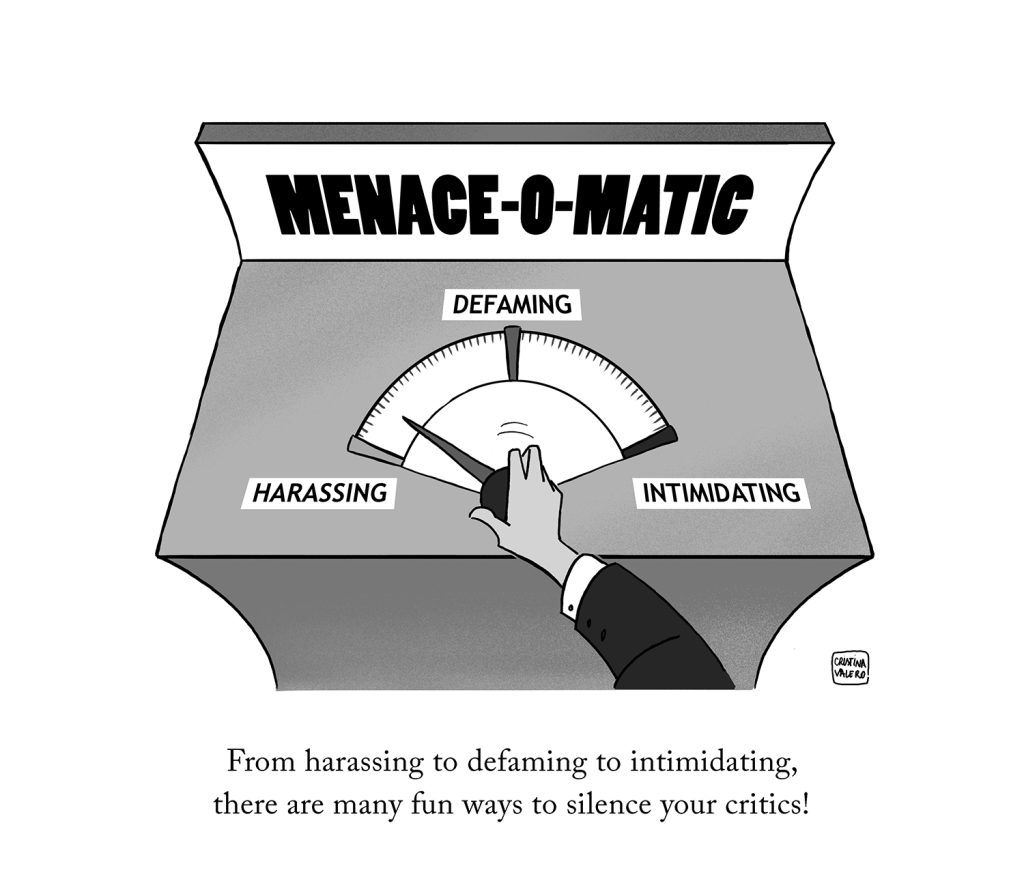
We can speak of three basic types of tactics along a spectrum through which you can escalate your actions:
► from first harassing those who criticise you,
► to then defaming them in public,
► to directly intimidating them to make them stop their work, and for others to see what happens when someone talks bad about your company.
Harass people who are annoying your company
First, you can try harassing in private people who point out what’s wrong with your company’s products or behaviour. Or you can preemptively harass people who are conducting research into your company and might find out about your wrongdoing or the harms done by your products. Your aim is to frighten them and make them stop their work. Hopefully, your actions will also scare their colleagues and prevent them from looking too closely into your company.
There are different ways to get to your critics in private, so that they get the message to stop messing with you before things get nastier. As in other parts of The Strategy, here too the well-documented expertise of the tobacco industry offers a good introduction for you to learn from. In one recent story from 2023, people from different parts of the world, who had dared to call for measures to restrict the activity of tobacco companies in their countries, reported receiving “hundreds of threatening messages” on social media, including legal threats, derogatory memes and other kinds of warnings, like “anonymous calls and messages with threats of physical violence or death”.
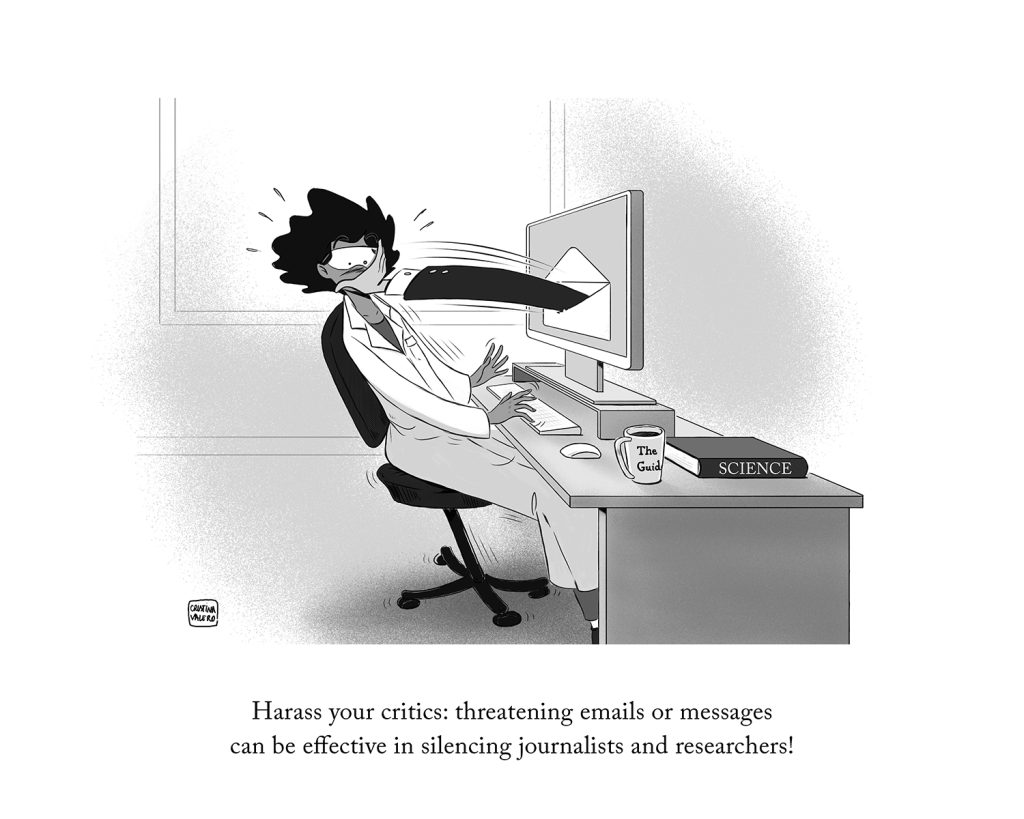
After having criticised the tobacco companies’ practices, researchers later had the impression that they were “being followed physically or online” by tobacco industry staff. Tobacco critics also suspected having their websites and email accounts hacked; and some people found “evidence that they [had been] under surveillance” by a tobacco company. Public universities employing researchers who were looking into the tobacco industry received, and had to answer, large numbers of access to information requests about their work about tobacco, which undermined or at the very least slowed down the universities’ research.
Defame people who won’t shut up about criticising your company
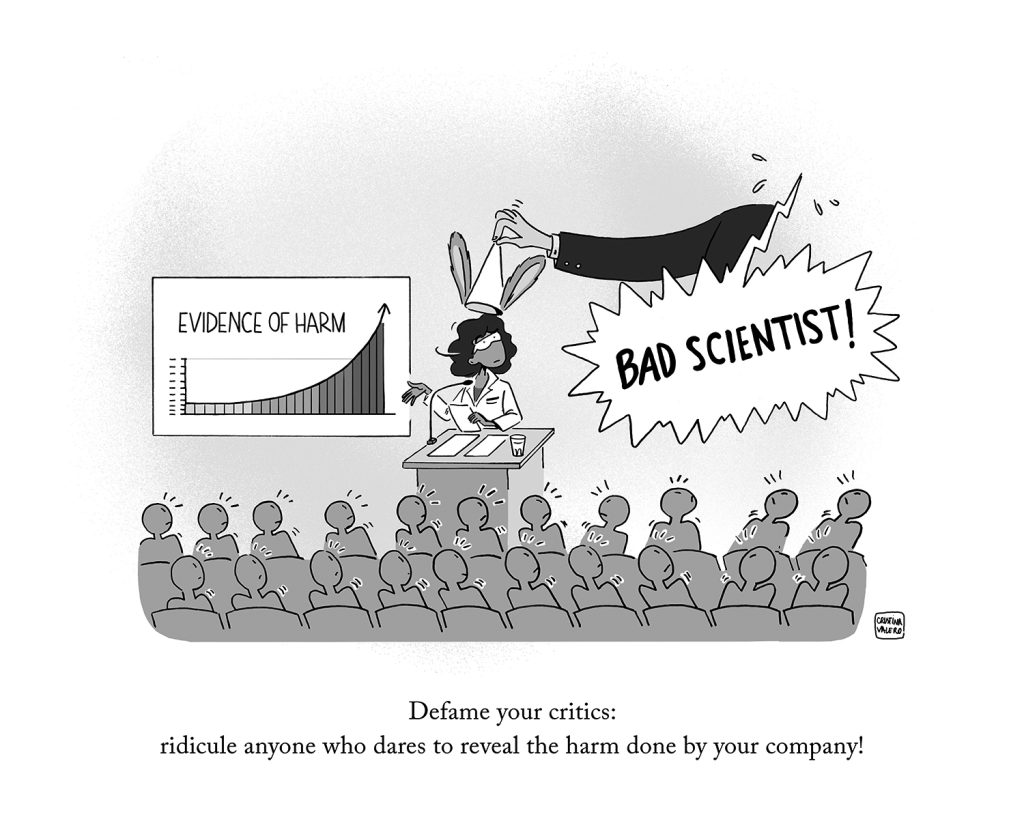
When harassing them is not enough, and journalists, researchers, activists or other people keep publishing work that shows how your products are harmful or how your company’s behaviour is toxic, then it’s time to step up your efforts and consider defaming those people in public.
You can again follow up on the steps of the tobacco companies, and use the media to publish “newspaper articles criticising [the researchers’] organisations and funders, making false claims about funding sources, or misquoting an organisation’s work”. Or you can even make “attempts to impersonate [your critics] online” and create fake webpages to defame them.
One step further, you can follow the lead of giant US agrochemical and biotechnology company Monsanto (acquired by German corporation Bayer in 2018), which was so much into this tactic that it even had its own intelligence centre “to monitor and discredit journalists and activists”. Between 2015 and 2017, a primary target of Monsanto’s was journalist Carey Gillam, who investigated Roundup, Monsanto’s flagship herbicide. Roundup was at the same time linked to cancer and a money-making machine for the company, which in 2015 had a revenue of 4.76 billion US dollars from herbicide products, most of which was Roundup. Monsanto planned how “to attack a book authored by Gillam” about Roundup, “directing ‘industry and farmer customers’ on how to post negative reviews” of the book, and paying Google to promote search results that criticised Gillam’s work. In parallel, Monsanto had been “orchestrat(ing) a campaign in [the US] Congress to criticize and defund scientists with the World Health Organization’s cancer research affiliate, after that body had declared [in 2015] that glyphosate, the active ingredient in Roundup, [was] a ‘probable carcinogen’”.
Another possibility is to take it to a more personal level and hire private investigators to dig up dirt on annoying reporters and others looking into and criticising your damaging corporate practices. For example, people who had criticised tobacco companies reported that “the waste disposed of by organisations and individuals was searched. In other instances, the car of an investigator and the offices of organisations were broken into. In both times, computers were stolen, and no culprit was identified”. You can then use the personal information you steal from your critics to “plant untrue stories about [them] in order to hurt [their] reputation”, as the Koch network reportedly did to journalist Jane Mayer, who was investigating how the Koch brothers, who owned a conglomerate of companies mostly in the fossil fuel and agrochemical businesses, followed The Strategy to influence public life in the US and beyond.
► How Syngenta unleashed the whole package against Tyrone Hayes
In 1997, scientist Tyrone Hayes was hired by Swiss company Novartis to study the effects on frogs and other amphibians of Atrazine, one of the world’s most widely used herbicides (from 2000, Atrazine was produced and commercialised by Switzerland-based Syngenta, which was formed through the merger of the agrochemical branches of Novartis and British-Swedish company AstraZeneca). Hayes found that Atrazine affected the reproductive organs of some frogs and turned males into females, limiting the species’ capacity to reproduce, which could also have very negative effects on the ecosystems where the frogs lived.
Because that wasn’t good news, Hayes’s corporate bosses did of course downplay the importance of the results. Then, annoyingly, Hayes left and repeated the experiments twice with independent funding and published his results in a scientific paper. That was a serious threat to Syngenta’s very profitable business making and selling Atrazine. Therefore, Syngenta followed The Strategy and decided to go full-on with the tactic of defaming Hayes.
“In 2001, at a meeting to discuss Hayes’ research, Syngenta brought in a statistical consultant who concluded his results were not statistically significant”. Another professor in Hayes’ department said of the meeting: “the issues the statistical consultant was raising were routine and ridiculous. A couple of glitches were presented as if they were the end of the world. I’ve been a scientist in academic settings for forty years, and I’ve never experienced anything like that. They were after Tyrone”.
Between 2004-2005, Syngenta developed its tactical moves to go after Hayes. “Notes by Sherry Ford, Syngenta’s communications manager, detail Syngenta’s plans to undermine Hayes, including “publication of 3rd party critique of his science,” “systematic rebuttals of all TH [Tyrone Hayes] appearances,” “making emails public,” “contact [Hayes’s workplace, the University of California,] Berkeley,” and even “investigate wife.” Meanwhile, an email from a communications consultant recommended getting hold of Hayes’ calendar of speaking engagements so Syngenta could provide audiences with “irrefutable evidence of his polluted message.” A later proposal floated the idea of purchasing Hayes’ name as a search word on the internet, presumably to tarnish his reputation”.
Syngenta followed through with the plan. As a former student of Hayes put it: “everywhere Tyrone went there was this guy asking questions that made a mockery of him. We called him the Axe Man.” Syngenta also “filed an ethics complaint with Berkeley over Hayes’ emails, charging that they were “aggressive, unprofessional, and insulting,” and released more than one hundred pages of messages. While the emails went viral, Berkeley’s chief counsel ruled that no ethics violations had occurred”.
The result? Sygenta not only managed to make Hayes’ life difficult, but it also sent a clear message to other scientists. Most importantly, and even though later it was also found that Atrazine makes cancer more likely in mice, Syngenta can still produce and sell herbicides with Atrazine in many countries (sadly, not in the EU or in Syngenta’s home country of Switzerland). Thanks to that, Syngenta’s revenue in 2023 from its “selective herbicides” (of which Atrazine is a key ingredient) was 3.77 billion US dollars. Oh yeah!
As some of Syngenta’s tactical moves did, a less elaborate, more direct and certainly more fun approach is to go all the way and say publicly that journalists or researchers, or anyone else criticising your harmful products, are wrong, bad professionals or even the worst of humanity. As another example, you can follow the food industry’s lead and “vilify critics with totalitarian language, characterizing them as the food police, leaders of a nanny state, and even ‘food fascists,’ and accuse them of desiring to strip people of their civil liberties”.
For instance, the US-based Center for Consumer Freedom (CCF), financed by the food and restaurant sectors, including companies like Coca-Cola, happily labelled as “food police” anyone calling for regulation of the food industry based on public health grounds. The CCF also called researcher Marion Nestle a “food fascist” for making the outrageous claim that the right to free speech shouldn’t allow “food companies to market junk foods to children and adults”.
Or your company can do as the gambling industry in the UK, which used events to attack the reputation of researchers looking into the negative effects of gambling on people, as one such researcher explains: “With the anxiety that I always felt about potentially upsetting the industry and colleagues who were closely linked with them, I had enough. I didn’t even finish writing up, because it was going to be too much. So no one ever told me not to publish, but in a sense I self-sabotaged. I was really scared about potentially annoying the industry and then getting my reputation trashed, because I saw that happen at [an event] and it really was horrible. So I had a choice, say everything is fine. In other words, lie. Or keep quiet and not expose myself to that critical attention.”
Intimidate people to stop their criticism and scare off others
Harassing and defaming people who point at your company’s wrongdoing will make some of your critics abandon their projects “due to safety concerns”, others may “move towards less risky areas such as awareness raising, or to other geographical regions”, and yet others may decide on “self-censorship” in response to your harassment. In one successful example, after “a very important researcher” looking into tobacco “was repeatedly threatened and physically intimidated”, their colleagues didn’t hear again about any work done by this researcher.
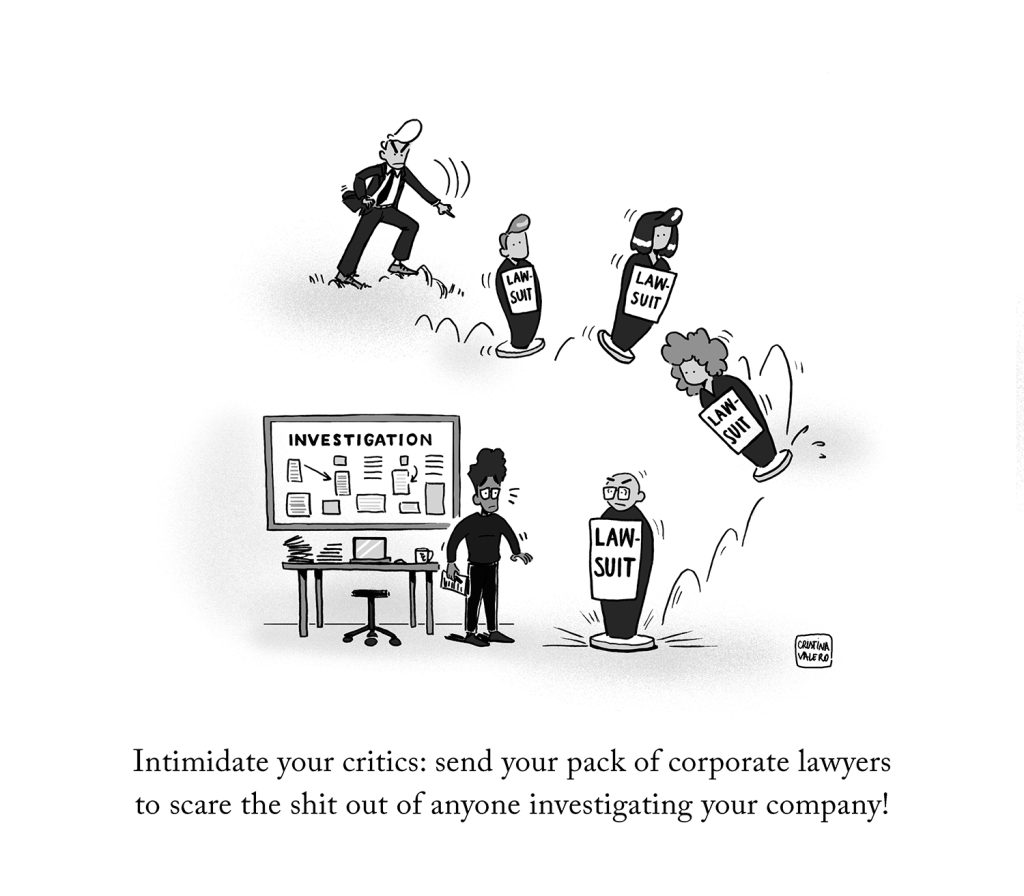
However, there will be times when harassment and defaming alone won’t be enough to put your critics off. Or when you feel that more direct action is warranted by the need to protect your corporate profits regardless of the harm done by your products. And that’s when you should dust off those corporate lawyers that are costing your company a fortune (even if that’s of course better than paying taxes), and send them to threaten and intimidate your critics.
Lawyers can scare the shit out of people, as it’s happened again in connection with the UK gambling industry, where “fears of legal action and intimidation can have a chilling effect on researchers and several left the field as a result”. That happened regarding “the actions of corporate lawyers who attended the launch of a new report”, as one of the researchers describes: “We ran some seminars and workshops to disseminate our findings and people came to those and attacked us — [corporate lawyers] from the industry primarily. (…) They tried to intimidate us indirectly in terms of what we published. And to discredit us in the eyes of other people. No one tried to shape directly what we wrote, but I didn’t try to take the work forward after that.”
As a gambling executive explains, companies in that sector are fond of this tactic because it helps them keep things quiet: “People in the industry are just suspicious about research because, let’s face it, the likelihood is that they [in the industry] already know if there’s a problem and their job is to keep it quiet.”
But of course it’s not only the gambling companies: corporations from other sectors also enjoy making that kind of threats — as it’s the case of the pharmaceutical industry. For instance, back in 1999, a scientist in the US found that Avandia, a diabetes drug made by British company GlaxoSmithKline, seemed to increase the risk of heart disease among people who took it. As it happened, GlaxoSmithKline “had long known about the drug’s potentially life-threatening side effects”. But when the scientist published his results, GlaxoSmithKline didn’t like it, not because the drug was life-threatening but because the revelations about the drug were profit-threatening and did affect the company’s share value. GlaxoSmithKline followed The Strategy and went after the researcher: “a representative from the company contacted the scientist’s boss, accused him of lying, and threatened to sue him for a $4 billion drop in the company’s stock valuation”.
The threat worked, and the scientist “sign(ed) a letter drafted by the company [GlaxoSmithKline] which walked back his scientific findings”. Later, in 2007, another scientific study confirmed and made clear that “there was a 43 percent increase in the risk of heart disease among diabetics taking Avandia”. In 2010, EU regulators banned the sales of Avandia, while the US regulator placed “stringent restrictions on its use” there. However, by then and thanks to The Strategy, GlaxoSmithKline had kept making money off Avandia for many years regardless of the danger to the health of people who took the drug. Another corporate success!
SLAPP your critics!
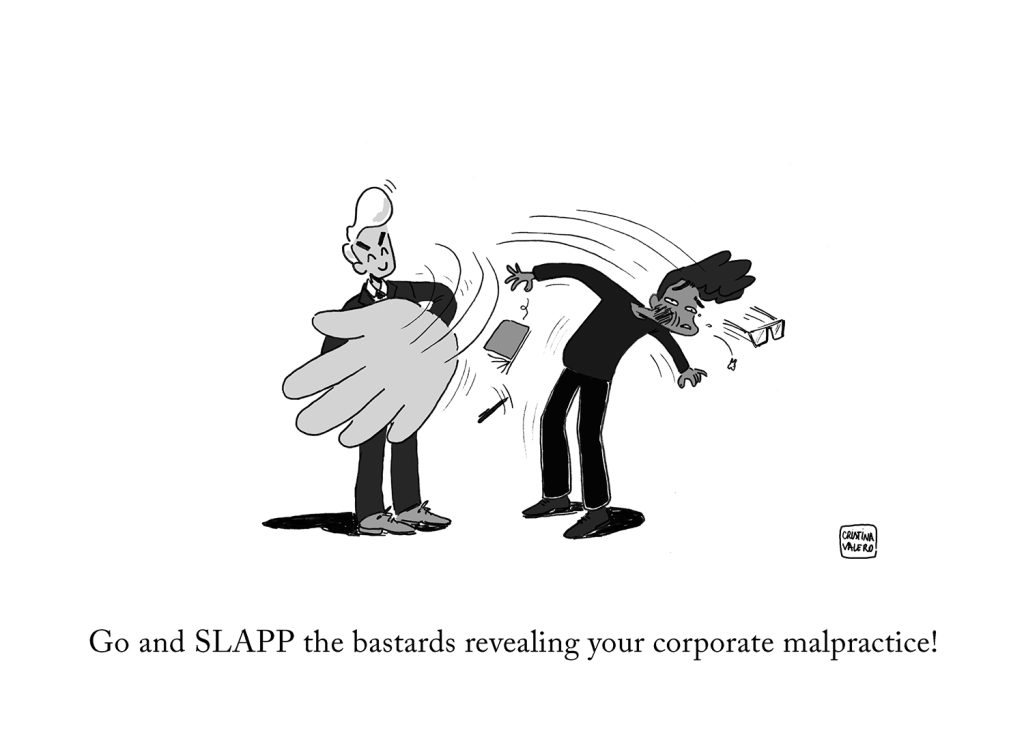
As a further step, your company can always make good on the legal threats or simply go straight and SLAPP the bastards revealing your corporate malpractice.
SLAPP stands for Strategic Litigation Against Public Participation. SLAPPs encompass different kinds of lawsuits, filed by corporations (and also by political parties and even by individuals) who say their reputation is being harmed. Most often, those on the receiving end of a SLAPP are journalists, researchers and activists denouncing corruption and other wrongdoing, and the lawsuits are aimed at intimidating and keeping them quiet.
SLAPPs are a great way for your company to abuse legal systems across borders and bully critics into silence: while your company can choose the most convenient jurisdiction to file the lawsuit, for example by claiming that your company’s reputation was harmed in the country that offers you the best conditions to sue (London used to be a great location for SLAPPs), often those you are suing won’t even have the financial means to defend themselves. The lawsuit will drain their money and other resources, and delay or even hopefully prevent the publication of their work criticising your company. That’s also why SLAPPs don’t need to reach the court stage to be scary and useful (in fact, it’s often best if the case doesn’t arrive in front of a judge, because a close examination of the claims that your company was harmed will be often revealed as baseless).
This is a very small sample of cases for you to learn from:
► SOCFIN is a Luxembourg-registered agricultural industrial group that owns and operates palm oil and rubber plantations in several African and Asian countries. Between 2009 and 2018, SOCFIN expanded its plantations from 129,000 to 194,000 hectares of land across those regions. And as journalists and NGOs documented and published reports of “violations of the rights of local communities, land conflicts, risk of deforestation, pollution, poor working conditions, as well as criminalization of human rights defenders” during such expansion, SOCFIN responded by filing nearly 30 defamation cases against them.
► In 2017, German fossil fuel giant RWE “claimed 2 Million Euros in compensation against German climate activists due to the protest that took place in one of RWE’s coal mining plants in Germany. Along with the civil damages case, 14 activists were criminally charged for ‘trespassing’ and ‘disrupting the electricity supply’. The criminal charges were dropped in trial and the accused received € 250 fine for resisting arrest. RWE also sued Jannis Grosse, a journalist who was photographing the climate activists during their protest”.
► In November 2020, Realtid, a Swedish online magazine, was going to publish a story about the corporate group Eco Energy World (EEW) “ahead of an impending stock market launch in Norway”. That wasn’t to the liking of Swedish businessman Svante Kumlin, the CEO of EEW and a resident in Monaco. Kumlin filed a lawsuit against Realtid and also individually against two of its journalists and the editor-in-chief. And Kumlin made the legal claim not in Sweden, Monaco or Norway but in London, in the UK, which was a much more friendlier jurisdiction to his corporate interests. Kumlin and EEW were asking the three journalists for an estimated 15 million euros in compensation, and the case was settled out of court in January 2023.
► In Italy, investigative journalist Amalia De Simone has been facing a long series of SLAPPs for many years. As one example, in 2012 she was sued by four members of the Di Francia family because of an article that “explored allegations of deplorable waste management in the Campania region”, and particularly in a suburban area of Naples, where the people managing the waste company were also part of the same Di Francia family. The case, like the others De Simone has faced, was dismissed. But that’s OK because “De Simone has still faced very long inquiries and has been subject to continuous legal proceedings that are both expensive and time consuming”.
► Check out the European SLAPP Contest!
SLAPPs have become so popular in Europe that, for the last few years, there has been a contest dedicated to them!
In the European SLAPP Contest 2024, the Corporate Bully of the Year Award went to the Bulgarian insurance company Lev Ins, which filed a SLAPP case against the fact-checking news website Mediapool. Lev Ins was demanding 500,000 euros from the journalists, and this threatened to bankrupt Mediapool. The SLAPP was “tied to an article covering a statement made by the Minister of Finance during a government session, even though the transcript of the meeting was publicly accessible”. The fact that the “requested sum represent[ed] the highest-ever compensation claimed against the media in the country’s history” helped Lev Ins win the award.
Have a look at all the other winners and finalists from last years!
► Read about the European SLAPP Contest 2024
► Read about the European SLAPP Contest 2022
► Watch the Award Ceremony of the European SLAPP Contest 2021
Sadly, SLAPPs may become a victim of their own success. The EU approved in February of 2024 a law aimed at protecting “journalists, activists and academics and their organisations against abusive lawsuits aimed at silencing them”, i.e., against SLAPPs. But EU member states won’t need to enforce that law until at least early 2026, so there’s still time for your company to keep on SLAPPing critics in order to protect your profit and to try to win next year’s European SLAPP Contest!
Conclusion_ Generate fear and also feed into the growing social polarisation
This tactic works: people who felt harassed after criticising corporate interests were forced to abandon their projects “due to safety concerns” or resorted to self-censorship to stay on the safe side.
Besides, by being an aggressive bully, your company may instigate a climate of fear that will prevent other people from speaking out against your damaging corporate practices. Hence, another big part of this tactic’s success is invisible: all the future criticism that you are spared from thanks to going quickly and decisively after anyone daring to reveal your corporate wrongdoing. And by preventing such public criticism, you will hopefully be delaying or even averting ensuing regulation aimed at dealing with your company’s harmful practices.
However, we need to note here that there is a worrying development about this tactic of The Strategy, and particularly regarding lawsuits: some people are turning the tables and daring to sue companies because of the damage they cause: what’s the world turning into! In May 2021, activists in the Netherlands won a climate case against oil giant Shell, which was ordered by the court to cut its CO2 emissions by 45 percent by the end of 2030 compared to 2019 levels. Shell still followed The Strategy and responded by appealing the verdict, changing its name and moving its headquarters from the Netherlands to the UK (by January 2024, the appeal case was reportedly still open).
But that’s not all: even people from faraway Latin America are daring to sue giant European firms! Luciano Lliuya, a Peruvian farmer and guide, filed a lawsuit against German fossil fuel giant RWE. Luciano’s lawyers argue that RWE has contributed to 0.47% of the total “global industrial greenhouse gas emissions since the beginning of industrialization”, and that makes the German company legally liable for the negative effects that the climate crisis — caused mostly by greenhouse gas emissions — is having in Luciano’s home region.
That’s why this tactic, “shooting” the messenger, is to be used with caution and in a very strategic way, ideally along with other tactics featured in The Guide. In fact, by abusing science (tactic 04), portraying yourself as good, legitimate and the adult in the room (tactic 07), and vilifying critics who demand responsibility for your corporate profiteering and wrongdoing as doom-sayers who want to change people’s lifestyles (this chapter’s tactic), you can fan the flames of our growing polarised public conversation, and that can make regular people follow your lead and turn against your critics.
The next chapter of The Guide tells you about a vintage tactic at the heart of the launch of The Strategy in the 1950s: how to abuse science to protect corporate profits regardless of any danger to people or even the world.
Now, let’s keep on influencing!
This chapter was last reviewed and published on 4 October 2024.
Notes and references
– In the list below, the lines in bold are the phrases in this chapter of The Guide that the ensuing note refer to. When I consider the title or headline of a reference clear and informative enough to support the corresponding statement in the text of this chapter, I only include here the information about the citation and a link to the reference. When the reference is a long document, and/or when particular paragraphs from the reference are clearly related to the corresponding statement, then I quote such paragraphs here. I have minimally edited those quotes to delete the spaces between paragraphs in the original source, so that here they appear as one single (if long) paragraph. For the sake of simplicity, I have also removed embedded links and superscript citation numbers from the quoted paragraphs; those links and citations can be seen and followed in the text in the original reference source. When I use quotes in the text of the chapter, I may re-stylise the initial lower or upper case letters of some quotes to make them fit with their place in the paragraphs in the text.
– The Guide doesn’t call for the murder of journalists, activists or anyone else denouncing abusive corporate behaviour.
– In the last decades, many journalists, activists and other people involved in investigating corporate and political harm have been attacked and murdered all across the world.
– 974 Journalists Killed between 1992 and 2024 / Motive Confirmed / Murdered
– CPJ. (2024). Explore all CPJ data. Committee to Protect Journalists (CPJ), 2024. Available on https://cpj.org/data/killed/2024 and on the Internet Archive (last visited on 3 October 2024)
– Global Witness. (2023). Almost 2,000 land and environmental defenders killed between 2012 and 2022 for protecting the planet. Global Witness website, 13 September 2023. Available on https://www.globalwitness.org/en/press-releases/almost-2000-land-and-environmental-defenders-killed-between-2012-and-2022-protecting-planet and on the Internet Archive (last visited on 3 October 2024)
– “The report also reveals statistics gathered and verified by the HRD Memorial initiative – which Front Line Defenders coordinates – documenting the killings of at least 300 HRDs in 28 countries in 2023. Almost a third of those killed (31%) were Indigenous people’s rights defenders. This brings the total documented killings of HRDs [human rights defenders] in the last decade to nearly 3,000.”
– Frontline Defenders. (2024). Global Analysis 2023/24. Frontline Defenders website, 22 May 2024. Available on https://www.frontlinedefenders.org/en/resource-publication/global-analysis-202324 and on the Internet Archive (last visited on 3 October 2024)
– “A new report published by UNESCO on World Press Freedom Day, 3 May, warns of increasing violence against, and intimidation of journalists reporting on the environment and climate disruption. At least 749 journalists or news media reporting on environmental issues have been attacked in the last 15 years, and online disinformation has surged dramatically in this period. UNESCO is calling for stronger support for environmental journalists and better governance of digital platforms.”
– UNESCO. (2024). UNESCO report reveals 70% of environmental journalists have been attacked for their work. UNESCO, 3 May 2024. Available on https://www.unesco.org/en/articles/unesco-report-reveals-70-environmental-journalists-have-been-attacked-their-work and on the Internet Archive (last visited on 3 October 2024)
– This [“shooting” the messenger] is actually an old, tried-and-tested tactic that’s been used in war and politics since forever
– “In Shakespeare’s Antony and Cleopatra, Cleopatra has harsh words for the messenger who conveys the unwelcome news that Antony has married another. If Cleopatra’s response is any guide, messengers are the targets of unwarranted nastiness. Indeed, history is replete with situations in which those who dutifully deliver bad news face devastating consequences. From ancient pharaohs to Alexander the Great, some of history’s greatest rulers are infamous for killing those who brought unwelcome news. In each of these cases, the messenger was just that: a person charged with merely communicating information, notably with no role in causing the unfortunate event to occur in the first place.”
– John, L.K., Blunden, H. & Liu, H. (2019). Shooting the Messenger. Journal of Experimental Psychology, 148(4), pages 644-666, 2019. Available on https://psycnet.apa.org/record/2019-19962-004 and on http://dx.doi.org/10.1037/xge0000586 (last visited on 3 October 2024)
– which [“shooting” the messenger as a tactic] big companies who want to achieve influence have been also using for a while. Indeed, smart corporations are known to be “aggressive and inventive in their responses to health professionals, civil society organizations, scholars, journalists, and government officials, whose work focuses on highlighting these corporate practices. The tobacco industry, for example, monitored and spied on the activities of public health professionals, used misleading criticism of their work, and attacked their reputation and motivation.”
– “Understanding and addressing harmful corporate practices is a key building block in protecting and promoting public health internationally. Corporations are however aggressive and inventive in their responses to health professionals, civil society organizations, scholars, journalists, and government officials, whose work focuses on highlighting these corporate practices. The tobacco industry, for example, monitored and spied on the activities of public health professionals, used misleading criticism of their work, and attacked their reputation and motivation. With the present project, our Aims were i) to map industry responses to the work of health professionals, civil society organisations, and scholars involved in identifying, monitoring and raising awareness about the harmful practices of corporations, across the globe, ii) to identify solutions to address these responses and better protect public health professionals, and, ultimately, public health policy. Our project comprised three interrelated work packages.”
– Mialon, M. & al. (2023). Industry responses to the work of those involved in exposing the harmful practices of corporations. Population Medicine, 5 (supplement), 2023. Available on https://www.populationmedicine.eu/Industry-responses-to-the-work-of-those-involved-in-exposing-the-harmful-practices,164940,0,2.html and https://doi.org/10.18332/popmed/164940 (last visited on 3 October 2024)
– These below are other reports documenting corporate practices of harassment and intimidation of their critics, especially scientists.
– “Corporations that stand to lose from the results of independent scientific inquiry have gone to great lengths to manipulate and control science and scientists by: Terminating and suppressing research. Companies have controlled the dissemination of scientific information by ending or withholding results of research that they sponsor that would threaten their bottom line. Intimidating or coercing scientists. Corporations bury scientific information by harassing scientists and their institutions into silence. Scientists have been threatened with litigation and the loss of their jobs, have had their research defunded, have been refused promotion or tenure, and have been transferred to non-research positions, leading to self-censorship and changes in research direction.”
– UCS. (2012). Heads They Win, Tails We Lose. How Corporations Corrupt Science at the Public’s Expense. Union of Concerned Scientists (UCS), February 2012. Available as a PDF file on https://www.ucsusa.org/sites/default/files/2019-09/heads-they-win-report.pdf and on the Internet Archive (last visited on 3 October 2024)
– “A Koch-funded think tank tried to harass and discredit prominent climate scientist Michael Mann by suing for access to his private correspondence. Mann defeated the effort—but fears the resulting “chill” could deter young climate scientists. There was the envelope stuffed with cornstarch, meant to mimic anthrax. There were the thousands of hate-filled emails, laced with warnings and threats. There were the Congressional hearings, where presenting scientific evidence—and fighting off fact-free attacks by hostile members of Congress—was a torturous uphill battle. Climate scientist Michael Mann hasn’t had it easy since first publishing his pioneering “hockey stick” graph in the 1998. Together with co-authors Raymond S. Bradley and Malcolm Hughes, the research indicated unprecedented global warming in the last century. In doing so, the graph also painted a bright red target on the authors’ backs for those intent on undermining public understanding of climate change. While some of the attacks against Mann have been the work of rogue individuals—albeit individuals possibly spurred by the fossil fuel industry’s decades-long work manufacturing doubt against climate science—it’s remarkable how many attacks actually trace directly to involvement by the fossil fuel industry.”
– UCS. (2017). How the Fossil Fuel Industry Harassed Climate Scientist Michael Mann. Union of Concerned Scientists (UCS), 12 October 2017. Available on https://www.ucsusa.org/resources/how-fossil-fuel-industry-harassed-climate-scientist-michael-mann and on the Internet Archive (last visited on 3 October 2024)
– In one recent story from 2023, people from different parts of the world, who had dared to call for measures to restrict the activity of tobacco companies in their countries, reported receiving “hundreds of threatening messages” on social media, including legal threats, derogatory memes and other kinds of warnings, like “anonymous calls and messages with threats of physical violence or death”.
– After having criticised the tobacco companies’ practices, researchers later had the impression that they were “being followed physically or online” by tobacco industry staff. Tobacco critics also suspected having their websites and email accounts hacked; and some people found “evidence that they [had been] under surveillance” by a tobacco company. Public universities employing researchers who were looking into the tobacco industry received, and had to answer, large numbers of access to information requests about their work about tobacco, which undermined or at the very least slowed down the universities’ research.
– You can again follow up on the steps of the tobacco companies, and use the media to publish “newspaper articles criticising [the researchers’] organisations and funders, making false claims about funding sources, or misquoting an organisation’s work”. Or you can even make “attempts to impersonate [your critics] online” and create fake webpages to defame them.
– “Participants reported a wide range of forms of intimidation. Public-facing attacks seeking to “give somebody a bad name” (A/AFR) and “create a negative opinion regarding one’s efforts” (A&R/EUR) were repeatedly mentioned. This included newspaper articles criticising organisations and funders, making false claims about funding sources, or misquoting an organisation’s work. In response to a research paper, a tobacco company published a letter which “not only criticised the research, but also criticised [the author] as a bad researcher” (R/EUR). An advocate shared that “almost any time we’ve released a major report, we’ll get a response, usually [claiming] unfactual things” (A/Global).”
– “Members from a civil society organisation discovered posters portraying them “as agents of Big Tobacco and enemies of local communities” (A&R/SEAR). Harassment on social media was seen as a growing concern, particularly around e-cigarettes and heated tobacco products, and the topic of tobacco harm reduction. In one instance, after talking on TV about e-cigarettes, a participant received “hundreds of threatening messages” online (anonymous). Attacks also involved legal threats and derogatory memes. Participants also reported attempts to impersonate them online and the creation of fake webpages. Several participants faced legal threats from tobacco companies or third parties, usually in the form of letters sent to them, their employers or journal editors. An advocate explained “they sound like cease-and-desist letters but they’re not, they don’t really have that legal backing” (A/Global). No participant reported legal action against them. Advocates and researchers also received non-legal threats, including anonymous calls and messages with threats of physical violence or death. In one case, it remained unclear how personal numbers had been obtained. In another instance, a tobacco company threatened to “go after [a researcher’s] job” if they continued their work (A/AMR). Elsewhere, organisations pushing for policy change, received calls from tobacco retailer associations threatening: “if [you] don’t stop, the association people and all the vendors will come and sit in front of [your] offices and homes, they will sit there in protest and shout slogans (R/SEAR).”
– “Intimidating physical action, burglary and theft were also mentioned. In some places, the waste disposed of by organisations and individuals was searched. In other instances, the car of an investigator and the offices of organisations were broken into. In both times, computers were stolen, and no culprit was identified. Participants also voiced suspicions of being followed physically or online. For example, industry staff attended tobacco control events, in person and online, and an unknown individual took photos during government-organised workshops. Industry staff, and individuals suspected to be industry-linked, also attempted to connect with participants, for example, via LinkedIn, Facebook, email or in person. A few participants had evidence that they were under surveillance: “colleagues […] found that in [company] reports, they say my name” (A&R/EUR). Participants also reported hacking, or the suspected hacking, of websites and email accounts. A few researchers reported that their employer received large numbers of Freedom of Information requests. Through such requests – in some jurisdictions called Access to Information requests – citizens or residents can obtain documents held by public bodies, including public universities. Participants reported “vexatious requests” relating to their work. A participant concluded: “[such requests] are done in order to try and undermine our work or to slow us down” (R/EUR).”
– Matthes, B.K., Alebshehy, R. & Gilmore, A.B. (2023). “They try to suppress us, but we should be louder”: a qualitative exploration of intimidation in tobacco control. Globalizaton and Health, 19, 88, 16 November 2023. Available on https://globalizationandhealth.biomedcentral.com/articles/10.1186/s12992-023-00991-0 and https://doi.org/10.1186/s12992-023-00991-0 (last visited on 3 October 2024)
– you can follow the lead of giant US agrochemical and biotechnology company Monsanto (acquired by German corporation Bayer in 2018), which was so much into this tactic that it even had its own intelligence centre “to monitor and discredit journalists and activists”. Between 2015 and 2017, a primary target of Monsanto’s was journalist Carey Gillam, who investigated Roundup, Monsanto’s flagship herbicide. Roundup was at the same time linked to cancer and a money-making machine for the company, which in 2015 had a revenue of 4.76 billion US dollars from herbicide products, most of which was Roundup. Monsanto planned how “to attack a book authored by Gillam” about Roundup, “directing ‘industry and farmer customers’ on how to post negative reviews” of the book, and paying Google to promote search results that criticised Gillam’s work.
– “Monsanto operated a “fusion center” to monitor and discredit journalists and activists, and targeted a reporter who wrote a critical book on the company, documents reveal. The agrochemical corporation also investigated the singer Neil Young and wrote an internal memo on his social media activity and music. The records reviewed by the Guardian show Monsanto adopted a multi-pronged strategy to target Carey Gillam, a Reuters journalist who investigated the company’s weedkiller and its links to cancer. Monsanto, now owned by the German pharmaceutical corporation Bayer, also monitored a not-for-profit food research organization through its “intelligence fusion center”, a term that the FBI and other law enforcement agencies use for operations focused on surveillance and terrorism. The documents, mostly from 2015 to 2017, were disclosed as part of an ongoing court battle on the health hazards of the company’s Roundup weedkiller. They show: Monsanto planned a series of “actions” to attack a book authored by Gillam prior to its release, including writing “talking points” for “third parties” to criticize the book and directing “industry and farmer customers” on how to post negative reviews. Monsanto paid Google to promote search results for “Monsanto Glyphosate Carey Gillam” that criticized her work. Monsanto PR staff also internally discussed placing sustained pressure on Reuters, saying they “continue to push back on [Gillam’s] editors very strongly every chance we get”, and that they were hoping “she gets reassigned”.”
– Levin, S. (2019). Revealed: how Monsanto’s ‘intelligence center’ targeted journalists and activists. The Guardian, 8 August 2019. Available on https://www.theguardian.com/business/2019/aug/07/monsanto-fusion-center-journalists-roundup-neil-young and on the Internet Archive (last visited on 3 October 2024)
– Roundup was at the same time linked to cancer and a money-making machine for the company, which in 2015 had a revenue of 4.76 billion US dollars from herbicide products, most of which was Roundup.
– “The International Agency for Research on Cancer (IARC), the specialized cancer agency of the World Health Organization, has assessed the carcinogenicity of five organophosphate pesticides. A summary of the final evaluations together with a short rationale have now been published online in The Lancet Oncology, and the detailed assessments will be published as Volume 112 of the IARC Monographs. What were the results of the IARC evaluations? The herbicide glyphosate [the active ingredient of Roundup] and the insecticides malathion and diazinon were classified as probably carcinogenic to humans (Group 2A).”
– “For the herbicide glyphosate, there was limited evidence of carcinogenicity in humans for non-Hodgkin lymphoma. The evidence in humans is from studies of exposures, mostly agricultural, in the USA, Canada, and Sweden published since 2001. In addition, there is convincing evidence that glyphosate also can cause cancer in laboratory animals. On the basis of tumours in mice, the United States Environmental Protection Agency (US EPA) originally classified glyphosate as possibly carcinogenic to humans (Group C) in 1985. After a re-evaluation of that mouse study, the US EPA changed its classification to evidence of non-carcinogenicity in humans (Group E) in 1991. The US EPA Scientific Advisory Panel noted that the re-evaluated glyphosate results were still significant using two statistical tests recommended in the IARC Preamble. The IARC Working Group that conducted the evaluation considered the significant findings from the US EPA report and several more recent positive results in concluding that there is sufficient evidence of carcinogenicity in experimental animals. Glyphosate also caused DNA and chromosomal damage in human cells, although it gave negative results in tests using bacteria. One study in community residents reported increases in blood markers of chromosomal damage (micronuclei) after glyphosate formulations were sprayed nearby.”
– IARC. (2015). IARC Monographs Volume 112: evaluation of five organophosphate insecticides and herbicides. International Agency for Research on Cancer (IARC), World Health Organization, 20 March 2015. Available as a PDF file on https://www.iarc.who.int/wp-content/uploads/2018/07/MonographVolume112-1.pdf and on the Internet Archive (last visited on 3 October 2024)
– “How much money does Monsanto make from Roundup? In 2015, the company made nearly $4.76 billion in sales and $1.9 billion in gross profits from herbicide products, mostly Roundup. That represents a significant portion of the global glyphosate market, although the company will continue to lose market share to generic competitors as demand grows. Therefore, as far as Monsanto is concerned, the road to the future will be paved with seeds and genomics products, not chemical herbicides.”
– Chatsko, M. (2016). How Much Money Does Monsanto Make From Roundup? The Motley Fool, 26 May 2016. Available on https://www.fool.com/investing/2016/05/26/how-much-money-does-monsanto-make-from-roundup.aspx and on the Internet Archive (last visited on 3 October 2024)
– Net sales. Agricultural Productivity, 2015. 4,758 million US dollars.
– Gross Profit. Agricultural Productivity, 2015. 1,905 million US dollars.
– Monsanto. (2016). Form 10-K. Monsanto Company. Available on https://www.sec.gov/Archives/edgar/data/1110783/000111078315000230/mon-20150831x10k.htm and on the Internet Archive (last visited on 3 October 2024)
– In parallel, Monsanto had been “orchestrat(ing) a campaign in [the US] Congress to criticize and defund scientists with the World Health Organization’s cancer research affiliate, after that body had declared [in 2015] that glyphosate, the active ingredient in Roundup, [was] a ‘probable carcinogen’”.
– “Monsanto deployed aggressive tactics to punish critics of Roundup, the most widely used herbicide in the world and the company’s marquee product over the last several decades. Emails released through ongoing litigation in California last year showed that the firm used its lobbyists to orchestrate a campaign in Congress to criticize and defund scientists with the World Health Organization’s cancer research affiliate, after that body had declared that glyphosate, the active ingredient in Roundup, is a “probable carcinogen.” Many of the documents detailing Monsanto’s role in shaping the public discourse around glyphosate were released during the course of class-action lawsuits filed by cancer victims who blame the company for their illnesses.”
– Fang, L. (2020). The Playbook for Poisoning the Earth. The Intercept, 18 January 2020. Available on https://theintercept.com/2020/01/18/bees-insecticides-pesticides-neonicotinoids-bayer-monsanto-syngenta/ and on the Internet Archive (last visited on 3 October 2024)
– For example, people who had criticised tobacco companies reported that “the waste disposed of by organisations and individuals was searched. In other instances, the car of an investigator and the offices of organisations were broken into. In both times, computers were stolen, and no culprit was identified”.
– “Intimidating physical action, burglary and theft were also mentioned. In some places, the waste disposed of by organisations and individuals was searched. In other instances, the car of an investigator and the offices of organisations were broken into. In both times, computers were stolen, and no culprit was identified.”
– Matthes, B.K., Alebshehy, R. & Gilmore, A.B. (2023). “They try to suppress us, but we should be louder”: a qualitative exploration of intimidation in tobacco control. Globalizaton and Health, 19, 88, 16 November 2023. Available on https://globalizationandhealth.biomedcentral.com/articles/10.1186/s12992-023-00991-0 and https://doi.org/10.1186/s12992-023-00991-0 (last visited on 3 October 2024)
– You can then use the personal information you steal from your critics to “plant untrue stories about [them] in order to hurt [their] reputation”, as the Koch network reportedly did to journalist Jane Mayer, who was investigating how the Koch brothers, who owned a conglomerate of companies mostly in the fossil fuel and agrochemical businesses, followed The Strategy to influence public life in the US and beyond.
– “One thing I always wonder about these guys is: Why are they doing this? Do they genuinely believe they have a better version for America, or are their efforts purely self-serving?
I think it’s all of the above. I think that Charles Koch is a true believer in his own vision of what a perfect society would be. And he hasn’t really changed his view very much since the late Sixties, when the group he belonged to was described as Anarcho-Totalitarian by William F. Buckley. They were so far to the right that conservatives like Buckley viewed them as the fringe; they are so anti-government that they bordered on anarchy. I have papers and documents I describe in the book, in which Charles Koch talks about how he wants to fund and build a movement that will be radical, that will destroy the “statist paradigm,” as he calls it. He really believes it. Some of his ideas that seemed so crazy and fringe back in 1980, such as abolishing the IRS and the EPA, you’re hearing those same ideas now echoing among the Republican presidential candidates. So these ideas have really gained a lot of traction through the years, in part because of their funding. Do they really believe it? Yes, they truly believe it. And is it good for their bottom line? That too.
It sounds like your experience writing this book was a bit harrowing. The Kochs really went after you.
They play very rough. I’ve been a reporter for a long time, covering wars, the CIA, presidencies and a lot of very powerful organizations. But the Kochs are the only people I’ve ever covered who have hired a private investigator to try to dig up dirt and plant untrue stories about me in order to hurt my reputation. And it’s not just me; they’ve used private eyes to try to discredit people throughout their lives, including their own brothers. There are four Koch brothers, and the two we know of, Charles and David, have spent 20 years litigating against the two other ones, Fred and Bill. They hired private eyes to go through each other’s garbage. But, you know, that’s what reporting is all about: trying to speak truth to power, and holding accountable those who’ve got tremendous power — especially people who don’t even run for office and want to change American politics.”
– Kelley, L. (2016). Author Jane Mayer on How the Koch Brothers Have Changed America. Rolling Stone Magazine, 14 February 2016. Available on https://www.rollingstone.com/politics/politics-news/author-jane-mayer-on-how-the-koch-brothers-have-changed-america-235310/3/ and on the Internet Archive (last visited on 3 October 2024)
– “It’s been a relatively quiet past few years, all things considered, for Koch Industries, almost too quiet for comfort. But of course, that’s how Charles and David Koch (David died in 2019), co-owners of the second-largest private company in the U.S., always preferred to conduct business. At the end of 2023, the fossil fuel and agrochemical giant re-emerged from its recent lull in activity and made a splash in the business press. The company announced its $3.6 billion purchase of OCI Global’s Iowa Fertilizer, among the largest chemical production sites in the state for nitrogen-based fertilizers.”
– “The deal marks the return of the Koch Brothers into national headlines after a prolonged period of relative reclusiveness. For most of the company’s history, secrecy is how the Kochs chose to run the company. The family-run corporation, which deals in the energy, chemical, and agriculture industries, resisted going public in order to maintain the highest degree of privacy around its business dealings. By the early 2000s, the company quietly ascended to become the second-largest private company in the country, next to Cargill. Its growth went nearly unnoticed by the broader public even as its oil refineries and agrochemical plants rapidly spread across the country. What really put the Koch brothers under the public spotlight were the investigations that started coming out about their shadow network of right-wing political organizations that had taken hold of the Republican Party. Through a number of think tanks and dark-money groups, the Kochs used their vast fortunes to imprint a radical free-market ideology onto Washington and statehouses, always on the side of strangling government, lowering taxes, and slashing regulations.”
– Goldstein, L. (2024). The Return of the Koch Brothers. The American Prospect, 1 February 2024. Available on https://prospect.org/power/2024-02-01-return-of-koch-brothers/ and on the Internet Archive (last visited on 3 October 2024)
– In 1997, scientist Tyrone Hayes was hired by Swiss company Novartis to study the effects on frogs and other amphibians of Atrazine, one of the world’s most widely used herbicides (from 2000, Atrazine was produced and commercialised by Switzerland-based Syngenta, which was formed through the merger of the agrochemical branches of Novartis and British-Swedish company AstraZeneca). Hayes found that Atrazine affected the reproductive organs of some frogs and turned males into females, limiting the species’ capacity to reproduce, which could also have very negative effects on the ecosystems where the frogs lived.
– Hayes’s corporate bosses did of course downplay the importance of the results. Then, annoyingly, Hayes left and repeated the experiments twice with independent funding and published his results in a scientific paper.
– “In 1997, EcoRisk approached Hayes on behalf of Syngenta’s corporate predecessor, Novartis. They wanted him to study atrazine, which at the time was going through a product reapproval process mandated by the EPA. Hayes took the gig, figuring Novartis wouldn’t ask him to look into the herbicide’s effects if it expected him to find anything. “My hypothesis was, nothing’s going to happen,” he recalls. Yet something did. In his experiments, male Xenopus exposed to atrazine had shrunken voice boxes, which put them at a disadvantage for courting females. That was startling enough. But when Hayes examined the frogs’ gonads, he discovered something more disturbing: About a third of the exposed males had malformed reproductive organs. Many were hermaphrodites, with both ovaries and testes. Some had more than two of each organ—and some of the testes produced eggs instead of sperm. Xenopus are not naturally hermaphroditic, and no intersex frogs were found in Hayes’ control tanks. But gender deformities were present among frogs exposed to as little as 0.1 part per billion (picture a thousandth of a grain of salt in a half gallon of water). That’s 30 times less than the 3 ppb the EPA allows in our drinking water. Since 1980, scientists had been reporting shrinking amphibian populations—close to one-third of known species are now in danger of extinction. Hayes was intrigued to think he might have discovered a cause for the decline. “Everybody is out there looking for dead frogs and what killed the frogs,” he explains. “We’re asking, ‘How come there aren’t any new frogs?’ Atrazine isn’t killing the frogs. But if they’re reproductively impaired, that’s killing the population.” To Hayes’ surprise, EcoRisk and Novartis didn’t seem as concerned about his findings as he was. He was asked to repeat the studies but wasn’t given the necessary funding, he says, and EcoRisk scientists suggested statistical manipulations that made the voice box effect appear to vanish. Hayes weighed simply handing over his data. After all, this was contract work. “It’s just like if I was an artist and you told me to paint you this color, and I paint you that color and you buy the painting and I’m done with it,” he says. In the end, he couldn’t do it. In 2000, he resigned from the panel of scientists working for EcoRisk. He then repeated the experiment, twice, and in April 2002 published his findings in the Proceedings of the National Academy of Sciences.”
– Slater, D. (2012). The Frog of War. Mother Jones, January / February 2012. Available on https://www.motherjones.com/environment/2012/02/tyrone-hayes-atrazine-syngenta-feud-frog-endangered/ and on the Internet Archive (last visited on 3 October 2024)
– “In 2001, at a meeting to discuss Hayes’ research, Syngenta brought in a statistical consultant who concluded his results were not statistically significant”. Another professor in Hayes’ department said of the meeting: “the issues the statistical consultant was raising were routine and ridiculous. A couple of glitches were presented as if they were the end of the world. I’ve been a scientist in academic settings for forty years, and I’ve never experienced anything like that. They were after Tyrone”.
– Between 2004-2005, Syngenta developed its tactical moves to go after Hayes. “Notes by Sherry Ford, Syngenta’s communications manager, detail Syngenta’s plans to undermine Hayes, including “publication of 3rd party critique of his science,” “systematic rebuttals of all TH [Tyrone Hayes] appearances,” “making emails public,” “contact [Hayes’s workplace, the University of California,] Berkeley,” and even “investigate wife.” Meanwhile, an email from a communications consultant recommended getting hold of Hayes’ calendar of speaking engagements so Syngenta could provide audiences with “irrefutable evidence of his polluted message.” A later proposal floated the idea of purchasing Hayes’ name as a search word on the internet, presumably to tarnish his reputation”.
– Syngenta followed through with the plan. As a former student of Hayes put it: “everywhere Tyrone went there was this guy asking questions that made a mockery of him. We called him the Axe Man.” Syngenta also “filed an ethics complaint with Berkeley over Hayes’ emails, charging that they were “aggressive, unprofessional, and insulting,” and released more than one hundred pages of messages. While the emails went viral, Berkeley’s chief counsel ruled that no ethics violations had occurred”.
– “In 2001, at a meeting to discuss Hayes’ research, Syngenta brought in a statistical consultant who concluded his results were not statistically significant. David Wake, a professor in Hayes’ department, later told the New Yorker “the issues the statistical consultant was raising were routine and ridiculous. A couple of glitches were presented as if they were the end of the world. I’ve been a scientist in academic settings for forty years, and I’ve never experienced anything like that. They were after Tyrone.” While Syngenta and Hayes fought an increasingly public battle over the following years, the company’s new plans to discredit Hayes were formed in 2004 and 2005, according to documents unsealed following the 2012 legal settlement. Notes by Sherry Ford, Syngenta’s communications manager, detail Syngenta’s plans to undermine Hayes, including “publication of 3rd party critique of his science,” “systematic rebuttals of all TH appearances,” “making emails public,” “contact Berkeley,” and even “investigate wife.” Meanwhile, an email from a communications consultant recommended getting hold of Hayes’ calendar of speaking engagements so Syngenta could provide audiences with “irrefutable evidence of his polluted message.” A later proposal floated the idea of purchasing Hayes’ name as a search word on the internet, presumably to tarnish his reputation. While the company claimed that many of their ideas were never implemented, it is clear that several were. Hayes had long claimed that Syngenta representatives were following him to talks, having noticed one or two suspiciously sharply-dressed men asking pointed questions. A former student of Hayes commented that “everywhere Tyrone went there was this guy asking questions that made a mockery of him. We called him the Axe Man.” A Syngenta spokeswoman later confirmed that “A Syngenta representative does try to attend events where Dr. Hayes is speaking. It’s in our best interest, and farmers’, that we have the opportunity to counter his outrageous accusations.” Syngenta also followed through on several other harassment tactics. The company filed an ethics complaint with Berkeley over Hayes’ emails, charging that they were “aggressive, unprofessional, and insulting,” and released more than one hundred pages of messages. While the emails went viral, Berkeley’s chief counsel ruled that no ethics violations had occurred.”
– UCS. (2017). Syngenta Harassed the Scientist Who Exposed Risks of its Herbicide Atrazine. Union of Concerned Scientists (UCS), 12 October 2017. Available on https://www.ucsusa.org/resources/syngenta-harassed-scientist-who-exposed-risks-its-herbicide-atrazine and on the Internet Archive (last visited on 3 October 2024)
– “In January, 2001, Syngenta employees and members of the EcoRisk panel travelled to Berkeley to discuss Hayes’s new findings. Syngenta asked to meet with him privately, but Hayes insisted on the presence of his students, a few colleagues, and his wife. He had previously had an amiable relationship with the panel—he had enjoyed taking long runs with the scientist who supervised it—and he began the meeting, in a large room at Berkeley’s Museum of Vertebrate Zoology, as if he were hosting an academic conference. He wore a new suit and brought in catered meals. After lunch, Syngenta introduced a guest speaker, a statistical consultant, who listed numerous errors in Hayes’s report and concluded that the results were not statistically significant. Hayes’s wife, Katherine Kim, said that the consultant seemed to be trying to “make Tyrone look as foolish as possible.” Wake, the biology professor, said that the men on the EcoRisk panel looked increasingly uncomfortable. “They were experienced enough to know that the issues the statistical consultant was raising were routine and ridiculous,” he said. “A couple of glitches were presented as if they were the end of the world. I’ve been a scientist in academic settings for forty years, and I’ve never experienced anything like that. They were after Tyrone.” Hayes later e-mailed three of the scientists, telling them, “I was insulted, felt railroaded and, in fact, felt that some dishonest and unethical activity was going on.” When he explained what had happened to Theo Colborn, the scientist who had popularized the theory that industrial chemicals could alter hormones, she advised him, “Don’t go home the same way twice.” Colborn was convinced that her office had been bugged, and that industry representatives followed her. She told Hayes to “keep looking over your shoulder” and to be careful whom he let in his lab. She warned him, “You have got to protect yourself.””
– “He began giving more than fifty lectures a year, not just to scientific audiences but to policy institutes, history departments, women’s health clinics, food preparers, farmers, and high schools. He almost never declined an invitation, despite the distance. He told his audiences that he was defying the instructions of his Ph.D. adviser, who had told him, “Let the science speak for itself.” He had a flair for sensational stories—he chose phrases like “crime scene” and “chemically castrated”—and he seemed to revel in details about Syngenta’s conflicts of interest, presenting theories as if he were relating gossip to friends. (Syngenta wrote a letter to Hayes and his dean, pointing out inaccuracies: “As we discover additional errors in your presentations, you can expect us to be in touch with you again.”) At his talks, Hayes noticed that one or two men in the audience were dressed more sharply than the other scientists. They asked questions that seemed to have been designed to embarrass him: Why can’t anyone replicate your research? Why won’t you share your data? One former student, Ali Stuart, said that “everywhere Tyrone went there was this guy asking questions that made a mockery of him. We called him the Axe Man.””
– Aviv, R. (2014). A Valuable Reputation. The New Yorker, 2 February 2014. Available on https://www.newyorker.com/magazine/2014/02/10/a-valuable-reputation and on the Internet Archive (last visited on 3 October 2024)
– even though later it was also found that Atrazine makes cancer more likely in mice
– “There is evidence that the triazine herbicide atrazine, which is used extensively, is present in both surface water and groundwater, and its interfering effect on immune systems, endocrine systems, and tumours has been reported by laboratory and epidemiological studies. This study explored how atrazine affected 4T1 breast cancer cell development in vitro and in vivo. The obtained results showed that after exposure to atrazine, the cell proliferation and tumour volume were significantly increased and the expression of MMP2, MMP7, and MMP9 was upregulated. The thymus and spleen indices, the CD4 + and CD3 + lymphocyte percentages which from the spleen and inguinal lymph nodes, and the CD4 + /CD8 + ratio were noticeably lower than they were in the control group. Importantly, tumour-infiltrating lymphocytes such as CD4 + , CD8 + , and NK cells were decreased while Treg cells were increased. Moreover, IL-4 was increased and IFN-γ and TNF-α were decreased in the serum and tumour microenvironment. These results suggested that atrazine can suppress systemic as well as local tumour immune function and upregulate MMPs to promote breast tumour development.”
– Wang, M. & al. (2023). Atrazine promotes breast cancer development by suppressing immune function and upregulating MMP expression. Ecotoxicology and Environmental Safety, 253, 15 March 2023. Available on https://www.sciencedirect.com/science/article/pii/S0147651323001951 and https://doi.org/10.1016/j.ecoenv.2023.114691 (last visited on 3 October 2024)
– Syngenta can still produce and sell herbicides with Atrazine in many countries (sadly, not in the EU or in Syngenta’s home country of Switzerland). Thanks to that, Syngenta’s revenue in 2023 from its “selective herbicides” (of which Atrazine is a key ingredient) was 3.77 billion US dollars. Oh yeah!
– Revenue by major product line. Selective herbicides, year 2023: 3,771 US million dollars.
– Syngenta. (2024). Financial Report 2023. Syngenta, March 2024. Available as a PDF file on https://www.syngenta.com/sites/syngenta/files/bond-investor-information/financial-results/financial-report-2023.pdf and on the Internet Archive (last visited on 3 October 2024)
– As another example, you can follow the food industry’s lead and “vilify critics with totalitarian language, characterizing them as the food police, leaders of a nanny state, and even ‘food fascists,’ and accuse them of desiring to strip people of their civil liberties”.
– “The food industry appears to have a strategy as well, repeatedly carried to the public by spokespersons from food companies, trade associations, and their political allies. As noted by Brownell and Horgen (2004) and Nestle (2002) regarding the food industry specifically and by Mooney (2006) and Michaels (2008) about industries in general, its main features are the following: Focus on personal responsibility as the cause of the nation’s unhealthy diet. Raise fears that government action usurps personal freedom. Vilify critics with totalitarian language, characterizing them as the food police, leaders of a nanny state, and even “food fascists,” and accuse them of desiring to strip people of their civil liberties. Criticize studies that hurt industry as “junk science.” Emphasize physical activity over diet. State there are no good or bad foods; hence no food or food type (soft drinks, fast foods, etc.) should be targeted for change. Plant doubt when concerns are raised about the industry.”
– Brownell, K.D. & Warner, K.E. (2009). The Perils of Ignoring History: Big Tobacco Played Dirty and Millions Died. How Similar Is Big Food? The Milbank Quarterly, 87(1), pages 259-294, 11 March 2009. Available on https://onlinelibrary.wiley.com/doi/10.1111/j.1468-0009.2009.00555.x and https://doi.org/10.1111/j.1468-0009.2009.00555.x (last visited on 3 October 2024)
– For instance, the US-based Center for Consumer Freedom (CCF), financed by the food and restaurant sectors, including companies like Coca-Cola, happily labelled as “food police” anyone calling for regulation of the food industry based on public health grounds. The CCF also called researcher Marion Nestle a “food fascist” for making the outrageous claim that the right to free speech shouldn’t allow “food companies to market junk foods to children and adults”.
– “When it comes to food fights, John Belushi’s character in “Animal House” has nothing on Rick Berman. A prominent Washington lobbyist, Mr. Berman runs the Center for Consumer Freedom, a nonprofit advocacy group that is financed by the food and restaurant industries. Two months ago, after a report in a leading medical journal cast doubt on several assumptions about obesity, he pounced. His group ran $600,000 worth of full-page ads in a half-dozen newspapers, gloating that the study showed that obesity was not an “epidemic” but rather a lot of hype. “Americans have been force-fed a steady diet of obesity myths by the ‘food police,’ trial lawyers, and even our own government,” the ad said. In recent years, Mr. Berman, who is not a scientist, has emerged as a powerful and controversial voice in the debate over the nation’s eating habits. In some ways, he has become the face of the food industry as it tries to beat back regulations and discourage consumer lawsuits. Food and restaurant companies, he says, are being unfairly blamed for making Americans fat and unhealthy; he adds that people are smart enough to make their own well-informed choices. Formed in 1995 with money from Philip Morris, now known as Altria, to fight bans on smoking in restaurants and bars, Consumer Freedom has gained attention for its provocative tactics.”
– “Run from the well-appointed offices of Mr. Berman’s lobbying firm, Berman & Company, the Center for Consumer Freedom employs 25 people. Mr. Berman, trained as a lawyer, built a career working on labor issues — he campaigned against the minimum-wage increase in 1997 and worked as a negotiator for Bethlehem Steel in union contract talks — before turning his attention to obesity. In newspaper advertising, Consumer Freedom describes itself as a “nonprofit organization dedicated to protecting consumer choices and promoting common sense.” But Mr. Berman readily acknowledges that he gets the bulk of his funds from food and restaurant companies, some of which are also clients of his lobbying firm.”
– “Mr. Berman has always declined to name the specific companies that support Consumer Freedom. He said in an interview that there were roughly 100 companies, including some that control very large brands, but that identifying them would serve no purpose. “I don’t want these companies getting targeted for something controversial that I’m saying,” he said. A watchdog group in Washington, the Center for Media and Democracy, has posted data about Consumer Freedom’s financing on its Web site. According to documents they say were obtained from a former Consumer Freedom staff member, corporate contributors to the group as of 2002 included Coca-Cola, Wendy’s and Tyson Foods, each of which gave $200,000. Cargill gave $100,000, according to the documents, and Outback Steakhouse gave $164,600. Coca-Cola confirms that it is a sponsor of Consumer Freedom and calls the group valuable as “another voice in the debate.” But a Coke spokeswoman, Kari Bjorhus, added that her company does “take the obesity issue very seriously.””
– Warner, M. (2005). Striking Back at the Food Police. The New York Times, 12 June 2005. Available on https://www.nytimes.com/2005/06/12/business/yourmoney/striking-back-at-the-food-police.html and on the Internet Archive (last visited on 3 October 2024)
– “Marion Nestle, Food Fascist. Sound harsh? After our latest check-in with everyone’s favorite anti-pleasure nutritionist, we think it’s completely appropriate. Marion Nestle published an article on her blog today quoting a law professor named Timothy Lytton, who insists that trampling on anyone’s First Amendment rights is a no-no. That prompted Nestle and fellow obesity warrior Dr. David Ludwig to fire off an astonishing letter.
– Center for Consumer Freedom Team. (2010). Marion Nestle, Food Fascist. The Center for Consumer Freedom, 8 December 2010. Available on https://consumerfreedom.com/2010/12/4325-marion-nestle-food-fascist/ and on the Internet Archive (last visited on 3 October 2024)
– “Food companies insist that they can make health claims for their products, whether backed by science or not, because commercial speech is protected by the First Amendment. (…) The founding fathers clearly intended the First Amendment to guarantee the right of individuals to speak freely about religious and political matters, not the right of food companies to market junk foods to children and adults. Laws are subject to reinterpretation and change, as the history of civil rights legislation makes clear.”
– Nestle, M. (2010). How about reassessing First Amendment “right” to market junk foods? Food Politics, 7 December 2010. Available on https://www.foodpolitics.com/2010/12/how-about-reassessing-first-amendment-right-to-market-junk-foods/ and on the Internet Archive (last visited on 3 October 2024)
– Or your company can do as the gambling industry in the UK, which used events to attack the reputation of researchers looking into the negative effects of gambling on people, as one such researcher explains: “With the anxiety that I always felt about potentially upsetting the industry and colleagues who were closely linked with them, I had enough. I didn’t even finish writing up, because it was going to be too much. So no one ever told me not to publish, but in a sense I self-sabotaged. I was really scared about potentially annoying the industry and then getting my reputation trashed, because I saw that happen at [an event] and it really was horrible. So I had a choice, say everything is fine. In other words, lie. Or keep quiet and not expose myself to that critical attention.”
– “Relatedly, fears of legal action and intimidation can have a chilling effect on researchers and several left the field as a result: “With the anxiety that I always felt about potentially upsetting the industry and colleagues who were closely linked with them, I had enough. I didn’t even finish writing up, because it was going to be too much. So no one ever told me not to publish, but in a sense I self-sabotaged. I was really scared about potentially annoying the industry and then getting my reputation trashed, because I saw that happen at [an event] and it really was horrible. So I had a choice, say everything is fine. In other words, lie. Or keep quiet and not expose myself to that critical attention. Wasn’t very brave of me was it?”
– Cassidy, R. (2016). “How Corporations Shape Our Understanding of Problems with Gambling and Their Solutions”. Chapter 7 in Kenworthy, N., MacKenzie, R. & Lee, K. (eds.). Case Studies on Corporations and Global Health Governance: Impacts, Influence and Accountability (page 98). Rowman & Littlefield International, 2016. Information about the book available on https://rowman.com/ISBN/9781783483563/Case-Studies-on-Corporations-and-Global-Health-Governance-Impacts-Influence-and-Accountability and on the Internet Archive (last visited on 3 October 2024)
– Harassing and defaming people who point at your company’s wrongdoing will make some of your critics abandon their projects “due to safety concerns”, others may “move towards less risky areas such as awareness raising, or to other geographical regions”, and yet others may decide on “self-censorship” in response to your harassment. In one successful example, after “a very important researcher” looking into tobacco “was repeatedly threatened and physically intimidated”, their colleagues didn’t hear again about any work done by this researcher.
– “Projects can be abandoned due to safety concerns. Advocates were advised “not to try to do anything if you don’t think it’s safe” (A&R/WPR). In one instance, after researchers heard they were under surveillance, they decided to not go ahead “because we felt we couldn’t keep our people safe […], sometimes you have to walk away” (A&R/Global). Some individuals and organisations would also move towards less risky areas such as awareness raising, or to other geographical regions. An advocate explained “for our next round of funding, we are avoiding a certain [geographical] area, [we] are fleeing” (A/WPR). Intimidation also drives individuals away from tobacco control: “they go to other areas where they are safe. [When] advocating for malaria or HIV, you wouldn’t have anybody threatening you, following you or trying to check your emails and stuff (A/WPR).” A participant mentioned a researcher who was repeatedly threatened and physically intimidated, “I haven’t heard about any other work that [they have] done. And [they were] a very important researcher” (A/AMR).”
– “Another response was adaptation. This involved self-censorship which a participant described as “actually quite normal in tobacco control” (A&R/SEAR). Members of the tobacco control community would select their words very carefully. Reflecting on their work pushing for a bill, an advocate stated: “[w]hen you are labelled the way they label you, you begin to withdraw some of the things that you say in public. You don’t want to be somebody that is hated […] because when you make comments, the next day somebody is in the radio saying, XYZ said, which you have not (A/AFR).””
– Matthes, B.K., Alebshehy, R. & Gilmore, A.B. (2023). “They try to suppress us, but we should be louder”: a qualitative exploration of intimidation in tobacco control. Globalizaton and Health, 19, 88, 16 November 2023. Available on https://globalizationandhealth.biomedcentral.com/articles/10.1186/s12992-023-00991-0 and https://doi.org/10.1186/s12992-023-00991-0 (last visited on 3 October 2024)
– Lawyers can scare the shit out of people, as it’s happened again in connection with the UK gambling industry, where “fears of legal action and intimidation can have a chilling effect on researchers and several left the field as a result”. That happened regarding “the actions of corporate lawyers who attended the launch of a new report”, as one of the researchers describes: “We ran some seminars and workshops to disseminate our findings and people came to those and attacked us — [corporate lawyers] from the industry primarily. (…) They tried to intimidate us indirectly in terms of what we published. And to discredit us in the eyes of other people. No one tried to shape directly what we wrote, but I didn’t try to take the work forward after that.”
– As a gambling executive explains, companies in that sector are fond of this tactic because it helps them keep things quiet: “People in the industry are just suspicious about research because, let’s face it, the likelihood is that they [in the industry] already know if there’s a problem and their job is to keep it quiet.”
– “Relatedly, fears of legal action and intimidation can have a chilling effect on researchers and several left the field as a result. (…) Another UK researcher described the actions of corporate lawyers who attended the launch of a new report: “We ran some seminars and workshops to disseminate our findings and people came to those and attacked us—people from the industry primarily. . . . They tried to intimidate us indirectly in terms of what we published. And to discredit us in the eyes of other people. No one tried to shape directly what we wrote, but I didn’t try to take the work forward after that.”This supports the opinion of an Australian researcher with more than twenty years’ experience in the field who explained that ‘most research is managed by never asking questions which are likely to produce embarrassing results’. A gambling executive explained this strategy in more detail: “People in the industry are just suspicious about research because, let’s face it, the likelihood is that they already know if there’s a problem and their job is to keep it quiet. If research comes up that we don’t like then you either say it’s not comparable, because it comes from somewhere else, or the offering is different, or regulation is different or whatever, or you look at the methodology and you say well it’s only based on 50 people so it’s hardly representative, or you just get hold of some other research you’ve done already that says the opposite. It’s not difficult.””
– Cassidy, R. (2016). “How Corporations Shape Our Understanding of Problems with Gambling and Their Solutions”. Chapter 7 in Kenworthy, N., MacKenzie, R. & Lee, K. (eds.). Case Studies on Corporations and Global Health Governance: Impacts, Influence and Accountability (page 98). Rowman & Littlefield International, 2016. Information about the book available on https://rowman.com/ISBN/9781783483563/Case-Studies-on-Corporations-and-Global-Health-Governance-Impacts-Influence-and-Accountability and on the Internet Archive (last visited on 3 October 2024)
– For instance, back in 1999, a scientist in the US found that Avandia, a diabetes drug made by British company GlaxoSmithKline, seemed to increase the risk of heart disease among people who took it. As it happened, GlaxoSmithKline “had long known about the drug’s potentially life-threatening side effects”. But when the scientist published his results, GlaxoSmithKline didn’t like it, not because the drug was life-threatening but because the revelations about the drug were profit-threatening and did affect the company’s share value. GlaxoSmithKline followed The Strategy and went after the researcher: “a representative from the company contacted the scientist’s boss, accused him of lying, and threatened to sue him for a $4 billion drop in the company’s stock valuation”.
– The threat worked, and the scientist “sign(ed) a letter drafted by the company [GlaxoSmithKline] which walked back his scientific findings”.
– “In July 2010, an FDA advisory committee recommended a recall of Avandia, a drug used to treat Type-2 diabetes, and placed severe restrictions on its availability. GlaxoSmithKline, Avandia’s manufacturer, had long known about the drug’s potentially life-threatening side effects. But the company used its power to silence scientists rather than protecting its customers by bringing the harm to light. A decade earlier, in 1999, Dr. John Buse at the University of North Carolina found that Avandia users had a high risk of heart disease, and published his findings. In response, Buse alleges, a representative from the company contacted his boss, accused him of lying, and threatened to sue him for a $4 billion drop in the company’s stock valuation. A Senate Finance Committee report confirmed Buse’s charges, revealing that a GlaxoSmithKline official emailed Tadataka Yamada, then the company’s chairman of research and development, urging him to write a “firm letter” to Buse. It would contain a warning that “the punishment will be that we will complain up his academic line and to the CME [continuing medical education] granting bodies that accredit his activities.” Yamada wrote back, “I think there are two courses of action. One is to sue him for knowingly defaming our product even after we have set him straight as to the facts—the other is to launch a well-planned offensive on behalf of Avandia.” Yamada also called Fred Sparling, the chairman of Buse’s department at UNC, and communicated the threat of lawsuits. After this blatant harassment, Buse felt he had no choice but to sign a letter drafted by the company which walked back his scientific findings. It stated that his comments on the drug “had been taken out of context” and that “only years of use, greater patient exposure and comparative clinical trials” would provide the data needed to allow any drug “into proper perspective.” The letter was used by the industry to persuade financial analysts to change their safety assessment of Avandia, which resulted in its staying on the market another decade.”
– UCS. (2017). GlaxoSmithKline Tried to Silence the Scientist Who Exposed the Dangers of its Drug Avandia. Union of Concerned Scientists (UCS), 12 October 2017. Available on https://www.ucsusa.org/resources/glaxosmithkline-tried-silence-scientist-who-exposed-dangers-its-drug-avandia and on the Internet Archive (last visited on 3 October 2024)
– Later, in 2007, another scientific study confirmed and made clear that “there was a 43 percent increase in the risk of heart disease among diabetics taking Avandia”. In 2010, EU regulators banned the sales of Avandia, while the US regulator placed “stringent restrictions on its use” there.
– “In 2007, a meta-analysis of 42 randomized controlled trials of the drug confirmed Buse’s findings and revealed that there was a 43 percent increase in the risk of heart disease among diabetics taking Avandia.
– UCS. (2017). GlaxoSmithKline Tried to Silence the Scientist Who Exposed the Dangers of its Drug Avandia. Union of Concerned Scientists (UCS), 12 October 2017. Available on https://www.ucsusa.org/resources/glaxosmithkline-tried-silence-scientist-who-exposed-dangers-its-drug-avandia and on the Internet Archive (last visited on 3 October 2024)
– “Background. Rosiglitazone [the active substance in Avandia] is widely used to treat patients with type 2 diabetes mellitus, but its effect on cardiovascular morbidity and mortality has not been determined. Methods. We conducted searches of the published literature, the Web site of the Food and Drug Administration, and a clinical-trials registry maintained by the drug manufacturer (GlaxoSmithKline). Criteria for inclusion in our meta-analysis included a study duration of more than 24 weeks, the use of a randomized control group not receiving rosiglitazone, and the availability of outcome data for myocardial infarction and death from cardiovascular causes. Of 116 potentially relevant studies, 42 trials met the inclusion criteria. We tabulated all occurrences of myocardial infarction and death from cardiovascular causes. Results. Data were combined by means of a fixed-effects model. In the 42 trials, the mean age of the subjects was approximately 56 years, and the mean baseline glycated hemoglobin level was approximately 8.2%. In the rosiglitazone group, as compared with the control group, the odds ratio for myocardial infarction was 1.43 (95% confidence interval [CI], 1.03 to 1.98; P=0.03), and the odds ratio for death from cardiovascular causes was 1.64 (95% CI, 0.98 to 2.74; P=0.06). Conclusions. Rosiglitazone was associated with a significant increase in the risk of myocardial infarction and with an increase in the risk of death from cardiovascular causes that had borderline significance. Our study was limited by a lack of access to original source data, which would have enabled time-to-event analysis. Despite these limitations, patients and providers should consider the potential for serious adverse cardiovascular effects of treatment with rosiglitazone for type 2 diabetes.
– Nissen, S.E. & Wolski, M.P.H. (2007). Effect of Rosiglitazone on the Risk of Myocardial Infarction and Death from Cardiovascular Causes. The New England Journal of Medicine, 356, pages 2457-2471, 14 June 2007. Available on https://www.nejm.org/doi/full/10.1056/NEJMoa072761 and https://doi.org/10.1056/NEJMoa072761 (last visited on 3 October 2024)
– “In a highly unusual coordinated announcement, drug regulators in Europe and the United States said Thursday that Avandia, the controversial diabetes medicine, would no longer be widely available. The drug’s sales will be suspended entirely in Europe, while patients in the United States will be allowed access to the medicine only if they and their doctors attest that they have tried every other diabetes medicine and that patients have been made aware of the drug’s substantial risks to the heart. Patients now taking Avandia may continue to do so.”
– “One study estimated that from 1999 to 2009, more than 47,000 people taking Avandia needlessly suffered a heart attack, stroke or heart failure, or died.”
– “The suspension and restrictions all but ensure that Avandia’s sales $1.19 billion last year and $3.2 billion as recently as 2006 will plunge as regulatory authorities around the world are bound to follow with similar restrictions. Avandia was once the biggest-selling diabetes drug around the world, but concerns about heart attack risks have already cut sales. There are about 600,000 people currently taking Avandia in the United States, Dr. Hamburg said at a press conference. “I think the numbers will go down very, very significantly with these new requirements.””
– “Approved in 1999, Avandia helps control blood sugar levels in diabetics by making patients more sensitive to their own insulin. It is one of a class of three drugs, the first of which, Rezulin, was withdrawn because it caused liver damage. Actos, the last remaining drug in the class, appears safe in part because it seems to affect a different set of genes than either Rezulin or Avandia. Senate investigators found that GlaxoSmithKline spent years hiding from regulatory authorities clear indications that Avandia increased heart risks. In July, GlaxoSmithKline took a $2.3 billion liability charge related to legal cases involving Avandia and another medicine, Paxil. At the time, investors cheered the news as the company’s attempt to set a ceiling for its liability surrounding the medicine.”
– Harris, G. (2010). F.D.A. to Restrict Avandia, Citing Heart Risk. The New York Times, 23 September 2010. Available on https://www.nytimes.com/2010/09/24/health/policy/24avandia.html and on the Internet Archive (last visited on 3 October 2024)
– SLAPP stands for Strategic Litigation Against Public Participation. SLAPPs encompass different kinds of lawsuits, filed by corporations (and also by political parties and even by individuals) who say their reputation is being harmed. Most often, those on the receiving end of a SLAPP are journalists, researchers and activists denouncing corruption and other wrongdoing, and the lawsuits are aimed at intimidating and keeping them quiet.
– “The term SLAPP – Strategic Lawsuit Against Public Participation – was coined by Professors George W. Pring and Penelope Canan in their book SLAPPs: Getting Sued for Speaking Out (1996). The term generally refers to a lawsuit filed by powerful subjects (e.g. a corporation, a public official, a high profile business person) against non-government individuals or organisations who expressed a critical position on a substantive issue of some political interest or social significance. According to the American scholarship, SLAPP is something different than an ‘ordinary’ attack to free speech: SLAPPs aim to shut down critical speech by intimidating critics and draining their resources, undermining their active public engagement. Moreover, one core characteristic of this kind of actions is the disparity of power and resources between the plaintiff and the defendant. Often based upon ambiguous and elastic law provisions, SLAPPs use several strategies to exhaust resources and morale, generally including exorbitant claims for damages and allegations designed to smear, harass and overwhelm activists and/or civil society organisations. As underlined by the Special Rapporteur on the Rights to Freedom of Peaceful Assembly and of Association, a particular country’s environment can be more or less fertile for SLAPPs. It depends on different factors, such as how expensive legal costs are, the elasticity of laws targeting speech (especially defamation), and the existence of safeguards (e.g. anti-SLAPP statutes or cost awards against abuse of process). For instance, these three requirements are perfectly satisfied in the American context: for this reason, the free speech group Index on Censorship identified civil litigation as one of the growing threats to US press freedom.”
– Verza, S. (2018). SLAPPs’ 5 W’s: a background of the Strategic Lawsuits Against Public Participation. Resource Centre on Media Freedom in Europe, OBC Transeuropa, 27 June 2018. Available on https://www.rcmediafreedom.eu/Tools/Legal-Resources/SLAPPs-5-W-s-a-background-of-the-Strategic-Lawsuits-Against-Public-Participation and on the Internet Archive (last visited on 3 October 2024)
– SLAPPs are a great way for your company to abuse legal systems across borders and bully critics into silence: while your company can choose the most convenient jurisdiction to file the lawsuit, for example by claiming that your company’s reputation was harmed in the country that offers you the best conditions to sue (London used to be a great location for SLAPPs), often those you are suing won’t even have the financial means to defend themselves. The lawsuit will drain their money and other resources, and delay or even hopefully prevent the publication of their work criticising your company. That’s also why SLAPPs don’t need to reach the court stage to be scary and useful (in fact, it’s often best if the case doesn’t arrive in front of a judge, because a close examination of the claims that your company was harmed will be often revealed as baseless).
– “This report examines the issue of legal intimidation and legal actions initiated in the United Kingdom (UK) against journalists and media outlets with the purpose, or effect, of stifling scrutiny and debate on matters of public interest. Concern has been growing globally regarding this phenomenon often referred to as strategic lawsuits against public participation (SLAPPs). However, it is the UK, and more specifically London, that has been identified as a leading jurisdiction for domestic and trans-national SLAPP cases against media. The report begins by focusing on legal cases recently brought to the London High Court against investigative journalists and their publishers that bear the hallmarks of SLAPPs. It explores the challenges that they have faced in defending themselves, highlighting issues within the English and Welsh legal system that can create a more ‘claimant friendly’ environment, despite reforms in 2013. Typically, however, the intention of a SLAPP claimant is not necessarily to reach the court stage, where the facts of the matter might be examined more closely, but rather to draw out the legal proceedings in order to delay publication and/or exhaust the financial as well as other resources (time, energy and psychological) of the defendant. Journalists and media subject to legal threats understandably therefore may fold under the financial pressure of taking a case to court, where they may lose thousands if not tens of thousands of pounds, even if they were to eventually win. Journalists who have ‘won’ cases, usually due to the claimant withdrawing at a late stage, can still feel that they have lost due to the level of resources wasted that cannot be reclaimed.”
– Coughtrie, S. & al. (2022). ‘London Calling’: The issue of legal intimidation and SLAPPs against media emanating from the United Kingdom. The Foreign Policy Centre & Article 19, April 2022. Available as a PDF file on https://fpc.org.uk/wp-content/uploads/2022/04/London-Calling-publication-April-2022.pdf and on the Internet Archive (last visited on 3 October 2024)
– “Swedish freedom of expression campaigners have pointed out that despite the negligibility of Realtid’s readership outside of Sweden, Kumlin chose to pursue claims in foreign jurisdictions but not in Sweden itself. Under Swedish law it is not possible to sue journalists independently of their publication. Two of the journalists, Per Agerman and Annelie Östlund, and the editor-in-chief, Camilla Jonsson, are also being sued personally. Kumlin’s London-based solicitors, TLT, also warned the journalists in the early communication of the potential for criminal defamation proceedings to be pursued in Monaco in what has been seen as exceptionally heavy-handed effort to stop their reporting. The justification put forward for the libel claim, estimated to be worth more than £13 million, to be heard in the UK is that Kumlin resides in the UK part-time, while his company EEW Energy, listed as a second plaintiff, is registered in London (ince 2019).”
– Foreign Policy Centre. (2023). Realtid, a Swedish business publication, its editor and two investigative journalists. The Foreign Policy Centre, 15 February 2023. Available on https://fpc.org.uk/realtid-a-swedish-business-publication-its-editor-and-two-investigative-journalists/ and on the Internet Archive (last visited on 3 October 2024)
– “One of the techniques used to harass and silence journalists, human rights defenders, activists and other society watchdogs are strategic lawsuits against public participation (SLAPPs), i.e. groundless or abusive lawsuits, disguised as defamation actions or alleged constitutional and/or civil rights violations, that are initiated against journalists or activists because they exercise their political rights and/or their freedom of expression and information regarding matters of public interest or social significance. They are usually not filed with the intention of pursuing justice but of intimidating, silencing, and draining the financial and psychological resources of SLAPP targets. SLAPPs are often characterised by a great imbalance of power between the claimant and the defendant, where one has the resources and ability to effectively silence the other through litigation techniques that amplify the psychological and economic burden of protracted proceedings. Abusive lawsuits might be initiated by private entities wanting to protect their personal, financial or reputational interests, or by public/state entities to protect politicians’ or public officials’ positions. Ultimately, the result is to suppress scrutiny on issues of public interest. The abusive lawsuits seek to bring expensive and time-consuming court proceedings that will have a ‘chilling effect’ on other potential targets, preventing them from reporting abuses and crimes or asserting their rights; suppressing critical discourse; intimidating individuals; and undermining public engagement. Those initiating SLAPPs base their claims on various grounds, most often criminal or civil defamation but also data protection, the protection of privacy and intellectual property. The use of criminal defamation has an undisputed chilling effect on those engaging in public participation, particularly when a prison sentence can be imposed on the accused. However, civil defamation lawsuits are also used to silence journalists and other activists, as high compensation for damages can exert a pressure similar to that of a criminal penalty and as the defendant usually enjoys fewer procedural safeguards in civil proceedings than the accused in criminal ones, offering claimants more possibilities to (ab-)use the procedure to attain their purposes.”
– “Apart from the patchy situation at national level, EU private international law has been criticised for offering claimants the possibility to abuse civil lawsuits in defamation cases, with the consequent impact on public participation with a cross-border component. The Brussels Ia Regulation, the main EU instrument governing the recognition and enforcement of judgments in civil and commercial matters between EU Member States, was designed to prevent ‘forum shopping’ by vesting jurisdiction in civil and commercial cases in the court most closely connected to the facts of the case, normally that of the domicile of the defendant. However, the regulation allows the claimant, in tort, delict or quasi-delict cases, to unilaterally choose between the forum of the domicile of the defendant or that of ‘the place where the harmful event occurred or may occur’ (Article 7(2)). This second possibility has been interpreted by the Court of Justice of the EU (CJEU) in defamation cases in a broad way, allowing the claimant to bring actions in all states in which the publication has been distributed for damage arising in that jurisdiction, or to sue the defendant for the whole of the damage caused before the courts of the Member State in which the publisher of that content is established or in the Member State where the claimant has its centre of interest (C-251/20; C-509/09). In the era of online media, this interpretation offers claimants wide possibilities to develop their litigation strategies and exhaust possible targets of SLAPPs by bringing actions for damages in multiple fora and/or fora that differ from the one in which the defendant resides.”
– European Parliament. (2024). Strategic lawsuits against public participation (SLAPPs). European Parliament, 2024. Available as a PDF file on https://www.europarl.europa.eu/RegData/etudes/BRIE/2022/733668/EPRS_BRI(2022)733668_EN.pdf and on the Internet Archive (last visited on 3 October 2024)
– Between 2009 and 2018, SOCFIN expanded its plantations from 129,000 to 194,000 hectares of land across those regions. And as journalists and NGOs documented and published reports of “violations of the rights of local communities, land conflicts, risk of deforestation, pollution, poor working conditions, as well as criminalization of human rights defenders” during such expansion, SOCFIN responded by filing nearly 30 defamation cases against them.
– “From 2 to 5 December, 4 NGOs and 7 of their employees were called to appear before an investigating judge in Luxembourg following a defamation lawsuit initiated by the agro-industrial multinational SOCFIN. SOCFIN is an agro-industrial group specialising in the cultivation of oil palm and rubber. The group is controlled by the Belgian businessman Hubert Fabri (54.2% of the shares) and by the Frenchman Vincent Bolloré (39% of the shares). For several years, SOCFIN has been expanding its plantations in several African and Asian countries. In total, the multinational controls more than 400,000 ha of land (which is more than 1.5 times the territory of Luxembourg) and its plantations increased from 129,658 to 194,300 ha between 2009 and 2018. This expansion is detrimental to small farmers and is often accompanied by violations of the rights of local communities, land conflicts, risk of deforestation, pollution, poor working conditions, as well as criminalization of human rights defenders, among others. These impacts have been documented in numerous NGO reports and articles by the press, but also by UN bodies. In an attempt to silence criticism, the SOCFIN and Bolloré groups have regularly taken legal action. Over the past ten years, nearly thirty defamation proceedings have been launched against NGOs and journalists. The systematism of these procedures demonstrates a real strategy of SLAPPs. Although almost never successful, these procedures aim to intimidate NGOs and journalists, silence them and make them financially vulnerable. New complaints of calumny, insults and violation of privacy are brought by the SOCFIN group and Hubert Fabri. They concern a report by the human rights NGO FIAN Belgium on Sierra Leone, as well as a series of press releases from the NGOs and an awareness-raising campaign conducted during the SOCFIN General Assembly in Luxembourg in May 2019. This action, carried out in a totally peaceful manner, aimed to raise public awareness of the situation in the affected communities and to challenge the company’s leaders. In parallel to these proceedings, NGOs were informed that a defamation case has also been launched by SOCFIN in Sierra Leone against a human rights defender from the NGO Green Scenery. The NGOs prosecuted denounce attempts of intimidation, especially since the NGO’s employees are targeted.”
– FIAN. (2019). New SLAPP of the agro-industrial group SOCFIN. FoodFirst Information and Action Network (FIAN), 8 December 2019. Available on https://www.fian.org/en/press-release/article/new-slapp-of-the-agro-industrial-group-socfin-2258 and on the Internet Archive (last visited on 3 October 2024)
– In 2017, German fossil fuel giant RWE “claimed 2 Million Euros in compensation against German climate activists due to the protest that took place in one of RWE’s coal mining plants in Germany. Along with the civil damages case, 14 activists were criminally charged for ‘trespassing’ and ‘disrupting the electricity supply’. The criminal charges were dropped in trial and the accused received € 250 fine for resisting arrest. RWE also sued Jannis Grosse, a journalist who was photographing the climate activists during their protest”.
– “RWE AG v. German Climate Activists. Defendant: 14 climate activists. Case summary: RWE claimed 2 Million Euros in compensation against German climate activists due to the protest that took place in one of RWE’s coal mining plants in Germany. Along with the civil damages case, 14 activists were criminally charged for “trespassing” and “disrupting the electricity supply”. The criminal charges were dropped in trial and the accused received € 250 fine for resisting arrest. RWE also sued Jannis Grosse, a journalist who was photographing the climate activists during their protest. Current status: Unknown.”
– CASE. (2021). European SLAPP Contest 2021. Coalition Against SLAPPs in Europe (CASE), May 2021. Available as a PDF file on https://www.ecpmf.eu/wp-content/uploads/2021/05/European-SLAPP-Contest-Press-Pack.pdf and on the Internet Archive (last visited on 3 October 2024)
– In November 2020, Realtid, a Swedish online magazine, was going to publish a story about the corporate group Eco Energy World (EEW) “ahead of an impending stock market launch in Norway”. That wasn’t to the liking of Swedish businessman Svante Kumlin, the CEO of EEW and a resident in Monaco. Kumlin filed a lawsuit against Realtid and also individually against two of its journalists and the editor-in-chief. And Kumlin made the legal claim not in Sweden, Monaco or Norway but in London, in the UK, which was a much more friendlier jurisdiction to his corporate interests. Kumlin and EEW were asking the three journalists for an estimated 15 million euros in compensation, and the case was settled out of court in January 2023.
– “Realtid, a Swedish business publication, its editor and two of its journalists were subject to legal action in London for their investigations into the business affairs of the Monaco-based Swedish businessman, Svante Kumlin. Realtid had been investigating Kumlin’s group of companies, Eco Energy World (EEW), ahead of an impending stock market launch in Norway. Although Realtid’s public interest investigation was published in Swedish for a Swedish readership, the case was nevertheless filed in the UK in November 2020.”
– “The justification put forward for the libel claim, estimated to be worth more than £13 million, to be heard in the UK is that Kumlin resides in the UK part-time, while his company EEW Energy, listed as a second plaintiff, is registered in London (since 2019). A hearing to decide the jurisdiction admissibility was held on 24th and 25th March 2021, presided over by Justice Julian Knowles. On 11th May 2022, 15 months after the jurisdiction hearing took place, Justice Knowles ruled that the courts of England and Wales do not have jurisdiction over ten of the 13 defamation claims. EEW was precluded from bringing its claim over five different articles on the basis that it did not show that it suffered serious financial loss stemming from Realtid’s publications, is proceeding with the case as an individual on only three of the original eight articles he sued over, but these actions have been restricted to claiming for any harm he suffered in England and Wales. In his judgment Mr Justice Knowles concluded that Kumlin “has failed to displace the general position that his centre of interests is Monaco, where he is habitually resident.””
– “The case was filed in November 2020, with a jurisdictional hearing in March 2021, the judgment for which was handed down in May 2022. A follow up hearing was anticipated in spring 2023, but the case was settled out of court in January 2023.”
– Foreign Policy Centre. (2023). Realtid, a Swedish business publication, its editor and two investigative journalists. The Foreign Policy Centre, 15 February 2023. Available on https://fpc.org.uk/realtid-a-swedish-business-publication-its-editor-and-two-investigative-journalists/ and on the Internet Archive (last visited on 3 October 2024)
– “Realtid is being sued by Mr Svante Kumlin, a Swedish businessman, domiciled in Monaco. Realtid had been investigating Mr Kumlin’s group of companies, Eco Energy World (EEW) ahead of an impending stock market launch in Norway, a matter of clear public interest. The investigation began in September when Realtid’s reporters wrote about another stock market launch and discovered off-market sales of shares in EEW. Prior to publishing, the journalists contacted the company for an interview and for reply but did not receive a response. In October, after publishing the report, the journalists once more tried to contact the people behind the company, including Mr Kumlin to exercise their right of reply. After Mr Kumlin declined to be interviewed, the journalists sent 14 questions that Mr Kumlin could answer in writing, but Mr Kumlin answered that his legal counsel “will respond to you directly”. This was followed by several emails and attached letters from both a law firm in the United Kingdom, TLT Solicitors, and from Monaco, Gardetto. The firms threatened legal action in both countries if Realtid continued to investigate and to publish its investigations into the company and its owners. On November 20, Mr Kumlin and TLT Solicitors filed a defamation lawsuit at the High Court in London against Realtid, its editor-in-chief and the two reporters behind the story. In their letters the lawyers accuse the editor-in-chief, Camilla Jonsson, and the reporters, Per Agerman and Annelie Östlund of defamation for publishing false information, and breaching a non-disclosure agreement by sharing, what the lawyers claim to be, confidential information. They also claim that Realtid violated Swedish press ethics and laws. If the latter claim is accurate, there are existing procedures to handle the case through the Swedish Media Ombudsman. It is our assessment that it is inappropriate to threaten the magazine and the journalists with legal action in two jurisdictions, including by citing large fines and prison sentences.”
– Article 19. (2020). SLAPP lawsuit suing Swedish online magazine Realtid filed in London. Article 19 website, 8 December 2020. Available on https://www.article19.org/resources/slapp-realtid-in-london/ and on the Internet Archive (last visited on 3 October 2024)
– In Italy, investigative journalist Amalia De Simone has been facing a long series of SLAPPs for many years. As one example, in 2012 she was sued by four members of the Di Francia family because of an article that “explored allegations of deplorable waste management in the Campania region”, and particularly in a suburban area of Naples, where the people managing the waste company were also part of the same Di Francia family. The case, like the others De Simone has faced, was dismissed. But that’s OK because “De Simone has still faced very long inquiries and has been subject to continuous legal proceedings that are both expensive and time consuming”.
– “Earlier, in 2012, Ms. De Simone was prosecuted for criminal defamation (Article 595 of the Italian Criminal Code) at the instigation of Luigi, Salvatore, Giorgio and Palma Di Francia, who were associates of the Cos. Mer. S.p.a. company. The case arose from one of Ms. De Simone’s articles that featured on the online version of the Italian national newspaper Il Corriere della Sera. The article was entitled “Lo scandalo della discarica di Pianura” (“The Pianura’s dump scandal”). This article explored allegations of deplorable waste management in the Campania region. In particular, the article observed that the dump in Pianura (a suburban area of Naples) had been managed by the same business groups since the 1980’s. Among other things, the article noted that the associates of these business groups mainly belonged to the Di Francia family, and that these groups had been repeatedly appointed to their positions by the local administrative institutions of Naples. Following the article in question, the four associates complained that the article had linked them to “the same Di Francia managing the dump of Pianura for 20 years through the Di.Fra.Bi. and Elektrica S.p.a. companies.” However, as Ms. De Simone’s attorney Caterina Malavenda noted, this statement only referred to their belonging to the same family as the associates running those companies that were responsible for managing the Pianura dump for the past 20 years. Moreover, the Italian Parliamentary Commission on waste and connected illicit activities wrote a report in 2000 addressing the companies in question, declaring that the disposal of waste in Pianura was illicit. Subsequently, the companies were banned from continuing their activities under anti-mafia legislation. A consulting member of the Public Prosecutor’s office in Naples stated that “the waste management has been conferred to different companies that changed their business name […] even though they can be traced back to the same business groups since the 1980’s.” A report from the Anti-Mafia Investigative Group in January 27, 2009 reached similar conclusions. The existence of family ties between some of the associates of these companies was also confirmed by Judgment No. 8332/2009 of the Campania Regional Administrative Tribunal (TAR).”
– “All the cases that have been brought against Amalia De Simone over the last few years (mainly criminal defamation cases) have been dismissed by the Public Prosecutor’s Office before they have reached the first instance court. Nonetheless, the plaintiffs would regularly appeal these dismissals and bring their cases before the Judge for Preliminary Investigations. This has meant that, although the Public Prosecutor has been unwilling to pursue the cases, Amalia De Simone has still faced very long inquiries and has been subject to continuous legal proceedings that are both expensive and time consuming.”
– Verza, S. (2018). Vexatious cases hindering investigative journalism in Italy. Global Freedom of Expression, Columbia University, 27 March 2018. Available on https://globalfreedomofexpression.columbia.edu/updates/2018/03/vexatious-cases-hindering-investigative-journalism-italy/ and on the Internet Archive (last visited on 3 October 2024)
– In the European SLAPP Contest 2024, the Corporate Bully of the Year Award went to the Bulgarian insurance company Lev Ins, which filed a SLAPP case against the fact-checking news website Mediapool. Lev Ins was demanding 500,000 euros from the journalists, and this threatened to bankrupt Mediapool. The SLAPP was “tied to an article covering a statement made by the Minister of Finance during a government session, even though the transcript of the meeting was publicly accessible”. The fact that the “requested sum represent[ed] the highest-ever compensation claimed against the media in the country’s history” helped Lev Ins win the award.
– The Corporate Bully of The Year. Winner: Lev Ins.
– “Lev Ins (Bulgaria). The fact-checking news website Mediapool faces bankruptcy as a result of a €500K SLAPP lawsuit initiated by the insurance company Lev Ins. The legal action is tied to an article covering a statement made by the Minister of Finance during a government session, even though the transcript of the meeting was publicly accessible. Bulgarian watchdogs raise concerns, noting that the requested sum represents the highest-ever compensation claimed against the media in the country’s history.”
– CASE. (2024). The European SLAPP Contest 2024. Coalition Against SLAPPs in Europe (CASE), 19 January 2024. Available on https://www.the-case.eu/latest/the-european-slapp-contest-2024/ and on the Internet Archive (last visited on 3 October 2024)
– Sadly, SLAPPs may become a victim of their own success. The EU approved in February of 2024 a law aimed at protecting “journalists, activists and academics and their organisations against abusive lawsuits aimed at silencing them”, i.e., against SLAPPs. But EU member states won’t need to enforce that law until at least early 2026, so there’s still time for your company to keep on SLAPPing critics in order to protect your profit and to try to win next year’s European SLAPP Contest!
– “MEPs confirmed on Tuesday [27 February 2024] their determination to protect journalists, activists and academics and their organisations against abusive lawsuits aimed at silencing them. The European Parliament approved with 546 votes in favour, 47 against and 31 abstentions a new law, agreed with the Council on 30 November 2023, to ensure individuals and organisations working on matters of public interest such as fundamental rights, allegations of corruption, protection of democracy or the fight against disinformation are given EU protection against unfounded and abusive lawsuits. The protection will apply to all cross-border cases except when both the defendant and claimant are from the same EU country as the court or when the case is only relevant to one member state.”
– “Next steps. The directive will enter into force on the twentieth day following its publication in the EU Official Journal. Member states will have two years to transpose the rules into their national systems.”
– EP Press Room. (2024). New EU rules to defend critical voices from judicial intimidation. European Parliament (EP) Press Room, 27 February 2024. Available on https://www.europarl.europa.eu/news/en/press-room/20240223IPR18074/new-eu-rules-to-defend-critical-voices-from-judicial-intimidation and on the Internet Archive (last visited on 3 October 2024)
– This tactic works: people who felt harassed after criticising corporate interests were forced to abandon their projects “due to safety concerns” or resorted to self-censorship to stay on the safe side.
– “Projects can be abandoned due to safety concerns. Advocates were advised “not to try to do anything if you don’t think it’s safe” (A&R/WPR). In one instance, after researchers heard they were under surveillance, they decided to not go ahead “because we felt we couldn’t keep our people safe […], sometimes you have to walk away” (A&R/Global). (…) Another response was adaptation. This involved self-censorship which a participant described as “actually quite normal in tobacco control” (A&R/SEAR). Members of the tobacco control community would select their words very carefully.”
– Matthes, B.K., Alebshehy, R. & Gilmore, A.B. (2023). “They try to suppress us, but we should be louder”: a qualitative exploration of intimidation in tobacco control. Globalizaton and Health, 19, 88, 16 November 2023. Available on https://globalizationandhealth.biomedcentral.com/articles/10.1186/s12992-023-00991-0 and https://doi.org/10.1186/s12992-023-00991-0 (last visited on 3 October 2024)
– In May 2021, activists in the Netherlands won a climate case against oil giant Shell, which was ordered by the court to cut its CO2 emissions by 45 percent by the end of 2030 compared to 2019 levels. Shell still followed The Strategy and responded by appealing the verdict, changing its name and moving its headquarters from the Netherlands to the UK (by January 2024, the appeal case was reportedly still open).
– “A court in the Hague has ordered Royal Dutch Shell to cut its global carbon emissions by 45% by the end of 2030 compared with 2019 levels, in a landmark case brought by Friends of the Earth and over 17,000 co-plaintiffs. The oil giant’s sustainability policy was found to be insufficiently “concrete” by the Dutch court in an unprecedented ruling that will have wide implications for the energy industry and other polluting multinationals. The Anglo-Dutch company was told it had a duty of care and that the level of emission reductions of Shell and its suppliers and buyers should be brought into line with the Paris climate agreement. Judge Larisa Alwin said Shell must “at once” reduce its CO2 output, adding that the ruling would have “far-reaching consequences” for the company and may “curb the potential growth of the Shell group”. “The interest served with the reduction obligation outweighs the Shell group’s commercial interests,” she said.”
– “Shell, which said it would appeal the judgment, was the ninth biggest polluter in the world in 1988-2015, according to the Carbon Majors database. An appeal against the ruling could last two years but Cox said he hoped the company’s executives and shareholders would act in the meantime. Shell had said in February it would accelerate the transition of its business to net-zero emissions, including targets to reduce the carbon intensity of energy products by 6-8% by 2023, 20% by 2030, 45% by 2035 and 100% by 2050. But lawyers for the plaintiffs successfully argued that the company had been aware for decades of the dangerous consequences of CO2 emissions and its targets remained insufficiently robust. It was claimed that Shell was breaching article 6:162 of the Dutch civil code and violating articles 2 and 8 of the European convention on human rights – the right to life and the right to family life – by causing a danger to others when alternative measures could be be taken. The court ruled that there were indeed obligations under both Dutch law and the convention and that the company had known for “a long time” about the damage of carbon emissions. While the company had not acted unlawfully, the court said it had established that there would be an “imminent violation of the reduction obligation”. It added that company’s “policy intentions and ambitions for the Shell group largely amount to rather intangible, undefined and non-binding plans for the long-term”.”
– Boffey, D. (2021). Court orders Royal Dutch Shell to cut carbon emissions by 45% by 2030. The Guardian, 26 May 2021. Available on https://www.theguardian.com/business/2021/may/26/court-orders-royal-dutch-shell-to-cut-carbon-emissions-by-45-by-2030 and on the Internet Archive (last visited on 3 October 2024)
– “In May 2021, The Hague District Court in the Netherlands accepted the NGO’s arguments that Dutch law required Shell to align its business with the Paris Agreement objectives under the law’s “duty of care” obligation, and ordered the global oil giant to slash its CO2 emissions 45 percent by 2030. Importantly, the court’s historic ruling, which the corporation is appealing, applies not just to Shell’s direct emissions from extracting fossil fuels around the world, but also to those from using its products. (After the verdict, Royal Dutch Shell moved its headquarters from The Netherlands to the United Kingdom and dropped “Royal Dutch” from its legal name.)”
– Drugmand, D. (2024). This NGO Won a Climate Case Against Shell. Its Next Target? Dutch Bank ING. DeSmog, 26 January 2024. Available on https://www.desmog.com/2024/01/26/milieudefensie-climate-lawsuit-shell-netherlands-ing-bank/ and on the Internet Archive (last visited on 3 October 2024)
– Luciano Lliuya, a Peruvian farmer and guide, filed a lawsuit against German fossil fuel giant RWE. Luciano’s lawyers argue that RWE has contributed to 0.47% of the total “global industrial greenhouse gas emissions since the beginning of industrialization”, and that makes the German company legally liable for the negative effects that the climate crisis — caused mostly by greenhouse gas emissions — is having in Luciano’s home region.
– “In November 2015, Saúl Luciano Lliuya, a Peruvian farmer who lives in Huaraz, Peru, filed claims for declaratory judgment and damages in the District Court Essen, Germany against RWE, Germany’s largest electricity producer. Luciano Lliuya’s suit, supported by NGO Germanwatch, alleged that RWE, having knowingly contributed to climate change by emitting substantial volumes of greenhouse gases (GHGs), bore some measure of responsibility for the melting of mountain glaciers near his town of Huaraz. Especially, as the melting gave rise to an acute threat: Palcacocha, a glacial lake located above Huaraz, has experienced substantial volumetric increase since 1975, which has dramatically accelerated from 2003 onwards. Luciano Lliuya presented several legal theories in support of his claim, including one that characterized RWE’s emissions as a nuisance due to which plaintiff had incurred compensable costs to mitigate. Acknowledging that RWE was a contributor to the emissions responsible for climate change and thus for the lake’s growth, Luciano Lliuya asked the court to order RWE to reimburse him for a portion of the costs that he and the Huaraz authorities are expected to incur from setting up flood protections. The share calculated amounted to 0.47% of the total cost – the same percentage as RWE’s estimated contribution to global industrial greenhouse gas emissions since the beginning of industrialization (from 1751 onwards).”
– Climate Case Chart. (2024). Luciano Lliuya v. RWE AG. Sabin Center for Climate Change Law, 2024. Available on https://climatecasechart.com/non-us-case/lliuya-v-rwe-ag/ and on the Internet Archive (last visited on 3 October 2024)
– “As well as being a farmer, Saúl Luciano Lliuya works here as a mountain guide, leading tourists up the icy peaks year after year. Now in his early 40s, he came of age at a time of unprecedented environmental change in his homeland. Avalanches and glacial floods happen more and more often, and he has lost a number of colleagues and friends. Flood modelling studies show that Luciano Lliuya’s family home is in the danger zone if another large avalanche was to fall into Lake Palcacocha, causing its banks to burst. As in many parts of the world, climate change has intensified existing vulnerabilities in the rural Andes while creating new dimensions of risk. Luciano Lliuya comes from an Indigenous population subjugated by Spanish colonisers that still faces marginalisation today. He grew up speaking Quechua at home and faced discrimination at school in Huaraz. Teachers only used Spanish and beat children for speaking their Indigenous language.”
– “Almost ten years ago, Luciano Lliuya was introduced via his father to a group of climate activists from the environmental NGO Germanwatch. They discussed the chance to ask one of the world’s biggest greenhouse gas emitters, German energy giant RWE, to make a tribute payment to these mountains too. If the case succeeds, it could set a global precedent to hold major polluters responsible for the effects of climate change, even on the other side of the world. Already, it has had a significant impact. After the case was declared admissible by the German judges in November 2017 – meaning that Luciano Lliuya had won a key legal argument, if not yet the scientific ones – RWE’s stock value took a hit. This reflects a broader trend: international companies and their investors are waking up to the financial risks posed by climate litigation.”
– “When I began working on this project nearly a decade ago, holding a major emitter responsible for climate change occurring across the world seemed an outlandish idea. German lawyers had come up with the idea of bringing a claim under the country’s neighbourhood law (part of the extensive German Civil Code) – but this idea had yet to be tested in court. When Saúl Luciano Lliuya first heard about this option, he said his preferred option was to confront a major polluter, so we settled on a claim against the German multinational RWE. Based some 6,500 miles away in the industrial city of Essen, RWE has produced coal-fired energy since it was founded in the 19th century. Much more recently, its plans for the huge new Garzweiler open-cast coalmine in western Germany have been met with sustained protests and some controversy about RWE’s relationship with the regional police. Over the past 25 years, the energy company has diversified into renewable energy, and states that it will be “climate neutral by 2040”. A 2014 study, commissioned by the Climate Justice Programme in Australia, estimated that RWE had produced 0.47% of all the world’s industrial greenhouse gas emissions between 1854 and 2010. In Luciano Lliuya’s homeland, the local government plans to build a new dam and drainage system at Lake Palcacocha to reduce the risk of flooding, at a projected cost of about US$4 million. Luciano Lliuya, via the lawsuit, wants RWE to cover 0.47% of that sum, or around US$20,000. The case’s central argument is simple: that climate change makes everyone in the world potential neighbours – so, RWE should be a good neighbour and accept its responsibility for contributing to climate change impacts in Peru.”
– “Most fossil fuel companies are no longer engaging in climate denial. RWE acknowledges the dangers of global warming and claims to be “at the leading edge of the shift to sustainable energy.” Yet the company is still making massive profits with fossil fuels, and refuses to pay up for damage caused by past emissions. (…) In early 2021, Luciano Lliuya’s legal team submitted a new piece of impartial evidence: a scientific study linking flood risk in the Peruvian Andes to global warming. It found that around 95% of the glacier’s retreat at Lake Palcacocha is due to human-made climate change. One media article called it a “smoking gun”. After RWE’s lawyers challenged the legal validity of the study, in July 2021 the court acknowledged it as a piece of independently produced evidence, meaning it is “of higher value than private expert opinions commissioned by the parties”. In response, RWE’s legal team presented a study in the scientific journal Remote Sensing, which analysed satellite data for the glacier above Lake Palcacocha and found there was “no evidence of significant glacial instability” within a three-year observation period. RWE’s lawyers used this study to argue that a large avalanche is unlikely – a position that has been strongly contested by Luciano Lliuya’s legal team.”
– Walker-Crawford, N. (2023). A Peruvian farmer is trying to hold energy giant RWE responsible for climate change – the inside story of his groundbreaking court case. The Conversation, 27 November 2023. Available on https://theconversation.com/a-peruvian-farmer-is-trying-to-hold-energy-giant-rwe-responsible-for-climate-change-the-inside-story-of-his-groundbreaking-court-case-218408 and on the Internet Archive (last visited on 3 October 2024)
– In fact, by abusing science (tactic 04), portraying yourself as good, legitimate and the adult in the room (tactic 07), and vilifying critics who demand responsibility for your corporate profiteering and wrongdoing as doom-sayers who want to change people’s lifestyles (this chapter’s tactic), you can fan the flames of our growing polarised public conversation, and that can make regular people follow your lead and turn against your critics.
– “Corporations are now taking stands on contemporary and controversial social issues that share no obvious connection to the corporations’ business practices. At the same time, political polarization continues to intensify, which begs the question: Are these corporate stands – referred to as corporate social advocacy (CSA) – and political polarization related to each other, and if so, how? The purpose of this study is to provide a conceptualization of the connections between CSA and political polarization through a series of propositions that can be tested in subsequent research studies. Corporations have influence in society, and the ways in which they communicate on controversial social issues could further intensify or help assuage political polarization. Conversely, political polarization may be causing CSA in the first place, which would put into question the legitimacy and desirability of CSA because of the environment from which CSA is cultivated.”
– Parcha, J.M. (2023). Conceptualizing the relationshiop between corporate social advocacy and political polarization. Corporate Communications: An International Journal, 28(6), pages 893-904, 26 May 2023. Available on https://www.emerald.com/insight/content/doi/10.1108/CCIJ-09-2022-0117/full/html and https://doi.org/10.1108/CCIJ-09-2022-0117 (last visited on 3 October 2024)
– “The 2024 Edelman Trust Barometer reveals a rift between innovation and society that has become the new factor causing further polarization. Respondents, by nearly a two-to-one margin, feel innovation is being poorly managed; this is true across age groups, income levels, and gender, and in both developed and developing countries people are more likely to say innovation is poorly managed than well managed. Innovations have also become politicized, especially in Western democracies where right leaning individuals are far more likely than those on the left to reject them; the biggest differences between those on the right and left are in the U.S. (41 points), Australia (23 points), Germany (20 points), and Canada (18 points). (…) Business has the best opportunity to reverse this trend because it is the most trusted institution, both in general and when it comes to introducing new innovations into society. But it must focus on explaining the impact of innovation and its net positive for society and not just investors. But it can’t act alone. Over the last decade the Trust Barometer has seen a 15-point increase (45 percent to 60 percent) in people saying that business and government partnering on developing and implementing technology-led innovations would increase their trust in business. Nearly two thirds expect CEOs to manage changes occurring in society, not just those occurring in their business (62 percent), and around 8 in 10 employees say it’s important for their CEO to speak publicly about job skills of the future (82 percent), the ethical use of technology (79 percent) and automation’s impact on jobs (78 percent). Many believe that science is losing its independence: to Government, funders, and the political process. In the U.S., two thirds believe science has become politicized (67 percent) and in China, three quarters of respondents say that Government and organizations that fund research have too much influence on how science is done (75 percent). When people feel that innovation is poorly managed, they are more likely to say that the system is biased in favor of the rich than those who feel innovation is managed well (82 percent vs 53 percent). This has led to a dispersion of authority, where people view “someone like me” (74 percent) on par with scientists and experts (74 percent) in terms of who they can trust to tell them the truth about new innovations and technologies.”
– Edelman. (2024). 2024 Edelman Trust Barometer Reveals Innovation has Become a New Risk Factor for Trust. Edelman website, 14 January 2024. Available on https://www.edelman.com/news-awards/2024-edelman-trust-barometer and on the Internet Archive (last visited on 3 October 2024)