Contents of this chapter
– [Introduction]
– It’s not about (simply) denying science
– Produce your own research to know about your company’s wrongs — and keep it private
– Disqualify scientific research that threatens your profit
– Promote research that’s favourable to your company’s interests
– Sign up friendly researchers to your cause
– Conclusion_ Making people distrust science
– Notes and references
Science! One of the greatest human achievements. Thanks to scientific advances, successful corporate types can enjoy luxury yachts and private jets, holiday trips to space, and deconstructed molecular cuisine.
However, as an ambitious executive or director you also need to see science as a threat. Why? Because if your product or company is harmful to people or the environment, scientific researchers will probably find evidence of it sooner or later. And that could prompt regulation designed to make you change your business model, which could in turn reduce your profits.
But don’t make a sad face! Science can also bring about many opportunities for wannabe ruthless corporate executives like yourself — just keep on reading this chapter of The Guide to learn how to abuse science in the service of corporate profits!
It’s not about (simply) denying science
When scientific research threatens your business, don’t make the rookie mistake of simply denying the evidence. You don’t want your company to be seen as anti-science, which could make you unpopular among some policy-makers and the general public. You need to be more subtle: instead of rejecting science, you should co-opt it and abuse the scientific method. That way, you can put into question any research that might threaten your profits, while still being seen as pro-evidence and pro-science!
That piece of advice is actually at the origin of The Strategy: it was John W. Hill, then-president of PR firm Hill & Knowlton, who gave that advice to the US tobacco executives in the early 1950s, when scientific research started to show links between smoking and cancer: “Hill understood that simply denying emerging scientific facts would be a losing game. This would not only smack of self-interest but also ally the companies with ignorance in an age of technological and scientific hegemony. So he proposed seizing and controlling science rather than avoiding it. If science posed the principal — even terminal — threat to the industry, Hill advised that the companies should now associate themselves as great supporters of science. (…) Of critical importance, Hill argued, they should declare the positive value of scientific skepticism of science itself. Knowledge, Hill understood, was hard won and uncertain, and there would always be skeptics. What better strategy than to identify, solicit, support, and amplify the views of skeptics of the causal relationship between smoking and disease?”
Following Hill’s advice, the tobacco CEOs funded research that considered alternative causes of cancer, raised scepticism about the studies that did show a link between smoking and cancer, and exploited the fact that straightforward causality is very hard to prove. And as the first chapter of The Guide showed you, the tactic worked. Sales of cigarettes rebounded; and despite the overwhelming evidence that smoking kills people, regulation restricting the marketing and sale of tobacco would take decades to be established.
But let’s get to it: in practice, how can your company abuse science to prevent regulation in the service of corporate interests and to keep making money by selling harmful stuff?
Produce your own research to know about your company’s wrongs — and keep it private
If you are making good money by selling products that may be toxic to people or damaging to the environment, you must do your own private studies to find out how dangerous your products actually are. And if it turns out that your products are dangerous, then of course do not publish that information! Instead, keep that knowledge close to your heart and away from prying eyes. Use it to stay ahead of potential legal challenges, regulation, or bad press; and avoid actions that could bring attention to the dangers posed by your product — so that your company can keep selling and profiting from it for as long as possible!
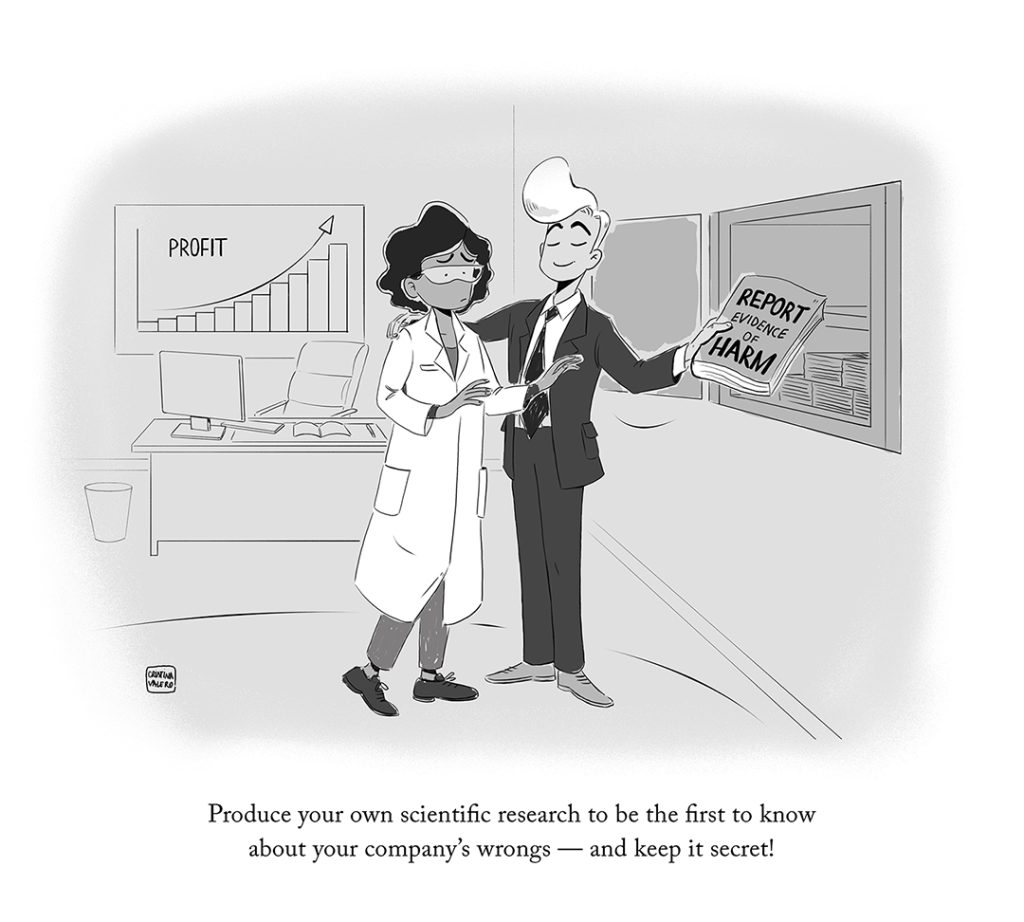
► Case study_ ‘Forever chemicals’, forever profits_
If you make a lot of money from manufacturing toxic chemicals that take centuries to degrade in the environment and last for many years in people’s bodies, you should definitely not make that information public but hide it and keep fattening your corporate profit instead.
That’s exactly the case regarding PFAS (or per- and polyfluoroalkyl substances), almost indestructible chemical compounds nicknamed “forever chemicals”. Because they are so resistant, PFAS have been used since the 1940s to manufacture all sorts of things: from non-stick cookware, food packaging, cosmetics, medical devices, computer components, and different kinds of fabrics, to industrial machinery and military hardware.
PFAS are so useful and have so many uses, that they promptly became a money-making machine for their two biggest producers: 3M and DuPont. And here is the interesting bit: thanks to their own research, 3M and DuPont knew since at least 1970 that PFAS are “highly toxic when inhaled and moderately toxic when ingested”. In fact, DuPont found that its workers at plants producing PFAS had high rates of cancer and women were giving birth to children with birth defects. Did 3M and DuPont make such information public?
Of course not! Because PFAS weren’t regulated as a type of substance, corporations could simply invent new types of these chemicals and use them, no questions asked. And it wasn’t until 1998 that knowledge about the toxicity of PFAS became public, when a court case made DuPont release private documents. Ever since, more and more evidence kept emerging that linked PFAS to cancer, immune system suppression and other negative health effects in people, farmed and wild animals, and the environment. Since 2009, some PFAS have been included in the global Stockholm Convention to eliminate their use. After that, in 2019 the EU passed a regulation to restrict the use of PFAS included in the Convention. And since February 2023, the European Chemicals Agency (ECHA) has been studying a proposal to impose a broad restriction on all PFAS chemicals, which would cover around 10,000 substances.
But because PFAS are so hardy, if by 2025 you were living in Planet Earth, then your body is already full for PFAS and will stay like that for many years. In the meantime, by July 2024, 3M was saying that its “current annual net sales of manufactured PFAS are approximately $1.3 billion”. And back in 2005, DuPont was still making “$1 billion per year in revenues [just] from the Teflon chemical”, which is a type of PFAS. Like a TV series that gives its cool villain their own show, In 2015 DuPont created a spin-of company, Chemours, which then took over the production of Teflon and other chemical products from DuPont. And while Chemours doesn’t specify its revenue or profits due to Teflon, its whole net income in 2023 was of 425 million US dollars, not bad either!
► More examples_ oil, pesticides, Instagram
► Thanks to doing their own scientific research, the oil industry knew since the 1950s that burning fossil fuels was contributing to dangerous global warming. Two decades later, Exxon’s scientists “were uncannily accurate in their projections from the 1970s onwards, predicting an upward curve of global temperatures and carbon dioxide emissions that is close to matching what actually occurred as the world heated up at a pace not seen in millions of years”. Did the oil industry share that knowledge with the public?
Hell no. Instead, Exxon and other big oil companies spent decades questioning the growing scientific evidence about the climate crisis they knew to be happening and worsening, in order to delay regulation that might threaten their business model.
The result? The oil and gas industry made 2.8 billion US dollars a day “in pure profit” from 1970 to 2020, while fossil fuels “are by far the largest contributor to global climate change”. In the meantime, as destructive climate events like hurricanes, floods, wildfires and drought pile up, it’s been estimated “that, between 2000 and 2019, the world suffered at least $2.8 trillion in loss and damage from climate change – costing around $16 million per hour”. Oh, and between February 2022 and February 2024, Exxon (today known as ExxonMobil), Chevron, TotalEnergies, Shell and BP made $281 billion more in profits (truth be told, the money they made during those two years wasn’t only due to their decades-long strategic denial of the climate crisis, but also thanks to their profiteering from the Russian invasion of Ukraine and the war there).
► Bayer and Syngenta took their time to share with EU regulators the results of studies that these companies did between 2001 and 2017, which showed how their pesticides could be harmful to people’s brains, and generally to human health. “[Between 2017 and 2022,] when the EU authorities were made aware of the studies, between 14 and 21 years after they were conducted, new safety limits were applied in some cases and evaluation is still under way in other cases”. In the meantime, not only could Bayer and Syngenta keep making money by selling those pesticides, but by June 2023, “no known penalty [had] been imposed on any pesticide company” by national regulators in the EU, which are the ones with the legal power to penalise companies that “unlawfully fail to disclose toxicity studies”.
► When Meta (which owns Facebook, Instagram and WhatsApp) learnt through its internal research that Instagram was addictive and harmful, especially to teenagers, what could the company do with such knowledge?
Instead of making the information public, which could have prompted restrictive regulation, Meta used it to engineer its products to make them more addictive. For instance, an internal presentation from May 2020, titled “teen fundamentals”, “highlighted certain vulnerabilities of the young brain that could be exploited by product development”. The document “discussed teen brains’ relative immaturity, and teenagers’ tendency to be driven by ’emotion, the intrigue of novelty and reward’ and asked how these asked how these characteristics could ‘manifest … in product usage’.”
The result? While it’s now known that Instagram and social media use among teenagers and young people are associated with mental health issues, including deliberate self-harm, people’s use of Instagram and other social media contributed to Meta’s profits of 23.2 billion dollars in 2022, and of 39 billion dollars in 2023! One more success of The Strategy!
Disqualify scientific research that threatens your profits
In an ideal world, your company would be able to keep such damaging knowledge private forever. In the real world, what can you do when scientists who are not on your payroll do publish research that uncovers negative aspects of your product or business?
Easy: you pretend to apply scientific scepticism with the only aim of discrediting and raising doubts about any good research that poses a threat to your profits. To achieve that, you can take advantage of the fact that the scientific method is cautious, scientific research is open to revision and there are different ways to test theories, and good science will almost never claim absolute certainty. That all means that you have at your disposal a menu of different ways to question any good scientific research that threatens your company’s profits.
► Case study_ CFCs and corporate profit VS risking the end of the world_
If you are old enough, you probably remember CFCs (chlorofluorocarbons), chemicals widely used back in the 1970s and 1980s in refrigerators and aerosol sprays, among other household and industrial applications. In the mid-1970s, the biggest manufacturer of CFCs was DuPont, then responsible for around one fourth of the global output, which at the time was increasing annually by 10%.
Then, in 1974 two scientists and party poopers published a paper showing that the continued use of CFCs could deplete the Earth’s protective ozone layer in a few decades. CFCs could cause a 5 to 7% ozone loss by 1995, and as much as a 30 to 50% loss by 2050. The ozone layer absorbs the sun’s ultraviolet UV-B light, which can be very harmful to humans and all other living organisms. A depletion of the ozone layer was a huge risk, of which the most immediate effects would be an increase of skin cancer cases and eye cataracts on people and animals, and reduced growth in plants. It would also contribute to the greenhouse effect and global warming. And in worse-case scenarios, a serious depletion of the ozone shield might even threat life on Earth as we know it, by disrupting food chains and whole ecosystems across the planet.
DuPont executives and other companies producing and profiting from CFCs faced a tricky situation. On the one hand, the use of CFCs was a threat to people’s health and possibly to life on Earth. On the other hand, these companies were making a lot of money out of CFCs — at the time, the industry was worth around 8 billion dollars only in the US — and had counted on increasing their profits even more during the following decades. What would DuPont do? Stop production and sales of CFCs?
C’mon, of course not!
The thing with CFCs is that the chemicals in these gases take decades to reach the stratosphere, where the ozone layer is. By 1974, the negative impacts couldn’t be directly observed yet, and the study was based on laboratory experiments. Sure, the research was praised by the scientific community, and it contributed to the emerging scientific consensus around the danger posed by CFCs to the ozone layer — but DuPont could still say that it wasn’t more than a theory, that it was a mere lab experiment. Indeed, DuPont “spent millions of dollars running full-page newspaper advertisements in 1975 defending CFCs, claiming there was no proof that CFCs were harming the ozone layer”. And the aerosol industry joined the effort and issued press releases and false news stories claiming that the causal association between CFCs and the destruction of the ozone layer was a theory and not a scientific fact. Such pieces appeared in respected newspapers read by international audiences, like the New York Times and the Wall Street Journal in the US, and the Observer in the UK.
The industry’s campaign succeeded in delaying any significant action to restrict the production and use of CFCs — at least until 1985, when a hole on the ozone layer was observed over Antarctica. Two years later, the ozone depletion in that area had reached 50%, which was far worse than what the 1974 study had predicted. It was so scary that, in September 1987, the international community managed to quickly agree on and sign the Montreal Protocol, which phased out the production and consumption of CFCs during the next two decades.
But The Strategy had worked. By 1988, DuPont changed its public stance and heartedly accepted the Montreal Protocol because the company’s strategy had paid off in more ways than one. Not only had DuPont continued making money by producing and selling CFCs for years after the 1974 study; but knowing that an eventual ban of CFCs was unavoidable, the company had also used that time to develop and patent alternative chemicals that could be ready to be deployed when finally CFCs were banned. Brilliant!
► Bonus points_ dismiss some studies because they use a particular methodology, and others because they don’t use that same methodology
When doing scientific research, there are different ways to test scientific theories — and that means that you can always question the methodology of any particular research, depending on whether such research is favourable to your corporate interests or not. And it doesn’t matter if you are inconsistent.
One example. During the 1950s and 1960s, there was emerging evidence linking high consumption of fat and sugar to heart disease. That was a threat not only to people’s health but, more worryingly, to companies producing foods considered fatty (dairy, meat, eggs…) and to companies that produced sugary drinks and food (sweets and confectionery, ice cream, sodas and fizzy drinks…). Who would follow The Strategy first: fat food companies or sugar food companies?
Back then, it was the sugar industry who mobilised itself quickly and decisively to respond to that danger. In 1967, the New England Journal of Medicine published a literature review — funded and managed by the Sugar Research Foundation, an industry body — that “singled out fat and cholesterol as the dietary causes” of heart disease, “and downplayed evidence that sucrose [i.e. sugar] consumption was also a risk factor”.
The sugar-funded review employed many tricks to disregard research that linked sugar consumption to bad health outcomes. One such trick involved looking at the methodology used in the research being reviewed. If a study had measured how people consumed sugary stuff in real life and how that affected them, then the review dismissed that study because real life it’s too complicated and there are “too many possible factors getting in the way” of the study. And if a study of sugar consumption was done under controlled laboratory conditions, then the review dismissed that “for being too dissimilar to real life”. Isn’t that genius?
Chemical companies and our old friend the tobacco industry have also used this tactic. In those cases, when human epidemiologic studies (which measure the occurrence of a certain illness among populations) found that a suspect substance seemed to be a cause of cancer, but studies on animals didn’t confirm it, then these companies said that “animal studies are required to prove causation”. And when studies on animals showed that a particular substance was causing cancer, but human epidemiological studies were incomplete or showed negative results, then these companies said that “human evidence is required before the government can regulate the substance and before workers and others [negatively affected, for example by developing cancer] can be compensated”. That’s how clever The Strategy is: with such kind of arguments, you can never lose!
Generate and promote research that’s favourable to your company’s interests
If your company’s products are harmful, another possibility is for you to generate scientific research yourself — this time, not to keep it private but to have it published. But here’s the trick: you shall fund, support, promote or directly conduct yourself research that puts the focus on other possible causes of the harm your company is causing. The point of this tactical move is not to question or deny that your product is damaging to people or the environment. Here, the point is to muddle the waters and generate doubt about what could possibly be causing such harm. Ideally, you want people, including policy-makers, to end up confused and conclude that science is frustrating and nothing can really be known for sure. To achieve that, you can do like the cool corporate kids and take advantage of the different ways in which particular studies can be designed, run and published: “Previous studies of the tobacco, food, pharmaceutical and chemical industries show that industry’s influence on the design, conduct, and dissemination of research plays a strong role in shaping public health knowledge about harmful products and determining product safety standards, particularly in the US market”.
► Case study_ Tobacco says: anything can cause cancer!_
In the early 1950s, scientific evidence associating tobacco use and cancer was quickly mounting up and was privately accepted by tobacco executives. But, then again, other things may cause cancer too, right? Voilà: in 1954, the tobacco companies established the Tobacco Industry Research Committee, which went on to produce and promote science that never studied links between smoking and cancer — but always researched anything and everything that might have anything to do with cancer, even in the cases when the research could sound ridiculous.
These are the headlines of some papers published between 1961 and 1964 in “Reports on Tobacco and Health Research”, a journal supported by the tobacco industry, and sent to the media:
► Cancer Personality Pattern Is Reported to Begin in Childhood
► Lung Specialist Cites 28 Reasons for Doubting Cigarette-Cancer Link
► Marital Data Show ‘Fallacy’ of Using Correlations to Find Disease Causes
► Psychological, Familial Factors May Have Roles in Lung Cancer
► Smokers, Non-Smokers Differ in Weight, Size
► Rare Fungus Infection Mimics Lung Cancer
► Nicotine Effect Is Like Exercise
Such studies, and indeed such headlines as sent to the news media, were not intended as contributions to honest scientific research. Their aim was to send the message that people could keep on smoking cigarettes, because actually anything and everything might be causing cancer, while it hadn’t been proved that cigarettes actually caused it. That was of course a strategic lie, because by then tobacco executives had known for years that smoking did cause cancer. And most of the tobacco industry kept lying to people’s faces until the late 1990s. Thanks to The Strategy, between 1990 and 2019 “more than 200 million deaths have been caused by smoking tobacco use, and annual economic costs due to smoking tobacco use exceed US$1 trillion”. During one single year, in 2019, as the first chapter of The Guide mentioned, tobacco “was responsible for 8.71 million deaths” globally. In parallel, one year earlier the world’s six biggest tobacco companies had declared profits before income taxes of 55 billion US dollars.
► Advanced tactical move_ use technicalities to remove negative results from your research_
In some fields, scientific research is really fundamental. For example, if you are in the pharmaceutical industry, then you do need to conduct research to develop new drugs to sell as medicines. And then, before you can actually market and sell new drugs, you need to conduct clinical trials, which are a particular type of scientific study designed to test the effects on people of the new drugs being researched.
That’s very problematic. Clinical trials are slow and expensive; and if the trials show that the drug is not good for people, then regulators won’t allow you to sell the drug, which is really bad for your business. So, what can you do?
Thankfully, it’s mostly up to the pharmaceutical companies themselves to fund and do this kind of research. And because the topic is complex, if you are in the pharma industry then you have plenty of opportunities to influence clinical trials to make your drugs look more effective and safer than they are, so that your company can sell the medicines and make money even when the drugs are actually harmful.
This is how you can follow the lead of some smart pharmaceutical companies. First of all, if a clinical trial gives you mixed results, then you only publish the results that make your drug look good. And if all or most of the results generated by the clinical trial are bad, then you don’t publish anything at all. You can always redesign the study in a different way or use different data, so that a new clinical trial can generate different results that say your drug is more effective and safer than it actually is. And when you do have positive results to share, you go and publish not one but several different academic articles to disseminate the same positive results in different ways, so that it looks like those results are supported by several different studies.
It goes without saying that you should always conceal data about the adverse reactions provoked by the drug you are researching. For example, if the study shows that your drug leads to an increase in mortality among patients, you don’t publish those results (as American pharmaceutical company Merck & Co. did regarding a drug it made for Alzheimer’s disease).
Sadly, this tactic has become harder to pull off in recent times. Most academic journals now require pharmaceutical companies to register clinical trials publicly before starting them. The idea is precisely to make it harder for you to publish only partial results or to conveniently forget about the clinical trial if the results are very bad. But worry not! By following The Strategy you will always have an ace up the sleeve. A clever trick when registering your next clinical trial is not to describe the expected “primary outcome” of the study, or to enter only vague information (e.g. not being specific about the expected results or not providing a timeframe). That way, you will still be free to selectively publish only the good results of any study you are forced to register.
Thanks to these tricks, when “professional medical bodies construct evidence-based guidelines on the basis of published trial results, […] their recommendations may be flawed. This contributes to excessive prescription of expensive new drugs whose efficacy is overestimated and risks underestimated. Moreover, because the evidence is distorted patients do not receive adequate information”. But who cares about that if it allows your company to keep making money out of drugs that are harming patients?
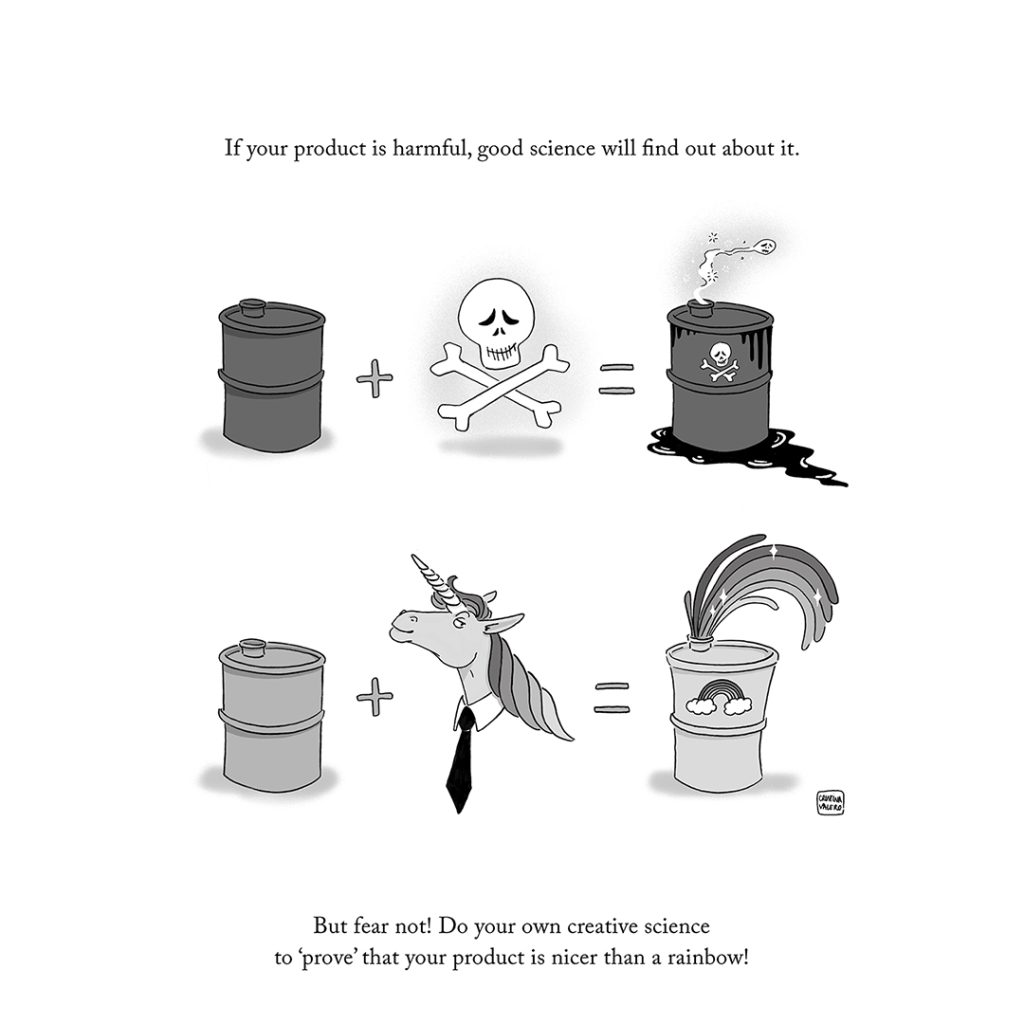
► Advanced tactical move_ promote research that ignores how your product is marketed and distributed_
If you sell products that are harmful to people, then surely you know that the precise ways in which those products are marketed, distributed and consumed can have a huge effect in making people desire and buy them; or even better, in making people addicted to them. That’s why you should generate and promote research that moves the focus away from the real-life marketing, distribution and consumption of your products. Like that, you will make it harder for regulators to restrict what you can do to make people buy and get hooked to any unhealthy or harmful stuff you sell.
For example, if you are a corporation making money by selling ultra-processed food — like Nestlé —, then you know that the way ultra-processed food is designed, marketed and distributed is key to make it easily accessible, readily available and cheap, so that people find it tasty and convenient and can become over-reliant on it (especially children). All of which means that ultra-processed food is a very good business indeed and “has become a core strategy of profit maximisation within the industrial food system”.
However, as more and more annoying scientific studies link ultra-processed food with bad health outcomes, your company can respond by promoting research that disregards real-life data, and instead insists that ultra-processed food has many vitamins, proteins and other micro- and macro-nutrients that people can recognise when they see them listed on food packaging. Then, even if eating ultra-processed food regularly is bad for people while a healthy diet provides all the vitamins and nutrients people need, you can do like Nestlé and fund and influence research that says that ultra-processed food shouldn’t be criticised because, you know, it has added vitamins! “Given the observed significance of the contribution of PFs [processed foods] to macro- and micronutrient intake, it would seem unwise to endorse the NOVA recommendation that the intake of UPFDs [ultra-processed foods and drinks] should be avoided and that the intake of PFs should be minimised” (NOVA is a classification system that ranks food from non or minimally processed to ultra-processed), said the conclusion of a 2017 study in which the main researcher “serves on scientific committees for Nestlé and Cereal Partners Worldwide [which makes breakfast cereals for Nestlé and General Mills], and another of the researchers also worked for Nestlé in the past — something that wasn’t originally mentioned in the published study.
Sign up friendly researchers to your cause
While you should do your own private science to protect your corporate interests, it’s always nice to find — or buy — external researchers whose work can be seen as supporting your cause.
► Case study_ a thousand scientists want you to eat meat_
It’s estimated that the greenhouse gas emissions of the livestock industry (i.e. farmed animals) represent “between 14.5 percent and 19.6 percent of the world’s total”, and meat and dairy production uses 80% of the global agricultural land. On the other hand, livestock products provide “just 17% of the world’s calories and 38% of its protein”. Because of that, and as the negative effects of the climate crisis increase, experts have called on people to eat less meat. But that’s a threat to the meat industry’s big profits, regardless of any possible climate catastrophe.
So, when in October 2022 the “Dublin Declaration of Scientists on the Societal Role of Livestock” was published, it was a big thing. The declaration, signed by a thousand scientists, defends meat production as beneficial to “human health”, “the environment” and “socio-economics”; and “aims to give voice to the many scientists around the world who research diligently, honestly and successfully in the various disciplines in order to achieve a balanced view of the future of animal agriculture”.
The declaration looked like great news for the meat industry, which promptly started disseminating and promoting it to defend that meat is not part of the problem but of the solution, and therefore no restrictive regulation is needed. In April 2023, the declaration was published in Animal Frontiers, the official journal of the World Association of Animal Production and European and American meat and animal science associations. The declaration has been promoted by the European Livestock Voice (ELV), a meat industry lobby group, as the “evidence base” to protect meat production and consumption against “the controversial restriction of meat through policy”, as put in a speech given by Professor Frédéric Leroy, one of the authors of the declaration. To round it up, a representative of the ELV said that the “scientists who signed the declaration are ‘independent, [and have] nothing to do with the livestock industry’”.
And here’s the good part: that’s not true, it was all a clever trick of the industry! Indeed, “the creation, launch, and promotion of the declaration had significant links to the livestock industry and its consultants. And four out of six of the authors of the Declaration have clear ties to industry”, including professor Leroy, a known vocal defender of the meat industry, which has supported his work.
And what about the thousand scientists that signed the declaration when it was launched? That was simply another ingenious ploy! While it may not be immediately evident by looking at the Declaration, it turns out “that 60% of the signatories have affiliations with the livestock industry”. In addition, “around 30% of the signatories have a background other than one that could be considered relevant to the claims the declaration makes about environmental science or human health. Around two-thirds of them are veterinarians, who aren’t necessarily funded by industry (only 10% of that 30% overlaps with the industry affiliation set) but do potentially benefit from a thriving livestock sector to be able to carry out their work”.
► More examples_ Coke, universities for rent, Syngenta and Monsanto
If your company makes cheap sugary drinks, like for example Coke does, you know a couple of things: that you need to sell as many drinks as possible to keep your profit fat, and that taking too much sugar also keeps people fat and is associated with several negative health outcomes. The latter is now public knowledge, which is a problem for your company when activists and policy-makers call for sugar taxes to make your product more expensive and less attractive to people. And one thing you can do, following Coca-Cola’s example, is to pay scientists and help establish a research organisation to abuse science and find supposedly alternative solutions. That’s what Coke did by funding and supporting the creation of the Global Energy Balance Network, a research organisation that went on to promote a “new ‘science-based’ solution to the obesity crisis”. And what’s that new solution? Telling people that, despite independent scientific evidence pointing to the contrary, it’s OK to drink Coke and not worry about the calories, as long as they also move their asses and do some exercise — so that no tax on sugar is needed!
And here’s another idea: what about having a friendly university at hand to produce and promote scientific research to support your corporate interests? In 2022, CropLife Europe and CropLife International, as part of their work against the EU Farm to Fork strategy, commissioned Wageningen University, in the Netherlands, to conduct a study that would be “guided” and “supervised” by CropLife representatives. The study was not supposed to include the environmental benefits of the Farm to Fork strategy, and instead would need to focus on its potential negative economic impact. Besides all that, “Wageningen researchers presented the studies as key speakers in various industry-led lobby events”. How could CropLife get so much influence on Wageningen University? Well, apart from paying for the study and organising events to promote it, it helped that the university’s Chair of the Board, Louise Fresco, had “joined the Board of Syngenta [a member of CropLife] in 2019, and previously was a paid advisor to Unilever and Rabobank”. As it happens, the three companies, Syngenta, Unilever and Rabobank, are among the founding members of the Climate Smart Agriculture initiative, which is supported by CropLife and advocates for expensive high-tech agriculture, including “advanced genetic techniques”, as offered by CropLife’s corporate members. In addition, reportedly German giant chemical company “BASF and Anglo-Dutch oil company Shell had funded professorships at (Wageningen) university”.
In fact, if your company is going to be a regular follower of The Strategy, then you should do like Syngenta and Monsanto (today owned by Bayer), both of which are veteran and proficient users of The Strategy and have “maintain(ed) a list of ‘third party stakeholders,’ including free market think tanks and scientists the industry could turn to for messaging support”.
► The curious effects of disclosing conflicts of interest
Logically, you want that scientists whose work favours your own corporate interests are perceived as independent and unrelated to you — especially when it’s your company who pays for their work. However, keeping your influence on scientists secret is becoming harder and harder, as annoyingly pesky journalists and researchers keep looking into your business.
So here’s a counterintuitive idea: make the scientists on your payroll disclose such conflict of interest — because that can actually make them more credible and not less, as found by a study published in 2005: “Although disclosure is often proposed as a potential solution to [conflicts of interest], we show that it can have perverse effects. First, people generally do not discount advice from biased advisors as much as they should, even when advisors’ conflicts of interest are disclosed. Second, disclosure can increase the bias in advice because it leads advisors to feel morally licensed and strategically encouraged to exaggerate their advice even further. As a result, disclosure may fail to solve the problems created by conflicts of interest and may sometimes even make matters worse. (…) When possible, the more lasting solution to these problems is to eliminate the conflicts of interest”.
But, of course, you don’t want to eliminate conflicts of interest, because generating such conflicts of interest is part of The Strategy and will help you protect your corporate profit, so don’t you worry about that and keep on working to abuse science and influence scientific research!
Conclusion_ Making people distrust science
Good science is like the shy kid that gets bullied at school: humble, cautious, lets others speak and listens to them, doesn’t claim to be 100% certain of anything, and it’s willing to change their opinion if new data tell them so. And you, as an aggressive and ambitious corporate executive or director, need to become a bully to good science. Because while scientific research may look cute and nice, it can actually pose a threat to your business model and profits. That’s why in this chapter of The Guide you learnt how to abuse the scientific method to protect your business and money: keep private your own research about the harms caused by your products, question and disqualify external research that reveals those harms, produce and promote your own partial or biased research to help your cause, and find or buy friendly scientists who’ll do your biding.
And that’s just an overview of this tactic. As mentioned at the start of this chapter, abusing science lies at the origin of The Strategy and has become one of its fundamental elements. There are whole books devoted to develop this tactic and help you put it to good use to keep the money flowing into your pockets. For a clear-sighted and deadpan manual, go and read The Playbook: How to Deny Science, Sell Lies, and Make a Killing in the Corporate World (while focused on the US and on abusing science, The Playbook was a key inspiration for The Guide). And if you’d like to get a longer list of tactical moves connected to abusing science, here you have a very informative and handy one.
An intended consequence of this tactic is to generate doubt among people, including elected politicians and other policy-makers, so that they will say things like: “But is that product really dangerous or is it actually safe? One can’t really tell!” “Some headlines say this food is unhealthy but then some other headlines say it’s good for your health”. “Everything seems to cause cancer, and in any case in the long term we are all dead, so”. “I mean, have you tried to read an academic paper?, they’re so long and boring — and for each study that says one thing there’s another study that says the opposite is true!” “And since we are at that: is climate change really happening?, there were heat waves and cold snaps when I was a child too!”
That’s the beauty of it: by abusing science, you will contribute to muddle the waters of the public debate, make everything look complicated and confusing, and push people to distrust science and simply believe whatever they like — and then you can influence what they like using the first tactic of The Strategy: exploiting weak PR regulation, isn’t that genius?
All this confusion and polarisation — because people who believe one thing will dislike and argue with people who believe another thing — shall help you protect your corporate profit by delaying, or ideally preventing, regulation that could make you change your business model. And as long as your industry remains weakly regulated, your company will be free to do whatever it takes to keep maximising profit.
In the next chapter, The Guide tells you about one of the most insidious and satisfying ways to use The Strategy: making individuals feel guilty and responsible for everything bad that happens to them and in the world after they consume your products. And when problems are too big to deny, as it’s the case with the climate and environmental crises, you shall also say that it’s actually the consumers who need to make an effort and change their behaviour. There’s no need to regulate your business: it’s all the consumers fault!
Now, let’s keep on influencing!
This chapter was last reviewed and published on 5 May 2025.
Notes and references
– In the list below, the lines in bold are the phrases in this chapter of The Guide that the ensuing note refer to. When I consider the title or headline of a reference clear and informative enough to support the corresponding statement in the text of this chapter, I only include here the information about the citation and a link to the reference. When the reference is a long document, and/or when particular paragraphs from the reference are clearly related to the corresponding statement, then I quote such paragraphs here. I have minimally edited those quotes to delete the spaces between paragraphs in the original source, so that here they appear as one single (if long) paragraph. For the sake of simplicity, I have also removed embedded links and superscript citation numbers from the quoted paragraphs; those links and citations can be seen and followed in the text in the original reference source. When I use quotes in the text of the chapter, I may re-stylise the initial lower or upper case letters of some quotes to make them fit with their place in the paragraphs in the text.
– That piece of advice is actually at the origin of The Strategy, as it was John W. Hill, then-president of PR firm Hill & Knowlton, who gave it to the US tobacco executives when scientific research started to show links between smoking and cancer: “Hill understood that simply denying emerging scientific facts would be a losing game. This would not only smack of self-interest but also ally the companies with ignorance in an age of technological and scientific hegemony. So he proposed seizing and controlling science rather than avoiding it. If science posed the principal — even terminal — threat to the industry, Hill advised that the companies should now associate themselves as great supporters of science. (…) Of critical importance, Hill argued, they should declare the positive value of scientific skepticism of science itself. Knowledge, Hill understood, was hard won and uncertain, and there would always be skeptics. What better strategy than to identify, solicit, support, and amplify the views of skeptics of the causal relationship between smoking and disease?”
– “Hill offered the companies powerful advice and guidance as they faced their crisis. Hill understood that simply denying emerging scientific facts would be a losing game. This would not only smack of self-interest but also ally the companies with ignorance in an age of technological and scientific hegemony. So he proposed seizing and controlling science rather than avoiding it. If science posed the principal—even terminal—threat to the industry, Hill advised that the companies should now associate themselves as great supporters of science. The companies, in his view, should embrace a sophisticated scientific discourse; they should demand more science, not less. Of critical importance, Hill argued, they should declare the positive value of scientific skepticism of science itself. Knowledge, Hill understood, was hard won and uncertain, and there would always be skeptics. What better strategy than to identify, solicit, support, and amplify the views of skeptics of the causal relationship between smoking and disease? Moreover, the liberal disbursement of tobacco industry research funding to academic scientists could draw new skeptics into the fold. The goal, according to Hill, would be to build and broadcast a major scientific controversy. The public must get the message that the issue of the health effects of smoking remains an open question. Doubt, uncertainty, and the truism that there is more to know would become the industry’s collective new mantra.”
– Brandt, A.M. (2011). Inventing Conflicts of Interest: A History of Tobacco Industry Tactics. American Journal of Public Health, 102, 1:63-71, 1 January 2012. Available on https://ajph.aphapublications.org/doi/full/10.2105/AJPH.2011.300292 and https://doi.org/10.2105/AJPH.2011.300292 (last visited on 19 November 2024)
– Following Hill’s advice, the tobacco CEOs funded research that considered alternative causes of cancer, raised scepticism about the studies that did show a link between smoking and cancer, and exploited the fact that straightforward causality is very hard to prove. And as the first chapter of The Guide showed you, it worked. Sales of cigarettes rebounded; and despite the overwhelming evidence that smoking them kills people, regulation restricting the marketing and sale of tobacco would take decades to be established.
– “Hill was above all a cynic, deeply committed to the instrumental ideals of public relations. He was profoundly confident that public relations strategies, well developed and implemented, could effectively serve the needs of his clients. He believed—and he convinced the companies’ leadership—that by calling for more research and offering funding, they could take high ground in their public pronouncements. Although he had quit smoking himself, he had no interest in examining and assessing the data or the emerging science. For Hill, science would be a means to a public relations end. The executives of the 5 major companies endorsed his strategic plan and hired Hill & Knowlton to manage their burgeoning corporate crisis.”
– “Although public relations practitioners had considerable experience manipulating the media, what was radical about Hill’s proposed strategy was the desire to manipulate scientific research, debate, and outcomes. It would be crucial to identify scientists who expressed skepticism about the link between cigarettes and cancer, those critical of statistical methods, and especially those who had offered alternative hypotheses for the causes of cancer. Hill set his staff to identifying the most vocal and visible skeptics of the emerging science of smoking and disease. These scientists (many of whom turned out to be smokers themselves) would be central to the development of an industry scientific program in step with larger public relations goals. (…) Individual tobacco companies had sought to compile information that cast doubt on the smoking–cancer connection even before Hill & Knowlton became involved. One R.J. Reynolds official announced to other industry executives in November 1953 that the company had formed a bureau of scientific information to “combat the propaganda which is being directed at the tobacco industry.” At the same time, American Tobacco began to collect the public statements of scientists who had expressed skepticism about the research findings indicting tobacco. The company’s own public relations counsel understood that it would be critical to create questions about the reliability of the new findings and to attack the notion that these studies constituted proof of the relationship of smoking to cancer. Pooling these efforts, Hill & Knowlton produced a compendium of statements by physicians and scientists who questioned the cigarette–lung cancer link. This compendium became a fundamental component of Hill & Knowlton’s initial attempts to shape and implement its public relations strategy.”
– “It was Hill who hit on the idea of creating an industry-sponsored research entity. Ultimately, he concluded, the best public relations approach was for the industry to become a major sponsor of medical research. This tactic offered several essential advantages. The call for new research implied that existing studies were inadequate or flawed. It made clear that there was more to know, and it made the industry seem a committed participant in the scientific enterprise rather than a self-interested critic. The industry had supported some individual research in recent years, but Hill’s proposal offered the potential of a research program that would be controlled by the industry yet promoted as independent. This was a public relations masterstroke. Hill understood that simply giving money to scientists—through the National Institutes of Health or some other entity, for example—offered little opportunity to shape the public relations environment. However, offering funds directly to university-based scientists would enlist their support and dependence. Moreover, it would have the added benefit of making academic institutions “partners” with the tobacco industry in its moment of crisis.”
– Brandt, A.M. (2011). Inventing Conflicts of Interest: A History of Tobacco Industry Tactics. American Journal of Public Health, 102, 1:63-71, 1 January 2012. Available on https://ajph.aphapublications.org/doi/full/10.2105/AJPH.2011.300292 and https://doi.org/10.2105/AJPH.2011.300292 (last visited on 19 November 2024)
– “Cigarettes were recognised as the cause of the epidemic in the 1940s and 1950s, with the confluence of studies from epidemiology, animal experiments, cellular pathology and chemical analytics. Cigarette manufacturers disputed this evidence, as part of an orchestrated conspiracy to salvage cigarette sales. Propagandising the public proved successful, judging from secret tobacco industry measurements of the impact of denialist propaganda. As late as 1960 only one-third of all US doctors believed that the case against cigarettes had been established. The cigarette is the deadliest artefact in the history of human civilisation. Cigarettes cause about 1 lung cancer death per 3 or 4 million smoked, which explains why the scale of the epidemic is so large today. Cigarettes cause about 1.5 million deaths from lung cancer per year, a number that will rise to nearly 2 million per year by the 2020s or 2030s, even if consumption rates decline in the interim. Part of the ease of cigarette manufacturing stems from the ubiquity of high-speed cigarette making machines, which crank out 20 000 cigarettes per min. Cigarette makers make about a penny in profit for every cigarette sold, which means that the value of a life to a cigarette maker is about US$10 000.”
– “On December 14, 1953, at the Plaza Hotel in Manhattan, CEOs of the six largest tobacco manufacturers in the USA (all but Liggett) met to plan a response. The outcome was a far-reaching plan to refute the accumulating evidence, using adverts, ‘white papers’, press releases and corporate schmoozing with popular science writers and journalists. Support for (industry-friendly) science was a vital part of this enterprise: cigarette manufacturers called for ‘more research’ to resolve a purported ‘controversy’, and set out to reassure the public that the companies were taking charge. That campaign was by and large a success, judging from the fact that per capita consumption rebounded from its dip in 1953. Cigarette consumption in the USA would in fact continue to grow throughout the 1960s and 1970s, peaking at about 630 billion sticks in 1982 before starting to decline.”
– “One source of information for the history of ignorance is the polling data amassed by professional opinion research agencies and their tobacco industry counterparts. In 1954, for example, George Gallup sampled a broad swath of the US public to ask: ‘do you think cigarette smoking is one of the causes of lung cancer, or not?’ 41% answered ‘yes’, with the remainder answering either ‘no’ or ‘undecided’. Even large numbers of doctors remained unconvinced. In 1960, in a poll organised by the American Cancer Society, only a third of all US doctors agreed that cigarette smoking should be considered ‘a major cause of lung cancer’. This same poll revealed that 43% of all American doctors were still smoking cigarettes on a regular basis, with occasional users accounting for another 5%. With half of all doctors smoking, it should come as no surprise that most Americans remained unconvinced of life-threatening harms from the habit. The tobacco industry was not innocent in this persistence of ignorance. Cigarette makers spent countless sums to deny and distract from the cigarette–cancer link, in some instances actually quantifying the impact of their denialist propaganda. In 1973, for example, the Tobacco Institute hired AHF-Basico Market Research Co. and Audience Studies, Inc., to measure the impact of its 1972 propaganda film, ‘Smoking and Health: The Need to Know’, shown to hundreds of thousands throughout the country, including high school students. Prior to screening, viewers were asked a series of questions about whether the Surgeon General ‘could be wrong about the dangers of smoking’; the same questions were then asked after the screening. Anne Duffin at the Tobacco Institute was happy to report that the film had reduced by 17.8% the number of people agreeing that ‘Cigarette smoking cause[s] lung cancer’ (from 74.9% to 57.1%). The film had also produced ‘significant shifts’ in attitudes favourable to the industry in other areas, including whether recent reports had ‘overemphasized the dangers of smoking’.”
– Proctor, R.N. (2012). The history of the discovery of the cigarette–lung cancer link: evidentiary traditions, corporate denial, global toll. Tobacco Control, 2012, 21:87-91, 16 February 2012. Available on https://tobaccocontrol.bmj.com/content/21/2/87 and https://doi.org/10.1136/tobaccocontrol-2011-050338 (last visited on 19 November 2024)
– That’s exactly the case regarding PFAS (or per- and polyfluoroalkyl substances), almost indestructible chemical compounds nicknamed “forever chemicals”. Because they are so resistant, PFAS have been used since the 1940s to manufacture all sorts of things: from non-stick cookware, food packaging, cosmetics, medical devices, computer components, and different kinds of fabrics, to industrial machinery and military hardware.
– “PFAS stands for per- and polyfluoroalkyl substances, it’s an umbrella term for a family of thousands of chemicals – about 12,000 at the last count – that are prized for their indestructible and non-stick properties. They are used in a huge range of consumer products, including waterproof clothing, furniture, cookware, electronics, food packaging and firefighting foams and are employed in a wide array of industrial processes. Most PFAS are so well designed and robust that they won’t break down in the environment for tens of thousands of years, earning them the moniker “forever chemicals”. This persistence means the PFAS burden is ever growing, so much so that a group of scientists have concluded that the global spread of just four PFAS in the atmosphere has led to the “planetary boundary for chemical pollution being exceeded, raising risks to the stability of the Earth system”.”
– “It was DuPont that introduced PFAS to the world in the 1940s as Teflon and it was DuPont that revealed how harmful they could be. It emitted PFOA from its US plant in south-west Parkersburg into the air and Ohio River from the 1950s until the early 2000s, and it eventually reached drinking water supplies. The ensuing lawsuit, which led to DuPont settling 3,500 personal injury cases for $670.1m (£555m), was made famous by the Mark Ruffalo film Dark Waters.”
– Salvidge, R. & Hosea, L. (2023). What are PFAS, how toxic are they and how do you become exposed? The Guardian, 23 February 2023. Available on https://www.theguardian.com/environment/2023/feb/23/what-are-pfas-forever-chemicals-how-toxic-are-they-and-how-do-you-become-exposed and on the Internet Archive (last visited on 19 November 2024)
– “Per- and polyfluoroalkyl substances (PFAS) are a class of synthetic compounds prized for their ability to repel oil, grease, and water. These qualities have led to their use in everything from nonstick cookware to stain-resistant carpets to firefighting foam. PFAS are extremely persistent in the environment and human body—meaning they do not break down and can accumulate—and nationwide biomonitoring results indicate that nearly all Americans carry trace amounts of PFAS in their bodies. This exposure is due to the remarkably widespread contamination of drinking water and groundwater supplies by PFAS manufacturers and by military bases and airports using PFAS-containing firefighting foams, as well as from their use in household products.”
– UCS. (2019). DuPont, 3M Concealed Evidence of PFAS Risks. Union of Concerned Scientists (UCS), 22 March 2019. Available on https://www.ucsusa.org/resources/dupont-3m-concealed-evidence-pfas-risks and the Internet Archive (last visited on 19 November 2024)
– “Most weapons platforms incorporate PFAS, and PFAS are found throughout the defense industrial base in roles supporting mission critical component production and supply. PFAS uses may be direct, where a PFAS is a constituent in a consumable item or is incorporated into an article (e.g., end item), or indirect, where a PFAS is used to formulate another chemical or is part of a manufacturing process. These uses and processes are necessary to the production of key components of the defense industrial base, such as microelectronic chips and lithium-ion (Li-ion) batteries.”
– US DoD. (2023). Report on Critical Per- and Polyfluoroalkyl Substance Uses. United States Department of Defense (US DoD), August 2023. Available as a PDF file on https://www.acq.osd.mil/eie/eer/ecc/pfas/docs/reports/Report-on-Critical-PFAS-Substance-Uses.pdf and on the Internet Archive (last visited on 19 November 2024)
– PFAS are so useful and have so many uses, that they promptly became a money-making machine for their two biggest producers: 3M and DuPont.
– “Two of the 12,034 known PFAS variants, PFOS and PFOA (formerly known as C8), have been shown to adversely impact a range of health outcomes. Two major companies in the U.S. have manufactured the majority of legacy and emerging PFAS: 3M, makers of Scotchguard, and E.I. du Pont de Nemours & Company, known as DuPont, makers of Teflon. PFAS were long presumed to be biologically inert, but legal disclosures and investigative reporting have uncovered evidence that companies that manufacture PFAS learned of their toxic effects on human health and the environment long before the public health community.”
– Gaber, N. & al. (2023). The Devil they Knew: Chemical Documents Analysis of Industry Influence on PFAS Science. Annals of Global Health, 89(1), 1 June 2023. Available on https://annalsofglobalhealth.org/articles/10.5334/aogh.4013 and https://doi.org/10.5334/aogh.4013 (last visited on 19 November 2024)
– “PFAS were first developed in the 1940s and it was not until the late 1990s that the public knew about the dangers they pose. But, according to a new study published in Annals of Global Health, DuPont and 3M—the leading manufacturers of the chemicals—had preliminary evidence of PFAS toxicity as early as the 1960s, and knew broadly about the dangers the chemicals pose by 1970.”
– Kluger, J. (2023). Companies Knew the Dangers of PFAS ‘Forever Chemicals’—and Kept Them Secret. Time Magazine, 1 June 2023. Available on https://time.com/6284266/pfas-forever-chemicals-manufacturers-kept-secret/ and the Internet Archive (last visited on 19 November 2024)
– “3M said its annual sales of manufactured PFAS are about $1.3 billion with estimated earnings before interest, tax, depreciation (EBITDA) margins of about 16%.”
– Reuters. (2022). 3M to end ‘forever chemicals’ output at cost of up to $2.3 bln. Reuters, 20 December 2022. Available on https://www.reuters.com/business/3m-stop-making-forever-chemicals-take-up-23-bln-charge-2022-12-20/ and the Internet Archive (last visited on 19 November 2024)
– “Since the 1940s, DuPont made and used PFAS chemicals to make highly profitable consumer products, including Teflon, which at one point earned $1 billion a year for the chemical giant. Communities whose water is contaminated with the Teflon chemical, or other PFAS compounds from other companies, face huge costs for installing filters to remove the chemicals, which have been linked to cancer, thyroid disease, reproductive and immune system problems and many other serious health harms.”
– EWG. (2019). DuPont Made Billions Polluting Tap Water With PFAS; Will Now Make More Cleaning It Up. Environmental Working Group (EWG), 12 December 2019. Available on https://www.ewg.org/news-insights/news-release/dupont-made-billions-polluting-tap-water-pfas-will-now-make-more and the Internet Archive (last visited on 19 November 2024)
– And here is the interesting bit: thanks to their own research, 3M and DuPont knew since at least 1970 that PFAS are “highly toxic when inhaled and moderately toxic when ingested”. In fact, DuPont found that its workers at plants producing PFAS had high rates of cancer and women were giving birth to children with birth defects. Did 3M and DuPont make such information public?
– Of course not! Because PFAS weren’t properly regulated as a type of substance, corporations could simply invent new types of these chemicals and use them, no questions asked. And it wasn’t until 1998 that knowledge about the toxicity of PFAS became public, when a court case made DuPont release private documents. Ever since, more and more evidence kept emerging that linked PFAS to cancer, immune system suppression and other negative health effects in people, farmed and wild animals, and the environment.
– “Per-and polyfluoroalkyl substances (PFAS) are a class of widely-used chemicals that persist in the environment and bioaccumulate in humans and animals, becoming an increasing cause for global concern. While PFAS have been commercially produced since the 1940s, their toxicity was not publicly established until the late 1990s. (…) Our review of industry documents shows that companies knew PFAS was “highly toxic when inhaled and moderately toxic when ingested” by 1970, forty years before the public health community. Further, the industry used several strategies that have been shown common to tobacco, pharmaceutical and other industries to influence science and regulation – most notably, suppressing unfavorable research and distorting public discourse. We did not find evidence in this archive of funding favorable research or targeted dissemination of those results.”
– “Two of the 12,034 known PFAS variants, PFOS and PFOA (formerly known as C8), have been shown to adversely impact a range of health outcomes. Two major companies in the U.S. have manufactured the majority of legacy and emerging PFAS: 3M, makers of Scotchguard, and E.I. du Pont de Nemours & Company, known as DuPont, makers of Teflon. PFAS were long presumed to be biologically inert, but legal disclosures and investigative reporting have uncovered evidence that companies that manufacture PFAS learned of their toxic effects on human health and the environment long before the public health community. Chemours’ website still claims PTFE is “inert to virtually all chemicals and considered the most slippery material in existence.” An initial lawsuit filed in 1998 ended in settlement in 2001, establishing that DuPont dumped more than 7,100 tons of PFOA-laced sludge onto Plaintiff Tenant’s property and the Ohio River, where the chemical seeped into the ground and entered the Ohio River and local water sources. Legal discovery in Tennant showed that DuPont and 3M had evidence of clear health and environmental impacts as early as 1976.”
– “Human harm, including pregnancy-induced hypertension, kidney and testicular cancers, and ulcerative colitis, from PFOA was not publicly established until 2011, following the reports of the C8 Science Panel, mandated and funded as part of a settlement agreement in the case of Jack W. Leach, et al. v. E.I. du Pont de Nemours & Company. (…) In addition to the findings of the C8 Science Panel, systematic reviews show that there is sufficient evidence that developmental exposure to PFOA restricts fetal growth, associated with dyslipidemia (a risk factor for adverse cardiovascular effects), and poses “an immune hazard” to humans, including impaired vaccine response. There is also growing evidence suggestive of impacts on human reproduction and development—including infertility, premature birth, trouble breastfeeding, delayed puberty, earlier menopause, and diverse metabolic impacts—as well as suggestions of a relationship with neurologic and behavioral disorders (including attention deficit hyperactivity [ADHD], autism, and schizophrenia).”
– “Beginning in the 1980s, there were increasing numbers of animal toxicology studies published showing liver damage, alterations of lipid metabolism, DNA damage, and increased tumor incidence. (…) In a 2003 study, rats exposed to PFOS throughout pregnancy birthed newborns with dose-dependent harmful effects. In one study, those in the high-dose group (10 mg/kg) were born pale and inactive, dying within an hour. At a lower dose (5 mg/kg), newborn pups became moribund but survived 8–12 hours. Over 95% of these offspring did not survive the first day of postnatal life, though no excess mortality was recorded among those that lived longer than a week. Extended reviews of the reproductive and developmental effects of PFAS have been undertaken elsewhere.”
– Gaber, N. & al. (2023). The Devil they Knew: Chemical Documents Analysis of Industry Influence on PFAS Science. Annals of Global Health, 89(1), 1 June 2023. Available on https://annalsofglobalhealth.org/articles/10.5334/aogh.4013 and https://doi.org/10.5334/aogh.4013 (last visited on 19 November 2024)
– “Despite the ubiquity of these chemicals, health problems linked to PFAS have only become public knowledge in recent years. The public could have learned of the dangers decades earlier, however, had chemical companies chosen not to bury or spin their own internal research. Indeed, health problems linked to PFAS only began to be revealed when, in 1998, Ohio attorney Rob Bilott took on the case of a Parkersburg, West Virginia family whose cattle were suffering unexplained illnesses. Bilott’s work ultimately led to the release of thousands of documents from the chemical company DuPont, whose PFOA-producing Washington Works plant was located in Parkersburg (PFOA, once used to make Teflon, is one of the oldest varieties of PFAS). The documents revealed that DuPont had concealed decades’ worth of internal research from that linked PFOA to negative health effects as well as concealed testing results that found the chemical in the local water supply. In the 1960s, for example, DuPont researchers found PFOA could increase liver size in animals. According to the New York Times, other documents revealed that by the 1990s, the company knew that PFOA caused multiple types of cancerous tumors. The company did not share its knowledge with the public, regulators, or even largely its own workers, who faced elevated levels of cancers and the possibility of giving birth to children with birth defects, among other health effects. DuPont was not the only company to engage in such corporate disinformation. In early 2018, the Minnesota Attorney General’s Office released documents showing that the chemical company 3M had also concealed and downplayed the dangers of PFAS for decades. 3M, which invented PFOA and used another variety of PFAS called PFOS in its popular product Scotchgard, had conducted scientific studies in the 1970s that showed the toxicity of the chemicals, but did not turn over any of its science to the Environmental Protection Agency for more than 20 years. The company also softened its various findings on PFAS when submitting to publications, and hired professor John Geisy, an expert in perfluorinated chemicals, to keep PFAS science company-friendly. As reported by The Intercept, Geisy “helped 3M spin the science on [PFAS] in the company’s favor even as he presented himself as an independent scientist.” Both 3M and DuPont have paid out hundreds of millions in legal settlements since their internal machinations have come to light, as scientific research has linked PFOA, PFOS, and other types of PFAS to health effects including testicular cancer, kidney cancer, and increased risk of asthma and thyroid disease.”
– UCS. (2019). DuPont, 3M Concealed Evidence of PFAS Risks. Union of Concerned Scientists (UCS), 22 March 2019. Available on https://www.ucsusa.org/resources/dupont-3m-concealed-evidence-pfas-risks and the Internet Archive (last visited on 19 November 2024)
– “The initial attention on PFAS was focused on two compounds, perfluorooctane sulfonate (PFOS) and perfluorooctanoic acid (PFOA). These two compounds have been used in large quantities, for example in aqueous film forming foams (AFFFs), used as fire extinguishers, and in the production of fluoropolymers, such as Teflon. Wide-spread environmental contamination by PFOS and PFOA was reported in the 1990s and 2000s. Concern over the environmental and health risks caused by these compounds led to voluntary phase-outs by the fluorochemical industry, and finally in 2009 to the inclusion of PFOS, its salts and related compounds in the international Stockholm Convention on Persistent Organic Pollutants (POPs) in 2009, which is an international treaty restricting the use of harmful chemicals. Since then, also PFOA and perfluorohexane sulfonate (PFHxS) have been listed in the Stockholm Convention for elimination (the ban on PFHxS coming into force at the end of 2023). Currently, so-called long-chain perfluorocarboxylic acids (PFCAs), with carbon chain lengths from 9 to 21 are on the Convention candidate list. In the EU, the Stockholm Convention is implemented through the POP regulation. In addition, PFCAs with chain lengths from nine to 14, their salts and precursors are restricted also in the EU/EEA area under REACH regulation since February 2023. Several PFAS compounds are also on the list of Substances of Very High Concern (SVHC), which obliges manufacturers and importers to give a declaration of the presence of a chemical if the content of the substance exceeds 0.1% of the weight of the product and give guidance on safe use. Due to restrictions on the production and use of PFAS such as PFOS and PFOA, their emissions to the environment have declined. However, due to their persistence, the already emitted PFAS remain in the environment. Also, as individual PFAS have been banned, the chemical industry has replaced them with other unregulated PFAS with similar chemical properties. In many cases, replacement substances have often proved to be at least as problematic as their predecessors. The phenomenon where a harmful chemical is replaced with another harmful chemical is called ‘regrettable substitution’. For example, HPFO-DA, a substance used to replace PFOA in fluoropolymer productions, has been included in the SVHC list due to health and environmental concerns related to the substance. It has been widely agreed, due to regrettable substitution, and the sheer number of potential PFAS, most of which cannot even be analyzed in environmental samples with existing analysis techniques, that environmental problems caused by PFAS cannot be solved with bans and restrictions based on individual substances. In 2022, a proposal of a group-based ban of production and use of PFAS in other than non-essential purposes was presented to the European Chemicals Agency (ECHA) by Denmark, Germany, Netherlands, Norway, and Sweden. The proposal defines PFAS as substances containing certain fluorinated carbon moieties, rather than defining them based on structures of individual PFAS molecules. This definition also includes fluoropolymers, such as polytetrafluoroethylene (PTFE), which is used for example in Teflon. Due to the high number of compounds included in the definition, the sheer scale of this group-based restriction would be historical.”
– Vainio, R. (2023). Why are PFAS a concern and how are they regulated? Interreg Baltic Sea Region, 13 June 2023. Available on https://interreg-baltic.eu/project-posts/why-are-pfas-a-concern-and-how-are-they-regulated/ and the Internet Archive (last visited on 23 April 2025)
– “This begs the question: If PFAS are that bad, how on earth can they still be allowed? I´d say that there are several answers to this question. The most obvious being that regulation of many chemicals to date has been a hard-fought victory against a well-funded industry, lobbying to keep substances on the market (I’m mainly writing from an EU perspective, but the same goes for the US). To put it blunt: There’s a lot of money in PFAS. In addition to this, current legislation makes it very hard to regulate chemicals on a group basis. PFAS are not one single chemical, the PFAS group covers more than 4,700 substances. In the 1980s, two of the substances – PFOA and PFOS – were found to be toxic and some countries have enforced limits to use them. However, as chemicals are regulated one-by-one, it has been possible to keep manufacturing all kinds of molecular varieties of these chemicals to replace PFOA and PFOS. The pattern of escaping regulation by shifting to a less studied – but still toxic – cousin is not unique for PFAS. Varieties of toxic chemicals such as halogenated flame retardants, bisphenols and phthalates have all eluded legislation in the same manner. For this reason, more and more stakeholders are asking for solutions to regulate chemicals on a group level. One current initiative is an EU restriction that in practice will cover a group of about 200 PFAS chemicals. The restriction will be rolled out in steps between 2020 and 2023. It holds a number of exemptions, but it’s a good start. The last reason why PFAS aren’t yet regulated relates to how the toxicity of chemicals, or the hazardous properties, is dealt with in a policy context. The main and common problematic property for all PFAS is that they do not degrade. They are extremely persistent and can remain in nature for hundreds – or even thousands – of years. Water can transport PFAS and, unwillingly, humans, birds and fishes also help transport these chemicals to remote places, far from any regular human activity. That’s why, for example, polar bears have been found with PFAS in their blood streams. But for a substance to be covered by regulatory criteria, being persistent is not enough. The persistence needs to be accompanied with proof that the substance is taken up by organisms (bioaccumulative) and preferably also that it causes harm (is toxic). There are some methodological challenges in proving bioaccumulation, and to prove toxicity requires much evidence from animal testing. Arguments are being raised that this regulatory gap needs attention, and that it should be possible to address very persistent chemicals only on the basis of them being persistent. In this argumentation PFAS is the main example. The argumentation is built on the fact that the release of persistent chemicals into the environment can never be reversed. If science finds a persistent chemical safe from a toxic standpoint today, and later turns out to be wrong (which has happened countless times in the past), it will be too late. Aggregating levels of persistent chemicals will most likely, at some point in time, reach concentrations that will cause problems. From my standpoint, it is an absolute no-brainer that PFAS should be addressed with regulatory urgency. And if you don’t think that the health and environmental concerns connected to PFAS are enough, then I have something for you too. Recently the Nordic Council of Ministers published a comprehensive study that estimates the societal costs for not regulating PFAS. The costs relate to health impacts of workers and the general population following PFAS exposure, but also to costs for cleaning up contaminated soil and water. It is not a shy sum. We are talking about billions of Euros.”
– Lennquist, A. (2019). If PFAS are so bad, why aren’t they regulated? ChemSec, 25 March 2019. Available on https://chemsec.org/if-pfas-are-so-bad-why-arent-they-regulated/ and the Internet Archive (last visited on 23 April 2025)
– Since 2009, some PFAS have been included in the global Stockholm Convention to eliminate their use.
– “The Stockholm Convention on Persistent Organic Pollutants was adopted by the Conference of Plenipotentiaries on 22 May 2001 in Stockholm, Sweden. The Convention entered into force on 17 May 2004. Introduction. The Stockholm Convention on Persistent Organic Pollutants is a global treaty to protect human health and the environment from chemicals that remain intact in the environment for long periods, become widely distributed geographically, accumulate in the fatty tissue of humans and wildlife, and have harmful impacts on human health or on the environment. Exposure to Persistent Organic Pollutants (POPs) can lead to serious health effects including certain cancers, birth defects, dysfunctional immune and reproductive systems, greater susceptibility to disease and damages to the central and peripheral nervous systems. Given their long range transport, no one government acting alone can protect its citizens or its environment from POPs. In response to this global problem, the Stockholm Convention, which was adopted in 2001 and entered into force in 2004, requires its parties to take measures to eliminate or reduce the release of POPs into the environment.”
– Stockholm Convention. (2024). Stockholm Convention on Persistent Organic Pollutants (POPs). The Convention. Secretariat of the Stockholm Convention. Available on https://chm.pops.int/TheConvention/Overview/tabid/3351/Default.aspx and the Internet Archive (last visited on 20 November 2024)
– “Per- and polyfluoroalkyl substances (PFASs) are chemicals that have partially or completely fluorinated carbon chains of varied lengths. These substances are used in almost all industry branches and many consumer products (Glüge et al. 2020). The most-studied PFASs are perfluorooctane sulfonic acid (PFOS), perfluorooctanoic acid (PFOA), and perfluorohexane sulfonic acid (PFHxS). PFOS, its salts and PFOSF: In 2009, the Conference of the Parties listed PFOS, its salts and perfluorooctane sulfonyl fluoride (PFOSF) in Annex B to the Stockholm Convention (decision SC-4/17). To facilitate the implementation of the Stockholm Convention with regard to newly listed POPs, the Conference of the Parties adopted a work programme, including on PFOS, its salts and PFOSF (decisions SC-4/19, SC-5/3 and SC-6/7). In 2019, following the evaluation of the continued need for PFOS, its salts and PFOSF, the Conference of the Parties amended Annex B to remove several of the specific exemptions and acceptable purposes for PFOS, its salts and PFOSF (decision SC-9/4).”
– Stockholm Convention. (2024). Stockholm Convention on Persistent Organic Pollutants (POPs). PFASs listed under the Stockholm Convention. Secretariat of the Stockholm Convention. Available on https://chm.pops.int/Implementation/IndustrialPOPs/PFAS/Overview/tabid/5221/Default.aspx and the Internet Archive (last visited on 20 November 2024)
– After that, in 2019 the EU passed a regulation to restrict the use of PFAS included in the Convention. And since February 2023, the European Chemicals Agency has been studying a proposal to impose a broad restriction on all PFAS chemicals, which would cover around 10,000 substances.
– “Regulation (EU) 2019/1021 of the European Parliament and of the Council of 20 June 2019 on persistent organic pollutants (recast) (Text with EEA relevance)”.
– “Taking into account, in particular, the precautionary principle, the objective of this Regulation is to protect human health and the environment from POPs by prohibiting, phasing out as soon as possible, or restricting the manufacturing, placing on the market and use of substances subject to the Stockholm Convention on Persistent Organic Pollutants, hereinafter ‘the Convention’, or the Protocol to the 1979 Convention on Long-Range Transboundary Air Pollution on Persistent Organic Pollutants, hereinafter ‘the Protocol’, by minimising, with a view to eliminating where feasible as soon as possible, releases of such substances, and by establishing provisions regarding waste consisting of, containing or contaminated by any of those substances. Where appropriate, Member States may apply stricter requirements than those laid down in this Regulation, in accordance with the TFEU.”
– Publications Office of the EU. (2024). Consolidated text: Regulation (EU) 2019/1021 of the European Parliament and of the Council of 20 June 2019 on persistent organic pollutants (recast) (Text with EEA relevance). Publications Office of the European Union (EU), 17 October 2024. Available on http://data.europa.eu/eli/reg/2019/1021/2024-10-17 and the Internet Archive (last visited on 20 November 2024)
– “The details of the proposed restriction of around 10 000 per- and polyfluoroalkyl substances (PFASs) are now available on ECHA’s website. ECHA’s scientific committees will now start evaluating the proposal in terms of the risks to people and the environment, and the impacts on society.”
– ECHA. (2023). ECHA publishes PFAS restriction proposal. European Chemicals Agency (ECHA), 7 February 2023. Available on https://echa.europa.eu/-/echa-publishes-pfas-restriction-proposal and on the Internet Archive (last visited on 20 November 2024)
– But because PFAS are so hardy, if by 2025 you were living in Planet Earth, then your body is already full for PFAS and will stay like that for many years.
– “Perfluorinated and polyfluorinated alkyl substances (PFAS), more than 4700 in number, are a group of widely used man-made chemicals that accumulate in living things and the environment over time. They are known as “forever chemicals” because they are extremely persistent in our environment and body. Because PFAS have been widely used for many decades, their presence is evident globally, and their persistence and potential toxicity create concern for animals, humans and environmental health. They can have multiple adverse health effects, such as liver damage, thyroid disease, obesity, fertility problems, and cancer. The most significant source of living exposure to PFAS is dietary intake (food and water), but given massive industrial and domestic use, these substances are now punctually present not only domestically but also in the outdoor environment. For example, livestock and wildlife can be exposed to PFAS through contaminated water, soil, substrate, air, or food.”
– Peritore, A.F. & al. (2023). Current Review of Increasing Animal Health Threat of Per- and Polyfluoroalkyl Substances (PFAS): Harms, Limitations, and Alternatives to Manage Their Toxicity. International Journal of Molecular Sciences. 2023; 24(14). Available on https://www.mdpi.com/1422-0067/24/14/11707 and https://doi.org/10.3390/ijms241411707 (last visited on 20 November 2024)
– “Hazardous “forever chemicals” have probably been flowing through your veins for years. Per- and polyfluoroalkyl substances (PFAS) are a class of thousands of human-made chemicals, which are likely in your food, water, clothes, and furniture. They’re linked to multiple cancers, thyroid disease, liver damage, decreased fertility, asthma, allergies, and reduced vaccine response in children. (…) Scientists suspect PFAS are in every American’s bloodstream — and they stay there. That’s how these substances earned the “forever chemicals” nickname. They don’t break down. “Once they get into your body, they stick around for a really, really long time,” Carmen Messerlian, a professor of reproductive environmental epidemiology at Harvard’s TH Chan School of Public Health, who studies PFAS, told Business Insider in March 2023. Just how long they stick around is straightforward to calculate using a rule of chemistry, called “half-life.” In humans, half-life is the amount of time it takes for your body to expel half the amount of a substance from your blood, by urinating or absorbing it into other tissues. The half-life of a substance can vary widely between individual people, but studies have calculated averages. That research tells us how long PFAS can linger in our blood, compared to toxic heavy metals or everyday substances like caffeine. (…) But PFAS surpass all of these other substances. Some of the PFAS that have been studied — PFOA, PFOS, and PFHS — can take over seven years to reduce by half in your bloodstream. It’s no wonder they’re called “forever chemicals.”. That means if you completely cut PFAS out of your life — a feat that scientists say is virtually impossible — in four years, seven years, or maybe even 10 years, your body will have only expelled half the chemicals.”
– McFall-Johnsen, M. & Tyson, T. (2024). How long PFAS ‘forever chemicals’ stay in the body. Business Insider, 10 April 2024. Available on https://www.businessinsider.com/chart-how-long-hazardous-forever-chemicals-pfas-stay-in-blood-2023-3 and the Internet Archive (last visited on 20 November 2024)
– In the meantime, by July 2024, 3M was saying that its “current annual net sales of manufactured PFAS are approximately $1.3 billion”.
– “As noted above, 3M will exit all PFAS manufacturing by the end of 2025. The current annual net sales of manufactured PFAS are approximately $1.3 billion with estimated EBITDA margins of approximately 16%. In addition, as also noted above, 3M will work to discontinue the use of PFAS across our product portfolio by the end of 2025, which represents a small portion of 3M’s overall revenue. Over the course of the exit from PFAS manufacturing, 3M expects to incur related total pre-tax charges of approximately $1.3 billion to $2.3 billion, including the fourth quarter 2022 amount below. Approximately 70-80% of the total is expected to be non-cash.”
– 3M. (2022). 3M to Exit PFAS Manufacturing by the End of 2025. 3M News Center, 20 December 2022. Available on https://news.3m.com/2022-12-20-3M-to-Exit-PFAS-Manufacturing-by-the-End-of-2025 and on the Internet Archive (last visited on 20 November 2024)
– “3M’s current annual net sales of manufactured PFAS are approximately $1.3 billion, which is approximately 4% of 3M’s annual revenue. In addition, 3M will work to discontinue the use of PFAS across our product portfolio. To learn more about 3M products that use PFAS*, click here. (Last Updated: July 18, 2024).”
– 3M. (2024). PFAS & Their Uses. 3M website, July 2024. Available on https://pfas.3m.com/pfas_uses and the Internet Archive (last visited on 20 November 2024)
– And back in 2005, DuPont was still making “$1 billion per year in revenues [just] from the Teflon chemical”, which is a type of PFAS.
– “DuPont disclosed in its SEC filing last week that the company earns $1 billion per year in revenues from the Teflon chemical PFOA or C8. Those revenues could be in danger if EPA decides to regulate the toxic chemical as a result of the agency’s lawsuit against DuPont for withholding information about the Teflon chemical’s health effects. DuPont also faces a criminal investigation involving the Teflon chemical, which is in the blood of 95 percent of Americans, never breaks down in the environment, and has been linked to cancer and birth defects.”
– EWG. (2005). For DuPont, $1B a Year Rides on Teflon. Environmental Working Group (EWG), 7 November 2005. Available on https://www.ewg.org/news-insights/news/dupont-1b-year-rides-teflon and the Internet Archive (last visited on 20 November 2024)
– Like a TV series that gives its cool villain their own show, In 2015 DuPont created a spin-of company, Chemours, which then took over the production of Teflon and other chemical products from DuPont. And while Chemours doesn’t specify its revenue or profits due to Teflon, its whole net income in 2023 was of 425 million US dollars, not bad either!
– “The Chemours Company (“Chemours”) (NYSE: CC), a global chemical company with leading market positions in titanium technologies, fluoroproducts and chemical solutions, announced today the completion of its spin-off from DuPont and its launch as an independent, publicly traded corporation. The company’s common stock will begin trading “regular way” today on the New York Stock Exchange (NYSE) under the symbol “CC”. (…) Our flagship products include prominent brands such as Teflon®, Ti-Pure®, Krytox® Viton®, Opteon® and Nafion®.”
– Chemours. (2015). The Chemours Company Completes Spin-Off from DuPont and Launches as an Independent, Publicly Traded Company. Chemours website, 1 July 2015. Available on https://www.chemours.com/en/news-media-center/all-news/press-releases/2015/the-chemours-company-completes-spin-off-from-dupont-and-launches-as-an-independent-publicly-traded-c and the Internet Archive (last visited on 20 November 2024)
– “Key Full Year 2023 Results. Net Sales of $6.0 billion, down 11% year-over-year. Net Loss attributable to Chemours of $238 million, or a loss of $1.60 per share. Adjusted Net Income1, which primarily excludes $639 million ($764 million pre-tax) in litigation settlement charges, was $425 million, compared to $738 million in the prior year. Adjusted Net Income per diluted share of $2.82, compared to $4.66 per diluted share in the prior year. Adjusted EBITDA1,2, which primarily excludes litigation settlement charges of $764 million, was $1.0 billion, compared to $1.4 billion in the prior year. Operating Cash Flow of $556 million and capital expenditures of $370 million”
– Chemours. (2024). The Chemours Company Reports Fourth Quarter and Full Year 2023 Results. Chemours website, 27 March 2024. Available on https://www.chemours.com/en/news-media-center/all-news/press-releases/2024/the-chemours-company-reports-fourth-quarter-and-full-year-2023-results and the Internet Archive (last visited on 20 November 2024)
– Thanks to doing their own scientific research, the oil industry knew since the 1950s that burning fossil fuels was contributing to dangerous global warming.
– “In 1955 in the wilds of Big Sur, a young Caltech researcher named Charles David Keeling gathered carbon dioxide samples among Northern California’s towering redwoods. Crawling out of his sleeping bag several times a night on research trips conducted over the course of 18 months, from January 1955 to June 1956, Keeling measured background levels of carbon dioxide across the western United States — at Big Sur, but also at desert and high mountain stations, in forests and grassland, above the city of Los Angeles, and over the waters of the Pacific Ocean. Keeling’s findings would lead him to conduct a separate series of experiments from the top of the Hawaiian volcano Mauna Loa resulting in the famous Keeling Curve — a visual depiction of rising atmospheric carbon dioxide (CO2) caused by the burning of fossil fuels. His work underpins our understanding of manmade climate change. Unknown until now, however, is the fact that Keeling’s earliest research into carbon dioxide across the western U.S. was funded in part by the fossil fuel industry via a private foundation — and that in 1954 this foundation was informed of the potential impact of manmade carbon dioxide emissions on both the climate and human civilization. Newly discovered documents affirm that the automobile and petroleum industries funded early climate science Keeling conducted at the California Institute of Technology (Caltech) between 1954 and 1956. Records show that “oil and auto companies” sponsored the scientist’s research via an organization called the Southern California Air Pollution Foundation, formed in 1953 to tackle Los Angeles’s infamous smog. American Motors, Chrysler, Ford, and General Motors were among 18 automotive companies that gave money to the foundation. A 1959 internal U.S. Public Health Service memo also identifies the American Petroleum Institute (API) and the Western Oil & Gas Association — the oldest petroleum trade association in the U.S., which is now known as the Western States Petroleum Association — as “major contributors to the funds of the Air Pollution Foundation.” Its Board of Trustees included top-level representatives from the Southern California Gas Company, the Southern California Edison Co., Chrysler, General Motors, and Union Oil (now Chevron). And from mid-1955, these trustees were also appraised of research projects by a seven-man “technical advisory committee,” which included a senior official from API as well as scientists from the Richfield Oil Corporation (now BP) and Chrysler. With the discovery of these Air Pollution Foundation documents, it is now possible to date the earliest sponsorship of climate science by the fossil fuel industry to 1954, approximately a quarter of a century before Exxon’s internal research program of the late 1970s. These new documents provide important evidence that the fossil fuel industry has been intricately connected to climate science from its earliest beginnings — not only as a driver of the greenhouse effect behind climate change, but also as a contributor to the scientific discoveries that would transform our understanding of humanity’s relationship with the Earth and its atmosphere. It’s important to know that the oil industry sponsored climate science research in the 1950s because it reveals a picture of a much more nuanced, closely connected world of science and the frontiers of scientific discovery than the oil industry has admitted to. In addition, despite being warned about the potential climate impacts of CO2 in 1954, 35 years later numerous members and sponsors of the Air Pollution Foundation (including API, the Automobile Manufacturers Association, Chevron, and BP) participated in a multi-million dollar campaign attacking climate policies aimed at tackling global warming and promoting denial of the science they themselves had helped to fund. Previously unseen correspondence between Caltech and the Air Pollution Foundation shows that the potential climate impact of fossil-fuel-generated CO2 emissions was communicated to the foundation in November 1954. Caltech’s research proposal, sent to the foundation by Keeling’s research director, Samuel Epstein, emphasized both the potential impact on Earth’s climate of burning “coal and petroleum,” and the prospect of using newly developed carbon isotope analysis at Caltech to identify “changes in the atmosphere.””
– John, R. (2024). New Evidence Reveals Fossil Fuel Industry Sponsored Climate Science in 1954. DeSmog, 30 January 2024. Available on https://www.desmog.com/2024/01/30/fossil-fuel-industry-sponsored-climate-science-1954-keeling-api-wspa/ and the Internet Archive (last visited on 20 November 2024)
– Two decades later, Exxon’s scientists “were uncannily accurate in their projections from the 1970s onwards, predicting an upward curve of global temperatures and carbon dioxide emissions that is close to matching what actually occurred as the world heated up at a pace not seen in millions of years”.
– “The oil giant Exxon privately “predicted global warming correctly and skilfully” only to then spend decades publicly rubbishing such science in order to protect its core business, new research has found. A trove of internal documents and research papers has previously established that Exxon knew of the dangers of global heating from at least the 1970s, with other oil industry bodies knowing of the risk even earlier, from around the 1950s. They forcefully and successfully mobilized against the science to stymie any action to reduce fossil fuel use. A new study, however, has made clear that Exxon’s scientists were uncannily accurate in their projections from the 1970s onwards, predicting an upward curve of global temperatures and carbon dioxide emissions that is close to matching what actually occurred as the world heated up at a pace not seen in millions of years. Exxon scientists predicted there would be global heating of about 0.2C a decade due to the emissions of planet-heating gases from the burning of oil, coal and other fossil fuels. The new analysis, published in Science, finds that Exxon’s science was highly adept and the “projections were also consistent with, and at least as skillful as, those of independent academic and government models”.”
– Milman, O. (2023). Revealed: Exxon made ‘breathtakingly’ accurate climate predictions in 1970s and 80s. The Guardian, 12 January 2023. Available on https://www.theguardian.com/business/2023/jan/12/exxon-climate-change-global-warming-research and the Internet Archive (last visited on 20 November 2024)
– Instead, Exxon and other big oil companies spent decades questioning the growing scientific evidence about the climate crisis they knew to be happening and worsening, in order to delay regulation that might threaten their business model.
– “The Global Climate Coalition (GCC) was an outspoken industry group based in the United States opposing policies to reduce greenhouse gas emissions. While the coalition disbanded in 2002, some members including the National Association of Manufacturers and the American Petroleum Institute continue to lobby against emissions reductions. The GCC was formed in 1989, after the formation of the Intergovernmental Panel on Climate Change (IPCC) by the World Meteorological Organization (WMO) and the United Nations Environment Programme (UNEP). GCC operated until 1997 out of the offices of the National Association of Manufacturers (NAM). Early members included Amoco, the American Forest & Paper Association, American Petroleum Institute (API), Chevron, Chrysler, Cyprus AMAX Minerals, Exxon, Ford, General Motors, Shell Oil, Texaco, the United States Chamber of Commerce and more than 40 other corporations and trade associations. The EOP Group and E. Bruce Harrison Company were employed as lobbyists on behalf of the GCC, which heavily lobbied international climate negotiations and distributed videos to journalists suggesting that increased carbon dioxide would be beneficial to increasing crop yields. E. Bruce Harrison has been described as “the founder of green PR” for his work for the pesticide industries in the 1960s, where he led opposition to Rachel Carson and her landmark book Silent Spring. According to GCC’s mission statement, “Existing scientific evidence does not support actions aimed solely at reducing or stabilizing greenhouse gas emissions. GCC does support actions to reduce greenhouse gas emissions or to increase greenhouse gas sinks that are justified for other economic or environmental reasons. GCC Efforts to Undermine IPCC. Documents released in April 2019 by the Climate Investigations Centre, in collaboration with DeSmog and Climate Liability News, revealed GCC’s extensive efforts to manipulate the UN’s official scientific advisory body, the Intergovernmental Panel on Climate Change (IPCC). The group focused on trying to limit the strength of the IPCC’s statements about human causes of climate change in the run-up to the UN’s climate summit in 1997, at which the Kyoto Protocol was signed.”
– DeSmog. (2024). Global Climate Coalition. DeSmog, 2024. Available on https://www.desmog.com/global-climate-coalition/ and the Internet Archive (last visited on 20 November 2024)
– “The analysis found that Exxon correctly rejected the idea the world was headed for an imminent ice age, which was a possibility mooted in the 1970s, instead predicting that the planet was facing a “carbon dioxide induced ‘super-interglacial’”. Company scientists also found that global heating was human-influenced and would be detected around the year 2000, and they predicted the “carbon budget” for holding the warming below 2C above pre-industrial times. Armed with this knowledge, Exxon embarked upon a lengthy campaign to downplay or discredit what its own scientists had confirmed. As recently as 2013, Rex Tillerson, then chief executive of the oil company, said that the climate models were “not competent” and that “there are uncertainties” over the impact of burning fossil fuels. “What they did was essentially remain silent while doing this work and only when it became strategically necessary to manage the existential threat to their business did they stand up and speak out against the science,” said Supran. “They could have endorsed their science rather than deny it. It would have been a much harder case to deny it if the king of big oil was actually backing the science rather than attacking it.””
– Milman, O. (2023). Revealed: Exxon made ‘breathtakingly’ accurate climate predictions in 1970s and 80s. The Guardian, 12 January 2023. Available on https://www.theguardian.com/business/2023/jan/12/exxon-climate-change-global-warming-research and the Internet Archive (last visited on 20 November 2024)
– The oil and gas industry made 2.8 billion US dollars a day “in pure profit” from 1970 to 2020, while fossil fuels “are by far the largest contributor to global climate change”.
– “The oil and gas industry has delivered $2.8bn (£2.3bn) a day in pure profit for the last 50 years, a new analysis has revealed. The vast total captured by petrostates and fossil fuel companies since 1970 is $52tn, providing the power to “buy every politician, every system” and delay action on the climate crisis, says Prof Aviel Verbruggen, the author of the analysis. The huge profits were inflated by cartels of countries artificially restricting supply. The analysis, based on World Bank data, assesses the “rent” secured by global oil and gas sales, which is the economic term for the unearned profit produced after the total cost of production has been deducted. The study has yet to be published in an academic journal but three experts at University College London, the London School of Economics and the thinktank Carbon Tracker confirmed the analysis as accurate, with one calling the total a “staggering number”. It appears to be the first long-term assessment of the sector’s total profits, with oil rents providing 86% of the total.”
– Carrington, D. (2022). Revealed: oil sector’s ‘staggering’ $3bn-a-day profits for last 50 years. The Guardian, 21 July 2022. Available on https://www.theguardian.com/environment/2022/jul/21/revealed-oil-sectors-staggering-profits-last-50-years and the Internet Archive (last visited on 20 November 2024)
– “Causes and Effects of Climate Change. Fossil fuels – coal, oil and gas – are by far the largest contributor to global climate change, accounting for over 75 per cent of global greenhouse gas emissions and nearly 90 per cent of all carbon dioxide emissions. As greenhouse gas emissions blanket the Earth, they trap the sun’s heat. This leads to global warming and climate change. The world is now warming faster than at any point in recorded history. Warmer temperatures over time are changing weather patterns and disrupting the usual balance of nature. This poses many risks to human beings and all other forms of life on Earth.”
– UN. (2024). Causes and Effects of Climate Change. UN Climate Action website, 2024. Available on https://www.un.org/en/climatechange/science/causes-effects-climate-change and the Internet Archive (last visited on 20 November 2024)
– “The Intergovernmental Panel on Climate Change (IPCC) has found that emissions from fossil fuels are the dominant cause of global warming. In 2018, 89% of global CO2 emissions came from fossil fuels and industry. Coal is a fossil fuel, and is the dirtiest of them all, responsible for over 0.3C of the 1C increase in global average temperatures. This makes it the single largest source of global temperature rise. Oil releases a huge amount of carbon when burned – approximately a third of the world’s total carbon emissions. There have also been a number of oil spills in recent years that have a devastating impact on our ocean’s ecosystem. Natural gas is often promoted as a cleaner energy source than coal and oil. However, natural gas is still a fossil fuel and accounts for a fifth of the world’s total carbon emissions.”
– ClientEarth. (2022). Fossil fuels and climate change: the facts. ClientEarth Communications, 18 February 2022. Available on https://www.clientearth.org/latest/news/fossil-fuels-and-climate-change-the-facts/ and the Internet Archive (last visited on 20 November 2024)
– In the meantime, as destructive climate events like hurricanes, floods, wildfires and drought pile up, it’s been estimated “that, between 2000 and 2019, the world suffered at least $2.8 trillion in loss and damage from climate change – costing around $16 million per hour”.
– “The effects of human-caused global warming are happening now, are irreversible for people alive today, and will worsen as long as humans add greenhouse gases to the atmosphere. (…) Global climate change is not a future problem. Changes to Earth’s climate driven by increased human emissions of heat-trapping greenhouse gases are already having widespread effects on the environment: glaciers and ice sheets are shrinking, river and lake ice is breaking up earlier, plant and animal geographic ranges are shifting, and plants and trees are blooming sooner. Effects that scientists had long predicted would result from global climate change are now occurring, such as sea ice loss, accelerated sea level rise, and longer, more intense heat waves. Some changes (such as droughts, wildfires, and extreme rainfall) are happening faster than scientists previously assessed. In fact, according to the Intergovernmental Panel on Climate Change (IPCC) — the United Nations body established to assess the science related to climate change — modern humans have never before seen the observed changes in our global climate, and some of these changes are irreversible over the next hundreds to thousands of years. Scientists have high confidence that global temperatures will continue to rise for many decades, mainly due to greenhouse gases produced by human activities.”
– NASA. (2024). The Effects of Climate Change. United States National Aeronautics and Space Administration (NASA), 2024. Available on https://science.nasa.gov/climate-change/effects/ and the Internet Archive (last visited on 20 November 2024)
– “Loss and damage refers to the negative effects of climate change that occur despite mitigation and adaptation efforts. While mitigation addresses the causes of climate change (like reducing greenhouse gas emissions) and adaptation addresses its impacts (like building sea walls to prevent flooding), loss and damage is concerned with the unavoidable and irreversible impacts of the climate crisis. Climate change impacts and risks are becoming more complex and difficult to manage. Scientific evidence suggests that loss and damage is unequally distributed and not comprehensively addressed by current adaptation and mitigation, particularly in vulnerable developing countries. Multiple climate hazards will occur simultaneously and interact, resulting in compounding risks across sectors and regions. Hard limits to adaptation have already been reached in some ecosystems. One clear example of this is seen in various low-lying islands that may become uninhabitable due to sea-level rise. Vulnerable islands have experienced losses in biodiversity, ecosystems, property, cultural heritage, and livelihoods. In some cases, there will be limits to what communities can do to adapt, with many subject to displacement, migration, and relocation. A 2023 analysis found that, between 2000 and 2019, the world suffered at least $2.8 trillion in loss and damage from climate change – costing around $16 million per hour. The concept often falls into two categories: Economic loss and damage refers to negative impacts where the costs are quantifiable, such as damage to infrastructure or reduced crop yields. Non-economic loss and damage refers to negative impacts that are not easily traded in markets, and typically harder to measure in monetary terms, such as loss of culture, ecosystem services, and displacement. These tends to be more irreparable and irreversible.”
– UNEP. (2024). About Loss and damage. United Nations Environmental Programme (UNEP), 2024. Available on https://www.unep.org/topics/climate-action/loss-and-damage/about-loss-and-damage and on the Internet Archive (last visited on 20 November 2024)
– Oh, and between February 2022 and February 2024, Exxon (today known as ExxonMobil), Chevron, TotalEnergies, Shell and BP made $281 billion more in profits (truth be told, the money they made during those two years wasn’t only due to their decades-long strategic denial of the climate crisis, but also thanks to their profiteering from the Russian invasion of Ukraine and the war there).
– “European and US oil and gas majors have made profits of more than a quarter of a trillion dollars since Russia invaded Ukraine, according to a new analysis by Global Witness marking two years since the conflict began. After posting record gains in 2022 off the back of soaring energy prices, the big five fossil fuel companies paid shareholders an unprecedented $111 billion in 2023. In the hottest year ever recorded, this figure is some 158 times what was pledged to vulnerable nations at last year’s COP28 climate summit. In total, Shell, BP, Chevron, ExxonMobil and TotalEnergies have paid $200 billion to shareholders since the invasion of Ukraine, funnelling cash to investors as more than 10,000 Ukrainian civilians were killed and millions of households across Europe struggled to keep the lights on. (…) Big five oil and gas firms have raked in total profits of more than $281 billion since Russia’s invasion of Ukraine in February 2022, analysis shows. An unprecedented $200 billion of this was paid to investors, missing a once-in-a-generation opportunity to invest in green energy and jobs. UK-based majors Shell and BP’s profits during the war could cover the cost of Britain’s household electricity bills until July 2025”
– Global Witness. (2024). US & European big oil profits top a quarter of a trillion dollars since the invasion of Ukraine. Global Witness, 19 February 2024. Available on https://www.globalwitness.org/en/press-releases/us-european-big-oil-profits-top-quarter-trillion-dollars-invasion-ukraine/ and the Internet Archive (last visited on 20 November 2024)
– Bayer and Syngenta took their time to share with EU regulators the results of studies that these companies did between 2001 and 2017, which showed how their pesticides could be harmful to people’s brains, and generally to human health. “[Between 2017 and 2022,] when the EU authorities were made aware of the studies, between 14 and 21 years after they were conducted, new safety limits were applied in some cases and evaluation is still under way in other cases”. In the meantime, not only could Bayer and Syngenta keep making money by selling those pesticides, but by June 2023, “no known penalty [had] been imposed on any pesticide company” by national regulators in the EU, which are the ones with the legal power to penalise companies that “unlawfully fail to disclose toxicity studies”.
– “Pesticide companies failed to disclose a series of studies assessing brain toxicity to European regulators, according to new research, despite the same studies having been submitted to US regulators. When the EU authorities were made aware of the studies, between 14 and 21 years after they were conducted, new safety limits were applied in some cases and evaluation is still under way in other cases. The researchers described the omissions as “outrageous”, concluding that “apparently non-disclosure is a problem that is not rare” and that there could be “no reliable safety evaluation of pesticides by EU authorities without full access to all performed toxicity studies”. The new research is the first systematic assessment of non-disclosure and focused only on developmental neurotoxicity (DNT) studies. The researchers found 35 DNT studies submitted to the US Environmental Protection Agency as part of the pesticide approval process but found that nine of these had not been included in dossiers sent to the EU authorities for the same pesticides. Among the findings in the undisclosed studies were changes in brain size, delayed sexual maturation and reduced weight gain in the offspring of laboratory rats exposed to a pesticide when pregnant. The pesticides identified in the new study include the insecticides abamectin, ethoprophos and pyridaben and the fungicide fluazinam. These are, or have been, used on a range of crops including tomatoes, strawberries, potatoes and aubergines.”
– “The power to penalise companies if they unlawfully fail to disclose toxicity studies in Europe lies with national regulators. But no known penalty has been imposed on any pesticide company to date. The UK pesticides regulator, the Health and Safety Executive, did not answer a request for comment.”
– “Previous work estimated that exposure in the EU to organophosphate insecticides, which are now banned and were not part of the new study, caused brain damage costing €146bn a year in lost productivity. The new report said: “For some compounds, it has taken decades from the initial evidence of DNT effects in humans until such hazards became widely recognised.” The study is published in the peer-reviewed journal Environmental Health. It found nine undisclosed DNT studies produced between 2001 and 2007, up to 20 years before the submission of the most recent EU regulatory dossiers. The EU authorities became aware of the studies between 2017 and 2022, the researchers said.”
– “For ethoprophos, Mie and Rudén said the DNT study “contributed to” it being banned by EU authorities in 2019. Bayer, the company that commissioned a DNT study on ethoprophos in 2004, denied this. The EU ruling that banned the pesticide said “the risk assessment could not be finalised” for DNT or other areas of concern and also noted a “high acute risk” to birds and soil organisms. Bayer sold ethoprophos to another company in 2010. (…) A spokesperson for Syngenta, which commissioned two DNT studies on abamectin in 2005 and 2007, as well as studies on two other pesticides, said: “Syngenta has complied with all EU data requests and provided relevant study data in accordance with regulatory requirements.””
– Carrington, D. (2024). Pesticide firms withheld brain toxicity studies from EU regulators, study finds. The Guardian, 1 June 2023. Available on https://www.theguardian.com/environment/2023/jun/01/pesticide-firms-withheld-brain-toxicity-studies-from-eu-regulators-study-finds and the Internet Archive (last visited on 20 November 2024)
– When Meta (which owns Facebook, Instagram and WhatsApp) learnt through its internal research that Instagram was addictive and harmful, especially to teenagers, what could the company do with such knowledge?
– Instead of making the information public, which could have prompted restrictive regulation, Meta used it to engineer its products to make them more addictive. For instance, an internal presentation from May 2020, titled “teen fundamentals”, “highlighted certain vulnerabilities of the young brain that could be exploited by product development”. The document “discussed teen brains’ relative immaturity, and teenagers’ tendency to be driven by ’emotion, the intrigue of novelty and reward’ and asked how these asked how these characteristics could ‘manifest … in product usage’.”
– “Facebook Knows Instagram Is Toxic for Teen Girls, Company Documents Show. Its own in-depth research shows a significant teen mental-health issue that Facebook plays down in public. (…) Around that time, researchers inside Instagram, which is owned by Facebook Inc., were studying this kind of experience and asking whether it was part of a broader phenomenon. Their findings confirmed some serious problems. “Thirty-two percent of teen girls said that when they felt bad about their bodies, Instagram made them feel worse,” the researchers said in a March 2020 slide presentation posted to Facebook’s internal message board, reviewed by The Wall Street Journal. “Comparisons on Instagram can change how young women view and describe themselves.” For the past three years, Facebook has been conducting studies into how its photo-sharing app affects its millions of young users. Repeatedly, the company’s researchers found that Instagram is harmful for a sizable percentage of them, most notably teenage girls. “We make body image issues worse for one in three teen girls,” said one slide from 2019, summarizing research about teen girls who experience the issues. “Teens blame Instagram for increases in the rate of anxiety and depression,” said another slide. “This reaction was unprompted and consistent across all groups.” Among teens who reported suicidal thoughts, 13% of British users and 6% of American users traced the desire to kill themselves to Instagram, one presentation showed.”
– Wells, G., & al. (2021). Facebook Knows Instagram Is Toxic for Teen Girls, Company Documents Show. The Wall Street Journal, 14 September 2021. Available on https://www.wsj.com/articles/facebook-knows-instagram-is-toxic-for-teen-girls-company-documents-show-11631620739 and the Internet Archive (last visited on 20 November 2024)
– “Instagram and Facebook parent company Meta purposefully engineered its platforms to addict children and knowingly allowed underage users to hold accounts, according to a newly unsealed legal complaint. (…) The lawsuit also focuses on longstanding assertions that Meta knowingly created products that were addictive and harmful to children, brought into sharp focus by whistleblower Frances Haugen, who revealed that internal studies showed platforms like Instagram led children to anorexia-related content. Haugen also stated the company intentionally targets children under the age of 18. Company documents cited in the complaint described several Meta officials acknowledging the company designed its products to exploit shortcomings in youthful psychology, including a May 2020 internal presentation called “teen fundamentals” which highlighted certain vulnerabilities of the young brain that could be exploited by product development. The presentation discussed teen brains’ relative immaturity, and teenagers’ tendency to be driven by “emotion, the intrigue of novelty and reward” and asked how these asked how these characteristics could “manifest . . . in product usage”. Meta said in a statement that the complaint misrepresents its work over the past decade to make the online experience safe for teens, noting it has “over 30 tools to support them and their parents”.”
– Paul, K. (2023). Meta designed platforms to get children addicted, court documents allege. The Guardian, 27 November 2023. Available on https://www.theguardian.com/technology/2023/nov/27/meta-instagram-facebook-kids-addicted-lawsuit and the Internet Archive (last visited on 20 November 2024)
– While it’s now known that Instagram and social media use among teenagers and young people are associated with mental health issues, including deliberate self-harm, people’s use of Instagram and other social media contributed to Meta’s profits of 23.2 billion dollars in 2022, and of 39 billion dollars in 2023! One more success of The Strategy!
– “The use of Instagram by adolescents to access deliberate self-harm content is a growing concern among scholars, mental health professionals and families, with many adolescents (10–19-year-olds) imitating offline what they have seen online. This scoping review aims to investigate the extent to which Instagram use impacts the mental health of its adolescent users, identifying whether there is a relationship between time spent on Instagram and engagement in deliberate self-harm. The databases, PubMed, Web of Science, Google scholar, APA PsycInfo, CINAHL and child development and adolescent studies were explored, and after applying the inclusion/exclusion criteria, 15 papers were included in this review. Thematic analysis indicated that there was a relationship between time spent on Instagram and deliberate self-harm; desensitization of deliberate self-harm resulting in normalization; social contagion and that Instagram provided a sense of belonging to its users who engaged in deliberate self-harm. Implications of this research is that it is quickly outdated as new social media platforms are developed and that the reliance on self-reports does not have high validity or reliability.”
– Moss, C. & al. (2022). Assessing the impact of Instagram use and deliberate self-harm in adolescents: A scoping review. International Journal of Mental Health Nursing, 32(1), pages 14-29, February 2023. Available on https://onlinelibrary.wiley.com/doi/10.1111/inm.13055 and https://doi.org/10.1111/inm.13055 (last visited on 20 November 2024)
– “More than a billion people use Instagram, spending an estimated average of 30 minutes per day on the image-heavy platform (eMarketer, 2020). But researchers know very little about how Instagram affects the mental health of its users. Facebook’s internal studies, published by The Wall Street Journalin September, point to how the app may harm teens, including worsening body image concerns for 1 in 3 teenage girls, but that data is correlational and self-reported. The same is true for much of the research in the field, which is in its early stages but starting to accelerate, including experimental studies, longitudinal analyses, and fMRI efforts. “It’s quite hard to replicate the many different interactions between comments and likes, known and unknown people,” said Jasmine Fardouly, PhD, a psychology researcher who studies social media use and body image at the University of New South Wales in Sydney, Australia. “Everyone’s experience on Instagram is slightly different—and we’re only just starting to get at some of the nuances.” Still, there is plenty of cause for concern. Studies have linked Instagram to depression, body image concerns, self-esteem issues, social anxiety, and other problems. By design, the app capitalizes on users’ biological drive for social belonging—and nudges them to keep on scrolling. “There’s something about the interactions occurring on social media that makes them qualitatively different from in-person interactions,” some of which are intentionally part of the way apps are designed, said Mitch Prinstein, APA’s chief science officer. “This introduces risks that were not there before, which are causing harm as a result.””
– Abrams, Z. (2021). How can we minimize Instagram’s harmful effects? American Psychological Association (APA), 2 December 2021. Available on the Internet Archive on https://web.archive.org/web/20211209115025/https://www.apa.org/monitor/2022/03/feature-minimize-instagram-effects (last visited on 20 November 2024)
– ““We had a good quarter as our community and business continue to grow,” said Mark Zuckerberg, Meta founder and CEO. “We’ve made a lot of progress on our vision for advancing AI and the metaverse.”
– “Fourth Quarter and Full Year 2023 Financial Highlights.”
– “Twelve Months Ended December 31”
– Net income 2023: 39,098 million US$
– Net income 2022: 23,200 million US$
– Meta. (2024). Meta Reports Fourth Quarter and Full Year 2023 Results; Initiates Quarterly Dividend. Meta Investor Relations, 1 February 2024. Available on https://investor.fb.com/investor-news/press-release-details/2024/Meta-Reports-Fourth-Quarter-and-Full-Year-2023-Results-Initiates-Quarterly-Dividend/default.aspx and the Internet Archive (last visited on 20 November 2024)
– If you are old enough, you probably remember CFCs (chlorofluorocarbons), chemicals widely used back in the 1970s and 1980s in refrigerators and aerosol sprays, among other household and industrial applications.
– “Widespread use of CFCs. In the 1920s, refrigeration and air conditioning systems used compounds such as ammonia, chloromethane, propane and sulfur dioxide as refrigerants. Though effective, the compounds were toxic and flammable, and exposure to them could result in serious injury or death. A team of chemists at Frigidaire led by Thomas Midgely Jr. (1889-1944) worked to develop nontoxic, nonflammable alternatives to the refrigerants. The team focused their effort on compounds containing carbon and halogens such as fluorine and chlorine. Such compounds were known to be volatile and chemically inert, both important properties for the team studying their use in refrigeration. The first compound they developed was dichlorodifluoromethane, CCl2F2, which they dubbed “Freon.” Midgely would receive the Society of Chemical Industry’s Perkin Medal for this research in 1937; in 1941, he was awarded the Priestley Medal, the American Chemical Society’s highest award, for his contributions to chemistry. By the early 1970s, CFCs were in widespread use, and worldwide production of the compounds had reached nearly one million tons per year, representing roughly a $500 million slice of the chemical industry.”
– ACS. (2017). Chlorofluorocarbons and Ozone Depletion. American Chemical Society (ACS), 18 April 2017. Available on https://www.acs.org/education/whatischemistry/landmarks/cfcs-ozone.html and the Internet Archive (last visited on 20 November 2024)
– “In the mid-80s, we wore big shoulder pads, parachute pants and had enormous hair – thanks to hairspray. Most spray containers at that time contained chlorofluorocarbons, AKA CFCs, substances that were used in many products and industries all over the world.”
– NILU. (2015). High hair & a hole in the ozone layer: the 80s. Norwegian Institute for Air Research (NILU), 4 December 2015. Available on https://nilu.com/2015/12/high-hair-a-hole-in-the-ozone-layer-the-80s/ and the Internet Archive (last visited on 20 November 2024)
– In the mid-1970s, the biggest manufacturer of CFCs was DuPont, then responsible for around one fourth of the global output, which at the time was increasing annually by 10%.
– “On June 28, 1974, Sherry Rowland and Mario Molina, chemists at the University of California, Irvine, published the first scientific paper warning that human-generated chlorofluorocarbons (CFCs) could cause serious harm to Earth’s protective ozone layer. They calculated that if CFC production continued to increase at the going rate of 10%/year until 1990, then remain steady, CFCs would cause a global 5 to 7 percent ozone loss by 1995 and 30-50% loss by 2050.”
– “DuPont, which made 1/4 of the world’s CFCs, spent millions of dollars running full-page newspaper advertisements defending CFCs in 1975, claiming there was no proof that CFCs were harming the ozone layer. Chairman Scorer of DuPont commented that the ozone depletion theory was “a science fiction tale…a load of rubbish…utter nonsense.”
– “The CEO of Pennwalt, the third largest CFC manufacturer in the U.S., talked of “economic chaos” if CFC use was to be phased out. DuPont, the largest CFC manufacturer, warned that the costs in the U.S. alone could exceed $135 billion, and that “entire industries could fold”. The Association of European Chemical Companies warned that CFC regulation might lead to “redesign and re-equipping of large sectors of vital industry…, smaller firms going out of business… and an effect on inflation and unemployment, nationally and internationally”.”
– Masters, J. (2004). The Skeptics vs. the Ozone Hole. Weather Underground, 2004. Available on the Internet Archive on https://web.archive.org/web/20120802062001/http://www.wunderground.com/resources/climate/ozone_skeptics.asp (last visited on 20 November 2024)
– Then, in 1974 two scientists and party poopers published a paper showing that the continued use of CFCs could deplete the Earth’s protective ozone layer in a few decades. CFCs could cause a 5 to 7% ozone loss by 1995, and as much as a 30 to 50% loss by 2050.
– “Chlorofluoromethanes are being added to the environment in steadily increasing amounts. These compounds are chemically inert and may remain in the atmosphere for 40–150 years, and concentrations can be expected to reach 10 to 30 times present levels. Photodissociation of the Chlorofluoromethanes in the stratosphere produces significant amounts of chlorine atoms, and leads to the destruction of atmospheric ozone.”
– Molina, M.J. & Rowland, F.S. (1974). Stratospheric sink for chlorofluoromethanes: chlorine atom-catalysed destruction of ozone. Nature, 249, pages 810-812, 28 June 1974. Available on https://www.nature.com/articles/249810a0 and https://doi.org/10.1038/249810a0 (last visited on 22 November 2024)
– “On June 28, 1974, Sherry Rowland and Mario Molina, chemists at the University of California, Irvine, published the first scientific paper warning that human-generated chlorofluorocarbons (CFCs) could cause serious harm to Earth’s protective ozone layer. They calculated that if CFC production continued to increase at the going rate of 10%/year until 1990, then remain steady, CFCs would cause a global 5 to 7 percent ozone loss by 1995 and 30-50% loss by 2050.”
– Masters, J. (2004). The Skeptics vs. the Ozone Hole. Weather Underground, 2004. Available on the Internet Archive on https://web.archive.org/web/20120802062001/http://www.wunderground.com/resources/climate/ozone_skeptics.asp (last visited on 20 November 2024)
– The ozone layer absorbs the sun’s ultraviolet UV-B light, which can be very harmful to humans and all other living organisms. A depletion of the ozone layer was a huge risk, of which the most immediate effects would be an increase of skin cancer cases and of eye cataracts on people and animals, and reduced growth in plants. It would also contribute to the greenhouse effect and global warming. And in worse-case scenarios, a serious depletion of the ozone shield might even threat life on Earth as we know it, by disrupting food chains and whole ecosystems across the planet.
– On the one hand, the use of CFCs was a threat to people’s health and possibly to life on Earth.
– “The ozone layer is a region of high ozone concentration in the stratosphere, 15 to 35 kilometres above Earth’s surface. The ozone layer acts as an invisible shield and protects us from harmful ultraviolet (UV) radiation from the sun. In particular, the ozone layer protects us from the UV radiation, known as UV-B, which causes sunburn. Long-term exposure to high levels of UV-B threatens human health and damages most animals, plants and microbes, so the ozone layer protects all life on Earth.”
– “There are strong links between over-exposure to UV radiation and the development of the three most common forms of skin cancer (malignant melanoma, basal cell carcinoma and squamous cell carcinoma). Even now, with the successful implementation of the Montreal Protocol, skin cancers are amongst the most common forms of cancer, especially in pale-skinned populations. Understanding how the prevalence of skin cancers would have increased with uncontrolled ozone depletion comes from computer models of the world avoided. These models combine our understanding of how ozone-depleting substances affect the ozone layer, of how changes in ozone affect UV radiation and of how UV radiation affects the incidence of skin cancers. For example, one global model suggests that by 2030 the successful implementation of the Montreal Protocol will be preventing about two million skin cancers every year. A longer-term model focussed on health effects in people born in the USA between 1890 and 2100. This model estimates that protecting the ozone layer will have prevented a total of approximately 443 million cases of skin cancers and 2.3 million skin cancer deaths in the USA alone. This includes 8-10 million cases of malignant melanoma. As yet there are no long-term world-avoided models for skin cancers globally. However, all the existing models lead to the same conclusion. Uncontrolled ozone depletion would have substantially increased the risk of skin cancers worldwide.”
– “Exposure to high levels of UV radiation leads to an increased risk of cataracts. The World Health Organisation already considers cataracts as a priority eye disease. Cataracts are responsible for around half of blindness world-wide, equivalent to about 20 million people in 2010. At the moment a world-avoided model for cataracts is only available for the USA. This model indicates that failure to control ozone depletion effectively would have led to almost 63 million additional cataract cases in people born in the USA between 1890 and 2100.”
– “Crops need sunlight for photosynthesis, so cannot avoid exposure to UV-B. They have evolved systems that reduce or repair damage, including pigments that act as ‘sun-screens’. As with human health, there is a balance between the positive and negative effects of UVB on plants. Uncontrolled ozone depletion would have shifted this balance very much towards the negative. Increased exposure to UV radiation can damage aquatic food chains and cause direct damage to crustaceans and fish eggs. As a result, uncontrolled ozone depletion would have threatened fisheries and other aquatic resources that make a significant contribution to global food supply. As yet there are no ‘world avoided’ models for food production. There are ‘ball-park’ figures of the relationship between ozone depletion and plant growth. These suggest that a 10 per cent reduction in stratospheric ozone might reduce plant production by about 6 per cent. If this relationship holds for the very severe ozone depletions expected in the world avoided then uncontrolled ozone depletion would have substantially reduced crop production globally. Overall, while we cannot yet quantify the loss in food production, it is clear that without the Montreal Protocol ozone depletion would have made it progressively harder to deliver the sustainable development goal of zero hunger.”
– “Just as uncontrolled ozone depletion threatens food production, it also threatens plants, animals and microbes in natural ecosystems. Those ecosystems provide the ‘ecosystem services’ that we all rely on for clean air and clean water, and to absorb carbon dioxide for the atmosphere.”
– “As with crops, wild plants are able to cope with current levels of UV-B radiation, but their growth can be reduced by large increases in UV-B. Most animals also seem to be able to avoid the damaging effects of current levels of UV-B radiation. We do not know at what point animals’ protection mechanisms would have been overwhelmed by the unprecedented increases in UV-B in the world avoided. Even so, damage to plants would reduce the food available for herbivores, with consequences for the whole food web.”
– “Oceans are the Earth’s biggest ecosystems. They contain micro-organisms, animals and plants that provide us with half of the oxygen we breathe and much of the food we eat. A healthy ocean is vital to our survival. In the oceans, lakes and rivers UV-B has adverse effects on many different aspects of the biology of organisms across the food web. While there are no ‘world avoided’ models for ecosystem responses, large increases in UV-B then whole food webs would have been disrupted, threatening biodiversity and ecosystem services.”
– “Through these effects on ecosystems, large-scale increases in UV-B could alter the exchange of carbon dioxide between the atmosphere and the biosphere. Increased UV radiation also stimulates the breakdown of decaying leaves and other organic matter. Together, the effects of increased UV-B would reduce the ability of ecosystems to trap carbon dioxide, including carbon dioxide produced by human activities. In this way, large-scale ozone depletion would have worsened the build-up of carbon dioxide in the atmosphere that is causing climate change. Changing UV-B also alters the cycling of nitrogen and other chemicals in the environment, which may worsen air pollution.”
– UNEP. (2024). Ozone and you. All about ozone and the ozone layer. United Nations Environmental Programme (UNEP). Ozone secretariat, 2024. Available on https://ozone.unep.org/ozone-and-you and the Internet Archive (last visited on 22 November 2024)
– On the other hand, these companies were making a lot of money out of CFCs — at the time, the industry was worth around 8 billion dollars only in the US — and had counted on increasing their profits even more during the following decades.
– “Trying to place the information in a context that would demonstrate its importance, Rowland pointed out that skin cancers could be expected to rise drastically from the increase in ultraviolet light that would reach the earth if unusual amounts of ozone were depleted. He raised the possibility that climatic patterns could shift due to temperatures dropping in the stratosphere. Stepping outside the neutral world of science, Rowland and Molina then entered the world of politics, a world that Rowland, especially, was never to escape. They suggested that the atmosphere was not an inexhaustible sink into which human waste could be dumped and forgotten. They said that chlorofluorocarbons—an $8 billion dollar industry in the United States and the basis for human hygiene and housekeeping convenience the world over—should be banned.” (page 27)
– “While the makers of CFCs had a fortune at stake by 1974, so too did the people who used 75 percent of all CFCs—the people who packed the propellants into more than 300 aerosol spray products, distributed and marketed them. According to the Natural Resources Defense Council, aerosol containers in 1974 were used for cosmetics, perfumes, deodorants, window cleaners, air fresheners, insect sprays, lubricants, degreasing products, food containers, automobile products, and veterinary products. How could modern people survive without them? What’s more, cried industry officials, how could anyone suggest shutting down an entire American industry? (…) But no one had a bigger stake in the ozone issue than Du Pont, the largest of six U.S. manufacturers of CFCs. Du Pont’s future with CFCs had looked quite rosy, despite the economic recession. In 1974, the company was putting the finishing touches on a new multimillion dollar CFC plant in Texas which was to become the largest manufac¬ turing plant for the chemicals in the world. (…) Du Pont officials couldn t believe their perfect product could, after decades, by found guilty of such a crime. Putting their best public affairs people on round-the-clock duty to answer media inquiries and sending researchers trained in public relations to scientific conferences to speak out on behalf of the product, Du Pont led the charge to defend CFCs and refute the Rowland-Molina theory. They were credited by many observers with handling the matter in the most professional manner of any of the CFC manufacturers.” (pages 34–36)
– Roan, S. (1989). Ozone Crisis: The 15-Year Evolution of a Sudden Global Emergency. John Wiley & Sons, Inc., 1989.
– The thing with CFCs is that the chemicals in these gases take decades to reach the stratosphere, where the ozone layer is. By 1974, the negative impacts couldn’t be directly observed yet, and the study was based on laboratory experiments. Sure, the research was praised by the scientific community, and it contributed to the emerging scientific consensus around the danger posed by CFCs to the ozone layer — but DuPont could still say that it wasn’t more than a theory, that it was a mere lab experiment.
– “As with most NOx calculations, our calculations have been based entirely on reactions in the gas phase, and essentially nothing is known of possible heterogeneous reactions of Cl atoms with particulate matter in the stratosphere. One important corollary of these calculations is that the full impact of the photodissociation of CF2Cl2 and CFCl3 is not immediately felt after their introduction at ground level because of the delay required for upward diffusion up to and above 25 km. If any Cl atom effect on atmospheric O3 concentration were to be observed from this source, the effect could be expected to intensify for some time thereafter. A lengthy period (of the order of calculated atmospheric lifetimes) may thus be required for natural moderation, even if the amount of Cl introduced into the stratosphere is reduced in the future”.
– Molina, M.J. & Rowland, F.S. (1974). Stratospheric sink for chlorofluoromethanes: chlorine atom-catalysed destruction of ozone. Nature, 249, pages 810-812, 28 June 1974. Available on https://www.nature.com/articles/249810a0 and https://doi.org/10.1038/249810a0 (last visited on 22 November 2024)
– “They [Molina & Roland] warned that the loss of ozone would significantly increase the amount of skin-damaging ultraviolet UV-B light reaching the surface, greatly increasing skin cancer and cataracts. The loss of stratospheric ozone could also significantly cool the stratosphere, potentially causing destructive climate change. Although no stratospheric ozone loss had been observed yet, CFCs should be banned, they said. At the time, the CFC industry was worth about $8 billion in the U.S., employed over 600,000 people directly, and 1.4 million people indirectly. Critics and skeptics–primarily industry spokespeople and scientists from conservative think tanks–immediately attacked the theory. Despite the fact that Molina and Rowland’s theory had wide support in the scientific community, a handful of skeptics, their voices greatly amplified by the public relations machines of powerful corporations and politicians sympathetic to them, succeeded in delaying imposition of controls on CFCs for many years.”
– Masters, J. (2004). The Skeptics vs. the Ozone Hole. Weather Underground, 2004. Available on the Internet Archive on https://web.archive.org/web/20120802062001/http://www.wunderground.com/resources/climate/ozone_skeptics.asp (last visited on 22 November 2024)
– “It was in 1974 that University of California, Irvine, chemists F. Sherwood Rowland and Mario Molina discovered that chlorofluorocarbons—the ubiquitous household chemicals that make up a billion-dollar worldwide industry—could rise slowly to the upper atmosphere and destroy the earth s fragile ozone shield. Ozone is a pungent, poisonous gas. Wafting some 15 miles above the earth’s surface, it helps shield living things from the sun’s searing ultraviolet light. If ozone is lost, more ultraviolet light reaches the earth. This can lead to increasing rates of skin cancer, the death of some microorganisms, and the failure of crops and plants. Rowland and Molina hurried to alert the world of their findings. But they were naive. Although their theory was judged to be correct in 1976, they were to discover that billions of dollars in profits would outweigh a potential environmental problem whose onset and magnitude were unknown. In their quest to rid the world of these chemicals, commonly used as coolants (such as Freon) for home and automobile air conditioners and in the making of fast-food containers, Rowland and Molina faced a curious dilemma. Since CFCs take a hundred years or more to decompose in the atmosphere, damage to the ozone layer takes place long before it becomes apparent. Prudence would suggest that the chemicals be banned before any damage was done. But prudence was misplaced in the case of the ozone crisis. Why did it take 15 years for anyone to believe the ozone layer was in danger and to act to protect it? The scientists’ warning was lost under an avalanche of profits and politics. In 1975, a Du Pont official said, “Should reputable evidence show that some fluorocarbons cause a health hazard through depletion of the ozone layer, we are prepared to stop production of the offending compounds.” By 1978, the environmentally conscious American spirit had led to a ban of CFCs in aerosol spray cans—a first step in the phase-out of the dangerous chemicals.” (pages vii-viii)
– “In the original paper, Rowland and Molina had referred to the CFCs by their most common trademark name, Freon, a trademark that belonged to the Du Pont company, the world’s largest CFC manufacturer. And, shortly after the Swedish newspaper story appeared, Rowland received a telephone call from a Du Pont public relations executive in Europe. The executive was appalled at what he viewed as a ludicrous theory. He also demanded to know what Rowland was thinking of by using the trademark name Freon. “His main concern seemed to be that I was using a trademark name. I took that very seriously and switched to ‘chlorofluorocarbons’ from then on,” Rowland later recalled. The man said nothing about Rowland and Molina’s theory that his company might be contributing to the downfall of modern man.” (page 21)
– “Expecting a barrage from the media, University of California, Irvine, officials sent out a press release with quotes from Rowland that explained the situation very clearly. “One of the troublesome aspects of the situation is the delayed action effect while the materials are diffusing upward,” Rowland told a small group of reporters. “If the destruction of the ozone because of the chemicals ever becomes measurable, it will be too late to reverse and the problem will remain for decades.” Whether it was because Rowland and Molina weren’t known as atmospheric chemists or because the implications of the theory seemed like something out of a bizarre science fiction novel, the media’s reaction to the Nature paper was tepid.” (page 22)
– “Smith’s job with the ACS [Dorothy Smith, news manager at the American Chemical Society, “a huge conglomeration of chemists from industry, academia and government”] was to see to it that the press was fed the most interesting stories, as long as those stories were based on good, legitimate chemistry. When she saw Rowland’s abstract and the discussion of CFCs deadly potential, she was intrigued and called Rowland. “Are you talking about Freon?” she asked. Yes, said Rowland, explaining the theory in greater detail. Although the debate over the ozone issue was to rage for another decade, Smith detected something about Rowland that convinced her the issue was legitimate. “I always thought he had perspective,” Smith said years later. Smith proceeded to type up information about the upcoming press conferences and sent it out to the media. Not surprisingly, a Du Pont official saw the press release and put in a call to Smith. “He told me this was an insignificant story,” Smith recalled. “I got the impression that it was not good chemistry.” She also got the impression that Du Pont was very worried over this paper. Smith now needed to find some neutral party who could advise her objectively on the legitimacy of the Rowland-Molina paper. She finally reached some scientists at the National Oceanic and Atmospheric Administration, a government-run agency, who were familiar with the theory. They assured Smith that the work was good chemistry and raised valid questions, cementing her decision to go ahead with the press conference.” (page 26)
– “For one, Rowland and Molina were beginning to pick up some scientific support for the theory. At the ACS meeting in Atlantic City, scientists at the Naval Research Laboratory had reported that air samples from the Arctic, north of the Norway mainland, showed the presence of chlorofluorocarbons in both populated and remote areas. And, two weeks after the ACS meeting, Cicerone and Stolarski reported in the journal Science that their computer calculations predicted a 10 percent decrease in ozone by 1985 to 1990. Cicerone and Stolarski’s paper, which was actually reported in the popular press two weeks before it appeared in Science, gave Rowland and Molina a big boost of credibility. Although they weren’t Nobel prize winners, Rowland, Molina, and Cicerone represented highly respected research universities. The three were articulate and, although they were new at speaking with the press, had respect for the nation’s science writers and were willing to spend time explaining their research. “The press felt, frankly, that we were unusually helpful scientists,” Cicerone said.” (page 28)
– “As support for the theory broadened, so did a fierce counterattack from the CFC industry. Industry representatives hastily set up a $5 million project, managed by an international trade group called the Manufacturing Chemists Association, to fund research projects on potential CFC hazards. (Lovelock received one such industry-funded grant.) But, too ill-prepared at this point to fight in the scientific arena, industry representatives spent most of their energy following the ACS meeting in Atlantic City on their first line of defense—preserving profits.” (page 32)
– “Suddenly, people were accusing Du Pont and other CFC manufacturers of reckless disregard for the environment. In the aftermath of the sniffing episode, this was a real bombshell. Du Pont officials couldn t believe their per¬ fect product could, after decades, by found guilty of such a crime. Putting their best public affairs people on round-the-clock duty to answer media inquiries and sending researchers trained in public re¬ lations to scientific conferences to speak out on behalf of the product, Du Pont led the charge to defend CFCs and refute the Rowland-Molina theory. They were credited by many observers with handling the matter in the most professional manner of any of the CFC manufacturers. “We welcome the scientific interest to develop hard, experimental facts about fluorocarbons and the atmosphere. We believe that when this data is in hand, it will exonerate fluorocarbons,” a Du Pont official told the Los Angeles Times. But if the data were to prove otherwise, the official contended, “I doubt that we would continue to manufacture or sell a product that poses a hazard to life.” It was a position Du Pont was to maintain well into the next decade, although many observers felt that such data was available a full 12 years before Du Pont finally announced, in March 1988, that it planned to phase out all uses of CFCs.” (page 36)
– Roan, S. (1989). Ozone Crisis: The 15-Year Evolution of a Sudden Global Emergency. John Wiley & Sons, Inc., 1989.
– Indeed, DuPont “spent millions of dollars running full-page newspaper advertisements in 1975 defending CFCs, claiming there was no proof that CFCs were harming the ozone layer”. And the aerosol industry joined the effort and issued press releases and false news stories claiming that the causal association between CFCs and the destruction of the ozone layer was a theory and not a scientific fact. Such pieces appeared in respected newspapers read by international audiences, like the New York Times and the Wall Street Journal in the US, and the Observer in the UK.
– “DuPont, which made 1/4 of the world’s CFCs, spent millions of dollars running full-page newspaper advertisements defending CFCs in 1975, claiming there was no proof that CFCs were harming the ozone layer. Chairman Scorer of DuPont commented that the ozone depletion theory was “a science fiction tale…a load of rubbish…utter nonsense.”. The aerosol industry also launched a PR blitz, issuing a press release stating that the ozone destruction by CFCs was a theory, and not fact. This press release, and many other ‘news stories’ favorable to industry, were generated by the aerosol industry and printed by the New York Times, Wall Street Journal, Fortune magazine, Business Week, and the London Observer. The symbol of Chicken Little claiming that “The sky is falling!” was used with great effect by the PR campaign, and appeared in various newspaper headlines. Such biased news reporting is hardly unusual in American journalism; several studies have shown that press releases are the basis for 40 – 50% of the content of U.S. newspapers. The material appears to be written by the paper’s own journalists, but is hardly changed from the press release.”
– Masters, J. (2004). The Skeptics vs. the Ozone Hole. Weather Underground, 2004. Available on the Internet Archive on https://web.archive.org/web/20120802062001/http://www.wunderground.com/resources/climate/ozone_skeptics.asp (last visited on 22 November 2024)
– The industry’s campaign succeeded in delaying any significant action to restrict the production and use of CFCs — at least until 1985, when a hole on the ozone layer was observed over Antarctica. Two years later, the ozone depletion in that area had reached 50%, which was far worse than what the 1974 study had predicted. It was so scary that, in September 1987, the international community managed to quickly agree on and sign the Montreal Protocol, which phased out the production and consumption of CFCs during the next two decades.
– “Critics and skeptics–primarily industry spokespeople and scientists from conservative think tanks–immediately attacked the theory. Despite the fact that Molina and Rowland’s theory had wide support in the scientific community, a handful of skeptics, their voices greatly amplified by the public relations machines of powerful corporations and politicians sympathetic to them, succeeded in delaying imposition of controls on CFCs for many years. However, the stunning discovery of the Antarctic ozone hole in 1985 proved the skeptics wrong. Human-generated CFCs were indeed destroying Earth’s protective ozone layer. In fact, the ozone depletion was far worse than Molina and Roland had predicted. No one had imagined that ozone depletions like the 50% losses being observed by 1987 over Antarctica were possible so soon. Despite the continued opposition of many of the skeptics, the Montreal Protocol, an international agreement to phase out ozone-destroying chemicals, was hurriedly approved in 1987 to address the threat. Ozone depletion worsened globally throughout the 1990’s, with peak ozone losses reaching 70% in Antarctica in Spring, 30% in the Arctic in Spring, 8% in Australia in summer, 10-15% in New Zealand in summer, and 3% globally year-round. In response, the international community adopted four amendments to the Montreal Protocol in the 1990’s to promote an ever faster phase out of ozone-destroying chemicals. Finally, in the early 2000’s, although the we cannot yet say that stratospheric ozone depletion has reached its maximum, atmospheric levels of ozone-destroying substances in the atmosphere are now declining, and a disappearance of the Antarctic ozone hole is expected by about 2050. Molina and Rowland were awarded the Nobel Prize in 1995. The citation from the Nobel committee credited them with helping to deliver the Earth from a potential environmental disaster.”
– Masters, J. (2004). The Skeptics vs. the Ozone Hole. Weather Underground, 2004. Available on the Internet Archive on https://web.archive.org/web/20120802062001/http://www.wunderground.com/resources/climate/ozone_skeptics.asp (last visited on 22 November 2024)
– “The Vienna Convention for the Protection of the Ozone Layer was adopted in 1985 and entered into force in 1988. Nations that signed the Convention – called the parties – agreed to research and monitor the effects of human activities on the ozone layer and to take concrete action against activities that are likely to have adverse effects on the ozone layer. The Convention did not require countries to take specific actions to control ozone-depleting substances. The specific actions are spelled out by the Montreal Protocol. (…) The Montreal Protocol on Substances that Deplete the Ozone Layer is a global agreement to protect Earth’s ozone layer by phasing out the consumption and the production of most chemicals that deplete it. The landmark agreement was signed on 16 September 1987 – marked globally as the World Ozone Day – and entered into force in 1989. The Protocol provides a set of practical, actionable tasks to phase out ozone-depleting substances that were universally agreed upon. The Protocol is unique in having the flexibility to respond to new scientific information. Since its inception the Protocol has successfully met its objectives, and continues to safeguard the ozone layer today.”
– UNEP. (2024). Ozone and you. All about ozone and the ozone layer. United Nations Environmental Programme (UNEP). Ozone secretariat, 2024. Available on https://ozone.unep.org/ozone-and-you and the Internet Archive (last visited on 22 November 2024)
– But The Strategy had worked. By 1988, DuPont changed its public stance and heartedly accepted the Montreal Protocol because the company’s strategy had paid off in more ways than one. Not only had DuPont continued making money by producing and selling CFCs for years after the 1974 study; but knowing that an eventual ban of CFCs was unavoidable, the company had also used that time to develop and patent alternative chemicals that could be ready to be deployed when finally CFCs were banned. Brilliant!
– “There was one significant positive development in the 1980s when the world adopted a key global environmental agreement to phase out chlorofluorocarbons (CFCs), which were creating a hole in the ozone layer. This agreement in 1987, supported by the conservative governments of Margaret Thatcher and Ronald Reagan, remains the classic example of denial and delay by industry being followed by decisive global action once denial ends. UN chief Kofi Annan described this agreement as “perhaps the single most successful international agreement to date,” and it remains a shining example of how action can be taken when business and governments decide to do so. Some years later, as an adviser to the DuPont Company, I heard the inside view on this shift from the executives there. When DuPont’s own scientists came to the conclusion that CFCs were definitely the cause of ozone depletion, the company faced an ugly reality that a whole area of their business was effectively finished. DuPont, despite being accurately targeted by Greenpeace at one stage as the “World’s Biggest Polluter,” has a strong ethical culture. When their scientists agreed with the problem, DuPont agreed to close down that business and cease production, well ahead of what the agreement required. This was a tough decision, as it was not yet then clear to DuPont whether they could participate in the market for alternative products. The executives I spoke to were proud of this decisive ethical action by their company. Mind you, at the time the decision wasn’t just about ethics, with DuPont correctly seeing this as a serious business issue. As DuPont’s Joseph Glas said, “When you have $3 billion of CFCs sold worldwide and 70 percent of that is about to be regulated out of existence, there is a tremendous market potential.” The politics and divisions within the business community around such shifts in direction are often complex and fascinating. So whereas in 1980 DuPont had spearheaded the creation of the Alliance for Responsible CFC Policy, a lobby group fighting against regulation of CFCs, in 1986 with their change of heart they switched sides and lobbied the Reagan administration for action to ban them. DuPont’s efforts culminated in the Montreal Protocol, a treaty President Reagan described as “a monumental achievement.” Some argued this was primarily about business rather than ethics. The reality is it was both. Mostafa Tolba, executive director of the UN Environment Programme, said, “The difficulties in negotiating the Montreal Protocol had nothing whatever to do with whether the environment was damaged or not. It was all about who was going to gain an edge over who; whether DuPont would have an advantage over the European companies or not.” I can well believe the negotiations at this point had become intensely commercial, with governments supporting their national companies’ positions. U.S. and European companies were racing one another to capture the market for substitutes, but the business decisions involved were complex. DuPont, for example, had to commit to around $500 million of investment, so timing and competitive position would have been critical business questions. This offers a very good example of the messy reality of business in relation to environmental decision making. There are deeply ethical issues involved, and they have enormous commercial consequences. This reflects the reality of how markets behave. Businesses often have a genuine, principled commitment to ethical behavior, but the evidence suggests it is only when change is profitable and in line with market reward that they shift behavior on a significant scale. This complexity continues today with climate change, where we see constantly shifting positions by companies and industries as they come to accept that change is both necessary and inevitable but then seek to gain commercial advantage by either accelerating or slowing down the transition.”
– Gilding, P. (2011). How the Climate Crisis Will Change Everything (For the Better). Bloomsbury Press, 2011 (quotes taken from an ebook version)
– “But an EPA [US Environmental Protection Agency] report released in May 1988 noted that progress in replacement of CFCs was already apparent. “Companies are now beginning to reduce their use of CFCs and halons. Many are acting out of concern for the environment and to avoid price increases and chemical shortages when EPA’s proposed regulation takes effect,” the EPA report stated. The agency reported that, in most industries, widespread substitution of safer chemicals will require five to seven years of research and development. (…) At Du Pont, the corporate giant has joined the Dolco Packaging Company to explore a chemical called Olefane to replace CFC-12 in the making of foam food packages. And in late 1988, Du Pont announced it expects to begin production of a new coolant by 1990 at a new $25 million plant in Corpus Christi, Texas.” (page 242)
– Roan, S. (1989). Ozone Crisis: The 15-Year Evolution of a Sudden Global Emergency. John Wiley & Sons, Inc., 1989.
– “Du Pont’s strategy, along with that of the rest of the chemical industry, has always been to ensure that once regulations on CFCs did come about they would be well positioned to control the CFC replacement market with a new generation of chemicals, such as HCFCs and HFCs. This fact did not escape Dr. Mostafa Tolba, former head of the UN Environment Programme, who was quoted in the June 30, 1990 edition of The New Scientist, “…the chemical industry supported the Montreal Protocol in 1987 because it set up a worldwide schedule for phasing out CFCs, which [were] no longer protected by patents. This provided companies with an equal opportunity to market new, more profitable compounds.” Du Pont’s Freon Division Director, Joseph Glass said: “When you have $3 billion of CFCs sold worldwide and 70 percent of that is about to be regulated out of existence, there is a tremendous market potential.””
– Greenpeace. (1997). Greenpeace Position Paper. Du Pont: A Case Study in the 3D Corporate Strategy. Greenpeace, 1997. Available as a PDF file on https://courses.seas.harvard.edu/climate/eli/Courses/EPS281r/Sources/Ozone-hole/more/Greenpeace-on-DuPont.pdf and the Internet Archive (last visited on 22 November 2024)
– “In the late 1970s, DuPont was the world’s major producer of CFCs, which it calls Freon, with 25% market share. In 1980, the company patented a process for manufacturing HFC-134a, the leading CFC alternative, after identifying it as a replacement to Freon in 1976. Immediately before and after the signing of the Montreal Protocol, DuPont had applied for more than 20 patents for CFC alternatives. Du Pont saw alternatives as a business opportunity. “There is an opportunity for a billion-pound market out there,” its Freon division head explained in 1988. Du Pont’s decision to back regulation was facilitated by economic opportunity – an opportunity that existed solely because of technological substitutes for CFCs.”
– Pielke Jr., R. (2012). Technology was the key factor in saving the ozone layer. Dialogue Earth, 6 November 2012. Available on https://dialogue.earth/en/pollution/5297-technology-was-the-key-factor-in-saving-the-ozone-layer/ and the Internet Archive (last visited on 22 November 2024)
– During the 1950s and 1960s, there was emerging evidence linking high consumption of fat and sugar to heart disease. That [scientific studies linking high consumption of fat and of sugar to heart disease] was a threat not only to people’s health but, more worryingly, to companies producing foods considered fatty (dairy, meat, eggs…) and to companies that produced sugary drinks and food (sweets and confectionery, ice cream, sodas and fizzy drinks…).
– Back then, it was the sugar industry who mobilised itself quickly and decisively to respond to that danger. In 1967, the New England Journal of Medicine published a literature review — funded and managed by the Sugar Research Foundation, an industry body — that “singled out fat and cholesterol as the dietary causes” of heart disease, “and downplayed evidence that sucrose [i.e. sugar] consumption was also a risk factor”.
– The sugar-funded review employed many tricks to disregard research that linked sugar consumption to bad health outcomes.
– “Early warning signals of the coronary heart disease (CHD) risk of sugar (sucrose) emerged in the 1950s. We examined Sugar Research Foundation (SRF) internal documents, historical reports, and statements relevant to early debates about the dietary causes of CHD and assembled findings chronologically into a narrative case study. The SRF sponsored its first CHD research project in 1965, a literature review published in the New England Journal of Medicine, which singled out fat and cholesterol as the dietary causes of CHD and downplayed evidence that sucrose consumption was also a risk factor. The SRF set the review’s objective, contributed articles for inclusion, and received drafts. The SRF’s funding and role was not disclosed. Together with other recent analyses of sugar industry documents, our findings suggest the industry sponsored a research program in the 1960s and 1970s that successfully cast doubt about the hazards of sucrose while promoting fat as the dietary culprit in CHD. Policymaking committees should consider giving less weight to food industry–funded studies and include mechanistic and animal studies as well as studies appraising the effect of added sugars on multiple CHD biomarkers and disease development.”
– “In the 1950s, disproportionately high rates of coronary heart disease (CHD) mortality in American men led to studies of the role of dietary factors, including cholesterol, phytosterols, excessive calories, amino acids, fats, carbohydrates, vitamins, and minerals in influencing CHD risk. By the 1960s, 2 prominent physiologists were championing divergent causal hypotheses of CHD: John Yudkin identified added sugars as the primary agent, while Ancel Keys identified total fat, saturated fat, and dietary cholesterol. However, by the 1980s, few scientists believed that added sugars played a significant role in CHD, and the first 1980 Dietary Guidelines for Americans focused on reducing total fat, saturated fat, and dietary cholesterol for CHD prevention. Although the contribution of dietary sugars to CHD is still debated, what is clear is that the sugar industry, led by the Sugar Association, the sucrose industry’s Washington, DC–based trade association, steadfastly denies that there is a relationship between added sugar consumption and CVD risk. This Special Communication uses internal sugar industry documents to describe how the industry sought to influence the scientific debate over the dietary causes of CHD in the 1950s and 1960s, a debate still reverberating in 2016.”
– “SRF’s Interest in Promoting a Low-Fat Diet to Prevent CHD Sugar Research Foundation president Henry Hass’s 1954 speech, “What’s New in Sugar Research,” to the American Society of Sugar Beet Technologists identified a strategic opportunity for the sugar industry: increase sugar’s market share by getting Americans to eat a lower-fat diet (…) The industry would subsequently spend $600 000 ($5.3 million in 2016 dollars) to teach “people who had never had a course in biochemistry… that sugar is what keeps every human being alive and with energy to face our daily problems.””
– “On July 13, 1965, 2 days after the Tribune article, the SRF’s executive committee approved Project 226, a literature review on “Carbohydrates and Cholesterol Metabolism” by Hegsted and Robert McGandy, overseen by Stare. 10 The SRF initially offered $500 ($3800 in 2016 dollars) to Hegsted and $1000 ($7500 in 2016 dollars) to McGandy, “half to be paid when you start work on the project, and the remainder when you inform me that the article has been accepted for publication.” Eventually, the SRF would pay them $6500 ($48 900 in 2016 dollars) for “a review article of the several papers which find some special metabolic peril in sucrose and, in particular, fructose.” (…) Project 226 resulted in a 2-part literature review by McGandy, Hegsted, and Stare “Dietary Fats, Carbohydrates and Atherosclerotic Disease,” in the New England Journal of Medicine (NEJM) in 1967. Industry and nonindustry funding of the review authors’ experimental research was disclosed, but the SRF’s funding and participation in the review was not. Evidence reported in the review was relevant to 2 questions: (1) Does the high sucrose content of the American diet cause CHD? and (2) What is the comparative effectiveness of interventions modifying the sucrose or saturated fat content of the diet for the prevention of CHD? The review concluded there was “no doubt” that the only dietary intervention required to prevent CHD was to reduce dietary cholesterol and substitute polyunsaturated fat for saturated fat in the American diet.”
– “These internal documents show that the SRF initiated CHD research in 1965 to protect market share and that its first project, a literature review, was published in NEJM in 1967 without disclosure of the sugar industry’s funding or role. The NEJM review served the sugar industry’s interests by arguing that epidemiologic, animal, and mechanistic studies associating sucrose with CHD were limited, implying they should not be included in an evidentiary assessment of the CHD risks of sucrose. Instead, the review argued that the only evidence modality needed to yield a definitive answer to the question of how to modify the American diet to prevent CHD was RCTs that exclusively used serum cholesterol level as a CHD biomarker. Randomized clinical trials using serum cholesterol level as the CHD biomarker made the high sucrose content of the American diet seem less hazardous than if the entire body of evidence had been considered. Following the NEJM review, the sugar industry continued to fund research on CHD and other chronic diseases “as a main prop of the industry’s defense.””
– “Study Limitations. The Roger Adams papers and other documents used in this research provide a narrow window into the activities of 1 sugar industry trade association; therefore, it is difficult to validate that the documents gathered are representative of the entirety of SRF internal materials related to Project 226 from the 1950s and 1960s or that the proper weight was given to each data source. There is no direct evidence that the sugar industry wrote or changed the NEJM review manuscript; the evidence that the industry shaped the review’s conclusions is circumstantial. We did not analyze the role of other organizations, nutrition leaders, or food industries that advocated that saturated fat and dietary cholesterol were the main dietary cause of CHD. We could not interview key actors involved in this historical episode because they have died.”
– Kearns, C.E. & al. (2016). Sugar Industry and Coronary Heart Disease Research: A Historical Analysis of Internal Industry Documents. JAMA Internal Medicine, 176(11), November 2016. Available on https://jamanetwork.com/journals/jamainternalmedicine/article-abstract/2548255 and https://www.doi.org/10.1001/jamainternmed.2016.5394 (last visited on 23 November 2024)
– One such trick [to disregard research that linked sugar consumption to bad health outcomes] involved looking at the methodology used in the research being reviewed. If a study had measured how people consumed sugary stuff in real life and how that affected them, then the review dismissed that study because real life it’s too complicated and there are “too many possible factors getting in the way” of the study. And if a study of sugar consumption was done under controlled laboratory conditions, then the review dismissed that “for being too dissimilar to real life”. Isn’t that genius?
– The review [funded by the Sugar Research Foundtion and published in the New England Journal of Medicine (NEJM) in 1967] minimized the significance of research that suggested sugar could play a role in coronary heart disease. In some cases the scientists alleged investigator incompetence or flawed methodology. “It is always appropriate to question the validity of individual studies,” Kearns [Cristin Kearns, the lead author in Kearns & al. (2016)] told Bloomberg via email. But, she says, “the authors applied a different standard” to different studies — looking very critically at research that implicated sugar, and ignoring problems with studies that found dangers in fat. Epidemiological studies of sugar consumption — which look at patterns of health and disease in the real world — were dismissed for having too many possible factors getting in the way. Experimental studies were dismissed for being too dissimilar to real life. One study that found a health benefit when people ate less sugar and more vegetables was dismissed because that dietary change was not feasible. Another study, in which rats were given a diet low in fat and high in sugar, was rejected because “such diets are rarely consumed by man.” The Harvard researchers then turned to studies that examined risks of fat — which included the same kind of epidemiological studies they had dismissed when it came to sugar. Citing “few study characteristics and no quantitative results,” as Kearns, Glantz and Schmidt put it, they concluded that cutting out fat was “no doubt” the best dietary intervention to prevent coronary heart disease.”
– Domonoske, C. (2016). 50 Years Ago, Sugar Industry Quietly Paid Scientists To Point Blame At Fat. NPR, 13 September 2016. Available on https://www.npr.org/sections/thetwo-way/2016/09/13/493739074/50-years-ago-sugar-industry-quietly-paid-scientists-to-point-blame-at-fat and the Internet Archive (last visited on 23 November 2024)
– “The documents leave little doubt that the intent of the industry-funded review was to reach a foregone conclusion. The investigators knew what the funder expected, and produced it. Whether they did this deliberately, unconsciously, or because they genuinely believed saturated fat to be the greater threat is unknown. But science is not supposed to work this way. The documents make this review seem more about public relations than science. This 50-year-old incident may seem like ancient history, but it is quite relevant, not least because it answers some questions germane to our current era. Is it really true that food companies deliberately set out to manipulate research in their favor? Yes, it is, and the practice continues. In 2015, the New York Times obtained emails revealing Coca-Cola’s cozy relationships with sponsored researchers who were conducting studies aimed at minimizing the effects of sugary drinks on obesity. Even more recently, the Associated Press obtained emails showing how a candy trade association funded and influenced studies to show that children who eat sweets have healthier body weights than those who do not. The results of such studies have obvious implications for public health.”
– “It is worth noting that this debate focuses on sugars and saturated fats rather than on the foods that contain them. This approach, termed “nutritionism” to refer to the reductive use of single nutritional factors to stand for foods and dietary patterns, is inherently misleading. In excess, both sugars and saturated fat are markers of Western dietary patterns high in calories from meat, processed foods, and sugary drinks, all associated with increased chronic disease risk. (…) Today, it is almost impossible to keep up with the range of food companies sponsoring research—from makers of the most highly processed foods, drinks, and supplements to producers of dairy foods, meats, fruits, and nuts—typically yielding results favorable to the sponsor’s interests. Food company sponsorship, whether or not intentionally manipulative, undermines public trust in nutrition science, contributes to public confusion about what to eat, and compromises Dietary Guidelines in ways that are not in the best interest of public health.”
– Nestle, M. (2016). Food Industry Funding of Nutrition Research. The Relevance of History for Current Debates. JAMA Internal Medicine, 176(11), November 2016. Available on https://jamanetwork.com/journals/jamainternalmedicine/article-abstract/2548251 and https://www.doi.org/10.1001/jamainternmed.2016.5400 (last visited on 23 November 2024)
– Chemical companies and our old friend the tobacco industry have also used this tactic. In those cases, when human epidemiologic studies (which measure the occurrence of a certain illness among populations) found that a suspect substance seemed to be a cause of cancer, but studies on animals didn’t confirm it, then these companies said that “animal studies are required to prove causation”. And when studies on animals showed that a particular substance was causing cancer, but human epidemiological studies were incomplete or showed negative results, then these companies said that “human evidence is required before the government can regulate the substance and before workers and others [negatively affected, for example by developing cancer] can be compensated”.
– “Redefinition of scientific criteria for determination of cause-effect relationships. This method, first developed by the tobacco industry, involves two parts. First, industry lawyers and scientists redefine the type and amount of “proof’ required to legally establish causation. This is done by derogating unfavorable classes of evidence that are unfavorable to industries’ litigation and regulatory positions and insisting that evidence that does not exist or is favorable to industry is most important or essential to establish a cause-effect relationship in court. For example, when a suspect carcinogen is found to cause cancer in human epidemiologic studies but not in animals, companies argue that animal studies are required to prove causation. On the other hand when animal studies are positive and human epidemiology is incomplete ornegative, companies argue that human evidence is required before the government can regulate the substance and before workers and others can be compensated. For example, tobacco companies argue that human epidemiologic studies cannot establish causation but instead only establish some “non-definitive” association between exposure to tobacco smoke and cancer. They have argued that epidemiologic studies cannot distinguish a genetic link between the propensity to smoke and the propensity to contract cancer. This critique of human epidemiologic studies is true, but irrelevant since there is no biologic basis for such speculation. On the other hand, when early researchers failed to induce cancer in animals that were exposed to tobacco smoke, tobacco companies insisted that only animal inhalation studies could “prove” causation. After the now-famous beagle studies, these companies emphasized the importance of mechanistic understanding as a causal requirement. They then argued that unless one could explain exactly how tobacco smoke caused cancer they had no “scientific proof’ of causation. Some chemical manufacturers have made’ comparable epistemological arguments when studies of their products have followed a similar fact pattern. In the early 1970s, for example, when researchers failed to induce cancer in animals following benzene exposure, industry expert witnesses stated that these missing animal data were required to establish that a substance was a human carcinogen. The second element of this method is industry’s insistence on direct causal evidence related to specific forms of exposure in individual cohorts of workers epidemiology is often lacking for most chemical-exposure cancer effects. Most chemical companies, therefore, argue that these missing “animal or other studies,” or human studies in which the exposed workers are exposed to the substance in question only (a virtual impossibility), are required to establish proof of a cause-effect relationship. In the latter case, industry argues that animal and in vitro studies are rendered invalid as evidence of causation. Since cancer effects have long latent periods and workers are generally subject to potential confounding exposures, these studies are rare and easily criticized. When clear. epidemiologic evidence of causation exists, as is the case of the relationship between asbestos and mesothelioma, companies and their experts have argued that before an injured worker can even file a claim for compensation two epidemiologic studies in similarly exposed individuals that find a statistically significant doubling of the risk must be published in peer-reviewed journals. Some Texas courts have accepted this argument and even appear to require· the publication of human epidemiologic studies for subgroups of particular industries with statistically significant rate ratios above two before a worker can even file a lawsuit. Greenland calls the use of this criteria a “methodologic error that has become a social problem.””
– Egilman, D.S. & Billings, M.A. (2005). Abuse of Epidemiology: Automobile Manufacturers Manufacture a Defense to Asbestos Liability, International Journal of Occupational and Environmental Health, 11(4), 2005. Available on https://www.tandfonline.com/doi/abs/10.1179/oeh.2005.11.4.360 and https://doi.org/10.1179/oeh.2005.11.4.360 (last visited on 23 November 2024)
– To achieve that, you can do like the cool corporate kids and take advantage of the different ways in which particular studies can be designed, run and published: “Previous studies of the tobacco, food, pharmaceutical and chemical industries show that industry’s influence on the design, conduct, and dissemination of research plays a strong role in shaping public health knowledge about harmful products and determining product safety standards, particularly in the US market”.
– “Previous studies of the tobacco, food, pharmaceutical and chemical industries show that industry’s influence on the design, conduct, and dissemination of research plays a strong role in shaping public health knowledge about harmful products and determining product safety standards, particularly in the U.S. market. These industries have been shown to share strategies for manipulating scientific information in order to maximize their profits. Much of the evidence about corporate manipulation of comes from analysis of previously secret industry documents that have been released through litigation. This influence, and its distorting effects on public health science, is increasingly considered a major etiology of disease, particularly in advanced industrial societies. A growing body of literature describes it as part of the commercial determinants of health.”
– Gaber, N. & al. (2023). The Devil they Knew: Chemical Documents Analysis of Industry Influence on PFAS Science. Annals of Global Health, 89(1), 1 June 2023. Available on https://annalsofglobalhealth.org/articles/10.5334/aogh.4013 and https://doi.org/10.5334/aogh.4013 (last visited on 20 November 2024)
– In the early 1950s, scientific evidence associating tobacco use and cancer was quickly mounting up and was privately accepted by tobacco executives.
– “By late 1953, the tobacco industry faced a crisis of cataclysmic proportions. Smoking had been categorically linked to the dramatic rise of lung cancer. Although health concerns about smoking had been raised for decades, by the early 1950s there was a powerful expansion and consolidation of scientific methods and findings that demonstrated that smoking caused lung disease as well as other serious respiratory and cardiac diseases, leading to death. These findings appeared in major, peer-reviewed medical journals as well as throughout the general media.”
– Brandt, A.M. (2011). Inventing Conflicts of Interest: A History of Tobacco Industry Tactics. American Journal of Public Health, 102, 1:63-71, 1 January 2012. Available on https://ajph.aphapublications.org/doi/full/10.2105/AJPH.2011.300292 and https://doi.org/10.2105/AJPH.2011.300292 (last visited on 27 November 2024)
– “In 1953, a great deal of attention was given to an experiment by Ernst Wynder, Evarts Graham and Adele Croninger, showing that tumours could be generated by painting cigarette smoke tars onto the shaved backs of mice. Life magazine devoted several pages to the story, and Time cited Graham’s conclusion that the case against tobacco had now been proved ‘beyond any doubt’. Public confidence in tobacco was shaken, and stock prices of American cigarette manufacturers plummeted.”
– Proctor, R.N. (2012). The history of the discovery of the cigarette–lung cancer link: evidentiary traditions, corporate denial, global toll. Tobacco Control, 2012, 21:87-91, 16 February 2012. Available on https://tobaccocontrol.bmj.com/content/21/2/87 and https://doi.org/10.1136/tobaccocontrol-2011-050338 (last visited on 27 November 2024)
– “A few years later [in 1946], H.B. Parmele, a scientist working for the Lorillard Tobacco Company, wrote a report to the company’s manufacturing committee observing that, “Certain scientists and medical authorities have claimed for many years that the use of tobacco contributes to cancer development in susceptible people. Just enough evidence has been presented to justify the possibility of such a presumption… benzpyrene is presumed to be a combustion product of burning tobacco and, by animal experiments, it has been shown to possess definite carcinogenic properties”.”
– Cummings, K.M., Brown, A. & O’Connor, R. (2007). The Cigarette Controversy. Cancer Epidemiology, Biomarkers & Prevention, 16, 6:1070-1076, 1 June 2007. Available on https://aacrjournals.org/cebp/article/16/6/1070/260310/The-Cigarette-Controversy and https://doi.org/10.1158/1055-9965.EPI-06-0912 (last visited on 27 November 2024)
– Voilà: in 1954, the tobacco companies established the Tobacco Industry Research Committee, which went on to produce and promote science that never studied links between smoking and cancer — but always researched anything and everything that might have anything to do with cancer, even in the cases when the research could sound ridiculous.
– “In January 1954, US tobacco manufacturers jointly sponsored an advocacy advertisement entitled “A Frank Statement to Cigarette Smokers” which appeared in 448 newspapers in 258 cities reaching an estimated 43 245 000 Americans. The advertisement questioned research findings implicating smoking as a cause of cancer, promised consumers that their cigarettes were safe, and pledged to support impartial research to investigate allegations that smoking was harmful to human health.”
– Cummings, K.M., Morley, C.P. & Hyland, A. (2002). Failed promises of the cigarette industry and its effect on consumer misperceptions about the health risks of smoking. Tobacco Control, 11, pages 110-117, 1 March 2002. Available on https://tobaccocontrol.bmj.com/content/11/suppl_1/i110 and https://doi.org/10.1136/tc.11.suppl_1.i110 (last visited on 28 November 2024)
– “We accept an interest in people’s heath as a basic responsibility, paramount to every other consideration in our business. We believe the products we make are not injurious to health. We always have and always will cooperate closely with those whose task it is to safeguard the public health. For more than 300 years tobacco has given solace, relaxation, and enjoyment to mankind. At one time or another during those years critics have held it responsible for practically every disease of the human body. One by one these charges have been abandoned for lace of evidence. Regardless for the record of the past, the fact that cigarette smoking today should even be suspected as a cause of a serious disease is a matter of deep concern to us. Many people have asked us what we are doing too meet the public’s concern aroused by the recent reports. Here is the answer: 1. We are pledging aid and assistance to the research effort into all phases of tobacco use and health. This joint financial aid will of course be in addition to what is already being contributed by individual companies. 2. For this purpose we are establishing a joint industry group consisting initially of the undersigned. This group will be known as Tobacco Industry Research Committee. 3. In charge of the research activities of the Committee will be a scientist of unimpeachable integrity and national repute. In addition there will be an Advisory Board of scientists disinterested in the cigarette industry. A group of distinguished men from medicine, science, and education will be invited to serve on this Board. These scientists will advise the Committee on its research activities.”
– TPLP. (2004). Reproduction of “A Frank Statement to Cigarette Smokers”, by the Tobacco Industry Research Committee. Tobacco Products Liability Project (TPLP), version archived on 13 February 2004. Available on https://web.archive.org/web/20040213052724/http://tobacco.neu.edu/litigation/cases/supportdocs/frank_ad.htm (last visited on 28 November 2024)
– These are the headlines of some papers published between 1961 and 1964 in “Reports on Tobacco and Health Research”, a journal supported by the tobacco industry, and sent to the media:
► Cancer Personality Pattern Is Reported to Begin in Childhood
► Lung Specialist Cites 28 Reasons for Doubting Cigarette-Cancer Link
► Marital Data Show ‘Fallacy’ of Using Correlations to Find Disease Causes
► Psychological, Familial Factors May Have Roles in Lung Cancer
► Smokers, Non-Smokers Differ in Weight, Size
► Rare Fungus Infection Mimics Lung Cancer
► Nicotine Effect Is Like Exercise
– “Here I would like to cite some headlines from “Reports on Tobacco and Health Research,” a rather short-lived journal published under the auspices of the Tobacco Institute. The primary audience was doctors and scientists, but also the news media; many of the articles reported information taken from published papers or unpublished presentations delivered at scientific meetings. Remember that these headlines and the studies they describe date from 1961 to 1964, years after Dr. Little’s clarion promise of cooperation in the search for truth: • “Cancer Personality Pattern Is Reported to Begin in Childhood” (the report of a Scottish psychologist) • “Lung Specialist Cites 28 Reasons for Doubting Cigarette-Cancer Link” • “Test Results: Smoking Fails to Raise Cholesterol Levels” • “Inhalation Tests Fail to Cause Lung Cancer; Virus Suggested” • “Scientists Report Lung Cancer Rise Linked to Decline in TB” • “Marital Data Show ‘Fallacy’ of Using Correlations to Find Disease Causes” • “Psychological, Familial Factors May Have Roles in Lung Cancer” • “Measles Virus Proposed as Cause of Emphysema” (this from a New York internist) • “Smokers, Non-Smokers Differ in Weight, Size” (this from a Harvard anthropologist) • “March Birth, Lung Cancer Linked” (a Dutch study) The list goes on and on: • “Heart Rate Deaths Reported Levelling [sic]; Elderly Smokers’ Health Studied” • “Miners’ Lung Cancers Triple Average” • “Smoke ‘Tars’ Give Negative Results” • “Do British Doctors Smoke More or Less Than Other Graduates?” (This study refuted the idea that doctors smoke less because of their “special knowledge” of the alleged health hazards.) • “Rare Fungus Infection Mimics Lung Cancer” (Two Toronto physicians studied three cases.) • “Follow-up Study Sheds New Light on Smoking and Infant Survival” (This study from a University of California biostatistician showed that small babies of smoking mothers were much less likely to die than those born to nonsmokers.) • “Lung Cancer Rare in Bald Men” (Two New Orleans physicians conducted this research.) • “Massive German Study Points to Occupational Hazards in Lung Cancer” • “Nicotine Effect Is Like Exercise” • “Scientist Links Amount of Smoking with Degree of Extroversion/ Personality Types, Cancer Also Found Associated” • “Reverse Smokers Are Free of Cancer” (The head of Harvard’s Forsyth Dental Center conducted this study of Caribbean smokers who inhale from the lighted end.) • “English Surgeon Links Urbanization to Lung Cancer” • “In 4,012 Cancer Autopsies . . .Find 26% Metastasize to Lung” • “Finds Occupational Tie in Lung, Gastric Cancer” • “Nearly Half of 1,000 Lung Cancer Cases Found to Be Non-Smokers”. Some of these studies sound reasonably plausible, whereas some sound ludicrous, but all of them were motivated by the same principle: Find other causes for disease, find smokers who do not have disease, find new associations of whatever sort, find this, find that, find anything—but the truth. Also and always contest the methods that epidemiologists used. Argue that “expectation-led” interviewers bias results. And because everyone knows our memories are faulty, emphasize “recall bias.” Industry documents argued that this bias was the Achilles’ heel of epidemiology, and that “failure to consider how the peculiarities of memory affect the studies underlying the policy decisions may fatally flaw the policies themselves.” As Hill and Knowlton promised, the headlines “strongly call out the point—Controversy! Contradiction! Other Factors! Unknowns!” The industry understood that the public is in no position to distinguish good science from bad. Create doubt, uncertainty, and confusion. Throw mud at the “antismoking” research under the assumption that some of it is bound to stick. And buy time, lots of time, in the bargain.”
– Michaels, D. (2008). Doubt Is Their Product: How Industry’s Assault on Science Threatens Your Health. Oxford University Press, 2008 (quotes taken from an ebook version)
– “Freed of the constraint of the TIRC’s scientific mission, Hill & Knowlton worked to create a state-of-the-art political and public relations operation to address the regulatory initiatives on the horizon in the wake of early congressional hearings. After its founding in 1958, the Tobacco Institute quickly emerged as one of Washington’s most powerful, well-heeled, and effective political lobbies. Just as the industry had made critical innovations in advertising and public relations, it now pioneered new and aggressive approaches to managing its regulatory and political environment. (…) Indeed, looking back at the half-century that followed the path-breaking science clearly linking cigarettes to disease and premature death, it is striking to note the utter lack of serious and effective regulatory action on the part of the federal government. It is also critical to note that the lobbying and public relations efforts of the Tobacco Institute rested fundamentally on the claims of the scientific doubt and uncertainty generated by the TIRC.”
– Brandt, A.M. (2011). Inventing Conflicts of Interest: A History of Tobacco Industry Tactics. American Journal of Public Health, 102, 1:63-71, 1 January 2012. Available on https://ajph.aphapublications.org/doi/full/10.2105/AJPH.2011.300292 and https://doi.org/10.2105/AJPH.2011.300292 (last visited on 28 November 2024)
– Such studies, and indeed such headlines as sent to the news media, were not intended as contributions to honest scientific research. Their aim was to send the message that people could keep on smoking cigarettes, because actually anything and everything might be causing cancer, while it hadn’t been proved that cigarettes actually caused it. That was of course a strategic lie, because by then tobacco executives had known for years that smoking did cause cancer.
– “Cigarette smoking is addictive. Cigarette smoking causes lung cancer. Today these statements are uncontroversial, but it’s easy to forget that this was not the case until relatively recently. The first studies reporting a link between smoking and lung cancer appeared in the 1950’s (although scientists in Germany had reported a link earlier), while the addictiveness of tobacco, and the isolation of nicotine as the principal addictive constituent, was not established until some time later. Part of the reason for this is simply that scientific progress is generally slow, and scientists themselves are typically not the kind of people to get ahead of themselves. However, another factor is that at every stage the tobacco industry has resisted scientific evidence which indicates harms associated with the use of its products. One way in which it has done this is by suggesting that there is uncertainty around the core evidence base used to support tobacco control policies. A 1969 document from the Brown and Williamson tobacco company (a subsidiary of British American Tobacco) outlines this strategy: “Doubt is our product, since it is the best means of competing with the ‘body of fact’ [linking smoking with disease] that exists in the mind of the general public”.
– Munafo, M. (2013). “Doubt is Our Product”: It’s vital that scientists engage with the public and the media to ensure that their research is accurately represented. British Politics and Policy blog, London School of Economics (LSE), 12 August 2013. Available on https://blogs.lse.ac.uk/politicsandpolicy/doubt-is-our-product/ and the Internet Archive (last visited on 3 December 2024)
– UCSF Library. (2002). Smoking and Health Proposal bythe Brown and Williamson tobacco company, 1969. Truth Tobacco Industry Documents, 1 February 2002. Available on https://www.industrydocuments.ucsf.edu/tobacco/docs/#id=psdw0147 and the Internet Archive (last visited on 3 December 2024)
– “By late 1953, the tobacco industry faced a crisis of cataclysmic proportions. Smoking had been categorically linked to the dramatic rise of lung cancer. Although health concerns about smoking had been raised for decades, by the early 1950s there was a powerful expansion and consolidation of scientific methods and findings that demonstrated that smoking caused lung disease as well as other serious respiratory and cardiac diseases, leading to death. These findings appeared in major, peer-reviewed medical journals as well as throughout the general media.”
– Brandt, A.M. (2011). Inventing Conflicts of Interest: A History of Tobacco Industry Tactics. American Journal of Public Health, 102, 1:63-71, 1 January 2012. Available on https://ajph.aphapublications.org/doi/full/10.2105/AJPH.2011.300292 and https://doi.org/10.2105/AJPH.2011.300292 (last visited on 27 November 2024)
– “In 1953, a great deal of attention was given to an experiment by Ernst Wynder, Evarts Graham and Adele Croninger, showing that tumours could be generated by painting cigarette smoke tars onto the shaved backs of mice. Life magazine devoted several pages to the story, and Time cited Graham’s conclusion that the case against tobacco had now been proved ‘beyond any doubt’. Public confidence in tobacco was shaken, and stock prices of American cigarette manufacturers plummeted.”
– Proctor, R.N. (2012). The history of the discovery of the cigarette–lung cancer link: evidentiary traditions, corporate denial, global toll. Tobacco Control, 2012, 21:87-91, 16 February 2012. Available on https://tobaccocontrol.bmj.com/content/21/2/87 and https://doi.org/10.1136/tobaccocontrol-2011-050338 (last visited on 27 November 2024)
– “A few years later [in 1946], H.B. Parmele, a scientist working for the Lorillard Tobacco Company, wrote a report to the company’s manufacturing committee observing that, “Certain scientists and medical authorities have claimed for many years that the use of tobacco contributes to cancer development in susceptible people. Just enough evidence has been presented to justify the possibility of such a presumption… benzpyrene is presumed to be a combustion product of burning tobacco and, by animal experiments, it has been shown to possess definite carcinogenic properties”.”
– Cummings, K.M., Brown, A. & O’Connor, R. (2007). The Cigarette Controversy. Cancer Epidemiology, Biomarkers & Prevention, 16, 6:1070-1076, 1 June 2007. Available on https://aacrjournals.org/cebp/article/16/6/1070/260310/The-Cigarette-Controversy and https://doi.org/10.1158/1055-9965.EPI-06-0912 (last visited on 27 November 2024)
– And most of the tobacco industry kept lying to people’s faces until the late 1990s.
– “In an unprecedented admission by a tobacco company, Liggett Group acknowledged Thursday that smoking causes cancer and heart disease, nicotine is addictive and the industry markets its products to underage youths. The historic concession came as the renegade cigarette maker settled lawsuits by 18 states seeking to recoup billions of dollars spent treating sick smokers. In a separate agreement, Liggett said it had settled about 20 huge class-action suits as well as individual claims seeking damages for smoking-related ailments. The watershed agreements call for Liggett, the industry’s weakest player financially, to make settlement payments and to actively assist attorneys general and private lawyers across the country in prosecuting dozens of massive lawsuits against the $50-billion-a-year industry.”
– Levin, M. & Stolberg, S. (1997). Tobacco Company Admits Smoking Leads to Cancer. Los Angeles Times, 21 March 1997. Available on https://www.latimes.com/archives/la-xpm-1997-03-21-mn-40672-story.html and on the Internet Archive (last visited on 3 December 2024)
– “Philip Morris is acknowledging that scientific evidence shows that smoking causes lung cancer and other deadly diseases, after decades of disputing the findings of the United States Surgeon General and other medical authorities. (…) The move by Philip Morris is part of a trend among tobacco producers to try to put health-related issues behind them after agreeing in the last two years to pay $246 billion to settle lawsuits brought by states seeking to recover their Medicaid costs for treating ill smokers. By making more disclosures about smoking risks, producers also want to make it harder for those who start smoking now to sue by contending they were unaware of the dangers. The Brown & Williamson Tobacco Company created a Web site with information on health issues last year, and the R. J. Reynolds Tobacco Company is creating one. (…) Asked why Philip Morris had not changed its stance earlier, he [Steven Parrish, a senior vice president at Philip Morris] said, ”That is all water under the bridge.” (…) Last year, Brown & Williamson Tobacco, a division of B.A.T. Industries P.L.C., revised its Internet site to reflect its stance on smoking and health issues. On it the company states it ”believes that it is appropriate for the public health community to conclude and warn the public that cigarette smoking causes certain diseases.”
– Meier, B. (1999). Philip Morris Admits Evidence Shows Smoking Causes Cancer. The New York Times, 13 October 1999. Available on https://www.nytimes.com/1999/10/13/us/philip-morris-admits-evidence-shows-smoking-causes-cancer.html and on the Internet Archive (last visited on 3 December 2024)
– Thanks to The Strategy, between 1990 and 2019 “more than 200 million deaths have been caused by smoking tobacco use, and annual economic costs due to smoking tobacco use exceed US$1 trillion”. During one single year, in 2019, as the first chapter of The Guide mentioned, tobacco “was responsible for 8.71 million deaths” globally. In parallel, one year earlier the world’s six biggest tobacco companies had declared profits before income taxes of 55 billion US dollars.
– “Over the past 30 years, more than 200 million deaths have been caused by smoking tobacco use, and annual economic costs due to smoking tobacco use exceed US$1 trillion. With more than 1 billion current smokers globally in 2019, these numbers are likely to increase over the coming decades. The enormous health and economic consequences of the global tobacco epidemic make tobacco control a clear and urgent public health priority.”
– GBD 2019 Tobacco Collaborators. (2021). Spatial, temporal, and demographic patterns in prevalence of smoking tobacco use and attributable disease burden in 204 countries and territories, 1990–2019: a systematic analysis from the Global Burden of Disease Study 2019. The Lancet, 27 May 2021. Available on https://www.thelancet.com/journals/lancet/article/PIIS0140-6736(21)01169-7/fulltext and https://doi.org/10.1016/S0140-6736(21)01169-7 (last visited on 3 December 2024)
– “Tobacco was responsible for 8.71 million deaths and 229.77 million DALYs globally in 2019.”
– Hairong He & al. (2022). Health Effects of Tobacco at the Global, Regional, and National Levels: Results From the 2019 Global Burden of Disease Study, Nicotine & Tobacco Research, vol. 24, 6:864–870. Available on https://academic.oup.com/ntr/article-abstract/24/6/864/6470875 and https://doi.org/10.1093/ntr/ntab265 (last visited on 3 December 2024)
– “These profits are as addictive as the tobacco that generates them, as manufacturing and selling tobacco products like cigarettes is astonishingly profitable, even with tobacco excise duty to pay. In 2018, the most recent year for which figures are reported, the world’s six largest cigarette manufacturers made profits (before income taxes) of more than US$55 billion. That is more than the combined profits (US$51 billion) of, for example, Coca-Cola, Pepsico, Nestle, Mondelez, Fedex, General Mills, Starbucks, Heineken, and Carlsberg, who collectively own many household brands with global appeal.”
– Branston, J.R. (2021). Industry profits continue to drive the tobacco epidemic: A new endgame for tobacco control? Tobacco Prevention & Cessation, vol. 7, 45. Available on https://www.tobaccopreventioncessation.com/Industry-profits-continue-to-drive-the-tobacco-epidemic-A-new-endgame-for-tobacco,138232,0,2.html and https://doi.org/10.18332/tpc/138232 (last visited on 3 December 2024)
– In some fields, scientific research is really fundamental. For example, if you are in the pharmaceutical industry, then you do need to conduct research to develop new drugs to sell as medicines. And then, before you can actually market and sell new drugs, you need to conduct clinical trials, which are a particular type of scientific study designed to test the effects on people of the new drugs being researched.
– That’s very problematic. Clinical trials are slow and expensive; and if the trials show that the drug is not good for people, then regulators won’t allow you to sell the drug, which is really bad for your business. So, what can you do?
– “The modern era of the pharmaceutical industry—of isolation and purification of compounds, chemical synthesis, and computer-aided drug design—is considered to have begun in the 19th century, thousands of years after intuition and trial and error led humans to believe that plants, animals, and minerals contained medicinal properties. The unification of research in the 20th century in fields such as chemistry and physiology increased the understanding of basic drug-discovery processes. Identifying new drug targets, attaining regulatory approval from government agencies, and refining techniques in drug discovery and development are among the challenges that face the pharmaceutical industry today. The continual evolution and advancement of the pharmaceutical industry is fundamental in the control and elimination of disease around the world.”
– Dailey, J.W. (2025). pharmaceutical industry. Encyclopedia Britannica, 17 April 2025. Available on https://www.britannica.com/technology/pharmaceutical-industry and the Internet Archive (last visited on 23 April 2025)
– “The pharmaceutical industry has become one of the most important agents of social change and contributors to social structure in the developed world, as well as having significant effects in other parts of the world. As a result, the industry also has become a site of research by anthropologists, historians, sociologists, and other scholars in science and technology studies. This article focuses on how: the pharmaceutical industry has been a major force behind international intellectual property agreements, spends large sums on medical research and enrolls a great many subjects in its clinical trials, has a substantial impact on medical knowledge and opinion, and shapes people’s perceptions of health and illness.”
– Sismondo, S. (2015). “Pharmaceutical Industry: Political Economies of Drugs and Knowledge”, in International Encyclopedia of the Social & Behavioral Sciences (Second Edition). Elsevier, 2015. Available on https://www.sciencedirect.com/science/article/abs/pii/B9780080970868850540 and https://doi.org/10.1016/B978-0-08-097086-8.85054-0 (last visited on 23 April 2025)
– “What is a clinical trial. For the purposes of registration, a clinical trial is any research study that prospectively assigns human participants or groups of humans to one or more health-related interventions to evaluate the effects on health outcomes. Clinical trials may also be referred to as interventional trials. Interventions include but are not restricted to drugs, cells and other biological products, surgical procedures, radiologic procedures, devices, behavioural treatments, process-of-care changes, preventive care, etc. This definition includes Phase I to Phase IV trials.”
– WHO. (2020). Clinical trials. Questions and answers. World Health Organisation (WHO), 16 January 2020. Available on https://www.who.int/news-room/questions-and-answers/item/clinical-trials and on the Internet Archive (last visited on 23 April 2025)
– “The Clinical Trials Regulation harmonises the processes for assessment and supervision of clinical trials throughout the EU. The evaluation, authorisation and supervision of clinical trials are the responsibilities of EU Member States and European Economic Area (EEA) countries. Prior to the Regulation, clinical trial sponsors had to submit clinical trial applications separately to national competent authorities and ethics committees in each country to gain regulatory approval to run a clinical trial. The Regulation enables sponsors to submit one online application via a single online platform known as the Clinical Trials Information System (CTIS) for approval to run a clinical trial in several European countries, making it more efficient to carry out such multinational trials. The Regulation also makes it more efficient for EU Member States to evaluate and authorise such applications together, via the Clinical Trials Information System. The purpose is to foster innovation and research in the EU, facilitating the conduct of larger clinical trials in multiple EU Member States/EEA countries.”
– EMA. (2025). Clinical Trials Regulation. European Medicines Agency (EMA), 2025. Available on https://www.ema.europa.eu/en/human-regulatory-overview/research-development/clinical-trials-human-medicines/clinical-trials-regulation and the Internet Archive (last visited on 23 April 2025)
– Thankfully, it’s mostly up to the pharmaceutical companies themselves to fund and do this kind of research. And because the topic is complex, if you are in the pharma industry then you have plenty of opportunities to influence clinical trials to make your drugs look more effective and safer than they are, so that your company can sell the medicines and make money even when the drugs are actually harmful.
– This is how you can follow the lead of some smart pharmaceutical companies. First of all, if a clinical trial gives you mixed results, then you only publish the results that make your drug look good. And if all or most of the results generated by the clinical trial are bad, then you don’t publish anything at all. You can always redesign the study in a different way or use different data, so that a new clinical trial can generate different results that say your drug is more effective and safer than it actually is. And when you do have positive results to share, you go and publish not one but several different academic articles to disseminate the same positive results in different ways, so that it looks like those results are supported by several different studies.
– “Background: In recent years, a number of studies have shown that clinical drug trials financed by pharmaceutical companies yield favorable results for company products more often than independent trials do. Moreover, pharmaceutical companies have been found to influence drug trials in various ways. This overview of current, systematic studies on this topic is intended to identify and characterize the particular aspects of the performance of a drug trial that can be affected by financial support from a pharmaceutical company. Methods: Publications retrieved from a systematic Medline search on this topic from 1 November 2002 to 16 December 2009 were independently evaluated and selected by two of the authors. These publications were supplemented by further ones found in their references sections. Results: 57 publications were included for evaluation in Parts 1 and 2 of this article. A number of studies revealed that many trials financed by pharmaceutical companies—in some cases, as many as half of all such trials—are never published. Moreover, multiple publications of the same findings were found, and some reports were found to include selectively published data. Further studies revealed evidence of other problems including incomplete trial registration, constraints on publishing rights, withheld knowledge of adverse drug reactions, and the use of ghostwriters who were supplied by the pharmaceutical companies. Conclusion: Financial support from a pharmaceutical company influences multiple aspects of the performance of drug trials and often leads to a favorable result for the corporate sponsor of the trial. Public access to trial protocols and results must be ensured. Moreover, more effort should be made to carry out drug trials independently, without the financial support of pharmaceutical companies.”
– Schott, G. & al. (2010). The Financing of Drug Trials by Pharmaceutical Companies and Its Consequences. Deutsches Ärzteblatt international, 107(17), pages 295-301, 2010. Available on https://di.aerzteblatt.de/int/archive/article/74591 and https://doi.org/10.3238/arztebl.2010.0295 (last visited on 23 April 2025)
– “Background. Expenditure on industry products (mostly drugs and devices) has spiraled over the last 15 years and accounts for substantial part of healthcare expenditure. The enormous financial interests involved in the development and marketing of drugs and devices may have given excessive power to these industries to influence medical research, policy, and practice. (…) Results. We located abundance of consistent evidence demonstrating that the industry has created means to intervene in all steps of the processes that determine healthcare research, strategy, expenditure, practice and education. As a result of these interferences, the benefits of drugs and other products are often exaggerated and their potential harms are downplayed, and clinical guidelines, medical practice, and healthcare expenditure decisions are biased. Conclusion. To serve its interests, the industry masterfully influences evidence base production, evidence synthesis, understanding of harms issues, cost-effectiveness evaluations, clinical practice guidelines and healthcare professional education and also exerts direct influences on professional decisions and health consumers. There is an urgent need for regulation and other action towards redefining the mission of medicine towards a more objective and patient-, population- and society-benefit direction that is free from conflict of interests.”
– Stamatakis, E.& al. (2013). Undue industry influences that distort healthcare research, strategy, expenditure and practice: a review. European Journal of Clinical Investigation, 43(5), pages 469-475, May 2013. Available on https://onlinelibrary.wiley.com/doi/10.1111/eci.12074 and https://doi.org/10.1111/eci.12074 (last visited on 23 April 2025)
– It goes without saying that you should always conceal data about the adverse reactions provoked by the drug you are researching. For example, if the study shows that your drug leads to an increase in mortality among patients, you don’t publish those results (as American pharmaceutical company Merck & Co. did regarding a drug it made for Alzheimer’s disease).
– “Sponsors have a marketing interest to represent their products in the best light. This approach conflicts with scientific standards that require the symmetric and comparable reporting of safety and efficacy data. Selective reporting of the results of clinical trials can misrepresent the risk-benefit profile of drugs. We summarize how the sponsor represented mortality findings associated with rofecoxib in clinical trials of patients with Alzheimer disease or cognitive impairment. We reviewed documents that became available during litigation related to rofecoxib involving Merck & Co, including internal company analyses and information provided by the sponsor to the FDA. We also evaluated information in 2 published articles that reported results of these trials. In one article (reporting results of protocol 091) published in 2004, 11 “non-drug related deaths” were reported (9 deaths among 346 rofecoxib patients and 2 deaths among 346 placebo patients). In another article (reporting results of protocol 078) published in 2005, 39 deaths were reported among patients taking study treatment or within 14 days of the last dose (24 among 725 rofecoxib patients and 15 among 732 placebo patients) and an additional 22 deaths in the off-drug period (17 in rofecoxib patients and 5 in placebo patients). However, these articles did not include analyses or statistical tests of the mortality data, and the 2 articles concluded that regarding safety, rofecoxib is “well tolerated.” In contrast, in April 2001, the company’s internal intention-to-treat analyses of pooled data from these 2 trials identified a significant increase in total mortality (hazard ratio [HR], 4.43; 95% CI, 1.26-15.53 for protocol 091, and HR, 2.55; 95% CI, 1.17-5.56 for protocol 078), with overall mortality of 34 deaths among 1069 rofecoxib patients and 12 deaths among 1078 placebo patients (HR, 2.99; 95% CI, 1.55-5.77). These mortality analyses were neither provided to the FDA nor made public in a timely fashion. The data submitted by the sponsor to the FDA in a Safety Update Report in July 2001 used on-treatment analysis methods and reported 29 deaths (2.7%) among 1067 rofecoxib patients and 17 deaths (1.6%) among 1075 placebo patients. This on-treatment approach to reporting minimized the appearance of any mortality risk. In December 2001, when the FDA raised safety questions about the submitted safety data, the sponsor did not bring these issues to an institutional review board for review and revealed that there was no data and safety monitoring board for the protocol 078 study. The findings from this case study suggest that additional protections for human research participants, including new approaches for the conduct, oversight, and reporting of industry-sponsored trials, are necessary.”
– Psaty, B.M. & al. (2008). Reporting Mortality Findings in Trials of Rofecoxib for Alzheimer Disease or Cognitive ImpairmentA Case Study Based on Documents From Rofecoxib Litigation. JAMA, 299(15), pages 1813-1817, 2008. Available on https://jamanetwork.com/journals/jama/article-abstract/181772 and https://doi.org/10.1001/jama.299.15.1813 (last visited on 23 April 2025)
– Sadly, this tactic has become harder to pull off in recent times. Most academic journals now require pharmaceutical companies to register clinical trials publicly before starting them. The idea is precisely to make it harder for you to publish only partial results or to conveniently forget about the clinical trial if the results are very bad. But worry not! By following The Strategy you will always have an ace up the sleeve. A clever trick when registering your next clinical trial is not to describe the expected “primary outcome” of the study, or to enter only vague information (e.g. not being specific about the expected results or not providing a timeframe). That way, you will still be free to selectively publish only the good results of any study you are forced to register.
– “Background. There is good evidence of selective outcome reporting in published reports of randomized trials. Methods. We examined reporting practices for trials of gabapentin funded by Pfizer and Warner-Lambert’s subsidiary, Parke-Davis (hereafter referred to as Pfizer and Parke-Davis) for off-label indications (prophylaxis against migraine and treatment of bipolar disorders, neuropathic pain, and nociceptive pain), comparing internal company documents with published reports. Results. We identified 20 clinical trials for which internal documents were available from Pfizer and Parke-Davis; of these trials, 12 were reported in publications. For 8 of the 12 reported trials, the primary outcome defined in the published report differed from that described in the protocol. Sources of disagreement included the introduction of a new primary outcome (in the case of 6 trials), failure to distinguish between primary and secondary outcomes (2 trials), relegation of primary outcomes to secondary outcomes (2 trials), and failure to report one or more protocol-defined primary outcomes (5 trials). Trials that presented findings that were not significant (P≥0.05) for the protocol-defined primary outcome in the internal documents either were not reported in full or were reported with a changed primary outcome. The primary outcome was changed in the case of 5 of 8 published trials for which statistically significant differences favoring gabapentin were reported. Of the 21 primary outcomes described in the protocols of the published trials, 6 were not reported at all and 4 were reported as secondary outcomes. Of 28 primary outcomes described in the published reports, 12 were newly introduced. Conclusions. We identified selective outcome reporting for trials of off-label use of gabapentin. This practice threatens the validity of evidence for the effectiveness of off-label interventions.”
– Vedula, S.S. & al. (2009). Outcome Reporting in Industry-Sponsored Trials of Gabapentin for Off-Label Use. The New England Journal of Medicine, 361, pages 1963-1971, 12 November 2009. Available on https://www.nejm.org/doi/full/10.1056/NEJMsa0906126 and https://doi.org/10.1056/nejmsa0906126 (last visited on 23 April 2025)
– “Background. Clinical trial registration allows interested parties to obtain information about ongoing and completed trials, but there are few data indicating the quality of the information provided during the registration process. We used information in the publicly available ClinicalTrials.gov database to describe patterns of trial registration before and after the implementation by journal editors of a new policy requiring registration as a prerequisite for publication. Methods. We reviewed ClinicalTrials.gov records to determine patterns of completion of the “Intervention Name” and “Primary Outcome Measure” data fields for trials registered on May 20 and October 11, 2005, and for trials registered during the interval between these two dates, inclusively. Results. During the interval studied, the number of registrations in ClinicalTrials.gov increased by 73 percent from 13,153 to 22,714. The percentage of interventional trials registered by industry with nonspecific Intervention Name entries (attributable to four drug companies) decreased from 10 percent to 2 percent; all other industry and nonindustry records contained specific entries in this field. Of the 2670 studies registered by industry between the two dates, 76 percent provided information in the Primary Outcome Measure field, although these entries varied markedly in their degree of specificity. In the remaining 24 percent of the records, this field was blank. Conclusions. During the summer of 2005, there were large increases in the number of clinical trial registrations. Overall, the data contained in records were more complete in October than they were in May, but there still is room for substantial improvement.”
– Zarin, D.A. & al. (2005). Trial Registration at ClinicalTrials.gov between May and October 2005. The New England Journal of Medicine, 353, pages 2779-2787, 29 December 2005. Available on https://www.nejm.org/doi/full/10.1056/NEJMsa053234 and https://doi.org/10.1056/nejmsa053234 (last visited on 23 April 2025)
– Thanks to these tricks, when “professional medical bodies construct evidence-based guidelines on the basis of published trial results, […] their recommendations may be flawed. This contributes to excessive prescription of expensive new drugs whose efficacy is overestimated and risks underestimated. Moreover, because the evidence is distorted patients do not receive adequate information”. But who cares about that if it allows your company to keep making money out of drugs that are harming patients?
– “This systematic review clearly shows that clinical trials with the involvement of pharmaceutical companies often present the therapeutic benefit of a drug in too positive a light and also fail to mention risks. Clinical studies are increasingly being funded by pharmaceutical companies. Professional medical bodies construct evidence-based guidelines on the basis of published trial results, so their recommendations may be flawed. This contributes to excessive prescription of expensive new drugs whose efficacy is overestimated and risks underestimated. Moreover, because the evidence is distorted patients do not receive adequate information”.
– Schott, G. & al. (2010). The Financing of Drug Trials by Pharmaceutical Companies and Its Consequences. Deutsches Ärzteblatt international, 107(17), pages 295-301, 2010. Available on https://di.aerzteblatt.de/int/archive/article/74591 and https://doi.org/10.3238/arztebl.2010.0295 (last visited on 23 April 2025)
– For example, if you are a corporation making money by selling ultra-processed food — like Nestlé —, then you know that the way ultra-processed food is designed, marketed and distributed is key to make it easily accessible, readily available and cheap, so that people find it tasty and convenient and can become over-reliant on it (especially children).
– “Recent studies have linked UPFs such as ice-cream, fizzy drinks and ready meals to poor health, including an increased risk of cancer, weight gain and heart disease. Global consumption of the products is soaring and UPFs now make up more than half the average diet in the UK and US. On Wednesday [27 September 2023], at a media briefing in London, a panel of expert scientists suggested consumers should not get too hung up on concerns raised about UPFs. They could sometimes even be good for people, they said. The briefing, organised by the Science Media Centre, generated headlines including “Ultra-processed foods as good as homemade fare, say experts”, “Ultra-processed foods can be good for you, say nutritionists”, and “Ultra-processed foods can sometimes be better for you, experts claim”. Three of the five participants on the panel have either received financial support for research from UPF manufacturers or hold key positions with organisations that are funded by them. The manufacturers include Nestlé, Mondelēz, Coca-Cola, PepsiCo, Unilever and General Mills.”
– Gregory, A. (2023). Scientists on panel defending ultra-processed foods linked to food firms. The Guardian, 28 September 2023. Available on https://www.theguardian.com/science/2023/sep/28/scientists-on-panel-defending-ultra-processed-foods-linked-to-food-firms and the Internet Archive (last visited on 23 April 2025)
– “Ultra-processed foods are defined within the NOVA classification system, which groups foods according to the extent and purpose of industrial processing. Processes enabling the manufacture of ultra-processed foods include the fractioning of whole foods into substances, chemical modifications of these substances, assembly of unmodified and modified food substances, frequent use of cosmetic additives and sophisticated packaging. Processes and ingredients used to manufacture ultra-processed foods are designed to create highly profitable (low-cost ingredients, long shelf-life, emphatic branding), convenient (ready-to-consume), hyper-palatable products liable to displace all other NOVA food groups, notably unprocessed or minimally processed foods. A practical way to identify an ultra-processed product is to check to see if its list of ingredients contains at least one item characteristic of the NOVA ultra-processed food group, which is to say, either food substances never or rarely used in kitchens (such as high-fructose corn syrup, hydrogenated or interesterified oils, and hydrolysed proteins), or classes of additives designed to make the final product palatable or more appealing (such as flavours, flavour enhancers, colours, emulsifiers, emulsifying salts, sweeteners, thickeners, and anti-foaming, bulking, carbonating, foaming, gelling and glazing agents).”
– Monteiro, C.A. & al. (2019). Ultra-processed foods: what they are and how to identify them. Public Health Nutrition, 22(5), pages 936-941, 12 February 2019. Available on https://www.cambridge.org/core/journals/public-health-nutrition/article/ultraprocessed-foods-what-they-are-and-how-to-identify-them/E6D744D714B1FF09D5BCA3E74D53A185 and https://doi.org/10.1017/S1368980018003762 (last visited on 23 April 2025)
– “This first alert provides an overview on marketing practices that generally promote brand loyalty via subtle modes and messages so that companies make sure consumers’ perception is positive and advantageous to their businesses. I. Unhealthy food marketing is inescapable and destructive. A recent report from the World Health Organization collected overwhelming evidence on how “food marketing continues to be prevalent everywhere and predominantly promotes foods that contribute to unhealthy diets,” while adversely impacting people’s health. As food is an essential part of life, food marketing is the main tool that Big Food counts on to position its UPP [ultra-processed food and beverage products], the consumption of which is associated with the global burden of diet-related disease and mortality. (…) Marketing is a corporate behavior that helps positively position corporate diets that affect healthy food policies and environmental and health policies, defending a business model that shapes a food system affecting human and environmental health. Agrifood companies are concentrated in a few global commercial and institutional relationships, perpetuating a globally standardized diet designed to maximize profits, benefit only a few, and produce adverse implications on a global scale.”
– “Junk food marketing is ubiquitous, and a crucial driver of UPP demand and consumption. Its main goal is to secure consumers’ loyalty and high-profit margins, to the detriment of human and planetary health. The UPP industry’s responsibility and recklessness in promoting corporate diets flooded with UPP have dramatically influenced societies toward a nutrition transition to a stage characterized by a high prevalence of diet-related diseases. The next alert in the series will focus on marketing to children, exploring how some practices commercially exploit this group’s vulnerability and violate their human rights, while also serving as a weak criterion for self-regulatory pledges.”
– GHAI. (2022). Marketing of unhealthy ultra-processed foods and drinks: A key driver of corporate diets. Global Health Advocacy Incubator (GHAI), August 2022. Available as a PDF file on https://assets.advocacyincubator.org/uploads/2022/08/2022_08_alert.pdf and the Internet Archive (last visited on 23 April 2025)
– “Background. Ultra-processed food (UPF) and Ultra-processed beverage (UPB) consumption is associated with higher risks of numerous non-communicable diseases (NCDs). Yet global consumption of these products is rising due to profound changes in production, processing, manufacturing, marketing, retail, and consumption practices, alongside the growth of the resources and political influence of Big Food. Whilst the sales of UPFs and UPBs in high-income countries (HICs) are stagnating, sales are rapidly expanding in more populous middle-income countries (MICs). In this paper, we adopt a political economy of food systems approach to understand how growth of Big Food in MICs drives the NCD pandemic. (…) Results. We project that the combined sales volume of UPFs in MICs will reach equivalency with HICs by 2024, and the total sales volume of UPBs in MICs is already significantly higher than in HICs. Similarly, annual growth in UPF sales is higher in MICs compared to HICs. We also show how Big Food has entrenched its presence within MICs through establishing global production and hyper-local distribution networks, scaling up its marketing, challenging government policies and scientific expertise, and co-opting civil society. We argue that public health can counter the influence of Big Food by developing an expanded global network of driven and passionate people with diverse skillsets, and advocating for increased government leadership.”
– Moodie, R. & al. (2021). Ultra-Processed Profits: The Political Economy of Countering the Global Spread of Ultra-Processed Foods – A Synthesis Review on the Market and Political Practices of Transnational Food Corporations and Strategic Public Health Responses. International Journal of Health Policy and Management, 10, pages 968-982, December 2021. Available on https://www.ijhpm.com/article_4050.html and https://doi.org/10.34172/ijhpm.2021.45 (last visited on 23 April 2025)
– “Question. Is consumption of ultraprocessed foods (UPF) in childhood associated with worse adiposity trajectories tracing into early adulthood? Findings. In this cohort study of 9025 British children, growth trajectories of body mass index, fat mass index, weight, and waist circumference from 7 to 24 years of age were greater among children with the highest (vs lowest) quintile of UPF consumption. Meaning. These findings suggest that radical and effective public health actions that reduce children’s exposure to and consumption of UPF and remove barriers to accessing minimally processed foods are urgently needed to counteract the growing burden of obesity in England and globally.”
– “Importance. Reports of associations between higher consumption of ultraprocessed foods (UPF) and elevated risks of obesity, noncommunicable diseases, and mortality in adults are increasing. However, associations of UPF consumption with long-term adiposity trajectories have never been investigated in children. Objective. To assess longitudinal associations between UPF consumption and adiposity trajectories from childhood to early adulthood. Design, Setting, and Participants. This prospective birth cohort study included children who participated in the Avon Longitudinal Study of Parents and Children (ALSPAC) in Avon County, southwest England. Children were followed up from 7 to 24 years of age during the study period from September 1, 1998, to October 31, 2017. Data were analyzed from March 1, 2020, to January 31, 2021. (…) Main Outcomes and Measures Repeated recordings of objectively assessed anthropometrics (body mass index [BMI; calculated as weight in kilograms divided by height in meters squared], weight, and waist circumference) and dual-energy x-ray absorptiometry measurements (fat and lean mass indexes [calculated as fat and lean mass, respectively, divided by height in meters squared] and body fat percentage). Associations were evaluated using linear growth curve models and were adjusted for study covariates. (…) Conclusions and Relevance. These findings suggest that higher UPF consumption is associated with greater increases in adiposity from childhood to early adulthood. Robust public health measures that promote minimally processed foods and discourage UPF consumption among children are urgently needed to reduce obesity in England and globally.”
– Chang, K. & al. (2021). Association Between Childhood Consumption of Ultraprocessed Food and Adiposity Trajectories in the Avon Longitudinal Study of Parents and Children Birth Cohort. JAMA Pediatrics, 175(9), 14 June 2021. Available on https://jamanetwork.com/journals/jamapediatrics/fullarticle/2780512 and https://doi.org/10.1001/jamapediatrics.2021.1573 (last visited on 23 April 2025)
– “Food manufacturers play an important role in shaping the appeal of UPF. Their underlying motivation is to better achieve such basic business goals as increased sales, market share, profits, and return on investment. To the extent that corporate decision-makers perceive that more appealing ultra-processed products will contribute to these aims, they will seek to increase their appeal. In this section, we provide a critical scan of the empirical literature on four corporate business practices that can contribute to appeal: product design, marketing, retail distribution and pricing. Our synthesis of the role of food industry practices is influenced by the growing body of work on commercial determinants of health, defined by West and Marteau as “factors that influence health which stem from the profit motive. Product design. Food manufacturers produce or formulate products that are more appealing to consumers by adding or blending sugar, fat, and salt, substances known to increase the palatability of products, or by modifying product characteristics in other ways, as summarized in the Products section. (…) Marketing. Food producers and distributors market their products via mass media, digital media and social networks, store displays, peer influencers, and other routes. While the traditional rationale for advertising is that it provides consumers with information to make informed choices, in practice advertising seeks to speak to – and occasionally manipulate – cognitive, emotional, and cultural needs of potential customers. For UPF makers, marketing can be used to increase the appeal of the product by linking it to positive emotions or to counteract fears of adverse health consequences by giving the product a “health halo.” (…) Retail distribution. The goal of corporate retail distribution practices is to put their products within reach of as many potential customers as possible. (…) By increasing the number and density of retail outlets where their products are available and now making home delivery more accessible, food producers make it easier for customers to act on their urges to purchase and consume products perceived as appealing. Evidence from other unhealthy products (e.g., alcohol and tobacco) has shown that retailer density can increase consumption. (…) Pricing. Like other for-profit businesses, UPF manufacturers seek to offer prices that will maximize revenues and profits. Among the strategies they use to make their products more appealing are to offer discounts on volume, a strategy that is desirable for customers while generating higher revenues. By reducing the unit cost for customers while also increasing revenues for producers, super-sizing UPF products (e.g., selling discounted soda in containers of more than a liter) facilitates increased consumption. An opposing but also used strategy is selling smaller volumes at a lower cost but higher per unit price to make the products more affordable to low-income customers and also to appeal to health concerns about over consumption.”
– “In practice, these four strategies are integrated such that the corporate operations for designing, marketing, distributing, and pricing products operate in synergy to increase sales, market share, and profit. In addition to these four market-oriented business practices, corporations that produce and distribute UPF engage in political practices such as lobbying, campaign contributions, sponsoring scientific research, and public relations. The goal of these political activities is to ensure that these companies can continue to increase the appeal of UPF and engage in their business practices without undue government interference. Several recent reviews summarize this body of work. Together, these studies show that the food industry spends significant resources on seeking to reject, limit or delay proposals that would compromise their ability to produce, market and distribute more appealing highly-processed food. These include policies on package labeling, taxes on unhealthy products, product reformulation, mainstream and digital advertising, and outlet density zoning. In the United States alone, for example, between 2011 and 2020, the food and beverage industry spent $293 million on federal lobbing and contributed $150 million to candidates in federal elections. The vast majority of these contributions came from the largest corporate producers of UPF.”
– Vignola, E.F. & al. (2021). What Makes Ultra-Processed Food Appealing? A critical scan and conceptual model. World Nutrition Journal, 12(4), 31 December 2021. Available on https://worldnutritionjournal.org/index.php/wn/article/view/805 and https://doi.org/10.26596/wn.202112483-135 (last visited on 23 April 2025)
– All of which means that ultra-processed food is a very good business indeed and “has become a core strategy of profit maximisation within the industrial food system”.
– “Background. In recent decades there has been a global rise in consumption of ultra-processed foods (UPFs) to the detriment of population health and the environment. Large corporations that have focused heavily on low-cost manufacturing and extensive marketing of UPFs to maximise profits have driven this dietary transition. The same corporations claim to serve the interests of multiple ‘stakeholders’, and that they are contributing to sustainable development. This paper aimed to test these claims by examining the degree to which UPF corporations have become ‘financialised’, focusing on the extent to which they have prioritised the financial interests of their shareholders relative to other actors, as well as the role that various types of investors have played in influencing their governance. Findings were used to inform discussion on policy responses to improve the healthiness of population diets. Methods. We adopted an exploratory research design using multiple methods. We conducted quantitative analysis of the financial data of U.S. listed food and agricultural corporations between 1962 and 2021, share ownership data of a selection of UPF corporations, and proxy voting data of a selection of investors between 2012 and 2022. We also conducted targeted narrative reviews using structured and branching searches of academic and grey literature. Results. Since the 1980s, corporations that depend heavily on manufacturing and marketing UPFs to generate profits have been increasingly transferring money to their shareholders relative to their total revenue, and at a level considerably higher than other food and agricultural sectors. In recent years, large hedge fund managers have had a substantial influence on the governance of major UPF corporations in their pursuit of maximising short-term returns. In comparison, shareholders seeking to take steps to improve population diets have had limited influence, in part because large asset managers mostly oppose public health-related shareholder proposals. Conclusions. The operationalisation of ‘shareholder primacy’ by major UPF corporations has driven inequity and undermines their claims that they are creating ‘value’ for diverse actors. Measures that protect population diets and food systems from the extractive forces of financialisation are likely needed as part of efforts to improve the healthiness of population diets.”
– “Unlike other foods, UPFs are exclusively made by for-profit corporations, and it is well recognised that these corporations have played a large role in driving the global UPF dietary transition. Since the advent of ultra-processing technologies in the late 19th century, ultra-processing has become a core strategy of profit maximisation within the industrial food system. The competitive and financial advantages that ultra-processing confers food corporations, such as by increasing product durability, as well as by facilitating product and brand differentiation, is likely one of the key explanatory factors as to why today’s major UPF corporations have been able to accrue extensive resources and capacities over a long period of time. Such resources and capacities have, in turn, underpinned the deployment of diverse strategies (e.g., global expansion, aggressive marketing, lobbying) by major UPF corporations intended to shape population diets and food systems in their favour. Corporate strategy alone, however, does not explain the global rise of UPFs. In recent years, a growing body of work has examined the ways in which various widespread and interlinked processes have facilitated the global UPF dietary transition by shifting institutional and governance arrangements towards accommodating, rather than constraining, the power and legitimacy of UPF corporations. Such processes include, inter alia, the industrialisation of food systems, economic globalisation, trade and investment liberalisation, and increases in multi-stakeholderism.”
– Wood, B. & al. (2023). What is the purpose of ultra-processed food? An exploratory analysis of the financialisation of ultra-processed food corporations and implications for public health. Globalization and Health, 19, 13 November 2023. Available on https://globalizationandhealth.biomedcentral.com/articles/10.1186/s12992-023-00990-1 and https://doi.org/10.1186/s12992-023-00990-1 (last visited on 23 April 2025)
– However, as more and more annoying scientific studies link ultra-processed food with bad health outcomes
– “The nutrition literature and authoritative reports increasingly recognise the concept of ultra-processed foods (UPF), as a descriptor of unhealthy diets. UPFs are now prevalent in diets worldwide. This review aims to identify and appraise the studies on healthy participants that investigated associations between levels of UPF consumption and health outcomes. This involved a systematic search for extant literature; integration and interpretation of findings from diverse study types, populations, health outcomes and dietary assessments; and quality appraisal. Of 43 studies reviewed, 37 found dietary UPF exposure associated with at least one adverse health outcome. Among adults, these included overweight, obesity and cardio-metabolic risks; cancer, type-2 diabetes and cardiovascular diseases; irritable bowel syndrome, depression and frailty conditions; and all-cause mortality. Among children and adolescents, these included cardio-metabolic risks and asthma. No study reported an association between UPF and beneficial health outcomes. Most findings were derived from observational studies and evidence of plausible biological mechanisms to increase confidence in the veracity of these observed associations is steadily evolving. There is now a considerable body of evidence supporting the use of UPFs as a scientific concept to assess the ‘healthiness’ of foods within the context of dietary patterns and to help inform the development of dietary guidelines and nutrition policy actions.”
– Elizabeth, L. & al. (2020). Ultra-Processed Foods and Health Outcomes: A Narrative Review. Nutrients, 12(7), 30 June 2020. Available on https://www.mdpi.com/2072-6643/12/7/1955 and https://doi.org/10.3390/nu12071955 (last visited on 23 April 2025)
– your company can respond by promoting research that disregards real-life data, and instead insists that ultra-processed food has many vitamins, proteins and other micro- and macro-nutrients that people can recognise when they see them listed on food packaging. Then, even if eating ultra-processed food regularly is bad for people while a healthy diet provides all the vitamins and nutrients people need, you can do like Nestlé and fund and influence research that says that ultra-processed food shouldn’t be criticised because, you know, it has added vitamins! “Given the observed significance of the contribution of PFs [processed foods] to macro- and micronutrient intake, it would seem unwise to endorse the NOVA recommendation that the intake of UPFDs [ultra-processed foods and drinks] should be avoided and that the intake of PFs should be minimised” (NOVA is a classification system that ranks food from non or minimally processed to ultra-processed), said the conclusion of a 2017 study in which the main researcher “serves on scientific committees for Nestlé and Cereal Partners Worldwide [which makes breakfast cereals for Nestlé and General Mills], and another of the researchers also worked for Nestlé in the past — something that wasn’t originally mentioned in the published study.
– “The NOVA classification of foods proposes 4 categories: unprocessed or minimally processed foods, processed culinary ingredients, processed foods, and ultra-processed foods and drinks (UPFDs). It is argued that the latter relies heavily on modifications to foods, resulting in enhanced amounts of salt, added sugar, and fat as well as the use of additives in an attempt to make this food category highly palatable. It further argues that controlling food processing, rather than examining nutrients, should be foremost in shaping nutrition policy. This commentary challenges many of the basic arguments of using the NOVA food classification system to examine the link between food and health. We believe that there is no evidence to uphold the view that UPFDs give rise to hyperpalatable foods associated with a quasi-addictive effect and that the prevailing European Union and US data fail to uphold the assertion that UPFDs, which dominate energy intake, give rise to dietary patterns that are low in micronutrients. With regard to the use of the NOVA food classification in the development of food-based dietary guidelines, we show that the very broad definition of UPFDs makes this impossible. Finally, the available evidence does not support the view that the globalization of food is the driver of increased intakes of UPFDs in low- to middle-income countries but rather that this is driven by small indigenous companies. On balance, therefore, there seems to be little advantage from the use of the NOVA classification compared with the current epidemiologic approach, which relies on the linkage of nutrient intakes to chronic disease with subsequent identification of foods that merit consideration in public health nutrition strategies.”
– “Finally, the proponents of NOVA, in advocating the avoidance of UPFDs and the reduction in PF intake, must recognize that they have a duty to verify that such a move is within the resources of ordinary families in order to address issues of nutritional security. Given the observed significance of the contribution of PFs to macro- and micronutrient intake, it would seem unwise to endorse the NOVA recommendation that the intake of UPFDs should be avoided and that the intake of PFs should be minimized. To date, to our knowledge, no data have been presented with regard to the positive or negative outcomes of such a strategy among free-living subjects. To our knowledge, no data exist with regard to the average consumer’s ability in terms of income, culinary skills, available culinary facilities, and time or food availability to uphold the case that the abandonment of UPFDs would significantly alter nutritional well-being. Without such data, there may be some ethical issues that would need to be considered before the mass abandonment of UPFD intake is recommended.”
– “The authors’ responsibilities were as follows—MJG [Michael J. Gibney], CGF [Ciarán G. Forde], DM [Deirdre Mullally], and ERG [Eileen R. Gibney]: wrote the manuscript; MJG and ERG: had primary responsibility for the final content; and all authors read and approved the final manuscript. MJG serves on scientific committees for Nestlé and Cereal Partners Worldwide. The remaining authors had no conflicts of interest to declare.”
– Gibney, M.J. & al. (2017). Ultra-processed foods in human health: a critical appraisal. The American Journal of Clinical Nutrition, 106(3), pages 717-724, March 2017. Available on https://www.sciencedirect.com/science/article/pii/S0002916522026235 and https://doi.org/10.3945/ajcn.117.160440 [last visited on 22 February 2025]
– “Cereal Partners Worldwide was founded by Nestlé and General Mills in 1990. Since then, the company has grown from strength to strength thanks to its passionate employees and their wealth of experience. Although CPW’s headquarters sits in Switzerland, the company’s reach is global with around 4’000 employees spanning 15 factories and 130 different countries around the world. CPW is one of the leading breakfast cereal companies in the world and behind some of the world’s most iconic breakfast cereals brands – NESQUIK®, FITNESS®, CHEERIOS® and CHOCAPIC® to name just but a few.”
– Nestlé Cereals. (2025). Cereal Partners Worldwide: Makers of Nestlé Breakfasts Cereals. Nestlé, 2025. Available on https://www.nestle-cereals.com/global/our-promises/about-cpw and the Internet Archive [last visited on 22 February 2025]
– “Coincidentally, a polemical ‘critical appraisal’ of ultra-processing was recently published in another journal. Debate and discussion are an essential part of the scientific endeavour. In this commentary, we correct inaccurate statements made about NOVA in the ‘appraisal,’ rebut points raised, and discuss the larger issue of scientific responsibility for publishing opposing views on controversial topics.”
– “A surprising observation about the ‘appraisal’ is the number of oversights that usually would not (and should not) escape peer review. One of the studies cited as supporting an association between ultra-processed foods and obesity (their reference 17) is a paper on famine in Somalia. Their reference 10 is repeated as reference 13 with incorrect authors. And as noted above, their second reference 52, cited to support the claim ‘that the dominant suppliers of packaged, and thus mainly processed, foods are, in fact, small-to medium-sized enterprises’, is a paper on food addiction. Also, while the conflicted interest of the lead author as a current consultant to Nestlé and to Cereal Partners Worldwide is acknowledged, the second author’s conflict of interest, his employment as a Senior Scientist at Nestlé’s Research Centre at Lausanne from April 2010 to October 2014 (https://sg.linkedin.com/in/ciaran-forde-0766995), was not mentioned. The fourth author has also consulted with a public relations firm (http://www.ucd.ie/foodandhealth/oldsite/people/academicstaff/dreileengibney/) whose current clients include McDonald’s (http://www.drurypn.ie/clients/), although this consultation was possibly not within the past three years specified in AJCN’s conflict of interest policy. Such errors and oversights detract from the more important scientific questions that need to be asked in an emerging area of research. A common practice followed by journal editors when considering a polemical contribution is to invite a full response in the same issue of the journal. However, no such invitation was made in the case of the ‘appraisal’. Challenges and debates are an essential part of the scientific endeavour, but AJCN provided no forum for this either as an invited response or as a letter, leaving Gibney et al.’s inaccurate claims and statements unchallenged in the journal.”
– Monteiro, C.A. & al. (2018). Ultra-processing. An odd ‘appraisal’. Public Health Nutrition, 21(3), pages 497-501, 2018. Available on https://www.cambridge.org/core/journals/public-health-nutrition/article/ultraprocessing-an-odd-appraisal/D90E02A1B25FAD146027B38B26C60067 and https://doi.org/10.1017/S1368980017003287 (last visited on 22 February 2025)
– “The following COI [conflict of interest] statement should have been included in the acknowledgments section of the article before the last sentence: “Until October 31, 2014, CGF [Ciarán G. Forde] was an employee of the Nestle Research Center. He has received travel reimbursement from Kerry Taste and Nutrition, and some of his research on child eating behavior is partially co-funded by the Nestle Research Center.””
– Gibney, M.J. & al. (2018). Corrigendum to Gibney, M.J. & al. (2017). The American Journal of Clinical Nutrition, 107(3), pages 482-483, March 2018. Available on https://www.sciencedirect.com/science/article/pii/S0002916522028088 and https://doi.org/10.1093/ajcn/nqx068 [last visited on 22 February 2025]
– It’s estimated that the greenhouse gas emissions of the livestock industry (i.e. farmed animals) represent “between 14.5 percent and 19.6 percent of the world’s total”
– “In 2006, the UN’s Food and Agriculture Organization (FAO) released a bombshell report, called “Livestock’s Long Shadow,” that focused public consciousness onto animal agriculture’s role in climate change. It turned out it wasn’t just cars, planes, and coal plants that belched planet-warming greenhouse gases into the atmosphere — it was also something as seemingly natural as the food we eat. The FAO estimated then that the production of meat, dairy, and eggs made up 18 percent of greenhouse emissions globally, a figure so high that, for many people in countries with high levels of meat consumption, dietary change came to be seen as perhaps the single most important step individuals could take to reduce their climate impact. Since then, the FAO estimates have gone through a few more iterations. Last October, it released its most recent estimate of animal agriculture’s carbon footprint, using data from 2015 (each estimate uses data from several years prior). It put livestock’s share of total annual greenhouse gas emissions at about 11 percent — down from its previous estimate of 14.5 percent released in 2013, which itself was down from the 2006 estimate of 18 percent. In raw numbers, too, the new estimate is lower, with animal agriculture accounting for 6.19 billion tons of carbon dioxide-equivalent emissions compared to 7.1 billion tons the FAO reported in 2013. This is a particularly surprising finding, given the rapidly growing number of animals raised for food globally. About 83 billion land animals were slaughtered for food in 2021 (chickens are the vast majority), up from about 68 billion a decade ago and 55 billion in 2006, according to FAO data. In the US, this Memorial Day weekend will kick off a summer grilling season when Americans alone are projected to consume some 7 billion hot dogs, or roughly 818 per second. Compared to many peer-reviewed studies, which put livestock emissions at between 14.5 percent and 19.6 percent of the world’s total, the FAO’s new estimate (which is not peer-reviewed) is the lowest to date, according to an analysis by the Breakthrough Institute. That raises an obvious question: why is it lower? There’s considerable uncertainty on the answer among scientists. Peer-reviewed research continues to warn that emissions from agriculture, most of which are driven by animal agriculture, could push global temperature rise past the Paris Agreement limit of 1.5°C.”
– “Despite the lack of transparency, Poore and others suggested several factors that may have lowered the new estimate, including changes in the Global Warming Potential metric, or GWP 100. That’s a key figure in climate science which is used to convert the warming effects of different greenhouse gases to “carbon dioxide equivalents,” so they can be easily be compared to one another. Methane is now considered 27 times as potent as carbon dioxide, down from a previous Intergovernmental Panel on Climate Change estimate of 34 times, while nitrous oxide, another greenhouse gas closely associated with animal agriculture, is considered 273 times as potent, down from a previous 298 times. A deeper concern about the FAO’s estimate voiced by some scientists is what it doesn’t include. It counts only emissions that the livestock industry is directly responsible for — like methane emitted by cows — but it doesn’t factor in the significant climate benefits we’d get if we freed up some of the land now dedicated to livestock farming and allowed forests to return, unlocking their potential as “carbon sinks” that absorb and sequester greenhouse gases from the air.”
– “The FAO’s latest numbers were produced by the third version of its Global Livestock Environmental Assessment Model, or GLEAM, a tool it’s been refining since 2009. The decreased estimate doesn’t actually mean that the world is successfully mitigating emissions from animal agriculture — it’s just changing the way it measures them. “The different figures should not be interpreted as a time series,” the dashboard reads. The FAO says it’s “impossible to draw conclusions like ‘emissions went up’ or ‘livestock emissions are becoming less important compared to total anthropogenic emissions.’””
– “For example, in a 2021 study aiming to check the accuracy of estimates of cattle emissions, Hayek and a colleague found significant discrepancies between real-world measurements of the air downwind of intensive animal feedlots across America, compared to modeled versions. The measured methane emissions were between 39 percent to 90 percent higher than models like the FAO’s predict, they found. Hayek said this finding suggests models may be underestimating emissions from intensive cattle farms.”
– “Some researchers criticize the FAO’s model for excluding one of the most important ways animal agriculture exacerbates climate change: the immense amount of land it requires. “Livestock use 75 percent of the world’s agricultural land,” which includes both the land that farm animals live on and the land devoted to growing crops to feed them, Searchinger said. “Forty percent of the world’s pasture was originally forest. We have lost a huge amount of carbon storage on that land.” The FAO’s model continues “to ignore the massive land use of animal agriculture, and the major carbon opportunity costs of that land,” Hayek said. Its estimate does account for new deforestation events — for example, when wild land is cleared to make way for cattle pasture or to grow animal feed crops like soy — but it doesn’t factor in carbon storage opportunities on land that’s already been deforested for animal agriculture.”
– Kevany, S. (2023). UN numbers say meat is bad for the climate. The reality is worse. Vox, 27 May 2023. Available on https://www.vox.com/future-perfect/23738600/un-fao-meat-dairy-livestock-emissions-methane-climate-change and the Internet Archive (last visited on 22 February 2025)
– and meat and dairy production uses 80% of the global agricultural land. On the other hand, livestock products provide “just 17% of the world’s calories and 38% of its protein”.
– “Almost half (44%) of the world’s habitable land is used for agriculture. In total, it is an area of 48 million square kilometers (km2). That’s around five times the size of the United States. Croplands comprise one-third of agricultural land, and grazing land comprises two-thirds. However, only half of the world’s croplands are used to grow crops that humans consume directly. We use a lot of land to grow crops for biofuels and other industrial products, and an even more significant share is used to feed livestock. If we combine global grazing land with the amount of cropland used for animal feed, livestock accounts for 80% of agricultural land use. Most of the world’s agricultural land is used to raise livestock for meat and dairy. Crops for humans account for 16%. And non-food crops for biofuels and textiles come to 4%. Despite the vast land used for livestock animals, they contribute quite a small share of the global calorie and protein supply. Meat, dairy, and farmed fish provide just 17% of the world’s calories and 38% of its protein.”
– Ritchie, H. & Roser, M. (2024). Half of the world’s habitable land is used for agriculture. Our World in Data, 16 February 2024. Available on https://ourworldindata.org/global-land-for-agriculture and the Internet Archive [last visited on 22 February 2025]
– Because of that, and as the negative effects of the climate crisis increase, experts have called on people to eat less meat. But that’s a threat to the meat industry’s big profits, regardless of any possible climate catastrophe.
– “Despite consistent findings by a range of scientists on the benefits of reducing intensive livestock production, there are few signs of any significant moves to do so in global climate policy. Some climate and animal welfare advocacy groups fear the livestock industry won’t let a good percentage go to waste, especially one that suggests, at least on the surface, that fewer emissions are coming from more animals. “I think the livestock sector will say [the new FAO estimates mean] it’s not as bad as everyone thought,” said Peter Stevenson, policy adviser for Compassion in World Farming and author of a new report on the environmental harms of livestock intensification. The US beef industry has already been fighting hard against the growing recognition that keeping the climate within planetary limits will require substantial reductions in beef production. “There are billions at stake here for those producing the feed, cages, crates, pharmaceuticals, and fast-growing, high-yielding animals that make industrial production possible,” Stevenson said. “The feed industry is the most valuable … worth over $400 billion a year,” he added, referring to the cultivation of crops that feed farm animals. “They have one consumer — intensively raised animals — and of course they want to protect that business.””
– Kevany, S. (2023). UN numbers say meat is bad for the climate. The reality is worse. Vox, 27 May 2023. Available on https://www.vox.com/future-perfect/23738600/un-fao-meat-dairy-livestock-emissions-methane-climate-change and the Internet Archive (last visited on 22 February 2025)
– “Today, and probably into the future, dietary change can deliver environmental benefits on a scale not achievable by producers. Moving from current diets to a diet that excludes animal products (table S13) (35) has transformative potential, reducing food’s land use by 3.1 (2.8 to 3.3) billion ha (a 76% reduction), including a 19% reduction in arable land; food’s GHG emissions by 6.6 (5.5 to 7.4) billion metric tons of CO2eq (a 49% reduction); acidification by 50% (45 to 54%); eutrophication by 49% (37 to 56%); and scarcity-weighted freshwater withdrawals by 19% (−5 to 32%) for a 2010 reference year. The ranges are based on producing new vegetable proteins with impacts between the 10th- and 90th-percentile impacts of existing production. For the United States, where per capita meat consumption is three times the global average, dietary change has the potential for a far greater effect on food’s different emissions, reducing them by 61 to 73%. Consumers can play another important role by avoiding high-impact producers. We consider a second scenario where consumption of each animal product is halved by replacing production with above-median GHG emissions with vegetable equivalents. This achieves 73% of the previous scenario’s GHG reduction and 67, 64, and 55% of the land use, acidification, and eutrophication reductions. Further, lowering consumption of more discretionary products (oils, sugar, alcohol, and stimulants) by 20% by avoiding production with the highest land use reduces the land use of these products by 39% on average. For emissions, the reductions are 31 to 46%, and for scarcity-weighted freshwater withdrawals, 87%. Communicating average product impacts to consumers enables dietary change and should be pursued. Though dietary change is realistic for any individual, widespread behavioral change will be hard to achieve in the narrow timeframe remaining to limit global warming and prevent further, irreversible biodiversity loss. Communicating producer impacts allows access to the second scenario, which multiplies the effects of smaller consumer changes.”
– Poore, J. & Nemecek, T. (2018). Reducing food’s environmental impacts through producers and consumers. Science, 360, pages 987-92, 1 June 2018. Available on https://www.science.org/doi/10.1126/science.aaq0216 and https://doi.org/10.1126/science.aaq0216 (last visited on 22 February 2025)
– So, when in October 2022 the “Dublin Declaration of Scientists on the Societal Role of Livestock” was published, it was a big thing. The declaration, signed by a thousand scientists, defends meat production as beneficial to “human health”, “the environment” and “socio-economics”; and “aims to give voice to the many scientists around the world who research diligently, honestly and successfully in the various disciplines in order to achieve a balanced view of the future of animal agriculture”.
– “Livestock systems must progress on the basis of the highest scientific standards. They are too precious to society to become the victim of simplification, reductionism or zealotry. These systems must continue to be embedded in and have broad approval of society. For that, scientists are asked to provide reliable evidence of their nutrition and health benefits, environmental sustainability, socio-cultural and economic values, as well as for solutions for the many improvements that are needed. This declaration aims to give voice to the many scientists around the world who research diligently, honestly and successfully in the various disciplines in order to achieve a balanced view of the future of animal agriculture.”
– “Livestock and Human Health. Livestock-derived foods provide a variety of essential nutrients and other health-promoting compounds, many of which are lacking in diets globally, even among those populations with higher incomes. Well-resourced individuals may be able to achieve adequate diets while heavily restricting meat, dairy and eggs. However, this approach should not be recommended for general populations, particularly not those with elevated needs, such as young children and adolescents, pregnant and lactating women, women of reproductive age, older adults, and the chronically ill. The highest standards of bio-evolutionary, anthropological, physiological, and epidemiological evidence underscore that the regular consumption of meat, dairy and eggs, as part of a well-balanced diet is advantageous for human beings. Livestock and the Environment. Farmed and herded animals are irreplaceable for maintaining a circular flow of materials in agriculture, by recycling in various ways the large amounts of inedible biomass that are generated as by-products during the production of foods for the human diet. Livestock are optimally positioned to convert these materials back into the natural cycle and simultaneously produce high-quality food. Ruminants in particular are also capable of valorising marginal lands that are not suitable for direct human food production. Furthermore, well-managed livestock systems applying agro-ecological principles can generate many other benefits, including carbon sequestration, improved soil health, biodiversity, watershed protection and the provision of important ecosystem services. While the livestock sector faces several important challenges regarding natural resources utilization and climate change that require action, one-size-fits-all agendas, such as drastic reductions of livestock numbers, could actually incur environmental problems on a large scale. Livestock and Socio-Economics. For millennia, livestock farming has provided humankind with food, clothing, power, manure, employment and income as well as assets, collateral, insurance and social status. Livestock-derived foods are the most readily available source of high quality proteins and several essential nutrients for the global consumer. Livestock ownership is also the most frequent form of private ownership of assets in the world and forms the basis of rural community financial capital. In some communities, livestock is one of the few assets that women can own, and is an entry point towards gender equality. Advances in animal sciences and related technologies are currently improving livestock performance along all above mentioned dimensions of health, environment and socio-economics faster than at any time in history.”
– The Dublin Declaration. (2022). The Dublin Declaration of Scientists on the Societal Role of Livestock. Dublin-Declaration.org, October 2022. Available on https://www.dublin-declaration.org and the Internet Archive (last visited on 22 February 2025)
– The declaration looked like great news for the meat industry, which promptly started disseminating and promoting it to defend that meat is not part of the problem but of the solution, and therefore no restrictive regulation is needed. In April 2023, the declaration was published in Animal Frontiers, the official journal of the World Association of Animal Production and European and American meat and animal science associations. The declaration has been promoted by the European Livestock Voice (ELV), a meat industry lobby group, as the “evidence base” to protect meat production and consumption against “the controversial restriction of meat through policy”, as put in a speech given by Professor Frédéric Leroy, one of the authors of the declaration. To round it up, a representative of the ELV said that the “scientists who signed the declaration are ‘independent, [and have] nothing to do with the livestock industry’”.
– The Dublin Declaration. (2023). The Dublin Declaration of Scientists on the Societal Role of Livestock. Animal Frontiers, 13(2), page 10, 15 April 2023. Available on https://academic.oup.com/af/article/13/2/10/7123469 and https://doi.org/10.1093/af/vfad013 (last visited on 22 February 2025)
– “Animal Frontiers is the official journal of the following globally active professional animal science societies: ASAS, the American Society of Animal Science; EAAP, the European Federation of Animal Science; AMSA, the American Meat Science Association; WAAP, World Association of Animal Production”.
– Animal Frontiers. (2025). About the Journal. Animal Frontiers, 2025. Available on https://academic.oup.com/af/pages/About and the Internet Archive (last visited on 22 February 2025)
– “On Wednesday, October 19, Teagasc – The Irish Agriculture and Food Development Authority – hosted an important international event in Dublin about meat production and consumption. “The Societal Role of Meat – What the Science Says” was the topic of the two-day summit. Several world-leading international experts gathered in the Irish capital to discuss the importance of meat in today’s society and the various debates surrounding meat production and consumption. All summit attendees with academic and scientific credentials were invited to endorse the evidence base presented by signing the ‘Dublin declaration of scientists on the societal role of meat’. This declaration aims to give voice to the many scientists worldwide who research diligently, honestly and successfully to achieve a balanced approach to the future of animal agriculture.”
– “Another interesting presentation, among many others, was the one by Wilhelm Windisch, Professorship of Animal Nutrition, from the TUM School of Life Sciences, about the role of grassland and nutrient circularity in animal agriculture. Or the speech given by Professor Frédéric Leroy from the Vrije Universiteit Brussel, speaking about the controversial restriction of meat through policy.”
– “European Livestock Voice is a multi-stakeholder group of like-minded EU partners in the livestock value chain that decided to unite to bring back a balanced debate around a sector that is playing such an essential role in Europe’s rich heritage and future. The associations which represent sectors ranging from animal health to feed, to breeding and animal farming, farmers, and output industries, aim to inform the public about the social value of livestock production and its contribution to global challenges, offering another perspective in the ongoing debates.”
– ELV. (2022). The Dublin Declaration: The Call from the Scientific Community for an Evidence-Based Debate on Meat. European Livestock Voice (ELV), 27 October 2022. Available on https://meatthefacts.eu/home/activity/beyond-the-headlines/the-dublin-declaration-the-call-from-the-scientific-community-for-an-evidence-based-debate-on-meat/ and the Internet Archive (last visited on 22 February 2025)
– “Frédéric Leroy. Leroy is a non-remunerated board member of three scientific societies, including the Belgian Association for Meat Science and Technology (president), the Belgian Society for Food Microbiology (president), and the Belgian Nutrition Society. The latter are non-profit organisations aiming at the dissemination of scientific information, while operating independently from the livestock industry. Still on a non-remunerated basis, he also serves on the Scientific Board of World Farmers’ Organization (WFO) and the FAO/COAG Sub-Committee on Livestock. Leroy’s research funding is declared in his scientific publications, where relevant, and does largely originate from European, national, and university research funds. Except for travel cost reimbursements, he does not accept speaker fees, honoraria, or other personal income when disseminating his expertise to food industry groups or companies. The views he expresses in relation to the Dublin Declaration are his alone and do not necessarily reflect those of all aforementioned organizations.”
– The Dublin Declaration. (2022). Authorship. Dublin-Declaration.org, October 2022. Available on https://www.dublin-declaration.org/authorship and the Internet Archive (last visited on 22 February 2025)
– “The Dublin Declaration is a short document that argues for the nutritional, environmental, and social benefits of meat production. It claims to “give voice to the many scientists around the world who research diligently, honestly, and successfully in the various disciplines in order to achieve a balanced view of the future of animal agriculture,” and it states that livestock “are too precious to society to become the victim of simplification, reductionism or zealotry.” This document is considered by the meat industry lobby group known as the European Livestock Voice (ELV), as the bedrock of scientific evidence on these matters. Speaking at a conference in the US earlier this year, the industry group ELV’s frontman, Andrea Bertaglio, said that the nearly one thousand scientists who signed the declaration are “independent, [and have] nothing to do with the livestock industry.””
– Lazzaris, S. (2024). Truths, Tactics and the Mist of Meat Lobby Science. FoodUnfolded, 15 January 2024. Available on https://www.foodunfolded.com/article/truths-tactics-and-the-mist-of-meat-lobby-science and the Internet Archive (last visited on 11 April 2025)
– And here’s the good part: that’s not true, it was all a clever trick of the industry! Indeed, “the creation, launch, and promotion of the declaration had significant links to the livestock industry and its consultants. And four out of six of the authors of the Declaration have clear ties to industry”, including professor Leroy, a known vocal defender of the meat industry, which has supported his work.
– “Speaking at a conference in the US earlier this year, the industry group ELV’s frontman, Andrea Bertaglio, said that the nearly one thousand scientists who signed the declaration are “independent, [and have] nothing to do with the livestock industry.” It didn’t take much research to determine that this claim is false. Documents obtained by Unearthed, Greenpeace UK’s journalism project, have shown the creation, launch, and promotion of the declaration had significant links to the livestock industry and its consultants. And four out of six of the authors of the Declaration have clear ties to industry. The declaration was also publicly promoted by the Global Meat Alliance, an industry-funded group, and the PR agency Red Flag, which has worked for the North American Meat Institute and the US National Cattlemen’s Beef Association.”
– Lazzaris, S. (2024). Truths, Tactics and the Mist of Meat Lobby Science. FoodUnfolded, 15 January 2024. Available on https://www.foodunfolded.com/article/truths-tactics-and-the-mist-of-meat-lobby-science and the Internet Archive (last visited on 11 April 2025)
– “Frédéric Leroy. Leroy is a non-remunerated board member of three scientific societies, including the Belgian Association for Meat Science and Technology (president), the Belgian Society for Food Microbiology (president), and the Belgian Nutrition Society. The latter are non-profit organisations aiming at the dissemination of scientific information, while operating independently from the livestock industry. Still on a non-remunerated basis, he also serves on the Scientific Board of World Farmers’ Organization (WFO) and the FAO/COAG Sub-Committee on Livestock. Leroy’s research funding is declared in his scientific publications, where relevant, and does largely originate from European, national, and university research funds. Except for travel cost reimbursements, he does not accept speaker fees, honoraria, or other personal income when disseminating his expertise to food industry groups or companies. The views he expresses in relation to the Dublin Declaration are his alone and do not necessarily reflect those of all aforementioned organizations.”
– The Dublin Declaration. (2022). Authorship. Dublin-Declaration.org, October 2022. Available on https://www.dublin-declaration.org/authorship and the Internet Archive (last visited on 22 February 2025)
– “Leroy is a food scientist at Vrije Universiteit Brussels and president of the Belgian Association of Meat Science and Technology. He has called plant-based meat alternatives “dietary comedy”, suggested green campaigners “would secretly enjoy a savage apocalypse” and called politicians backing green policies “out-of-touch, virtue-signalling simpletons”. The EU’s biggest farming lobby group, Copa Cogeca, says it “supports” a pro-livestock information initiative administered by Leroy and the documents show Leroy discussed the declaration with Copa Cogeca.”
– “In April, there was an event in Brussels promoting the declaration, hosted by the industry-backed group Animal Task Force (ATF). Leroy wrote of the event: “We’re specifically targeting the Brussels EU bubble.” In email discussions before the meeting, Leroy suggested involving ATF on the basis that it was a “network of scientists”. Ana Granados Chapatte, an ATF vice-president representing industry bodies, backed the suggestion, saying it would help the event “remain a scientific initiative … far from the use of science that the private sector or NGOs can do for their own interest … even if ATF is also the private sector”, ending the sentence with a winking face emoji. Chapatte told the Guardian: “ATF is a partnership that brings together public research and the private sector to define research and innovation priorities for European Commission research programmes aimed at enhancing livestock sector sustainability, with a focus on Brussels’ EU policymakers and stakeholders.””
– Carrington, D. (2023). Revealed: the industry figures behind ‘declaration of scientists’ backing meat eating. The Guardian, 27 October 2023. Available on https://www.theguardian.com/environment/2023/oct/27/revealed-industry-figures-declaration-scientists-backing-meat-eating and the Internet Archive (last visited on 22 February 2025)
– “In a May 2023 YouTube video on European Livestock Voice, Frédéric Leroy, Professor at Vrij Universiteit Brussels, spoke about the origins of anti-meat narratives being due to “ideological interferences”, which are “particularly present in urban centres such as Brussels, but also worldwide”.33 He spoke about policymakers being “vulnerable to all sorts of ideological agendas” and “end up creating harm because they’re so blinded to open conversation [and] because of a certain ideological target”. He argued this results in many policy decision being “driven by non-factual conclusions”, such that policy developments “in the longer term may be harmful for the public interest”.”
– DeSmog. (2025). European Livestock Voice. DeSmog Agribusiness Database, 2025. Available on https://www.desmog.com/european-livestock-voice/ and the Internet Archive (last visited on 22 February 2025)
– While it may not be immediately evident by looking at the Declaration, it turns out “that 60% of the signatories have affiliations with the livestock industry”. In addition, “around 30% of the signatories have a background other than one that could be considered relevant to the claims the declaration makes about environmental science or human health. Around two-thirds of them are veterinarians, who aren’t necessarily funded by industry (only 10% of that 30% overlaps with the industry affiliation set) but do potentially benefit from a thriving livestock sector to be able to carry out their work”.
– “However, more than one thousand scientists have decided to sign this declaration. And so we thought it would be reasonable to check how many of them have relationships with the meat industry. We were curious about the extent of the conflict of interest among the signatories. Based on previous research into the impact of affiliated research, our theory was that if a scientist has affiliations with the industry, it’s more likely they will decide to sign a document of this sort. With affiliations, we mean that their research has received any funding from the livestock industry over the past five years or that they held positions such as chair, advisor, consultant, or any other influential roles within industry associations. Our research showed that 60% of the signatories have affiliations with the livestock industry. While we were doing our research, looking at the signatories’ backgrounds one by one, we noticed something else too. Around 30% of the signatories have a background other than one that could be considered relevant to the claims the declaration makes about environmental science or human health. Around two-thirds of them are veterinarians, who aren’t necessarily funded by industry (only 10% of that 30% overlaps with the industry affiliation set) but do potentially benefit from a thriving livestock sector to be able to carry out their work. So, their signature doesn’t carry much weight when it comes to claims about the environment and human health. It’s as if a gastroenterologist gave you a diagnosis about your heart instead of a cardiologist.”
– Lazzaris, S. (2024). Truths, Tactics and the Mist of Meat Lobby Science. FoodUnfolded, 15 January 2024. Available on https://www.foodunfolded.com/article/truths-tactics-and-the-mist-of-meat-lobby-science and the Internet Archive (last visited on 11 April 2025)
– And one thing you can do, following Coca-Cola’s example, is to pay scientists and help establish a research organisation to abuse science and find supposedly alternative solutions. That’s what Coke did by funding and supporting the creation of the Global Energy Balance Network, a research organisation that went on to promote a “new ‘science-based’ solution to the obesity crisis”. And what’s that new solution? Telling people that, despite independent scientific evidence pointing to the contrary, it’s OK to drink Coke and not worry about the calories, as long as they also move their asses and do some exercise — so that no tax on sugar is needed!
– “Coca-Cola, the world’s largest producer of sugary beverages, is backing a new “science-based” solution to the obesity crisis: To maintain a healthy weight, get more exercise and worry less about cutting calories. The beverage giant has teamed up with influential scientists who are advancing this message in medical journals, at conferences and through social media. To help the scientists get the word out, Coke has provided financial and logistical support to a new nonprofit organization called the Global Energy Balance Network, which promotes the argument that weight-conscious Americans are overly fixated on how much they eat and drink while not paying enough attention to exercise. “Most of the focus in the popular media and in the scientific press is, ‘Oh they’re eating too much, eating too much, eating too much’ — blaming fast food, blaming sugary drinks and so on,” the group’s vice president, Steven N. Blair, an exercise scientist, says in a recent video announcing the new organization. “And there’s really virtually no compelling evidence that that, in fact, is the cause.” Health experts say this message is misleading and part of an effort by Coke to deflect criticism about the role sugary drinks have played in the spread of obesity and Type 2 diabetes. They contend that the company is using the new group to convince the public that physical activity can offset a bad diet despite evidence that exercise has only minimal impact on weight compared with what people consume. This clash over the science of obesity comes in a period of rising efforts to tax sugary drinks, remove them from schools and stop companies from marketing them to children. In the last two decades, consumption of full-calorie sodas by the average American has dropped by 25 percent. “Coca-Cola’s sales are slipping, and there’s this huge political and public backlash against soda, with every major city trying to do something to curb consumption,” said Michele Simon, a public health lawyer. “This is a direct response to the ways that the company is losing. They’re desperate to stop the bleeding.” Coke has made a substantial investment in the new nonprofit. In response to requests based on state open-records laws, two universities that employ leaders of the Global Energy Balance Network disclosed that Coke had donated $1.5 million last year to start the organization. Since 2008, the company has also provided close to $4 million in funding for various projects to two of the organization’s founding members: Dr. Blair, a professor at the University of South Carolina whose research over the past 25 years has formed much of the basis of federal guidelines on physical activity, and Gregory A. Hand, dean of the West Virginia University School of Public Health. Records show that the network’s website, gebn.org, is registered to Coca-Cola headquarters in Atlanta, and the company is also listed as the site’s administrator. The group’s president, James O. Hill, a professor at the University of Colorado School of Medicine, said Coke had registered the website because the network’s members did not know how.”
– “Coke’s involvement in the new organization is not the only example of corporate-funded research and advocacy to come under fire lately. The American Society for Nutrition and the Academy of Nutrition and Dietetics have been criticized by public health advocates for forming partnerships with companies such as Kraft Foods, McDonald’s, PepsiCo and Hershey’s. Dietitians have also faced criticism for taking payments from Coke to present the company’s soda as a healthy snack. Critics say Coke has long cast the obesity epidemic as primarily an exercise problem. “The message is that obesity is not about the foods or beverages you’re consuming, it’s that you’re not balancing those foods with exercise,” Dr. Freedhoff of the University of Ottawa said. Now, public health advocates say, Coca-Cola is going a step further, recruiting reputable scientists to make the case for them.”
– “Dr. Hill, the nonprofit’s president, is a co-founder of the National Weight Control Registry, a long-term study of people who have lost weight, and has served on committees for the World Health Organization and the National Institutes of Health. The American Society for Nutrition refers to him as “a leader in the fight against the global obesity epidemic.” Barry M. Popkin, a professor of global nutrition at the University of North Carolina at Chapel Hill, said Coke’s support of prominent health researchers was reminiscent of tactics used by the tobacco industry, which enlisted experts to become “merchants of doubt” about the health hazards of smoking. Marion Nestle, the author of the book “Soda Politics” and a professor of nutrition, food studies and public health at New York University, was especially blunt: “The Global Energy Balance Network is nothing but a front group for Coca-Cola. Coca-Cola’s agenda here is very clear: Get these researchers to confuse the science and deflect attention from dietary intake.” Funding from the food industry is not uncommon in scientific research. But studies suggest that the funds tend to bias findings. A recent analysis of beverage studies, published in the journal PLOS Medicine, found that those funded by Coca-Cola, PepsiCo, the American Beverage Association and the sugar industry were five times more likely to find no link between sugary drinks and weight gain than studies whose authors reported no financial conflicts.”
– “But much like the research on sugary drinks, studies of physical activity funded by the beverage industry tend to reach conclusions that differ from the findings of studies by independent scientists. Last week, the Pennington Biomedical Research Center in Louisiana announced the findings of a large new study on exercise in children that determined that lack of physical activity “is the biggest predictor of childhood obesity around the world.” The news release contained a disclosure: “This research was funded by The Coca-Cola Company.””
– O’Connor, A. (2015). Coca-Cola Funds Scientists Who Shift Blame for Obesity Away From Bad Diets. The New York Times, 9 August 2015. Available on https://archive.nytimes.com/well.blogs.nytimes.com/2015/08/09/coca-cola-funds-scientists-who-shift-blame-for-obesity-away-from-bad-diets/ and the Internet Archive (last visited on 11 April 2025)
– “This meta-analysis with bias-adjustment allowed a quantitative evaluation of the evidence for the prospective relationship between PA [physical activity] energy expenditure and the change in percent body fat in children. Previous narrative reviews reported that measured PA is not strongly related to the subsequent change in adiposity in children and concluded that PA is not the main determinant of unhealthy weight gain. However, because of the heterogeneous nature of the relevant studies and the difficulties in comparing results presented in different ways, the evidence has not been synthesized quantitatively. This limits the possibility of drawing an overall conclusion and making policy related decisions. Our analysis provides an overall quantitative synthesis of the evidence-base for decision-makers. The unadjusted results from the six studies gave a combined correlation of baseline PA with change in adiposity of −0.04 (95%CI: −0.22, 0.14), however, the large statistical heterogeneity among studies limits interpretability (I2 = 78%). After bias-adjustment the estimates remained similar, but heterogeneity amongst studies had been eliminated (I2 = 0%) and the data can now be interpreted with a clearer understanding of the biases. In our view, the observed weak and statistically non-significant bias-adjusted correlation, with a quite tight confidence interval around this null result, provides increased support to policymakers that individual differences in PA may not be a key determinant of unhealthy weight gain in children. It therefore reinforces the idea that regular physical activity may need to be combined with a healthy diet to prevent obesity”.
– Wilks, D.C. & al. (2011). Objectively Measured Physical Activity and Fat Mass in Children: A Bias-Adjusted Meta-Analysis of Prospective Studies. PLOS One, 6(2), 23 February 2011. Available on https://journals.plos.org/plosone/article?id=10.1371/journal.pone.0017205 and https://doi.org/10.1371/journal.pone.0017205 (last visited on 11 April 2025)
– “Four principal findings emerged from our study. First, a reduction in liquid calorie intake was significantly associated with weight loss at both 6 and 18 mo [months]. Second, the weight-loss effect of a reduction in liquid calorie intake was stronger than that of a reduction in solid calorie intake. Third, a reduction in SSB [sugar-sweetened beverage] intake was significantly associated with weight loss at both 6 and 18 mo. Fourth, no other beverage type was associated with weight change. On average, a reduction in liquid calorie intake of 100 kcal/d was associated with a 0.3-kg weight loss at 6 mo and a 0.2-kg weight loss at 18 mo. A reduction in SSB intake of 1 serving/d was associated with a 0.5-kg weight loss at 6 mo and a 0.7-kg weight loss at 18 mo.”
– Liwei, C. & al. (2009). Reduction in consumption of sugar-sweetened beverages is associated with weight loss: the PREMIER trial. The American Journal of Clinical Nutrition, 89(5), pages 1299-1306, May 2009. Available on https://www.sciencedirect.com/science/article/pii/S0002916523237879 and https://doi.org/10.3945/ajcn.2008.27240 (last visited on 11 April 2025)
– “Evidence exists both for and against the role of physical activity in weight control. High levels of physical activity and successful maintenance of body weight may be a result of better coupling between energy intake and energy expenditure, potentially mediated by physiological changes in appetite, albeit in the presence of large interindividual variability. Prospective studies, however, find little evidence of the more physically active members of a population gaining less excess weight than those who are the least physically active.”
– Cook, C.M. & Schoeller, D.A. (2011). Physical activity and weight control conflicting findings. Current Opinion in Clinical Nutrition and Metabolic Care, 14(5), pages 419-424, September 2011. Available on https://journals.lww.com/co-clinicalnutrition/abstract/2011/09000/physical_activity_and_weight_control__conflicting.3.aspx and https://doi.org/10.1097/MCO.0b013e328349b9ff (last visited on 11 April 2025)
– In 2022, CropLife Europe and CropLife International, as part of their work against the EU Farm to Fork strategy, commissioned Wageningen University, in the Netherlands, to conduct a study that would be “guided” and “supervised” by CropLife representatives. The study was not supposed to include the environmental benefits of the Farm to Fork strategy, and instead would need to focus on its potential negative economic impact. Besides all that, “Wageningen researchers presented the studies as key speakers in various industry-led lobby events”.
– “Scaremongering with alleged economic impacts from green policies is a tried-and-tested lobbying tactic. Impact assessments often over-emphasise negative economic impacts – which are, needless to say, far easier to measure than health or environmental benefits – and that often exclude the costs (eg to public health systems, to lack of pollinators in agriculture, to polluted waterways) of not acting.”
– “No less than six different ‘impact studies’ were paid for and launched by CropLife Europe, European Livestock Voice and Copa-Cogeca, the seed sector lobby EUROSEEDS, grain traders lobby group COCERAL, German agribusiness alliance the Grain Club, as well as major agri-industry ally, the US Department of Agriculture (USDA). Details of each of these ‘impact studies’ are listed in Annex 1. The studies were based on assumptions set by their own interests, or even used the opinions of industry as the basis for findings. They soon received strong criticism from environmental groups, academic institutions, and the Commission’s own scientific research centre (see Annex 1), for reasons including: neglecting the expected benefits of the EU Farm to Fork measures, or the impacts of not acting on soils, biodiversity, and climate; using models that are not fit for purpose, and failing to take into account crucial parameters, such as additional policies to reduce food waste and promote changes in diets to be more plant-based – both of which would make up for harvests being slightly lower. Also, changes are needed in the way farm subsidies are spent, and in the priorities set for trade agreements, while positive ecological feedback loops (eg better natural pest control from the restoration of agro-ecosystems) need to be taken into account. In addition, various of the ‘impact studies’ promote industry’s most profitable but controversial ‘solutions’ to the climate and biodiversity crises, such as deregulation of genetically modified (GM) crops, as an alternative to pesticides reduction or to mitigate reduced yields. The main pesticide producers also being key players in the commercial seed market (Bayer, BASF, Syngenta and Corteva), they have been pushing for more than a decade to get products from new GM technologies like CRISPR-Cas deregulated, meaning they would no longer be tested for risks, nor labelled. The negative messages taken from these industry-funded ‘studies’ – that Farm to Fork targets will lead to a drop in EU agricultural production, an increase in imports and a reduction in global food security – have, moreover, been contradicted by other studies, such as those by the French National Centre for Scientific Research and French think tank IDDRI. The latter, for example, found that implementing Farm to Fork while shifting to agroecology practices and lower animal protein consumption could turn Europe from a net importer to a net exporter of calories. Two of the six studies were commissioned by Copa-Cogeca and CropLife, together with a number of other agribusiness lobby groups (including Euroseeds and Fertilizers Europe) from Wageningen University (WUR) in the Netherlands. The WUR studies were intended to play a key role in the lobby campaign against the targets. Copa-Cogeca – in a previously leaked communications strategy – outlined several outreach plans for these impact studies and seemed to have prior knowledge of a “package” of Euractiv articles “to explain the common elements between the different impact assessments”. CropLife Europe’s leaked strategy document states that social media channels would be used to “amplify” the Wageningen study “to build ‘surround sound’ and pressure”. The studies were presented during three major lobby events that took place in the week before the European Parliament’s vote on its Farm to Fork report, scheduled for 19 October 2021”.
– “This is certainly not the first time that Wageningen University has been called out for its close ties to industry. Its Chair of the Board Louise Fresco joined the Board of Syngenta in 2019, and previously was a paid advisor to Unilever and Rabobank as well. Asked by Corporate Europe Observatory what the University thought of the role its study played in an industry lobbying campaign, a spokesperson responded: “We execute projects commissioned by a client in a scientific correct and transparent way (sic)”. However, the study was commissioned by the pesticide industry with a clear purpose, and the study’s preface explicitly states that CropLife Europe and CropLife International representatives “guided” and “supervised” the project. This supervision meant that WUR discussed their approach with CropLife, “presented intermediate results and received feedback, which we have processed if relevant”. Wageningen rejects any further responsibility for how the study was used as a lobby tool, saying “The way our customers use the results in lobbying for their interest is beyond the boundaries of our influence”. However, this is contradicted by the fact that the Wageningen researchers presented the studies as key speakers in various industry-led lobby events. Asked whether their participation to lobby events was an obligatory part of the CropLife Europe job, the answer from WUR was no. WUR added that it is “customary for our researchers to present their results for the organizations that have commissioned the research. This can be a closed event or in the case of Euractiv a more open event. These presentations can have different shapes and forms. In this case it was Croplife that thought it useful to present the impact study at the Euractiv event”. Corporate Europe Observatory also asked why the study did not include the expected environmental benefits of the Farm to Fork strategy. The response was that while “environmental impacts need to be included in evaluating the pros and cons of the policy interventions”, doing a full impact assessment was “unfortunately beyond the scope of the project”. Probed for the reasons that environmental aspects were not included, WUR responded: “Partial assignments are part and parcel of WUR’s work, specific areas, such as economic impact are investigated this time, environmental impacts the next…. It all depends on the assignment.” In short, those who have the financial means to give such assignments to a university decide on the scope that is most convenient, leading to a partial picture. They get the added benefit of university researchers voluntarily presenting this partial picture at lobby events, and of the university’s own communication channels promoting the conclusions. Wageningen refused to answer questions if it is undertaking any other work funded by pesticide corporations or CropLife Europe. Other Wageningen University researchers were unhappy about these types of studies undertaken on behalf of pesticide and other industries and called for more coherence between the farm subsidies and the Farm to Fork Strategy. Another Wageningen researcher praised the Commission for “finally showing some ambition” with the EU Green Deal, as her research showed that over 80 per cent of soils in Europe are contaminated by a cocktail of chemical pesticides and fertilizers.”
– CEO. (2022). A loud lobby for a silent spring. The pesticide industry’s toxic lobbying tactics against Farm to Fork. Corporate Europe Observatory (CEO), 17 March 2022. Available on https://corporateeurope.org/en/2022/03/loud-lobby-silent-spring and the Internet Archive (last visited on 11 April 2025)
– How could CropLife get so much influence on Wageningen University? Well, apart from paying for the study and organising events to promote it, it helped that the university’s Chair of the Board, Louise Fresco, had “joined the Board of Syngenta [a member of CropLife] in 2019, and previously was a paid advisor to Unilever and Rabobank”. As it happens, the three companies, Syngenta, Unilever and Rabobank, are among the founding members of the Climate Smart Agriculture initiative, which is supported by CropLife and advocates for expensive high-tech agriculture, including “advanced genetic techniques”, as offered by CropLife’s corporate members. In addition, reportedly German giant chemical company “BASF and Anglo-Dutch oil company Shell had funded professorships at (Wageningen) university”.
– “This is certainly not the first time that Wageningen University has been called out for its close ties to industry. Its Chair of the Board Louise Fresco joined the Board of Syngenta in 2019, and previously was a paid advisor to Unilever and Rabobank as well.
– CEO. (2022). A loud lobby for a silent spring. The pesticide industry’s toxic lobbying tactics against Farm to Fork. Corporate Europe Observatory (CEO), 17 March 2022. Available on https://corporateeurope.org/en/2022/03/loud-lobby-silent-spring and the Internet Archive (last visited on 11 April 2025)
– “As of 12 April, Louise Fresco has been appointed as independent non-executive board member on the board of breeding company Syngenta. She will be advising the company for four hours a week regarding ways to increase the sustainability of food production.”
– “A few days before Fresco’s appointment, Syngenta announced a new innovation policy in which the breeding company aims to find solutions for climate change, soil erosion and loss of biodiversity and to respond to ‘changing consumer expectations and views on agricultural technology.’ Small-scale farmers. Fresco will advise on that new innovation policy. ‘Taking place on the board offers an opportunity to work on making food production more sustainable and reducing the impact on the environment based on the latest scientific insights’, Fresco says. ‘I am mainly interested in how science can help small-scale farmers to sustainably increase their yields.’ Syngenta is one of the world’s largest breeding companies. It sells seeds and chemical crop protection products. The company of Swiss origin, which was established in 2000 through a merger of a breeding company and a chemical company, was taken over by the Chinese state-owned company ChemChina a few years ago. Syngenta has five establishments in the Netherlands.”
– Sikkema, A. (2019). Louise Fresco’s secondary activity at Syngenta. Resource. WUR [Wageningen University] from within, 15 April 2019. Available on https://www.resource-online.nl/index.php/2019/04/15/louise-frescos-secondary-activity-at-syngenta-2/?lang=en and the Internet Archive (last visited on 11 April 2025)
– “Unilever, Olam, Barry Callebaut, Syngenta, Rabobank and the We Mean Business coalition spearhead CSA [Climate Smart Agriculture] 100, which aims to close the emissions reduction gap and limit temperature rise to well below 2-degrees C. Singapore, 24 October 2018: Today, CEOs from a number of member companies belonging to the World Business Council for Sustainable Development (WBCSD) launched CSA 100, a new global initiative designed to accelerate climate smart agriculture across the food and agriculture sector, in order to bring the sector into closer alignment with the ambitions set out in the Paris Agreement. CSA 100 is being launched at the WBCSD Council Meeting in Singapore, as global leaders call on corporations around the world to accelerate and increase their climate efforts across food systems.”
– WBCSD. (2018). Leading companies commit to action in climate smart agriculture – essential to achieving Paris Agreement goals. World Business Council for Sustainable Development (WBCSD), 25 Octuber 2018. Available on https://www.wbcsd.org/news/leading-companies-commit-to-action-in-climate-smart-agriculture-essential-to-achieving-paris-agreement-goals/ and the Internet Archive (last visited on 11 April 2025)
– “Climate-Smart Agriculture: A Revolution, Not an Evolution. As defined by the Food and Agriculture Organization (FAO), climate-smart agriculture (CSA) is a strategic approach that guides the transition of agri-food systems toward environmentally sustainable and climate-resilient practices. CSA aligns with global objectives, including the Sustainable Development Goals (SDGs) and the Paris Agreement. Its primary objectives encompass three vital areas: sustainable enhancement of agricultural productivity and incomes; bolstering adaptation and resilience to climate change; and mitigating greenhouse gas emissions where possible. CSA is a key component of the World Bank’s Agriculture Action Plan 2023-2030, which aims to invest $35 billion in climate-related activities in agriculture. CSA represents more than just an evolution of traditional farming practices; it’s a revolutionary shift in mindset, transcending conventional farming by embracing a holistic landscape management strategy that includes cropland, livestock, forests, and fisheries. Its central goal is to effectively address the interconnected challenges of food security and climate change. While CSA can be applied worldwide, it acknowledges that regional variations may result in differing priorities and issues, whether in countries from the Global South or the Global North.”
– “Adaptive breeding is our insurance policy against crop failures due to changing climate. Adaptive breeding is a cornerstone of climate agriculture as it focuses on developing resilient crop varieties employing advanced genetic techniques like genome editing, conventional breeding, marker-assisted selection, and genomic selection. These approaches introduce traits vital for crop adaptation, boosting resilience against climate change, pests, diseases, and soil degradation.”
– “Precision farming, a part of climate-smart agriculture, deploys advanced technology and data for efficient crop management and eco-friendly practices. It optimizes input use, adapts to varying conditions, promotes productivity, resilience, and mitigation. Key technologies include GPS for precise mapping, drones and satellites for imagery analysis, sensors and the Internet of Things (IoT) for real-time data, and variable rate technology for input adjustments based on field variability. Moreover, by furnishing accurate, timely data on critical factors such as crop development, soil health, pest and disease risks, and yield projections, it equips farmers to make informed decisions, bolstering their resilience in the face of climate uncertainties.”
– “While CSA is an essential step towards a sustainable future, its implementation can present financial hurdles for farmers. It often involves substantial upfront expenses for new technologies and infrastructure. Precision farming, in particular, demands investments in specialized equipment and training. Despite these initial costs, it’s crucial to promote climate-smart agriculture due to its long-term benefits, including increased crop yields and environmental sustainability. Addressing the limited awareness among farmers regarding the environmental impacts of traditional agricultural methods and the potential advantage of CSA is essential. In marginalized areas with limited connectivity, access to real-time data, weather forecasts, and market information is a significant obstacle. Bridging the information divide is vital for the broader adoption of CSA practices.”
– “The time to embrace climate-smart agriculture is now, not tomorrow, not next year. Our survival depends on it. By adopting these practices, we can build a resilient, environmentally conscious agricultural sector that can thrive in the face of climate change, ensuring a healthier planet for generations to come. Anything less would be a disservice to our planet and future generations.”
– Datta, A. & Hor, R. (2023). The Future of Agriculture Is Climate-Smart Agriculture. CropLife, 6 November 2023. Available on https://www.croplife.com/management/the-future-of-agriculture-is-climate-smart-agriculture/ and the Internet Archive (last visited on 11 April 2025)
– “The industry often claims that green targets are “political”. And the EU’s proposed reforms, they say, do not take into account science and data that predict negative impacts. To drive this message home, the industry has underwritten no less than five “impact assessments” modelling the effects of the Farm to Fork strategy on different agricultural sectors. Three of these were commissioned by groups that DeSmog included in its analysis: CropLife Europe, COPA-COGECA and Euroseeds. Two of the five impact studies were conducted by Wageningen University and Research, the private consultancy arm of a Dutch public university. At the time, Wageningen President Louise O. Fresco was a member of the Syngenta board of directors. BASF and Anglo-Dutch oil company Shell had funded professorships at the university. The industry’s predictions that Farm to Fork’s agrochemical targets will decrease food production rely on the findings of these studies, which its lobbyists have promoted in Brussels. It’s a familiar tactic for Big Oil, which has poured millions into funding “independent” scientific and economic studies, including paying economists to estimate the costs of climate policies. The results “inflated predicted costs while ignoring policy benefits […] undermining numerous major climate policy initiatives”, according to a study from Stanford University. Campaigners, academics, and the European Commission have pointed to parallel flaws in the agribusiness-funded studies. According to Jereon Candel, associate professor of food & agricultural policy at Wageningen, they fail to account for the positive impacts of meeting the targets, such as how a thriving bee population benefits crop pollination. The studies also don’t consider parallel developments that could help offset potentially lower harvests, such as dietary shifts (a limitation highlighted in one of the Wageningen studies) or agroecological innovations (an omission that INRAE’s Huyghe says is crucial). Again, the research doesn’t account for the cost of inaction. In October, a study by the German government’s Environment Agency found that the annual costs of biodiversity loss due to intensive agriculture alone in the country amounted to 50 billion euros – far outstripping the potential economic costs of implementing the EU’s new pesticide regulations.”
– Carlile, C. (2022). Sowing Doubt: How Big Ag is Delaying Sustainable Farming in Europe. DeSmog, 21 December 2022. Available on https://www.desmog.com/2022/12/21/sowing-doubt-how-big-ag-is-delaying-sustainable-farming-in-europe/ and the Internet Archive (last visited on 11 April 2025)
– In fact, if your company is going to be a regular follower of The Strategy, then you should do like Syngenta and Monsanto (today owned by Bayer), both of which are veteran and proficient users of The Strategy and have “maintained a list of ‘third party stakeholders,’ including free market think tanks and scientists the industry could turn to for messaging support”.
– “Syngenta became infamous after its tactics against University of California, Berkeley Professor Tyrone Hayes were reported. Hayes’s research showed that the company’s signature herbicide, atrazine, appeared to disrupt the sexual development of frogs. The company dispatched people to follow and record Hayes at public speaking events, commissioned a psychological profile of the professor, and worked with a variety of writers to smear Hayes as “non-credible” and a liability to academics who considered working with him. The effort to sideline Hayes and his research, which included coordination with industry-friendly academics, was revealed in a series of court documents that were disclosed over litigation involving claims that Syngenta had polluted local water sources with atrazine. In the two lawsuits against Syngenta and Monsanto, subpoenaed documents revealed that both Syngenta and Monsanto maintain a list of “third party stakeholders,” including free market think tanks and scientists the industry could turn to for messaging support. Many of the think tanks and individuals included in the roster now play a prominent role in the neonic debate. The American Council on Health and Science, which has relied on corporate funding from Monsanto, Bayer, and Syngenta, has published over a dozen articles disputing the dangers posed by neonics.”
– Fang, L. (2020). The Playbook for Poisoning the Earth. The Intercept, 18 January 2020. Available on https://theintercept.com/2020/01/18/bees-insecticides-pesticides-neonicotinoids-bayer-monsanto-syngenta/ and the Internet Archive (last visited on 11 April 2025)
– Syngenta. (2004). “Supportive Third Party Stakeholder Database”, Syngenta internal documents, 2003-04. Published in DocumentCloud. (2013). 100Reporters Syngenta Clare Howard Investigation EXHIBIT11. DocumentCloud, 17 April 2013. Available on https://www.documentcloud.org/documents/686401-100reporters-syngenta-clare-howard-investigation/ and the Internet Archive (last visited on 21 April 2025)
– “Monsanto Company Confidential: Monsanto Stakeholder Engagement [link to document]. This document is a Monsanto stakeholder engagement report. The document shows targets for shareholder engagement, including the American Academy of Pediatrics, which is ‘already engaged’ per the report. Monsanto, which it is said will provide sponsorship support of “$120k x 5 years,” wants to “build relationships with AAP and IPA [International Pediatric Assn.] and use latter to leverage AAP opinion globally. In conjunction with this we will foster local pediatric and medical expertise in US and key global countries.” Monsanto also lists American College of Medical Toxicology and American Medical Association as targets to “Build network of Medical Toxicologists to support glyphosate and other herbicide safety issues.” (page 126)
– “Monsanto Email: Sam Murphey Discusses “Let Nothing Go” Campaign Moving Beyond Media to Direct Political Outreach in EU [link to document]. This email between Sam Murphey, Melissa Duncan, David Heering and others discusses Monsanto and Fleishman Hillard plan for glyphosate outreach in Europe, which “moves beyond our previous focus on the media components of the ‘Let Nothing Go’ campaign and specifically focuses on direct outreach to political stakeholders.” (page 143)
– “Monsanto Email Re: Country level plans as they currently stand [link to document]. This document contains an email exchange between Sam Murphey and PR firm FleishmanHillard discussing an EU market deck that includes stakeholders in EU countries. The deck in discussion is a work in progress that will demonstrate “who and how key stakeholders are influenced/ who and how stakeholders influence.” (page 143)
– “Monsanto Email re: OEHHA announces intention to list glyphosate on PROP 65 list. *ACTION BEING REQUESTED* [link to document]. This document contains email communications between Monsanto’s Steven Gould and Monsanto employees Myron Richardson et al. regarding OEHHA listing glyphosate on PROP 65 wherein Gould requests Industry stakeholders to sign a letter ghostwritten by Monsanto. MONGLY01031796 is the ghostwritten letter and MONGLY01223085 is a backgrounder on Prop 65 and glyphosate sent to stakeholders.” (page 185)
– “Unsigned Stakeholder Letter to OEHHA [link to document]. Stakeholder support outreach letter re Prop 65 – authored by Steven Gould” (page 185)
– “Prop 65 Decision to List Stakeholder Outreach [link to document]. This document is titled “Prop 65 Decision to List Stakeholder Outreach” and identifies groups and individuals identified by Monsanto as stakeholders to push back against the CA decision to list glyphosate as a substance known to the state to cause cancer.” (page 187)
– Wisner Baum. (2019). The Monsanto Papers – Master Chart. Wisner Baum, 2 December 2019. Available as a PDF file on https://www.wisnerbaum.com/documents/monsanto-documents-chart-101217.pdf and the Internet Archive (last visited on 21 April 2025)
– So here’s a counterintuitive idea: make the scientists on your payroll disclose such conflict of interest — because that can actually make them more credible and not less, as found by a study published in 2005: “Although disclosure is often proposed as a potential solution to [conflicts of interest], we show that it can have perverse effects. First, people generally do not discount advice from biased advisors as much as they should, even when advisors’ conflicts of interest are disclosed. Second, disclosure can increase the bias in advice because it leads advisors to feel morally licensed and strategically encouraged to exaggerate their advice even further. As a result, disclosure may fail to solve the problems created by conflicts of interest and may sometimes even make matters worse. (…) When possible, the more lasting solution to these problems is to eliminate the conflicts of interest”.
– “Conflicts of interest can lead experts to give biased and corrupt advice. Although disclosure is often proposed as a potential solution to these problems, we show that it can have perverse effects. First, people generally do not discount advice from biased advisors as much as they should, even when advisors’ conflicts of interest are disclosed. Second, disclosure can increase the bias in advice because it leads advisors to feel morally licensed and strategically encouraged to exaggerate their advice even further. As a result, disclosure may fail to solve the problems created by conflicts of interest and may sometimes even make matters worse.”
– “In sum, we have shown that disclosure cannot be assumed to protect recipients of advice from the dangers posed by conflicts of interest. Disclosure can fail because it (1) gives advisors strategic reason and moral license to further exaggerate their advice and (2) it may not lead to sufficient discounting to counteract this effect. The evidence presented here casts doubt on the effectiveness of disclosure as a solution to the problems created by conflicts of interest. When possible, the more lasting solution to these problems is to eliminate the conflicts of interest. As Surowiecki commented in an article in the New Yorker that dealt specifically with conflicts of interest in finance, “[T]ransparency is well and good, but accuracy and objectivity are even better. Wall Street doesn’t have to keep confessing its sins. It just has to stop committing them.”
– Cain, D.C. & al. (2005). The Dirt on Coming Clean: Perverse Effects of Disclosing Conflicts of Interest. The Journal of Legal Studies, 34(1), January 2005. Available on https://www.journals.uchicago.edu/doi/10.1086/426699 and https://doi.org/10.1086/426699 (last visited on 22 April 2025)
– And that’s just an overview of this tactic. As mentioned at the start of this chapter, abusing science lies at the origin of The Strategy and has become one of its fundamental elements. There are whole books devoted to develop this tactic and help you put it to good use to keep the money flowing into your pockets.
– Kessler, D. (2001). A Question of Intent: A Great American Battle with a Deadly Industry. PublicAffairs, 2001
– McGarity, T.O. & Wagner, W.E. (2008). Bending Science: How special interests corrupt public health research. Harvard University Press, 2008
– Michaels, D. (2008). Doubt Is Their Product: How Industry’s Assault on Science Threatens Your Health. Oxford University Press, 2008
– Oreskes, N. & Conway, E.M. (2010). Merchants of Doubt: How a Handful of Scientists Obscured the Truth on Issues from Tobacco Smoke to Global Warning. Bloomsbury Press, 2010
– Horel, S. (2018). Lobbytomie: comment les lobbies empoisonnent nos vies et la démocratie. La Découverte, 2018
– Foucart, S., Horel, S. & Laurens, S. (2020). Les gardiens de la raison: enquête sur la désinformation scientifique. La Découverte, 2020
– Michaels, D. (2020). The Triumph of Doubt: Dark Money and the Science of Deception. Oxford University Press, 2020
– For a clear-sighted and deadpan manual, go and read The Playbook: How to Deny Science, Sell Lies, and Make a Killing in the Corporate World (while focused on the US and on abusing science, The Playbook was a key inspiration for The Guide).
– Jacquet, J. (2022). The Playbook: How to Deny Science, Sell Lies, and Make a Killing in the Corporate World. Pantheon Books, 2022
– And if you’d like to get a longer list of tactical moves connected to abusing science, here you have a very informative and handy one [link to document].
– “Science has been at the centre of attempts by major industries, including tobacco, chemical, and pharmaceutical, to delay progress in tackling threats to human and planetary health by, inter alia, obscuring industry harms, and opposing regulation. Some aspects of this influence are well documented, others remain poorly understood, and similarities between industries remain underexplored. This study, therefore, aims to synthesise the literature to develop an evidence-based typology and model of corporate influence on science in order to provide an overview of this multi-faceted phenomenon. We obtained literature examining corporate attempts to influence science and the use of science in policy and practice from: database searches, bibliographies, expert recommendations, and web alerts; using a modified scoping review methodology. Through interpretive analysis we developed the Science for Profit Typology and Model. We identified eight corporate sectors repeatedly engaging in activities to influence science, including: manipulation of scientific methods; reshaping of criteria for establishing scientific “proof”; threats against scientists; and clandestine promotion of policy reforms that increase reliance on industry evidence. The typology identifies five macro-level strategies used consistently across the eight industries, comprising 19 meso-level strategies. The model shows how these strategies work to maximise the volume, credibility, reach, and use of industry-favourable science, while minimising these same aspects of industry-unfavourable science. This creates doubt about harms of industry products/practices or efficacy of policies affecting industry; promotes industry-favoured policy responses and industry products as solutions; and legitimises industry’s role as scientific stakeholder. These efforts ultimately serve to weaken policy, prevent litigation, and maximise use of industry products/practices—maximising corporate profitability. We provide an accessible way to understand how and why corporations influence science, demonstrate the need for collective solutions, and discuss changes needed to ensure science works in the public interest.”
– Legg, T. & al. (2021). The Science for Profit Model—How and why corporations influence science and the use of science in policy and practice. PloS One, 16(6), 23 June 2021. Available on https://journals.plos.org/plosone/article?id=10.1371/journal.pone.0253272 and https://doi.org/10.1371/journal.pone.0253272 (last visited on 22 April 2025)