Contents of this chapter
– [Introduction]
– Use every possible tool and channel to frame the public debate in any way necessary to protect your profits
– Case study_ Use diverse PR channels to turn the problem into a show and find a helpful villain
– Use vague terms and concepts to promote your products and company, and your commitments
– Case study_ Vagueness as a weapon of mass illusion: Nestlé’s Road Map to Net Zero
– Conclusion_ Strategic PR is your first step towards influencing politics
– Notes and references
The battle to prevent pernicious regulation and keep your company’s profits safe starts with influencing the public conversation. To do that, you have a beautiful weapon in your armoury: public relations (PR), which in The Guide we understand as including marketing and advertising.
Regulation of PR is weak, and your company can use it to say pretty much whatever you want to keep making money. Unlike proper scientific reporting and journalism, PR is not bound by expert review or fact-checking — so don’t be afraid to inundate the public debate with bullshit about how nice your product is and nothing bad about it has actually been proven.
Your objective here is to influence the wider public conversation: what issues and topics people, the media and experts talk about and how. For instance, hypothetical new technological solutions your company may be able to provide in the future. And as importantly: to influence what topics are not discussed and are left out of the public debate. For example, restricting the production and sale of toxic products made by your company.
In turn, the public conversation will influence what kind of issues become political priorities. And that will in the end affect what kind of policy gets approved in Brussels and by European national governments. For example, public funding and support to build more fossil fuel infrastructure your company can operate.
Now, let’s see how to implement this tactic in practice.
Use every possible tool and channel to frame the public debate in any way necessary to protect your profits
► Take the initiative to shape the public conversation and impose you story_
In 2020, the European Commission (EC) was working on the Digital Services Act (DSA), a law proposal that could result in restrictions to how online companies hoard and exploit people’s intimate data for profit by feeding them to advertisers. That was really dangerous to Google and Meta (the owner of Facebook, Instagram and WhatsApp), which one year earlier had made, respectively, 134.8 billion dollars and 69.6 billion dollars in revenue through advertising.
And not only that, but the DSA could also make it harder for such companies to keep exploiting their dominant position in the online market — as it’s the case with Amazon, which in 2019 had generated 280.5 billion dollars in net product and service sales.
What could these companies do? Start respecting people’s privacy and playing fair in an actually competitive market? Hell no!
Google, Meta, Amazon and other digital platforms followed The Strategy. They took the initiative and used every possible communication channel to reach all audiences — the general public, experts and politicians — and make them dislike the DSA even before the law proposal was published. Their message? That the law would be bad for people and small businesses in the EU, and for Europe itself — when in reality the threat was to these companies’ inflated profits!
► In their own public statements, the Big Tech corporations insisted consistently, without any base, “that the proposed laws could harm innovation and the European economy”.
► Amazon and Meta spent 8 and 7 million euros, respectively, publishing ads in newspapers just in Germany, saying that the DSA would harm people and small businesses. And both companies ran targeted ads on Facebook and Twitter aimed at tech policy experts.
► Google also enlisted academic researchers to question the rules being discussed, and funded a study, published in mid-2020, that said the DSA could lead to “a loss of about 85 billion EUR in GDP and 101 billion Euro in lost consumer welfare”, even though at the time there was no draft of the DSA and it wasn’t known how the law might affect companies. That study was really useful to Big Tech companies, whose representatives quoted those figures when speaking in events in Brussels.
► Then, Google also aimed to “to enlist U.S. officials from embassies across Europe and in the Office of the United States Trade Representative. [The company] suggested talking points for Google supporters, such as the risk to the economy during the [Covid-19] pandemic”, even though it would take years for the DSA to be approved and enter into effect, which would happen after the pandemic.
Do as Big Tech: take the initiative and leave no communications channel unturned to impose the story that’s beneficial to you!
► Disregard inconvenient facts and nuance, and use PR to populate the public conversation with concepts of your liking_
Giant fossil fuel company ExxonMobil has been one of the single highest contributors of CO2 emissions in the world since the Industrial Revolution; and, therefore, one of the corporations most historically responsible for the climate crisis. Thanks to that, ExxonMobil is also one of the richest companies on Earth, with 55.7 billion dollars in earnings in 2022 (which was a good year) and 36 billion dollars in 2023 (which was a bad year).
Scary as the climate crisis is, ExxonMobil is more afraid that people may start questioning such privatisation of profits while we all suffer more frequent and intense extreme weather events and worsening environmental degradation.
Because of all that, ExxonMobil has been using PR to ignore the facts and frame the public conversation in ways favourable to itself, for example by using advertisement “to shift responsibility for global warming away from the fossil fuel industry and onto consumers”. ExxonMobil also consistently labelled the climate crisis as a “risk” rather than as a reality, and kept describing renewable energy as unreliable. Moreover, in its propaganda ExxonMobil said that the fossil fuel industry is the one that actually can offer “meaningful leadership on climate change”.
All in all, between the 1970s and up to 2009, ExxonMobil used its PR “to construct a “Fossil Fuel Savior” (FFS) frame that downplays the reality and seriousness of climate change, normalizes fossil fuel lock-in, and individualizes responsibility”.
The result? ExxonMobil’s strategic communications have helped generate “a dominant public narrative about climate change” in which “we are all to blame”, and another pervasive narrative saying “that society must inevitably rely on fossil fuel for the foreseeable future”. And such public narratives have contributed to prevent strict regulation forcing fossil fuels to decrease production, yay!
Be especially proactive online and exploit digital media
You have even more freedom to use your PR on the online and digital realms, where your advertising and other PR content can engage directly with the public in highly personalised ways. Some of the opportunities at your disposal are “targeting which exploits the vulnerability of certain groups of consumers” and “consent forms and other design features which seek to steer consumers to make decisions against their interests”. Those are some of the techniques known with the cool name, “dark patterns”.
For example, research shows that young people, and especially children, are worse than adults at recognising online content as advertising. That gives you the chance to be “sneaky” like gambling companies, which use “popular cultural references, from ET to Gladiator”, in social media postings and campaigns that end up attracting young people and even children into gambling.
So-called native advertising provides your company with particularly good opportunities. Native advertising is different from conventional ads because it looks like journalistic stories. And even when there’s some small print saying “paid content” or “sponsored content”, most often “media users do not recognise native advertising when they see it”. That means you can produce your own PR content and make it look like serious news, official websites or scientific reporting, and most readers won’t notice that’s just your corporate propaganda!
You can also engineer online search results so that your company or product are not associated with negative information. For example, you can follow the lead of fossil fuel companies. They bought advertising space on Google Search, so that when someone looked up terms like “fossil fuels”, “net zero” and “eco friendly”, Google would show on the top of the list fossil fuel ads that looked like search results, “twisted the facts on climate change”, and disregarded the fact that fossil fuels account “for over 75 per cent of global greenhouse gas emissions and nearly 90 per cent of all carbon dioxide [CO2] emissions”.
► Use PR to respond decisively and creatively to emerging threats_
This move has been a tenet of The Strategy ever since its birth at the hands of PR firm Hill & Knowlton in response to the threat to the tobacco industry in the 1950s. That foundational meeting of tobacco CEOs and PR professionals was on 15 December 1953. Given how serious the danger to the tobacco business was, there was no time for Christmas, so “executives and staff [at Hill & Knowlton] canceled all holiday plans as they worked to frame and implement a full-scale campaign on behalf of the [tobacco] industry”. That effort culminated in a PR masterclass just three weeks later, on 4 January 1954, when 448 newspapers in the US printed “A Frank Statement to Cigarette Smokers”, an ad written by Hill & Knowlton.
In the “Statement”, the tobacco industry was everything but frank. The companies said they “accept(ed) an interest in people’s health as a basic responsibility, paramount to every other consideration in our business”, even though actually tobacco CEOs had known for years that smoking could cause cancer, and had of course kept it secret. The statement added that “the fact that cigarette smoking today should even be suspected as a cause of serious disease is a matter of deep concern to us”. Here, they were indeed frank: they were really concerned about the threat to their companies’ profits!
The “Frank Statement” also used PR magic to make some not-untrue statements: that medical research indicated “many possible causes of lung cancer”, and “that statistics purporting to link cigarette smoking with the disease could apply with equal force to any one of many other aspects of modern life”. And another master move: the “Statement” said the tobacco companies were “establishing a joint industry group”, known as the “Tobacco Industry Research Committee”, to help in the scientific research.
While the temptation could have been for tobacco CEOs to deny the emerging science linking cigarettes to cancer, the PR boss, John W. Hill, cunningly suggested that, instead, tobacco companies should say in public that they supported scientific research — and then use sophisticated PR tactics to abuse the scientific process. Namely, to exploit healthy scepticism and the fact that scientific research can be open to review as new data emerge; and that’s what made the “Frank Statement” such an innovative masterpiece of PR.
Thanks to this fantastic PR sleight of hands, the tobacco companies went on to use their Tobacco Industry Research Committee to abuse science in all ways imaginable — but The Guide will tell you more about that tactic when you get to chapter 06.
Case study_ Use diverse PR channels to turn the problem into a show and find a helpful villain
All is good_ Have you ever heard of “neonics”? It’s not something from a sci-fi novel but short for neonicotinoids: the world’s most widely used type of pesticide. First commercialised by German company Bayer in the 1990s, neonics became a hit because they can be applied to the crop seeds. That way, the plant already grows containing the insecticide, which removes the need for agricultural companies to apply pesticides regularly through costly spray treatments. As a result, neonics became a money-making machine for Bayer and other pesticide-makers.
And then_ Beekeepers across Europe started, already in the mid-1990s, reporting mass deaths of bees after neonics had been used in nearby fields. Scientific studies were showing that neonics not only affected pests but also harmed and could kill bees and other pollinators, which are needed to grow fruits and seeds for human consumption. Pesticide-manufacturers became naturally alarmed — not because their product was killing bees and threatening whole ecosystems, but because by 2008 several European countries had restricted the use of neonics pesticides. Worse, in 2013 the European Union suspended the use of neonics in outdoor fields for two years (in 2018, the EU would make this ban permanent). That all threatened the huge profits Bayer, Syngenta and others were making by selling neonics. What could they do?
Follow The Strategy!_ These companies deployed their PR machines to influence the public debate and counteract the narrative that neonics were dangerous for bees, so that the public, farmers and politicians would all be friendlier towards neonics. Their objective was to keep the market for neonics open in the US, and to put pressure on individual EU countries to keep allowing the use of neonics. To do that, the companies enlisted CropLife America, the US branch of CropLife International, a Brussels-based lobby representing the world’s biggest pesticide-makers. What they did is amazing, it was first published as a corporate PR playbook by The Intercept, and it’s worth reading about — because let’s face it, when it comes to showy PR, the Americans still do it best. This is how they did it:
► In 2013, CropLife America used “America’s Heartland”, a TV show that it supported financially, to describe the deaths of pollinators as a mystery and with no mention of pesticides.
► In 2015, in another segment in “America’s Heartland”, a representative of the “North American Bee Care Program”, Becky Langer, talked about how nutrition, habitats and pests affected bees. Langer didn’t mention neonics — and the TV show didn’t mention that she worked as a spokesperson for Bayer.
► CropLife America also worked with a subsidiary of PR firm Porter Novelli to engineer search results on Google and social media, to avoid mentions of neonics in connection with bees dying.
► But every good story needs an evil villain that the audience dislikes. So, in the meantime, Bayer worked on turning the Varroa mite, a parasite that can infect and transmit diseases to bees, into the bad guy.
► In 2013, Bayer started organising “Bee Care” tours across the US, and in 2014 Bayer opened a Bee Care Center in North Carolina, all to promote its research on the mite, and to ingratiate itself with farming communities, including by funding pollinator projects unrelated to neonics or pesticides.
► Bayer produced colourful websites stating that the “bee’s biggest enemy is [a mite] called Varroa destructor”, and published reports saying as late as in 2019 that “poor honey bee health is not associated with the use of neonicotinoids”; even though by 2015 an independent group of researchers had looked at more than 800 peer-reviewed scientific papers and found evidence that low doses of or acute exposure to neonics was toxic and harmed insect pollinators, other insects, and aquatic invertebrates; and that moderate doses were toxic to birds.
► In an example of creative PR at its best, Bayer built giant sculptures of bees being attacked by monster Varroa mites, so that people could get horrified at the horrendous parasites and get a proper idea of what was harming the bees.
► Incidentally, Bayer also sells various products aimed at killing those parasites. And Bayer was careful not to mention that, ironically, the Varroa mite itself also benefits from neonics: studies show that neonics make bees more vulnerable to the mite.
Success!_ Such PR tactics have contributed to keep alive a controversy that provides Bayer, Syngenta and other pesticide-makers with a useful public platform to defend neonics.
► To this day, those companies are allowed to sell neonics in the US, despite the fact that the Environmental Protection Agency found that neonics pesticides are dangerous to insects and of little benefit to some crops. Sadly, some US states have started individually restricting the use of neonics.
► Bayer, Syngenta and others were still able to keep selling neonics in the EU even when the European Commission banned them. After the Commission made permanent in 2018 the temporary ban on neonics in outdoors fields, between 2019 and the end of 2022 pesticide-users and -makers applied for and were granted “emergency authorisations” for the use and sale of neonics pesticides by 17 EU countries. In Romania neonics could still be used to grow food between January and May 2024. And this same year, neonics were also found in supposedly “bee friendly” plants and flowers grown in Sweden, Denmark and the Netherlands, and sold at least in garden shops in Sweden.
► While Bayer and Syngenta don’t disclose how much money they make specifically from neonics products, both companies have done quite well out of insecticides, which include their neonics business. Bayer went from 1.37 billion euros in insecticide sales in 2010 to 1.59 billion in 2023. Syngenta went from 1.47 billion US dollars in 2010 to 2.55 billion in 2023.
Now you know_ Use every possible way of spreading PR and propaganda to influence the public conversation, because that will set the stage in which the political process and policy-making will happen.
Use vague terms and concepts to promote your products and company, and your commitments
► Use and abuse all the feel-good buzzwords of the moment_
Be fashionable in your PR and marketing and use good-sounding words that, in practice, can mean anything you want. Say your product is “sustainable”, “responsible” or “conscious” — even when your only “conscious” choice is to increase your profits at the expense of the environment, and when you are “responsible” for filling the oceans, landfills and virtually every spot in the planet with plastic fibres and microplastics, which will “sustain” themselves there for centuries.
That’s what fast fashion and sportswear companies do. Brands like Zalando, H&M, Zara, Nike, Adidas, and many others, use cheap synthetic fibres, derived from oil and gas (namely polyester, nylon, acrylic and elastane), to produce and sell cheap garments that people can throw away after a little while to keep buying new ones.
Because they come from fossil fuels, synthetic fibres have high CO2 emissions, and “every time synthetic clothes are manufactured, worn, washed or disposed of, they release microplastics”. Besides, the garments made with synthetic fibres are hard to recycle or simply non-recyclable. In 2021, it was estimated that “fewer than 1% of items of clothing [were] recycled to produce new clothes” and that, worldwide, “roughly one garbage truck of clothes end(ed) up in landfill every second”. Just to name one example of good PR, in that same year, the clothes in H&M’s “Conscious Collection” had an even higher percentage of synthetic fibres (72%) than those in H&M’s main collection (61%).
When using feel-good expressions in your PR, never mind about reality: your company is only restricted by your creativity! Learn from Coca-Cola, which for years has maintained a marketing campaign called “A World Without Waste” despite producing around 3 million tonnes of plastic packaging every year, much of which ends up as waste. In fact, Coca-Cola has won the competition to be the world’s top plastic polluter every single year since 2018, when this ranking was started, and until the latest edition in 2023! PepsiCo and Nestlé, which have been among the top four global plastic polluter every year, are trying their best to compete, but they fall short of Coca-Cola’s immense and world-spanning plastic waste production.
You can also learn from companies that label processed and ultra-processed food as “traditional”, “artisanal”, “home-made”, “fresh”, “natural” or “containing natural ingredients”, and other such vague expressions. And use images of fresh fruits and vegetables on your packaging. That will make consumers think your product is healthy, even though some processed and much of ultra-processed food is clearly associated with very negative health outcomes and is suspected to be addictive. Because those words are vague and lack legal definitions, regulators will have a very hard time if they try to force you to stop using them.
And if people or policy-makers in Europe become pickier when it comes to those claims, do as Nestlé and use your PR to lie to people in poor countries!
Nestlé says its baby-food brands and other products help children “live healthier lives”, and in Switzerland — where Nestlé is headquartered — and in other European countries, those baby-food products are promoted as having “no added sugar”. Then, in lower-income countries, like South Africa and Guatemala, Nestlé aggressively promotes the same or equivalent baby and child food products as healthy, including by paying influencers on social media, at least some of whom don’t mention that they get money from Nestlé.
And here’s the trick: in those and other South American, African and Asian countries, Nestlé adds a lot of sugar to those products, and sometimes without even saying so on the packaging. Why? Because that way, children may get “accustomed to a certain level of sugar at a very early age, so that they prefer products high in sugar”, which Nestlé can keep selling them through its processed food. Maybe not very healthy for the children, but really healthy for Nestlé’s profits!
Use vague words to promote “safer” and “healthier” versions of harmful products
As in many other respects, food companies learnt from the tobacco industry this particular tactical move: using vague words and expressions that lack legal meaning to sell supposedly “healthier” or “safer” versions of harmful products, which are as bad or even worse than the originals.
After the scare caused by the the news in the 1950s that smoking could cause cancer, in the mid-1960s the tobacco companies came up with another innovative tactic: start selling low-tar and low-nicotine “light” cigarettes, which were marketed explicitly as safer than regular ones and were a big success.
When tested in lab conditions, these new cigarettes did yield less tar and nicotine, because the substances escaped through ventilation holes in the filters. But, in real life, smokers would block those holes with their fingers when smoking, which meant they took in more tar and nicotine than officially advertised. And because those new cigarettes did taste lighter and were perceived as safer, people inhale more when smoking and smoke more cigarettes overall, which was a boon to tobacco companies.
The food industry followed suit. When in the 1980s fat was blamed for making people fat, food companies started marketing and selling “low fat” processed food products, which instead were high in sugar and not really much healthier than fatty food. More recently, when sugar started being blamed for people’s bad health, the food industry simply switched to marketing and selling “low sugar” or similarly labelled food. These products compensated the reduced sugar by adding artificial sweeteners — which are bad for your gut bacteria — and other substances that don’t necessarily make the food healthier.
Then, as with supposedly “light” cigarettes, people tend to overeat when they think a given food product is “light” or “healthier”. And they may also think that, by choosing “light” products, then they can afford to eat more sweets and other processed food.
► Exploit the fact that the climate crisis is complicated and vague expressions about it abound_
The climate crisis offers your company fertile grounds to use vague terms. For instance, in 2020, Ryanair said in its advertising that it was a “low CO2 emissions” airline, even though, by definition, flying has very high CO2 emissions, made worse by the fact that planes expel CO2, other such gases and particulate matter directly at high altitudes, which increases their greenhouse effect. Ryanair also said it had “the lowest carbon emissions of any major airline”, even though one year earlier it had been the only airline included in the list of Europe’s top 10 polluters.
Due to their role as main contributors to the climate crisis, fossil fuel companies have also become adept at exploiting vague terms in their PR. For example, in 2019 BP spent millions of euros in its biggest PR campaign in years in the US and Europe, including short films, outdoor advertising, and ads on social media, other online sites and print newspapers. The campaign focused on BP’s renewable energy investments and spoke of “low-carbon activities”, even though BP devoted 96% of its annual capital expenditure to oil and gas.
Italian oil company Eni advertised its Diesel+ fuel as “green” on TV, radio, cinemas, fuel stations and print and online media, because the fuel had 15% of Hydrotreated Vegetable Oil, which Eni made from crude palm oil and its derivatives. Not only was the fuel 85% conventional, and therefore highly polluting, but a study commissioned by the EC found that using palm oil to make biodiesel was associated with a big impact on deforestation and as a high CO2 emission activity. Then, after Eni was fined in 2020 for misleading customers about the fact that diesel fuel can’t by its own nature be called “green”, in April 2024 Italy’s top administrative court said the fine was wrong and that green claims can be used “even in relation to products that are to some extent polluting, but which have less impact on the environment than others”. A great victory for fossil fuel companies: “green” means nothing and therefore can mean anything!
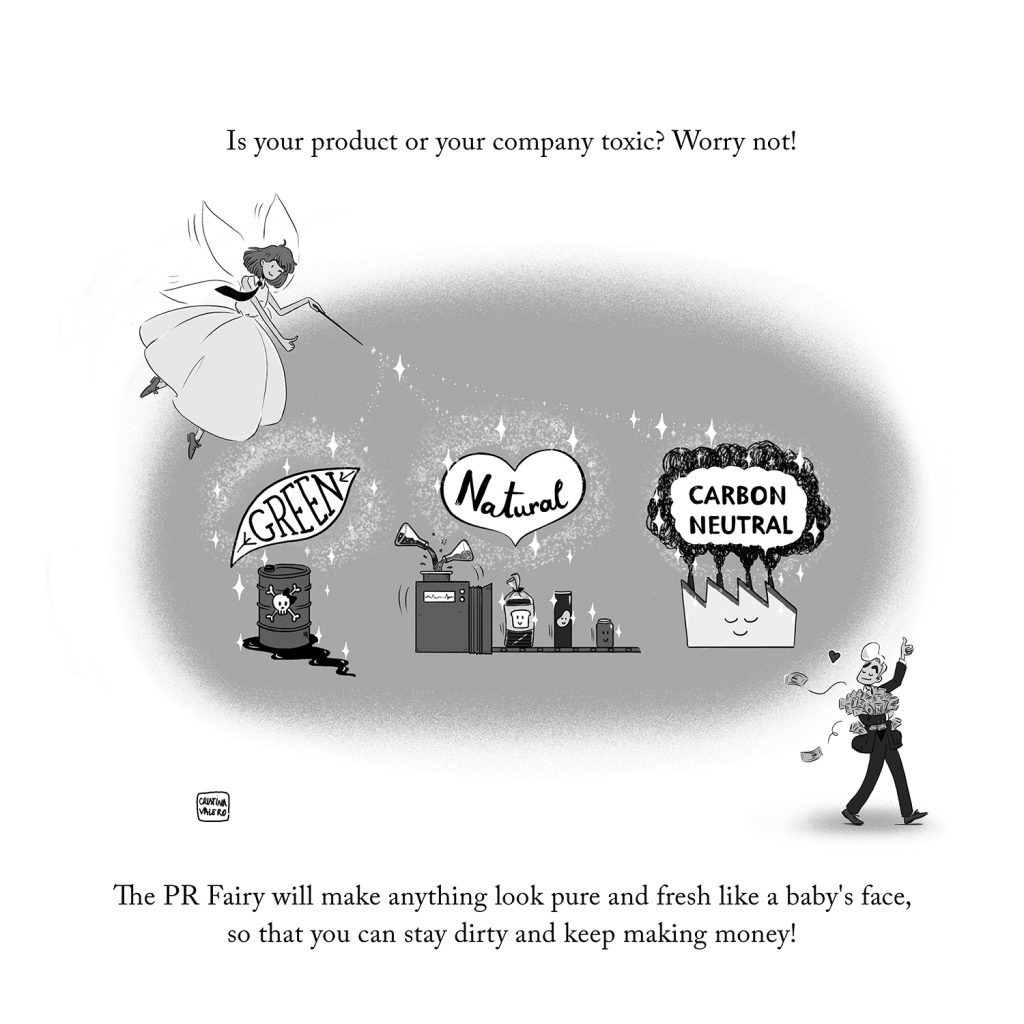
Illustration: Cristina Valero
Become “carbon neutral” and get to “net zero” without changing your business model
As the climate crisis gets harder to deny, your company needs to say it’s becoming “carbon neutral” and reaching “net zero”. Both expressions mean basically the same: compensating for the CO2 you release by somehow removing the same amount of CO2 from the atmosphere.
The idea is that first you reduce your emissions as much as possible, and only then compensate for the remainder through other activities. However, making an effort to actually reduce your company’s emissions would disrupt your business and cost you money. And removing CO2 from the atmosphere by technological means is very expensive and not yet feasible at scale.
Therefore, smart corporations offset their emissions by going to voluntary markets to buy cheap carbon credits linked to activities such as planting trees (which in the long term are expected to remove CO2 from the atmosphere) and preventing trees from being cut down (which prevents CO2 from being released).
If you want to buy carbon credits, for example to plant trees somewhere in Africa, you need to do that through intermediary organisations, which will sell you credits that have been certified by other intermediary organisations. These days, you can buy carbon credits online with a couple of clicks. For instance, if your company’s annual emissions are 10,000 tonnes of CO2, you can pay as little as 200,000 US dollars to buy credits to offset that amount of CO2 (globally, the average emissions per person is 4.7 energy-related tonnes per year; for companies, it may be tens or hundreds of thousands, or millions in some cases). And, voilà, now you can claim that your company is carbon neutral!
Has any tree been actually planted? And will that tree be taken care of for decades to come so that it can absorb tonnes of CO2?
Who knows! Because now comes the best part: such carbon offsetting is often little more than a great exercise in PR! Since the market is voluntary and unregulated, it promptly became a get-rich-quick scheme for the many intermediaries that popped up. The market also led to all sorts of abuses of local communities around forested areas, and was revealed to be a big fraud because trees weren’t being planted and forests kept being decimated (truth be told, even in an unrealistic best-case scenario, planting trees wouldn’t be enough to mitigate the climate crisis).
But who cares about all! Carbon offsetting allows your company to claim “carbon neutrality” without actually reducing your emissions, therefore protecting your business model and corporate profits: long live the PR Fairy!
Now you know_ PR allows you to fill the public debate with vague terms and expressions that lack legal or even a clear meaning. People will keep buying your harmful products because they are “natural”. And your company can claim there’s no need for additional regulation because your business is already “sustainable” and “green”, and because you are on your way to becoming “carbon neutral”.
Case study_ Vagueness as a weapon of mass illusion: Nestlé’s Road Map to Net Zero
All is good_ Nestlé is a company loved by many, maker of coffee and chocolate, and the world’s biggest food corporation by market capitalisation, valued in 230.64 billion euros, and also the world’s most profitable food company, with 15.10 billion euros of earnings during 2023.
And then_ As a huge food company, Nestlé had self-reported annual emissions of 113 million tonnes of CO2e by 2018. With the negative impact of the climate crisis becoming more visible, Nestlé was under pressure to be seen to be reducing its emissions. However, for Nestlé to decrease its CO2e emissions significantly, it would have to transform its whole value chain, which would come with a hefty price tag. What could Nestlé do?
Follow The Strategy!_ Of course, Nestlé followed The Strategy. In December 2020, it published its Roadmap to Net Zero as a flashy website and PDF version, pledging a reduction of 20% of its emissions by 2025 and of 50% by 2030 (with the figure from 2018 as a reference), and pledging to achieve net zero emissions by 2050.
Is Nestlé actually going to do that?
That’s not the point! Nestlé’s Roadmap to Net Zero is a PR masterclass: it’s based on vague terms that sound good, while in reality Nestlé is not committing to any significant changes in its business model; which means the company can keep growing, increasing its profits and making its investors happy.
This is how Nestlé did it according to the PDF version from 2020.
► To start with, 21.3 million tonnes of CO2e, 18.75% of Nestlé’s total emissions, are not covered by the pledge.
► Nestlé says it will source more ingredients from “regenerative agricultural methods” and “practices”, which are supposed to respect the soil and help reduce emissions. But Nestlé doesn’t give many more details, and because “no legal or regulatory definition of the term ‘regenerative agriculture’ exists nor is there a widely accepted definition”, and Nestlé’s pledge is voluntary, the company hasn’t actually committed to anything concrete.
► Besides, a study of various regenerative agricultural practices, published in January 2023 by the Food and Land Use Coalition, found that “effects on on-farm net [greenhouse gas] emissions tended to be neutral, inconclusive or negative largely due to the limited evidence and trade-offs associated with other emissions”. Bear in mind that this is from an organisation that was set up by the food industry itself!
► Nestlé says that “natural solutions, as well as technologies such as direct air capture and carbon storage” will contribute to helping the company reach net zero. “Direct air capture” removes CO2 from the atmosphere, but it’s really expensive, lacks the required capacity even in a scenario in which humanity has moved beyond fossil fuels, and it’s not clear whether it will ever work at the required scale to be a viable solution to the climate crisis.
► Nestlé doesn’t go into much detail about what it means by “natural climate solutions”, beyond better management of herds and soil, and planting trees. Those are things usually included in carbon offsetting, and here Nestlé was ahead of the curve in embracing a less well-known and even more useful idea: insetting! As carbon offsetting was already suspect of not really working, Nestlé said that its brands would reduce part of their emissions and then offset the remainder by both offsetting and insetting. Regarding its corporate pledge to get to net zero by 2025, Nestlé said that at the corporate level “offsetting is not allowed; all remaining emissions must be balanced by insetting”.
► Insetting is basically the same as offsetting but doing it inside one’s own value chain. This makes it harder for independent parties to research insetting claims, as they depend on data that’s self-reported by a company with a vested interest in saying that insetting works.
How could Nestlé get away with mentioning so many problematic concepts without actually abandoning its Roadmap to Net Zero?
Easy. Because the whole thing is voluntary and Nestlé’s plan is not subject to external monitoring or enforcement, the company can simply edit the document to remove any terms that go out of fashion. The original link to the PDF document now takes you to a version updated in March 2023, which simply doesn’t mention “direct air capture”, “insetting” or “offsetting”, moving those problems out of sight (it does still mention the word “offset” twice, once in connection with Nestlé’s logistics and brands, and once more in a glossary).
Success!_ With such a plan, you can say no regulation or enforcement of emissions reduction is needed, because your company is already on its way to becoming “carbon neutral” and releasing “net zero” emissions – without actually committing to enforceable changes to your business model. Just publish a nice-looking PDF plan including the trendiest buzzwords. You can always edit them out of the plan if experts question them: that’s the beauty of PR!
Conclusion_ Strategic PR is your first step towards influencing politics
Thanks to the PR Fairy, you can say your product is “natural” and “sustainable”, and your company “green” and “carbon neutral” — even when in reality it’s the opposite of all those things. And when it becomes hard to deny that your product is harmful, then say that you offer “safer” versions of it. Whatever it is, the PR Fairly will help you argue that there’s no need for regulation to force you to change your business model, which would reduce your profits. Instead, you shall make voluntary commitments, describing them in vague terms, not giving details or providing clear definitions, and avoiding measurable targets that others could use to appraise how you are actually doing.
You may be still wondering, “Sure, but do these PR tactics really work to influence the political process?” And the answer is they do!
In 2015, a study found that “strategic communication efforts to confront barriers to the industry and impact public policy” were indeed effective to “heighten the salience of some industry issues while minimizing others” in the public conversation. PR and marketing help to “distract attention from serious questions about public issues”, and succeed in “influencing policy because of their ability to persuade without seeming to do so”. And in 2023, the Intergovernmental Panel on Climate Change recognised that “fossil fuel industries have unique access to mainstream media via advertisements, shaping narratives of media reports, and exerting political influence in countries like Australia and the USA”.
The Climates They Are A-Changin’
Unless you are young, you probably remember the expression “global warming”, right?
It seems nobody has used it for a while and we don’t hear “global warming” anymore. These days, we all of course simply say “climate change”.
And here’s the thing: “climate change” sounds less threatening than “global warming”, doesn’t it? Change is simply change, it can be bad but also good; and the weather, which is how most of us experience the climate, is always changing.
So why did we stop using “global warming” (which sounds like “warning”) and start using the much more innocuous “climate change”?
Up to the 1990s, “global warming” was an accurate expression commonly used by scientists, politicians, the media, campaigners… and it was becoming an everyday phrase. But the fossil fuels industry, and politicians friendly to it, found that “global warming” was frightening people, that this “warming” might end up being seen as an established fact, and that more people might demand political change.
That’s why in 2002 a PR firm advised the Republican Party of then US president George W. Bush, who had worked in the oil industry, to stop saying “global warming” and insist instead on “climate change”. So, politicians and corporate interests started using “climate change”, and this PR move helped push the expression “global warming” away from the public debate and fed into climate denialism, which contributes to delay stricter regulation. Another success of the PR Fairy!
Now you know how the Big Guys do it. PR is a powerful weapon and your company can use it to influence what people talk about and how, as a first step towards influencing politics and preventing regulation that would hinder your profit.
In the next chapter, The Guide reveals one of the best-kept secrets of the corporate world: while big companies may compete to sell their products in the market, in reality they cooperate behind the scenes to fight any laws that could threaten their fat profits. The second tactic of The Strategy will show you how to collaborate with your competitors to keep your common enemy way: no to regulation!
This chapter was last reviewed and published on 20 September 2024.
This chapter was updated on 22 September 2024. The underlining to mark the phrases that the endnotes refer to was removed. Instead, and with the aim of making the text more readable, now the The Guide has “invisible” endnotes, as described here by The Chicago Manual of Style.
Notes and references
– In the list below, the lines in bold are the phrases in this chapter of The Guide that the ensuing note refer to. When I consider the title or headline of a reference clear and informative enough to support the corresponding statement in the text of this chapter, I only include here the information about the citation and a link to the reference. When the reference is a long document, and/or when particular paragraphs from the reference are clearly related to the corresponding statement, then I quote such paragraphs here. I have minimally edited those quotes to delete the spaces between paragraphs in the original source, so that here they appear as one single (if long) paragraph. For the sake of simplicity, I have also removed embedded links and superscript citation numbers from the quoted paragraphs; those links and citations can be seen and followed in the text in the original reference source. When I use quotes in the text of the chapter, I may re-stylise the initial lower or upper case letters of some quotes to make them fit with their place in the paragraphs in the text.
– That was really dangerous to Google and Meta (the owner of Facebook, Instagram and WhatsApp), which one year earlier had made, respectively, 134.8 billion dollars and 69.6 billion dollars in revenue through advertising
– Revenue generated by Google Advertising in 2019: 134,811 million US dollars.
– Alphabet. (2021). Form 10-K. United States Securities and Exchange Commission, 2021 (page 33). Available on https://www.sec.gov/Archives/edgar/data/1652044/000165204421000010/goog-20201231.htm and on the Internet Archive (last visited on 18 September 2024)
– Revenue generated by advertising by Meta in 2019: 69,655 million US dollars.
– Meta. (2021). Form 10-K. United States Securities and Exchange Commission, 2021. Available on https://www.sec.gov/Archives/edgar/data/1326801/000132680121000014/fb-20201231.htm and on the Internet Archive (last visited on 18 September 2024)
– Amazon, which in 2019 had generated 280.5 billion dollars in net product and service sales
– Amazon’s net product sales during 2019: 160,408 million US dollars. Amazon’s net service sales during 2019: 120,114 million US dollars. Amazon’s total net sales during 2019: 280,522 million US dollars.
– Amazon. (2021). Annual Report 2020. Amazon, April 2021. Available as a PDF file on https://s2.q4cdn.com/299287126/files/doc_financials/2021/ar/Amazon-2020-Annual-Report.pdf and on the Internet Archive (last visited on 19 September 2024)
– the Big Tech corporations insisted consistently, without any base, “that the proposed laws could harm innovation and the European economy”
– “Google, Amazon, Apple and Facebook declined to comment. In public statements, all have expressed a desire to work with European officials, while voicing concerns that the proposed laws could harm innovation and the European economy.”
– Satariano, A. & Stevis-Gridneff, M. (2020). Big Tech Turns Its Lobbyists Loose on Europe, Alarming Regulators. The New York Times, 14 December 2020. Available on https://www.nytimes.com/2020/12/14/technology/big-tech-lobbying-europe.html and on the Internet Archive (last visited on 19 September 2024)
– Amazon and Meta spent 8 and 7 million euros, respectively, publishing ads in newspapers just in Germany, saying that the DSA would harm people and small businesses
– both companies [Amazon and Meta] ran targeted ads on Facebook and Twitter aimed at tech policy experts
– “Instead, the industry spread its argument that the DSA would create economic harms to the European economy in the time-honoured way: through public relations campaigns directed at the public, undertaken through traditional media channels. For example, Amazon was busy during the DSA and DMA negotiations seeking to manage its public image, seeking in particular to push back against mounting public reports as well as regulatory inquiries into poor working conditions in the company’s logistics operations, and allegations that its platform down ranked third-party sellers and copied their most popular products via its in-house AmazonBasics brand. The company spent more than 8 million Euro for a print campaign in German newspapers in 2021 alone — more than double its inside lobbying expenditures in Brussels for that year. Similarly, Facebook ran almost 7 million Euro of newspaper ads related to the DSA package in Germany in the first 9 months of 2021, an estimated 2.5 million of which emphasised how small businesses relied on Facebook pages to reach their customers.”
– “Some of the most intensive public relations campaigns seemed to have not targeted the general public, however, but rather specific constituencies of tech policy experts actively involved in the DSA debate. Meta and Amazon appear to have run targeted ads on Facebook and Twitter that would be served to lookalike audiences built from the followings of the critical Politico journalists Laura Kayali and Mark Scott, as well as individuals in Belgium profiled by the platforms to have “interests” in “politics and current events” and “government policy”. Rather than seeking to persuade these audiences more generally that the platform company in question was a generally positive political actor, instead the companies appear to have made narrower arguments that bolstered some of their core lines of argument against the DSA — for instance, that “more than 50% of small businesses surveyed that used Facebook apps said doing so helped them attract new customers in the pandemic”, or that “Amazon has helped many small businesses prosper”.”
– Gorwa, R., Lechowski, G. & Schneiß, D. (2024). Platform lobbying: Policy influence strategies and the EU’s Digital Services Act. Internet Policy Review, 13(2), 26 June 2024. Available on https://policyreview.info/articles/analysis/platform-lobbying-digital-services-act and on https://doi.org/10.14763/2024.2.1782 (last visited on 19 September 2024)
– Google also enlisted academic researchers to question the rules being discussed
– “A leaked document jolted the European Union capital of Brussels in October, laying out in painstaking detail plans by Google to undermine new legislation that could severely damage its digital advertising business. “Academic allies” would raise questions about the new rules. Google would attempt to erode support within the European Commission to complicate the policymaking process.”
– Satariano, A. & Stevis-Gridneff, M. (2020). Big Tech Turns Its Lobbyists Loose on Europe, Alarming Regulators. The New York Times, 14 December 2020. Available on https://www.nytimes.com/2020/12/14/technology/big-tech-lobbying-europe.html and on the Internet Archive (last visited on 19 September 2024)
– [Google] funded a study, published in mid-2020, that said the DSA could lead to “a loss of about 85 billion EUR in GDP and 101 billion Euro in lost consumer welfare”
– That study was really useful to Big Tech companies, whose representatives quoted those figures when speaking in events in Brussels
– “To strengthen their epistemic position and make arguments about the potential negative implications of certain provisions in the DSA Package, industry also deployed the classic lobbying technique of directly funding research and organising events relating to the proposal. A prominent example can be seen in the Google-funded study published in mid-2020 by the European Center for International Political Economy (ECIPE), which sought to model the economic impacts of the (at that point speculative) DSA. Although the actual draft text of the DSA had not yet been published by the Commission, the paper speculated that the DSA might lead to ‘‘a loss of about 85 billion EUR in GDP and 101 billion Euro in lost consumer welfare’’. This figure, and argument of prospective economic harm that was echoed consistently in 2020, as representatives from many of the major platforms spoke on panels in Brussels discussing the new digital policy’s outlook.”
– Gorwa, R., Lechowski, G. & Schneiß, D. (2024). Platform lobbying: Policy influence strategies and the EU’s Digital Services Act. Internet Policy Review, 13(2), 26 June 2024. Available on https://policyreview.info/articles/analysis/platform-lobbying-digital-services-act and on https://doi.org/10.14763/2024.2.1782 (last visited on 19 September 2024)
– Google also aimed to “to enlist U.S. officials from embassies across Europe and in the Office of the United States Trade Representative. [The company] suggested talking points for Google supporters, such as the risk to the economy during the [Covid-19] pandemic”
– “The laws are not expected to be approved before 2022, giving the companies ample time to influence the debate. In October [2020], the leaked document showed how Google tried to influence the European debate before a draft was even introduced. It included plans to enlist U.S. officials from embassies across Europe and in the Office of the United States Trade Representative. It suggested talking points for Google supporters, such as the risk to the economy during the pandemic.”
– Satariano, A. & Stevis-Gridneff, M. (2020). Big Tech Turns Its Lobbyists Loose on Europe, Alarming Regulators. The New York Times, 14 December 2020. Available on https://www.nytimes.com/2020/12/14/technology/big-tech-lobbying-europe.html and on the Internet Archive (last visited on 19 September 2024)
– ExxonMobil has been one of the single highest contributors of CO2 emissions in the world since the Industrial Revolution
– “Carbon Majors Entities. Carbon Majors traces emissions to some of the largest fossil fuel and cement producing entities based on their production. Carbon Majors contains 122 of the world’s largest oil, gas, coal, and cement producers and over 1.42T tonnes of CO2e.”
– ExxonMobil is ranked as the 5th highest emitting company in the world during the analysed period (1854 to the present day), with 55,105 MtCO2e.
– InfluenceMap. (2024). Carbon Majors. Entities. CarbonMajors website, 2024. Available on https://carbonmajors.org/Entities and on the Internet Archive (last visited on 19 September 2024)
– “The Carbon Majors database aims to trace greenhouse gas emissions from fossil fuels and cement produced by companies, historically from as early as 1854 to the present.”
– InfluenceMap. (2024). Carbon Majors. Methodology. CarbonMajors website, 2024. Available on https://carbonmajors.org/Methodology and on the Internet Archive (last visited on 19 September 2024)
– [ExxonMobil] had 55.7 billion dollars in earnings in 2022 (which was a good year) and 36 billion dollars in 2023 (which was a bad year)
– ExxonMobil. (2024). ExxonMobil announces 2023 results. ExxonMobil News releases, 2 February 2024. Available on https://corporate.exxonmobil.com/news/news-releases/2024/0202_exxonmobil-announces-2023-results and on the Internet Archive (last visited on 19 September 2024)
– while we all suffer more frequent and intense extreme weather events and worsening environmental degradation
– “Floodwaters surged across Central Europe this week, inundating entire towns and transit systems with a rippling layer of murky brown water. More than 20 people have been killed by flooding across Romania, Poland, the Czech Republic and Austria, with many others missing in the days since heavy rainfall began last Thursday. Thousands more, including people in Hungary and Slovakia, have been displaced. On Monday night, the mayor of a Polish town asked 42,000 residents to evacuate ahead of continued rainfall. “These floods are a clear reminder of the growing threat of climate-induced extreme weather events,” said Sissi Knispel de Acosta, the general secretary of the European Climate Research Alliance, which is made up of research groups that study global warming. The record rains are part of a slow-moving, low-pressure system called Storm Boris that has dumped five times September’s average rainfall over four days. The weather system was fueled by a blast of Arctic air that moved in from the north, causing temperatures to plummet within 24 hours. While it’s not unprecedented for a polar blast to hit Europe in late summer, it could become more likely to happen in the future under a changing climate, said Richard Rood, a climatologist at the University of Michigan. That cold air collided with warmer air from the south that was dense with water vapor. The overloaded moisture came from an unusually warm Mediterranean Sea that hit the highest temperature ever recorded last month. “The climate is so warm that every storm or weather event is influenced by a warming climate,” Dr. Rood said. “It’s impossible to have an event, especially an extreme event, that doesn’t have some relation to climate change.””
– Gaffney, A. (2024). Flooding in Europe Is a ‘Clear Reminder’ of the Threat of Extreme Weather. The New York Times, 18 September 2024. Available on https://www.nytimes.com/2024/09/18/climate/central-europe-floods-global-warming.html and on the Internet Archive (last visited on 19 September 2024)
– “Ultimately, the way climate change impacts weather, the environment, animals, and agriculture affects humanity as well. But there’s more. Around the world, our ways of life—from how we get our food to the industries around which our economies are based—have all developed in the context of relatively stable climates. As global warming shakes this foundation, it promises to alter the very fabric of society. At worst, this could lead to widespread famine, disease, war, displacement, injury, and death. For many around the world, this grim forecast is already their reality. In this way, climate change poses an existential threat to all human life.”
– Lindwall, C. (2022). What Are the Effects of Climate Change? Natural Resources Defense Council (NRDC). Available on https://www.nrdc.org/stories/what-are-effects-climate-change and on the Internet Archive (last visited on 19 September 2024)
– “The climate crisis has increased the average global temperature and is leading to more frequent high-temperature extremes, such as heatwaves. Higher temperatures can cause increased mortality, reduced productivity and damage to infrastructure. The most vulnerable members of the population, such as the elderly and infants, will be most severely affected. (…) Due to the changing climate, many European regions are already facing more frequent, severe, and longer lasting droughts. A drought is an unusual and temporary deficit in water availability caused by the combination of lack of precipitation and more evaporation (due to high temperatures). It differs from water scarcity, which is the structural year-round lack of fresh water resulting from the over-consumption of water. (…) More frequent and severe droughts and rising water temperatures are expected to cause a decrease in water quality. Such conditions encourage the growth of toxic algae and bacteria, which will worsen the problem of water scarcity that has been largely caused by human activity. The increase of cloudburst events (sudden extreme rainfall) is also likely to influence the quality and quantity of fresh water available, as storm water can cause uncleaned sewage to enter surface water. (…) River flooding is a common natural disaster in Europe, which has, along with storms, resulted in fatalities, affected millions of people and incurred massive economic losses in the last three decades. Climate change is likely to increase the frequency of flooding across Europe in the coming years. Heavy rainstorms are projected to become more common and more intense due to higher temperatures, with flash floods expected to become more frequent across Europe. (…) Alongside other climate change impacts, sea-level rise will increase the risk of flooding and erosion around the coasts, with significant consequences for the people, infrastructure, businesses and nature in these areas. Moreover, sea level rise is projected to reduce the amount of available fresh water, as seawater pushes further into underground water tables. This is also likely to lead to much more saltwater intrusion into bodies of fresh water, affecting agriculture and the supply of drinking water. (…)”
– “As you can see, climate change is a serious matter and it affects us all.”
– Directorate-General for Climate Action at the EC. (2024). Consequences of climate change. European Commission, 2024. Available on https://climate.ec.europa.eu/climate-change/consequences-climate-change_en and on the Internet Archive (last visited on 19 September 2024)
– “Climate change is directly contributing to humanitarian emergencies from heatwaves, wildfires, floods, tropical storms and hurricanes and they are increasing in scale, frequency and intensity. Research shows that 3.6 billion people already live in areas highly susceptible to climate change. Between 2030 and 2050, climate change is expected to cause approximately 250 000 additional deaths per year, from undernutrition, malaria, diarrhoea and heat stress alone. The direct damage costs to health (excluding costs in health-determining sectors such as agriculture and water and sanitation) is estimated to be between US$ 2–4 billion per year by 2030. Areas with weak health infrastructure – mostly in developing countries – will be the least able to cope without assistance to prepare and respond. Reducing emissions of greenhouse gases through better transport, food and energy use choices can result in very large gains for health, particularly through reduced air pollution.”
– WHO. (2023). Climate change. World Health Organisation (WHO), 12 October 2023. Available on https://www.who.int/news-room/fact-sheets/detail/climate-change-and-health and on the Internet Archive (last visited on 19 September 2024)
– “Climate change impacts our health, environment, and economy. For example: Warmer temperatures increase the frequency, intensity, and duration of heat waves, which can pose health risks, particularly for young children and the elderly. Climate change can also impact human health by worsening air and water quality, increasing the spread of certain diseases, and altering the frequency or intensity of extreme weather events. Rising sea level threatens coastal communities and ecosystems. Changes in the patterns and amount of rainfall, as well as changes in the timing and amount of stream flow, can affect water supplies and water quality and the production of hydroelectricity. Changing ecosystems influence geographic ranges of many plant and animal species and the timing of their lifecycle events, such as migration and reproduction. Increases in the frequency and intensity of extreme weather events, such as heat waves, droughts, and floods, can increase losses to property, cause costly disruptions to society, and reduce the affordability of insurance.”
– EPA. (2023). Impacts of Climate Change. United States Environmental Protection Agency (EPA), 29 November 2023. Available on https://www.epa.gov/climatechange-science/impacts-climate-change and on the Internet Archive (last visited on 19 September 2024)
– [ExxonMobil has been] using advertisement “to shift responsibility for global warming away from the fossil fuel industry and onto consumers”. ExxonMobil also consistently labelled the climate crisis as a “risk” rather than as a reality, and kept describing renewable energy as unreliable
– ExxonMobil said that the fossil fuel industry is the one that actually can offer “meaningful leadership on climate change”
– ExxonMobil’s strategic communications have helped generate “a dominant public narrative about climate change” in which “we are all to blame”, and another pervasive narrative saying “that society must inevitably rely on fossil fuel for the foreseeable future”
– ExxonMobil used its PR “to construct a “Fossil Fuel Savior” (FFS) frame that downplays the reality and seriousness of climate change, normalizes fossil fuel lock-in, and individualizes responsibility”
– “A dominant public narrative about climate change is that “we are all to blame.” Another is that society must inevitably rely on fossil fuels for the foreseeable future. How did these become conventional wisdom? We show that one source of these arguments is fossil fuel industry propaganda. ExxonMobil advertisements worked to shift responsibility for global warming away from the fossil fuel industry and onto consumers. They also said that climate change was a “risk,” rather than a reality, that renewable energy is unreliable, and that the fossil fuel industry offered meaningful leadership on climate change. We show that much of this rhetoric is similar to that used by the tobacco industry. Our research suggests warning signs that the fossil fuel industry is using the subtle micro-politics of language to downplay its role in the climate crisis and to continue to undermine climate litigation, regulation, and activism.”
– “This paper investigates how ExxonMobil uses rhetoric and framing to shape public discourse on climate change. We present an algorithmic corpus comparison and machine-learning topic model of 180 ExxonMobil climate change communications, including peer-reviewed publications, internal company documents, and advertorials in The New York Times. We also investigate advertorials using inductive frame analysis. We find that the company has publicly overemphasized some terms and topics while avoiding others. Most notably, they have used rhetoric of climate “risk” and consumer energy “demand” to construct a “Fossil Fuel Savior” (FFS) frame that downplays the reality and seriousness of climate change, normalizes fossil fuel lock-in, and individualizes responsibility. These patterns mimic the tobacco industry’s documented strategy of shifting responsibility away from corporations—which knowingly sold a deadly product while denying its harms—and onto consumers. This historical parallel foreshadows the fossil fuel industry’s use of demand-as-blame arguments to oppose litigation, regulation, and activism.”
– Supran, G. & Oreskes, N. (2021). Rhetoric and frame analysis of ExxonMobil’s climate change communications. One Earth, 4(5), 21 May 2021, pages 696-719. Available on https://www.cell.com/one-earth/fulltext/S2590-3322(21)00233-5 and https://doi.org/10.1016/j.oneear.2021.04.014 (last visited on 19 September 2024)
– such public narratives have contributed to prevent strict regulation forcing fossil fuels to decrease production
– “It is widely recognized that fossil fuel companies, particularly large multinational oil and gas companies, continue to have a strong influence on climate policy and are slowing down the transition toward a renewable future. (…) As pressure is mounting to phase out fossil fuel supply, and the movement toward a global fossil fuel non-proliferation treaty is growing, business as usual for oil and gas companies is becoming more difficult. Presenting themselves as engaged renewable energy promoters through their public messaging provides another mechanism to delay more impactful regulatory measures that could restrict fossil fuel supply, end fossil fuel exploration, and lead to larger transformative changes in the fossil fuel industry.”
– “Research shows that multinational oil and gas companies have recently made a strategic shift away from outright climate denial to more nuanced discourses of climate delay. (…) Topic modeling on tweets about renewables shows that renewables are often mentioned together with natural gas, emphasizing how both are essential for emissions reductions. Similarly, computational text analysis on tweets about natural gas reveals how companies highlight the social good of natural gas including promoting its role in emissions reductions, presenting natural gas as a fuel for a cleaner future, and emphasizing that natural gas is critical to meeting growing societal demand for energy. This pattern of communication – linking renewables to natural gas and promoting natural gas as part of their corporate response to climate change – suggests an evolution of fossil fuel companies’ strategic efforts to delay the energy transition and obstruct climate action.”
– Si, Y. & al. (2023). Fossil fuel companies’ climate communication strategies: Industry messaging on renewables and natural gas. Energy Research & Social Science, 98, April 2023. Available on https://www.sciencedirect.com/science/article/pii/S2214629623000889 and https://doi.org/10.1016/j.erss.2023.103028 (last visited on 19 September 2024)
– Some of the opportunities at your disposal are “targeting which exploits the vulnerability of certain groups of consumers” and “consent forms and other design features which seek to steer consumers to make decisions against their interests”. Those are some of the techniques known with the cool name, “dark patterns”
– “Challenges and opportunities concerning digital advertising. Online targeted advertising can generate benefits for both consumers and SMEs, specifically by tailoring advertisements to match consumers’ interests and even by enabling the protection of certain consumers e.g. by screening out advertisements which may be unsuitable for minors. However, targeted advertising can also raise a number of concerns. Issues impacting consumers include: A lack of understanding by consumers that their data are being used to target advertising; Targeting which exploits the vulnerability of certain groups of consumers; Consent forms and other design features which seek to steer consumers to make decisions against their interests (dark patterns); Challenges to seek redress in cases where advertising or data collection / consent methods are inappropriate due to the range of bodies involved; and The potential for the algorithms used to target advertising to result in intentional or unintentional harmful discrimination.”
– Fourberg, N. & al. (2021). Online advertising: the impact of targeted advertising on advertisers, market access and consumer choice. European Parliament, June 2021. Available as a PDF file on http://www.europarl.europa.eu/RegData/etudes/STUD/2021/662913/IPOL_STU(2021)662913_EN.pdf and on the Internet Archive (last visited on 19 September 2024)
– research shows that young people, and especially children, are worse than adults at recognising online content as advertising
– That gives you the chance to be “sneaky” like gambling companies, which use “popular cultural references, from ET to Gladiator”, in social media postings and campaigns that end up attracting young people and even children into gambling
– “While data-driven personalisation strategies in marketing offer consumers several benefits, they potentially also create new disparities and vulnerabilities in society, and in individuals. This article explores in what ways application of so-called personalised marketing communication may lead to exploitation of vulnerability of consumers and builds on empirical findings on the issue by investigating if consumers are protected against such vulnerabilities under EU consumer protection law. We show a number of ways in which personalisation may lead to exploitation of internal and external vulnerabilities and that EU consumer law contains significant barriers to effectively address such exploitation.”
– “ When applying PMC [personalised marketing communication], organisations can explicitly personalise messages based on the inferred psychological state and the specific life situation of consumers. In the past, Facebook allegedly offered advertisers the option to target young users in a state of psychological vulnerability, inferring when the users feel insecure and stressed. In a similar pattern, a marketing firm found that women feel less attractive on Mondays, especially in the morning, and recommended targeting women with beauty products specifically at that time of the week.”
– Strycharz, J. & Duivenvoorde, B. (2021). The exploitation of vulnerability through personalised marketing communication: are consumers protected? Internet Policy Review, 10(4), 8 November 2021. Available on https://policyreview.info/articles/analysis/exploitation-vulnerability-through-personalised-marketing-communication-are and https://doi.org/10.14763/2021.4.1585 (last visited on 19 September 2024)
– “Tougher rules are required to crack down on betting firms’ use of “sneaky” social media postings and campaigns that may lure young people into gambling, warns a new report. Researchers at Bristol University have reported a rise in gambling promotions that typically blur the line between advertising for a betting company and popular cultural references, from ET to Gladiator. The research has found many children do not even recognise these promotions, known as content marketing, as advertising. It warns that this may lead to children following betting companies on social media, making it more likely that they sign up with them when they turn 18 and can legally gamble. Dr Raffaello Rossi, lecturer in marketing at Bristol University, one of the report’s authors, said content marketing was particularly popular with young people. “All ages were quite bad at recognising it as advertising, but children and young people were much less able to distinguish it,” said Rossi. “It’s a sneaky way to get people engaged and create a positive perception towards gambling.” Rossi said advertising rules stipulate that marketing communications “must be obviously identifiable as such”. He considered the social media postings were in breach of this rule.”
– Luck, A. & Ungoed-Thomas, J. (2024). ‘Sneaky’ social media ads are luring young into gambling, say campaigners. The Guardian, 17 March 2024. Available on https://www.theguardian.com/society/2024/mar/17/sneaky-social-media-ads-are-luring-young-into-gambling-say-campaigners and on Internet Archive (last visited on 19 September 2024)
– And even when there’s some small print saying “paid content” or “sponsored content”, most often “media users do not recognise native advertising when they see it”
– “Native advertising is more popular than ever before among advertisers and media companies because many users ignore conventional advertising such as banners and pop-up pages. Yet, native advertising is also a form of deception. Without knowing, users get content which isn’t purely journalistic. Instead, they consume advertising in disguise. Unsurprisingly, native advertising has also attracted the attention of researchers. Two recent studies by Bartosz W. Wojdynski, an assistant professor of journalism at the University of Georgia, USA, and David A. Hyman, a law professor at Georgetown University have now looked at how the presentation of native ads influences whether users recognise them as such. And the results are bleak. Both find that despite appropriate warnings, most media users do not recognise native advertising when they see it.”
– Ertz, G. (2018). The Native Advertising Deception. European Journalism Observatory (EJO), 17 April 2018. Available on https://en.ejo.ch/media-economics/the-native-advertising-deception and on the Internet Archive (last visited on 19 September 2024)
– They bought advertising space on Google Search, so that when someone looked up terms like “fossil fuels”, “net zero” and “eco friendly”, Google would show on the top of the list fossil fuel ads that looked like search results, “twisted the facts on climate change”
– “Researchers with the Center for Countering Digital Hate (CCDH), a U.S. nonprofit group that studies disinformation online, examined more than 32,000 search ads on Google’s U.S. site, paid for by major fossil fuel companies, targeting 61,000 different climate-related queries over the past two years. It found that the firms were purchasing ads on Google’s front page to display to users searching terms like “net zero” and “eco-friendly”, filling the space with ads that twisted the facts on climate change or disassembled the companies’ track records on planet-heating emissions and pollution. Imran Ahmed, founder of the CCDH, said Google had become complicit in the “climate denial industry”. “Google is used by billions of people as the primary lens to find information — if you can buy the right to be at the top of the search result, you can distort the lens people use to see the world,” he said. In response, Google spokesperson Michael Aciman pointed to the company’s stance against climate disinformation.”
– Asher-Schapiro, A. (2022). Gaming Google: Oil firms use search ads to greenwash, study says. Reuters, 3 November 2022. Available on https://www.reuters.com/business/cop/gaming-google-oil-firms-use-search-ads-greenwash-study-says-2022-11-03/ and on the Internet Archive (last visited on 19 September 2024)
– “Fossil fuel companies and firms that work closely with them are among the biggest spenders on ads designed to look like Google search results, in what campaigners say is an example of “endemic greenwashing”. The Guardian analysed ads served on Google search results for 78 climate-related terms, in collaboration with InfluenceMap, a thinktank that tracks the lobbying efforts of polluting industries. The results show that over one in five ads seen in the study – more than 1,600 in total – were placed by companies with significant interests in fossil fuels. Advertisers pay for their ads to appear on the search engine when a user queries certain terms. The ads are appealing to businesses because they are very similar in appearance to search results: more than half of users in a 2020 survey reported they could not tell the difference between a paid-for listing and a normal Google result.”
– McIntyre, N. (2022). Fossil fuel firms among biggest spenders on Google ads that look like search results. The Guardian, 5 January 2022. Available on https://www.theguardian.com/technology/2022/jan/05/fossil-fuel-firms-among-biggest-spenders-on-google-ads-that-look-like-search-results and on the Internet Archive (last visited on 19 September 2024)
– fossil fuels account “for over 75 per cent of global greenhouse gas emissions and nearly 90 per cent of all carbon dioxide [CO2] emissions
– “Fossil fuels – coal, oil and gas – are by far the largest contributor to global climate change, accounting for over 75 per cent of global greenhouse gas emissions and nearly 90 per cent of all carbon dioxide emissions. As greenhouse gas emissions blanket the Earth, they trap the sun’s heat. This leads to global warming and climate change. The world is now warming faster than at any point in recorded history. Warmer temperatures over time are changing weather patterns and disrupting the usual balance of nature. This poses many risks to human beings and all other forms of life on Earth.”
– UN. (2024). Causes and Effects of Climate Change. United Nations (UN). Climate Action, 2024. Available on https://www.un.org/en/climatechange/science/causes-effects-climate-change and on the Internet Archive (last visited on 19 September 2024)
– That foundational meeting of tobacco CEOs and PR professionals was on 15 December 1953
– “executives and staff [at Hill & Knowlton] canceled all holiday plans as they worked to frame and implement a full-scale campaign on behalf of the [tobacco] industry”
– “After the December 15 meeting that formally brought Hill & Knowlton into the picture, its executives spent the next 2 weeks meeting with various industry staff. During this time, Hill & Knowlton operated in full crisis mode. Executives and staff canceled all holiday plans as they worked to frame and implement a full-scale campaign on behalf of the industry. They made no independent attempt to assess the state of medical knowledge, nor did they seek informed evaluations from independent scientists. Their role was exclusively limited to serving the public relations goal of their collective clients. During these meetings, both Hill & Knowlton staffers and tobacco executives continued to voice the conviction that the industry’s entire future was threatened by the medical and scientific findings linking cigarette smoking to lung cancer and the consequent widespread public anxieties about smoking and health.”
– Brandt, A.M. (2012). Inventing Conflicts of Interest: A History of Tobacco Industry Tactics. American Journal of Public Health, 102, pages 63-71, January 2012. Available on https://ajph.aphapublications.org/doi/full/10.2105/AJPH.2011.300292 and https://doi.org/10.2105/AJPH.2011.300292 (last visited on 19 September 2024)
– on 4 January 1954, when 448 newspapers in the US printed “A Frank Statement to Cigarette Smokers”, an ad written by Hill & Knowlton
– “In January 1954, US tobacco manufacturers jointly sponsored an advocacy advertisement entitled “A Frank Statement to Cigarette Smokers” which appeared in 448 newspapers in 258 cities reaching an estimated 43 245 000 Americans. The advertisement questioned research findings implicating smoking as a cause of cancer, promised consumers that their cigarettes were safe, and pledged to support impartial research to investigate allegations that smoking was harmful to human health.”
– “Analysis of public statements issued by the tobacco industry sources over the past five decades shows that the companies maintained the stance that smoking had not been proven to be injurious to health through 1999. The public statements of the tobacco industry are in sharp contrast to the private views expressed by many of their own scientists. The tobacco documents reveal that many scientists within the tobacco industry acknowledged as early as the 1950s that cigarette smoking was unsafe. The sincerity of the industry’s promise to support research to find out if smoking was harmful to health and to disclose information about the health effects of smoking can also be questioned based upon the industry’s own documents which reveal: (1) scepticism about the scientific value of the smoking and health research program established by the industry; and (2) evidence that research findings implicating smoking as a health problem were often not published or disclosed outside the industry. Industry documents also show that the companies knew that their own customers were misinformed about smoking and health issues. Conclusion: It is clear that the cigarette companies failed to fulfill the promises made to consumers in the 1954 “Frank Statement” advertisement. The failure of cigarette manufacturers to honour these promises has resulted in a public that even today remains misinformed about the health risks of smoking.”
– Cummings, K.M., Morley, C.P. & Hyland, A. (2002). Failed promises of the cigarette industry and its effect on consumer misperceptions about the health risks of smoking. Tobacco Control, 11, pages 110-117, 1 March 2002. Available on https://tobaccocontrol.bmj.com/content/11/suppl_1/i110 and https://doi.org/10.1136/tc.11.suppl_1.i110 (last visited on 19 September 2024)
– The companies said they “accept(ed) an interest in people’s health as a basic responsibility, paramount to every other consideration in our business”
– “the fact that cigarette smoking today should even be suspected as a cause of serious disease is a matter of deep concern to us”
– that medical research indicated “many possible causes of lung cancer”, and “that statistics purporting to link cigarette smoking with the disease could apply with equal force to any one of many other aspects of modern life”
– “establishing a joint industry group”, known as the “Tobacco Industry Research Committee”, to help in the scientific research
– Several digital facsimiles of the “Frank Statement” are available online, either live or archived, as PDF or image files. A few of them are:
– Duke Library. (undated). Reproduction of “A Frank Statement to Cigarette Smokers”, by the Tobacco Industry Research Committee. Duke University Libraries, undated. Available on https://exhibits.library.duke.edu/items/show/11866, to download as an image file on https://exhibits.library.duke.edu/files/original/911938261d887b4d2e8efecb4086ad9b.jpg, and both pages also on the Interne Archive (last visited on 19 September 2024)
– TPLP. (2004). Reproduction of “A Frank Statement to Cigarette Smokers”, by the Tobacco Industry Research Committee. Tobacco Products Liability Project (TPLP), version archived on 13 February 2004. Available on https://web.archive.org/web/20040213052724/http://tobacco.neu.edu/litigation/cases/supportdocs/frank_ad.htm (last visited on 19 September 2024)
– Tobacco Exhibits. (2012). Reproduction of “A Frank Statement to Cigarette Smokers”, by the Tobacco Industry Research Committee. Tobacco Exhibits, 2012. Available as an image file on https://tobaccotimeline.wordpress.com/wp-content/uploads/2012/01/frankstatementimage815.png and on the Internet Archive (last visited on 19 September 2024)


– even though actually tobacco CEOs had known for years that smoking could cause cancer, and had of course kept it secret
– “Teague was not the only tobacco insider conceding a hazard. Harris Parmele, Lorillard’s director of research, in 1946 had commented privately on how ‘Certain scientists and medical authorities have claimed for many years that the use of tobacco contributes to cancer development in susceptible people. Just enough evidence has been presented to justify the possibility of such a presumption’.”
– Proctor, R.N. (2012). The history of the discovery of the cigarette–lung cancer link: evidentiary traditions, corporate denial, global toll. Tobacco Control, 2012, 21:87-91, 16 February 2012. Available on https://tobaccocontrol.bmj.com/content/21/2/87 and https://doi.org/10.1136/tobaccocontrol-2011-050338 (last visited on 19 September 2024)
– “A few years later [in 1946], H.B. Parmele, a scientist working for the Lorillard Tobacco Company, wrote a report to the company’s manufacturing committee observing that, “Certain scientists and medical authorities have claimed for many years that the use of tobacco contributes to cancer development in susceptible people. Just enough evidence has been presented to justify the possibility of such a presumption…benzpyrene is presumed to be a combustion product of burning tobacco and, by animal experiments, it has been shown to possess definite carcinogenic properties””
– Cummings, K.M., Brown, A. & O’Connor, R. (2007). The Cigarette Controversy. Cancer Epidemiology, Biomarkers & Prevention, 16, 6:1070-1076, 1 June 2007. Available on https://aacrjournals.org/cebp/article/16/6/1070/260310/The-Cigarette-Controversy and https://doi.org/10.1158/1055-9965.EPI-06-0912 (last visited on 19 September 2024)
– Parmele, H.B. (1946). “Cigarette cause cancer”, message to Riafner, A. Lorillard, 29 July 1946. Published in UCSF. (2003). Industry Documents Library. Truth Tobacco Industry Documents, 15 January 2003. Available on https://www.industrydocuments.ucsf.edu/docs/ztvv0061 and on the Internet Archive (last visited on 19 September 2024)
– John W. Hill, cunningly suggested that, instead, tobacco companies should say in public that they supported scientific research — and then use sophisticated PR tactics to abuse parts of the scientific process. Namely, to abuse healthy scepticism and the fact that scientific research can be open to review as new data emerge
– “With considerable anxiety and rancor within the tobacco industry, the industry’s highly competitive CEOs came together in December 1953 at the Plaza Hotel in New York City to map a strategy. They realized that the threat they now faced was unprecedented and would require new, collaborative approaches and expertise. Not surprisingly, given their history, they turned again to the field of public relations that had served them so well in the past. They called upon John W. Hill, the president of the nation’s leading public relations firm, Hill & Knowlton. (…) Hill offered the companies powerful advice and guidance as they faced their crisis. Hill understood that simply denying emerging scientific facts would be a losing game. This would not only smack of self-interest but also ally the companies with ignorance in an age of technological and scientific hegemony. So he proposed seizing and controlling science rather than avoiding it. If science posed the principal—even terminal—threat to the industry, Hill advised that the companies should now associate themselves as great supporters of science. The companies, in his view, should embrace a sophisticated scientific discourse; they should demand more science, not less. Of critical importance, Hill argued, they should declare the positive value of scientific skepticism of science itself. Knowledge, Hill understood, was hard won and uncertain, and there would always be skeptics. What better strategy than to identify, solicit, support, and amplify the views of skeptics of the causal relationship between smoking and disease? Moreover, the liberal disbursement of tobacco industry research funding to academic scientists could draw new skeptics into the fold. The goal, according to Hill, would be to build and broadcast a major scientific controversy. The public must get the message that the issue of the health effects of smoking remains an open question. Doubt, uncertainty, and the truism that there is more to know would become the industry’s collective new mantra. Hill was above all a cynic, deeply committed to the instrumental ideals of public relations. He was profoundly confident that public relations strategies, well developed and implemented, could effectively serve the needs of his clients. He believed—and he convinced the companies’ leadership—that by calling for more research and offering funding, they could take high ground in their public pronouncements. Although he had quit smoking himself, he had no interest in examining and assessing the data or the emerging science. For Hill, science would be a means to a public relations end. The executives of the 5 major companies endorsed his strategic plan and hired Hill & Knowlton to manage their burgeoning corporate crisis.”
– Brandt, A.M. (2011). Inventing Conflicts of Interest: A History of Tobacco Industry Tactics. American Journal of Public Health, 102, 1:63-71, 1 January 2012. Available on https://ajph.aphapublications.org/doi/full/10.2105/AJPH.2011.300292 and https://doi.org/10.2105/AJPH.2011.300292 (last visited on 19 September 2024)
– the tobacco industry went on to use their Tobacco Industry Research Committee to abuse science in all ways imaginable
– “Although public relations practitioners had considerable experience manipulating the media, what was radical about Hill’s proposed strategy was the desire to manipulate scientific research, debate, and outcomes. It would be crucial to identify scientists who expressed skepticism about the link between cigarettes and cancer, those critical of statistical methods, and especially those who had offered alternative hypotheses for the causes of cancer. Hill set his staff to identifying the most vocal and visible skeptics of the emerging science of smoking and disease. These scientists (many of whom turned out to be smokers themselves) would be central to the development of an industry scientific program in step with larger public relations goals. Hill understood that simply denying the harms of smoking would alienate the public. His strategy for ending what the tobacco CEOs called the hysteria linking smoking to cancer was to insist that there were 2 sides in a highly contentious scientific debate. Just as Bernays had worked to engineer consent, so Hill would engineer controversy. This strategy—invented by Hill in the context of his work for the tobacco industry—would ultimately become the cornerstone of a large range of efforts to distort scientific process for commercial ends during the second half of the 20th century.”
– “Pooling these efforts, Hill & Knowlton produced a compendium of statements by physicians and scientists who questioned the cigarette–lung cancer link. This compendium became a fundamental component of Hill & Knowlton’s initial attempts to shape and implement its public relations strategy.”
– “It was Hill who hit on the idea of creating an industry-sponsored research entity. Ultimately, he concluded, the best public relations approach was for the industry to become a major sponsor of medical research. This tactic offered several essential advantages. The call for new research implied that existing studies were inadequate or flawed. It made clear that there was more to know, and it made the industry seem a committed participant in the scientific enterprise rather than a self-interested critic. The industry had supported some individual research in recent years, but Hill’s proposal offered the potential of a research program that would be controlled by the industry yet promoted as independent. This was a public relations masterstroke. Hill understood that simply giving money to scientists—through the National Institutes of Health or some other entity, for example—offered little opportunity to shape the public relations environment. However, offering funds directly to university-based scientists would enlist their support and dependence. Moreover, it would have the added benefit of making academic institutions “partners” with the tobacco industry in its moment of crisis. The very nature of controlling and managing information in public relations stood in marked contrast to the scientific notion of unfettered new knowledge. Hill and his clients had no interest in answering a scientific question. Their goal was to maintain vigorous control over the research program, to use science in the service of public relations.”
– Brandt, A.M. (2011). Inventing Conflicts of Interest: A History of Tobacco Industry Tactics. American Journal of Public Health, 102, 1:63-71, 1 January 2012. Available on https://ajph.aphapublications.org/doi/full/10.2105/AJPH.2011.300292 and https://doi.org/10.2105/AJPH.2011.300292 (last visited on 19 September 2024)
– “Despite the claims of the Frank Statement and the TIRC mission statement which stated the aim of the TIRC was ‘’to aid and assist research into tobacco use and health, and particularly into the alleged relationship between the use of tobacco and lung cancer, and to make available to the public factual information on this subject’’ the TIRC rarely conducted or supported any research which might reveal a link between smoking and cancer. In 1959, Clarence Cook Little, the scientific director of the TIRC listed the TIRC research areas. 1. Heredity. 2. Infection. 3. Nutrition. 4. Hormones. 5. Nervous strain or tension. 6. Environmental factors. The amount of money spent on research was publically promoted to show the public that despite spending vast sums of money on research there still wasn’t conclusive evidence about the link between smoking and cancer. Over a period of approximately 40 years the industry disclosed that it had funded research by the TIRC to the tune of over $300 million. The TIRC disclosed monies spent as this was important PR, showing that the industry was investing millions to make sure that tobacco was safe for consumers.”
– “By as early as 1958, both the public health community and the tobacco industry itself expressed views that it was obvious that the TIRC was little more than a PR activity. According to the American Cancer Society in 1958, the whole point of the TIRC was: ‘’to deny repeatedly’’ and ‘’mislead’’ and ‘’to convince the trusting tobacco-consuming public of the industry’s eleemosynary, ‘lasting interest in people’s health’. A similar view is presented by the tobacco industry and it’s associates as documented in private documents that can be found in the tobacco documents library”.
– Tobacco Tactics. (2020). Tobacco Industry Research Committee. Tobacco Tactics, University of Bath, 7 February 2020. Available on https://tobaccotactics.org/article/tobacco-industry-research-committee and on the Internet Archive (last visited on 19 September 2024)
– “Despite the promise made to disclose information about smoking and health issues to the public, internal industry documents reveal that cigarette companies failed to keep this promise. A 1953 document from the files of the public relations firm of Hill and Knowlton which helped create the TIRC, suggests that the purpose of the “Frank Statement” advertisement was to assure smokers that it was safe to smoke rather than to share what was known about the health dangers of smoking: “There is only one problem—confidence, and how to establish it; public assurance, and how to create it . . .And, most important, how to free millions of Americans from the guilty fear that is going to arise deep in their biological depths—regardless of any pooh-poohing logic—every time they light a cigarette.” A 1962 internal report on the “smoking and health problem”, written by RJ Reynolds scientist Dr Alan Rodgman, reveals that: “Members of this [Reynolds] Research Department have studied in detail cigarette smoke composition. Some of the findings have been published. However, much data remain unpublished because they are concerned with carcinogenic or co-carcinogenic compounds or patentable material.” Given the cigarette industry’s promise to investigate the smoking and health question, one would expect to find numerous references to scientific papers authored by industry scientists in the medical and public literature. However, this turns out not to be the case. We performed an author query using the Center for Disease Control’s Smoking and Health database using the names of 29 tobacco company executives, senior industry scientists, and scientific leaders affiliated with the TIRC/CTR mentioned in the documents reviewed for this study (see footnote for the names of individuals included in this analysis). The Smoking and Health database contains over 63 120 citations to scientific papers published on the smoking and health question. This analysis yielded fewer than 100 citations to papers authored by these individuals. Many of the citations for papers authored by these individuals appeared in non-peer reviewed journals or are from conference proceedings. Few of the citation from papers authored by industry executives/scientists relate to active smoking and health concerns and most of the papers that do are based upon studies with animals not humans. It seems clear that if cigarette company scientists were seriously working on finding answers to the questions of smoking and health, they were not sharing their results with the broader scientific community. The promise to disclose evidence about the health risks of smoking is also not reflected in cigarette advertising and promotions used to sell cigarettes.”
– Cummings, K.M., Morley, C.P. & Hyland, A. (2002). Failed promises of the cigarette industry and its effect on consumer misperceptions about the health risks of smoking. Tobacco Control, 11, pages 110-117, 1 March 2002. Available on https://tobaccocontrol.bmj.com/content/11/suppl_1/i110 and https://doi.org/10.1136/tc.11.suppl_1.i110 (last visited on 19 September 2024)
– neonicotinoids: the world’s most widely used type of pesticide
– “Neonicotinoids are the most widely used insecticides worldwide.”
– Stehle, S. & al. (2022). Neonicotinoid insecticides in global agricultural surface waters – Exposure, risks and regulatory challenges. Science of the Total Environment, 867, 1 April 2023. Available on https://www.sciencedirect.com/science/article/abs/pii/S004896972208487X and https://doi.org/10.1016/j.scitotenv.2022.161383 (last visited on 19 September 2024)
– [Neonics were] First commercialised by German company Bayer in the 1990s, neonics became a hit
– “The insecticide world market, worth about 7 billion at the beginning of the 1990s, has long been dominated by old and well-established products belonging to the organophosphate, carbamate, and organochlorine classes and the newer class of pyrethroids. All these commercially important insecticides act at targets in the central nervous system and were responsible for more than 85% of worldwide insecticide sales. Inhibitors of the nicotinic acetylcholine receptor, the target of chloronicotinyl insecticides, were represented by earlier products like nicotine itself or nereistoxin analogs without any real commercial relevance at that time. There was a strong demand in the market for new broad-spectrum insecticides with new modes of action and favorable toxicological and environmental properties. The introduction of the first chloronicotinyl inseelicide, imidacloprid [a type of neonics], by Bayer in the beginning of the 1990s met that demand, culminating in a tremendous economic success.”
– Wollweber, D. & Tietjen, K. (1999). “Chloronicotinyl Insecticides: A Success of the New Chemistry”. In Yamamoto, I. & Casida, J.E. (eds.). Nicotinoid Insecticides and the Nicotinic Acetylcholine Receptor. Springer, 1999. Information about this chapter available on https://doi.org/10.1007/978-4-431-67933-2_5 (last visited on 19 September 2024)
– neonics became a money-making machine for Bayer and other pesticide-makers
– “The stunningly successful campaign has kept most neonic products in wide circulation in commercial agriculture as well as in home gardens. The result is a world awash in neonics — and massive profits for companies such as Syngenta and Bayer, which now counts Monsanto as a subsidiary.”
– Fang, L. (2020). The Playbook for Poisoning the Earth. The Intercept, 18 January 2020. Available on https://theintercept.com/2020/01/18/bees-insecticides-pesticides-neonicotinoids-bayer-monsanto-syngenta and on the Internet Archive (last visited on 19 September 2020)
– “Unearthed and Public Eye, an NGO that investigates human rights abuses by Swiss companies, combed this dataset for sales of chemicals on the Pesticide Action Network (PAN) International list of highly hazardous pesticides (HHPs). The investigation found that close to half (41%) of the leading products of the agrochemical giants BASF, Bayer, Corteva, FMC and Syngenta contained at least one HHP. Between them these companies control close to two thirds of the global agrochemicals market, and comprise five out of six members of the influential lobby group CropLife International. Of the $13.4bn of sales by the CropLife companies in the dataset, $4.8bn went on chemicals found by regulatory agencies to pose hazards like acute poisoning or chronic illness in people, or high toxicity to bees and other wildlife. The group’s full annual income from these chemicals will be billions of dollars greater, because the data analysed covered less than half of total global sales. The investigation’s key findings include that: The CropLife members made 10% of their leading products income ($1.3bn) from chemicals classed by the US Environmental Protection Agency (EPA) as highly toxic to bees. These include neonicotinoids produced by Germany’s Bayer and Switzerland-based Syngenta, which were permanently banned from outdoor use in the European Union in 2018. Brazil was their main market for these chemicals.”
– Dowler, C. (2020). Revealed: The pesticide giants making billions on toxic and bee-harming chemicals. Unearthed, 20 February 2020. Available on https://unearthed.greenpeace.org/2020/02/20/pesticides-croplife-hazardous-bayer-syngenta-health-bees and on the Internet Archive (last visited on 19 September 2024)
– Beekeepers across Europe started, already in the mid-1990s, reporting mass deaths of bees after neonics had been used in nearby fields
– neonics not only affected pests but also harmed and could kill bees and other pollinators
– “The evidence entangling neonicotinoids with bee die-offs began to surface almost as soon as they hit the market. In the early 1990s, in France, several bee hives near fields planted with neonicotinoids collapsed suddenly, and beekeepers observed mass bee die-offs in the vicinity of sunflower fields treated with Bayer’s imidacloprid-based Gaucho. The French beekeepers mounted a sustained pressure campaign, including demonstrations of hundreds marching in Paris and outside of Bayer’s factory in Cormery, in central France. The beekeepers observed that their bees were disoriented and unable to forage, and weakened to a point where disease and parasitic infections spread rapidly, destroying thousands of hives. Beekeepers found bees trembling and dying on the ground, a syndrome they nicknamed “mad bee disease.” They blamed neonics, but Bayer maintained that the chemicals caused no harm.”
– Fang, L. (2020). The Playbook for Poisoning the Earth. The Intercept, 18 January 2020. Available on https://theintercept.com/2020/01/18/bees-insecticides-pesticides-neonicotinoids-bayer-monsanto-syngenta and on the Internet Archive (last visited on 19 September 2020)
– “At the beginning of the 1990s, the neonicotinoids insecticides are introduced in France. Since then, about 300 000 hives perish each year, and have to be reconstituted. Mortality rose from 5% to 30%. Honey yields per hive are significantly reduced halving the French honey production in 20 years. At the same time, French imports of honey have exploded.”
– For a selection of scientific reports on the negative effects of neonics on bees and other pollinators, one can see the list provided by UNAF’s document: “From the beginning, producers of these new insecticides denied their effects on bees: ‘bees don’t reach the molecule’, ‘ghosting is well under control’, ‘doses are harmless’… But faced with these words, more and more studies have gradually confirmed beekeepers observations: imidacloprid is found in both pollens and nectar; the products are very persistent and toxic at infinitesimal doses in pollen and nectars. As soon as 2003 and 2004, a scientific and technical committee set by the French government concluded that imidacloprid and fipronil led to ‘worrying risks to bees’, ‘in agreement with beekeepers’ observations. Ten years later, those results have been confirmed by the European Food Safety Authority (EFSA)”.
– UNAF. (2019). French beekepers against systemic insecticides. Union Nationale de l’Apiculture Française (UNAF), 2019. Available as a PDF file on https://www.unaf-apiculture.info/IMG/pdf/unaf_poster_apimondia2019_en_vdef.pdf and on the Internet Archive (last visited on 19 September 2024)
– [pollinators] which are needed to grow fruits and seeds for human consumption
– “Pollinators are the unsung heroes of our ecosystems. In the symphony of nature, every flutter, buzz, and hum plays a vital role in the health of our planet. Pollination services are critical for food production and human livelihoods, and directly link wild ecosystems with agricultural production systems. The vast majority of flowering plant species only produce seeds if animal pollination move pollen from the anthers to the stigmas of their flowers. Without this pollination service, many species and processes functioning within an ecosystem would collapse. 3/4 of the world’s most productive crop plants depend, at least in part, on pollinators. 35% of world’s crop production (volume) is affected by bees, birds, bats and other pollinators. 200 000 species of animals act as pollinators, including over 20 000 species of bees.”
– FAO. (2024). Global Action on Pollination Services for Sustainable Agriculture. Food and Agriculture Organization of the United Nations (FAO), 2024. Available on https://www.fao.org/pollination and on the Internet Archive (last visited on 19 September 2024)
– by 2008 several European countries had restricted the use of neonics pesticides
– “In 1999, facing mounting pressure from farmers, the French government moved to temporarily ban the use of imidacloprid, though other neonicotinoids continued to be used. Annual hive loss continued. In 2008, officials in Italy, Germany, and Slovenia observed that the sowing of fields with neonic-treated seeds correlated with nearby mass bee die-offs. In one region of Germany, beekeepers reported the loss of 11,500 bee colonies following the planting of nearby canola fields with neonic-treated seeds. Similar observations across the continent led to the temporary restriction of commonly used neonic products in all three countries that year. The following year, a group of 70 scientists, including prominent biologists, toxicologists, entomologists, and other specialists in Europe formed the Task Force on Systemic Pesticides, an ad hoc group to study neonics and other systemic pesticides. The task force worked to conduct research independent of industry. Over the years, more and more research appeared to confirm that neonics were not only endangering nontarget insects.”
– Fang, L. (2020). The Playbook for Poisoning the Earth. The Intercept, 18 January 2020. Available on https://theintercept.com/2020/01/18/bees-insecticides-pesticides-neonicotinoids-bayer-monsanto-syngenta and on the Internet Archive (last visited on 19 September 2020)
– in 2013 the European Union suspended the use of neonics in outdoor fields for two years (in 2018, the EU would make this ban permanent).
– “The evidence was mounting. Shortly after vanEngelsdorp and Pettis revealed their findings, a number of French researchers produced a nearly identical study, feeding minute amounts of the same pesticide to bees, along with a control group. The study produced results that echoed what the Americans had found. Drifting clouds of neonicotinoid dust from planting operations caused a series of massive bee die-offs in northern Italy and the Baden-Württemberg region of Germany. Studies have shown neonicotinoids impaired bees’ ability to navigate and forage for food, weakened bee colonies, and made them prone to infestation by parasitic mites. In 2013, the European Union called for a temporary suspension of the most commonly used neonicotinoid-based products on flowering plants, citing the danger posed to bees — an effort that resulted in a permanent ban in 2018. In the U.S., however, industry dug in, seeking not only to discredit the research but to cast pesticide companies as a solution to the problem.”
– Fang, L. (2020). The Playbook for Poisoning the Earth. The Intercept, 18 January 2020. Available on https://theintercept.com/2020/01/18/bees-insecticides-pesticides-neonicotinoids-bayer-monsanto-syngenta and on the Internet Archive (last visited on 19 September 2020)
– OJ EU. (2013). Commission Implementing Regulation (EU) No 485/2013 of 24 May 2013 amending Implementing Regulation (EU) No 540/2011, as regards the conditions of approval of the active substances clothianidin, thiamethoxam and imidacloprid, and prohibiting the use and sale of seeds treated with plant protection products containing those active substances. Official Journal (OJ) of the European Union (EU), L139/12, pages 12-26, 25 May 2013. Available on http://data.europa.eu/eli/reg_impl/2013/485/oj and on the Internet Archive (last visited on 19 September 2024)
– OJ EU. (2018). Commission Implementing Regulation (EU) 2018/785 of 29 May 2018 amending Implementing Regulation (EU) No 540/2011 as regards the conditions of approval of the active substance thiamethoxam. Official Journal (OJ) of the European Union (EU), L132/40, pages 40-44. Available on http://data.europa.eu/eli/reg_impl/2018/785/oj and on the Internet Archive (last visited on 19 September 2024)
– To do that, the companies [Bayer, Syngenta and others] enlisted CropLife America
– “Lobbying documents and emails, many of which were obtained through open records requests, show a sophisticated effort over the last decade by the pesticide industry to obstruct any effort to restrict the use of neonicotinoids. Bayer and Syngenta, the largest manufacturers of neonics, and Monsanto, one of the leading producers of seeds pretreated with neonics, cultivated ties with prominent academics, including vanEngelsdorp, and other scientists who had once called for a greater focus on the threat posed by pesticides. The companies also sought influence with beekeepers and regulators, and went to great lengths to shape public opinion. Pesticide firms launched new coalitions and seeded foundations with cash to focus on nonpesticide factors in pollinator decline. “Position the industry as an active promoter of bee health, and advance best management practices which emphasize bee safety,” noted an internal planning memo from CropLife America, the lobby group for the largest pesticide companies in America, including Bayer and Syngenta. The ultimate goal of the bee health project, the document noted, was to ensure that member companies maintained market access for neonic products and other systemic pesticides.”
– Fang, L. (2020). The Playbook for Poisoning the Earth. The Intercept, 18 January 2020. Available on https://theintercept.com/2020/01/18/bees-insecticides-pesticides-neonicotinoids-bayer-monsanto-syngenta and on the Internet Archive (last visited on 19 September 2020)
– In 2013, CropLife America used “America’s Heartland”, a TV show that it supported financially, to describe the deaths of pollinators as a mystery and with no mention of pesticides
– In 2015, in another segment in “America’s Heartland”, a representative of the “North American Bee Care Program”, Becky Langer, talked about how nutrition, habitats and pests affected bees. Langer didn’t mention neonics — and the TV show didn’t mention that she worked as a spokesperson for Bayer
– CropLife America also worked with a subsidiary of PR firm Porter Novelli to engineer search results on Google and social media, to avoid mentions of neonics in connection with bees dying
– Bayer worked on turning the Varroa mite, a parasite that can infect and transmit diseases to bees, into the bad guy
– ““America’s Heartland,” a PBS series shown on affiliates throughout the country and underwritten by CropLife America, portrayed the pollinator declines as a mystery. One segment from early 2013 on the crisis made no mention of pesticides, with the host simply declaring that “experts aren’t sure why” bees and butterflies were disappearing. Another segment, released in January 2015, quickly mentions pesticides as one of many possible factors for honeybee deaths. A representative of the “North American Bee Care Program,” Becky Langer, appeared on the program to discuss the “exotic pests that can affect the bees.” The program does not mention Langer’s position as a spokesperson for Bayer focused on managing fallout from the bee controversy. Michael Sanford, a spokesperson for PBS KVIE, which produces “America’s Heartland,” wrote in an email to The Intercept that “consistent with strict PBS editorial standards and our own,” sponsors of the show provided no editorial input.”
– “Communications staff with CropLife America compiled a list of terms to shape on search engine results, including “neonicotinoid,” “pollinators,” and “neonics.” One of the consulting firms tapped to coordinate the industry’s outreach, Paradigm Communications, a subsidiary of the public relations giant Porter Novelli, helped lead the effort to shift how pesticide products were portrayed in search engine results. A slide prepared by Paradigm Communications showcases its push to decouple Google search results for bee decline with neonic pesticides.”
– “The greatest public relations coup has been the push to reframe the debate around bee decline to focus only on the threat of Varroa mites, a parasite native to Asia that began spreading to the U.S. in the 1980s. The mite is known to rapidly infest bee hives and carry a range of infectious diseases. CropLife America, among other groups backed by pesticide companies, has financed research and advocacy around the mite — an effort designed to muddy the conversation around pesticide use. Meanwhile, research suggests the issues are interrelated; neonics make bees far more susceptible to mite infestations and attendant diseases.”
– Fang, L. (2020). The Playbook for Poisoning the Earth. The Intercept, 18 January 2020. Available on https://theintercept.com/2020/01/18/bees-insecticides-pesticides-neonicotinoids-bayer-monsanto-syngenta and on the Internet Archive (last visited on 19 September 2020)
– America’s Heartland. (2015). Saving the Honey Bee – America’s Heartland. YouTube, 29 January 2015. Available on https://www.youtube.com/watch?v=UeO5horngm8 (last visited on 19 September 2024)
– In 2013, Bayer started organising “Bee Care” tours across the US, and in 2014 Bayer opened its Bee Care Center in North Carolina, all to promote its research on the mite, and to ingratiate itself with farming communities, including by funding pollinator projects unrelated to neonics or pesticides
– “The release goes to on to say, “Products and technology developed at the Center will control parasitic mites in honey bee hives, help manage a Healthy Bees program, assess the safety of crop protection products to bees, and much more. Other activities conducted on-site include a Sentinel Hive monitoring program, varroagate testing and development, varroa resistance monitoring and varroacide screening.” This multipronged PR effort has included social media outreach that points to the mite issue as the central threat. Recent tweets by @BayerBeeCare have included the following: “Bee researchers have described #varroa mite as the greatest threat to #beehealth. Learn more: http://beecaretour.bayer.com #BayerBeeTour””
– “In 2013, Bayer launched its mobile “Bee Care Tour” at the Ag Issues Forum and Commodity Classic in Orlando, Florida. According to the company: “The specially-wrapped vehicle and interactive exhibit traveled to university agriculture schools and farm communities across the Midwest. Everyone who visited the exhibit had the opportunity to commit to be a Champion for Bee Health encouraging everyone to make pollinator health and stewardship a priority.” The tour continues in 2014, with stops at Oregon State University, Washington State University, University of California, Davis, South Dakota State University and Purdue University. In June, the Bee Care Tour will be in Washington, D.C. for National Pollinator Week.”
– Simon, M. (2014). Follow the Honey. 7 ways pesticide companies are spinning the bee crisis to protect profits. Friends of the Earth, April 2014. Available as a PDF file on https://www.beyondpesticides.org/assets/media/documents/FollowTheHoneyReport.pdf and on the Internet Archive (last visited on 19 September 2024)
– “With more than 2,300 visitors last year, including U.S. Secretary of Agriculture Tom Vilsack, the Tour brought a specially-wrapped vehicle along with an interactive exhibit to agriculture universities throughout the Midwest to provide stewardship workshops and foster discussion about bee health. “Bee Health is a concern of everyone, but especially among those who understand the critical role honey bees and other pollinators play in sustainable agriculture,” said Dick Rogers, manager of the Bayer Bee Care Center which is scheduled to open this spring. ”Honey bee colony health is impacted by a great variety of factors including disease, mites and habitat. The Bayer Bee Care Tour helps to foster collaboration with stakeholders to improve honey bee colony health and help ensure the availability of pollination services.” Specifically, the Tour: provides information on the vital role honey bees play in sustainable agriculture and our food supply; raises awareness of health challenges impacting honey bees; and fosters collaboration among growers, beekeepers and other stakeholders.”
– Bayer. (2014). Bayer CropScience Promotes Bee Health with Second Annual Bee Care Tour. Bayer Crop Science, 6 February 2024. Available as an archived version on https://web.archive.org/web/20160322235801/https://www.cropscience.bayer.us/news/press-releases/2014/02062014-0018-bee-care-tour-launch (last visited on 19 September 2024)
– “In the spirit of true National Pollinator Week celebration, Bayer announced the first round of organizations that will receive funding to establish forage for pollinators across the nation. Nearly 100 projects were submitted in response to the request for proposals for the first round of funding, which were reviewed and evaluated by the inaugural Feed a Bee steering committee. Ultimately, 58 projects in more than 30 states and Washington, D.C., have been chosen as the first to receive awards ranging from $1,000 – $5,000. (…) Earlier this year, Bayer announced its latest Feed a Bee initiative to facilitate forage plantings in every state by the end of 2018 by distributing $500,000 to organizations across the country. These funds were made available to organizations working to combat the issue of limited pollinator forage found throughout the country and to provide a tangible solution to this challenge.”
– Bayer. (2017). Bayer Feed a Bee program celebrates National Pollinator Week by kicking off an initiative to support forage projects in all 50 states. AgNet West, 19 June 2017. Available as an archived version on https://web.archive.org/web/20170702220043/http://agnetwest.com/2017/06/19/feed-bee-announces-coast-coast-recipients-500000-pollinator-forage-initiative (last visited on 19 September 2024)
– “The fluctuations in managed colony numbers can be influenced by many factors, which will be covered later, but the most important reason is that they are linked to the number of practicing beekeepers. Much like farm livestock, honey bees are managed for honey production and for their value as pollinators of crops. Because of this, the number of bee colonies is determined largely by the number of professional and hobbyist beekeepers who care for them. Declines in the number of beekeepers is affected by many socioeconomic factors, including low honey prices, loss of subsidies, lack of manpower and the high costs of treating diseases, particularly as it relates to the Varroa mite.”
– Bayer. (2019). Bee Myths: Don’t Believe Everything You Hear! Bayer Bee Care, September 2019. Available as a PDF file on https://www.bayer.com/sites/default/files/Bee_Myth-Separating_Facts_from_Fictionk0wgjgwa.pdf and on the Internet Archive (last visited on 19 September 2024)
– “Back in 2014, the headlines lit up with bad news about declines in bee health, and scientific research tied that decline to the rise in the use of neonicotinoid pesticides. In the midst of this onslaught of news, Bayer Crop Science opened the “Bayer Bee Care Center” in North Carolina, to great fanfare. It was the site of a flurry of bee research and public tour groups for five years. Within a year, it drew television news coverage. (…) Public statements by the company posit that bee health has declined because of genetics, disease, climate change and Varroa mite infestation of hives. Decades of academic research point to neonicotinoids – the most widely used pesticides in human history – as a factor in declining bee populations as well. The Bayer Bee Care Center, a 6,000-square-foot, LEED-certified building that cost $2.4 million, opened in Research Triangle Park, N.C., in April 2014. On opening day, corporate officials displayed artwork by schoolchildren, a full library with an apiary, training facilities for beekeepers and office space for staff scientists and graduate researchers, according to a press release.”
– Raney, R. (2024). Is it science, or crisis PR? The strange case of the Bayer Bee Care Team. U.S. Right to Know (USRTK), 3 September 2024. Available on https://usrtk.org/bees-neonics/bayer-bee-care-team and on the Internet Archive (last visited on 19 September 2024)
– the “bee’s biggest enemy is [a mite] called Varroa destructor”
– “The Western honey bee’s biggest enemy is called Varroa destructor. The mite is a huge threat to the health of the honey bees as it transmits dangerous diseases. In this video we show how Bayer aims to support beekeepers to protect their honey bees.”
– Bayer. (2019). Bee Care. Bee Care homepage, 2019. Available as an archived version on https://web.archive.org/web/20190103134233/https://www.beecare.bayer.com/home (last visited on 19 September 2024)
– reports saying as late as in 2019 that “poor honey bee health is not associated with the use of neonicotinoids”
– Honey bee health issues began with the use of neonicotinoids. This common perception is easily verifiable, and the evidence clearly shows that it is completely wrong. Poor honey bee health is not associated with the use of neonicotinoids. Reality: Impaired bee health is an important issue, but neonicotinoids are not a significant factor”
– Bayer. (2019). Bee Myths: Don’t Believe Everything You Hear! Bayer Bee Care, September 2019. Available as a PDF file on https://www.bayer.com/sites/default/files/Bee_Myth-Separating_Facts_from_Fictionk0wgjgwa.pdf and on the Internet Archive (last visited on 19 September 2024)
– by 2015 an independent group of researchers had looked at more than 800 peer-reviewed scientific papers and found evidence that low doses of or acute exposure to neonics was toxic and harmed insect pollinators, other insects, and aquatic invertebrates; and that moderate doses were toxic to birds
– “The Worldwide Integrated Assessment of the Impact of Systemic Pesticides on Biodiversity and Ecosystems (WIA) has made a synthesis of 1,121 published peer-reviewed studies spanning the last five years, including industry-sponsored ones. It is the single most comprehensive study of neonics ever undertaken, is peer reviewed, and published as open access so that the findings and the source material can be thoroughly examined by others. Some aspects of this analysis have been broadly acknowledged before (e.g. risks to honeybees), but some have not (e.g. risks to birds, earthworms, other pollinators and aquatic invertebrates).”
– TFSP. (2015). Worldwide Integrated Assignment. Task Force on Systemic Pesticides, 2015. Available on https://www.tfsp.info/en/worldwide-integrated-assessment and on the Internet Archive (last visited on 19 September 2024)
– The reference to the effects at low and moderate doses, and of acute exposure, are in the “Conclusions of the Worldwide Integrated Assessment on the risks of neonicotinoids and fipronil to biodiversity and ecosystem functioning”.
– TFSP. (2015). Conclusions. Task Force on Systemic Pesticides, 2015. Available on https://www.tfsp.info/findings/conclusions and on the Internet Archive (last visited on 19 September 2024)
– “Overall, the existing literature clearly shows that present-day levels of pollution with neonicotinoids and fipronil caused by authorized uses (i.e. following label rates and applying compounds as intended) frequently exceed the lowest observed adverse effect concentrations for a wide range of non-target species and are thus likely to have a wide range of negative biological and ecological impacts. The combination of prophylactic use, persistence, mobility, systemic properties and chronic toxicity is predicted to result in substantial impacts on biodiversity and ecosystem functioning. The body of evidence reviewed in this Worldwide Integrated Assessment indicates that the present scale of use of neonicotinoids and fipronil is not a sustainable pest management approach and compromises the actions of numerous stakeholders in maintaining and supporting biodiversity and subsequently the ecological functions and services the diverse organisms perform.”
– Van der Sluijs, J.P. & al. (2015). Conclusions of the Worldwide Integrated Assessment on the risks of neonicotinoids and fipronil to biodiversity and ecosystem functioning. Environmental Science and Pollution Research, 22, pages 148-154, January 2015. Available on https://link.springer.com/article/10.1007/s11356-014-3229-5 and https://doi.org/10.1007/s11356-014-3229-5 (last visited on 19 September 2024)
– Bayer built giant sculptures of bees being attacked by monster Varroa mites
– “There is a bad guy lurking at the Bee Care Center — a killer of bees, if you will. It’s just not a pesticide. Bayer’s culprit in the mysterious mass deaths of bees can be found around the corner from the coffee bar. Looming next to another sculpture of a bee is a sculpture of a parasite known as a varroa mite, which resembles a gargantuan cooked crab with spiky hair. The varroa, sometimes called the vampire mite, appears to be chasing the bee next to it, which already has a smaller mite stuck to it. And in case the message was not clear, images of the mites, which are actually quite small, flash on a screen at the center.”
– Hakim, D. (2013). Accused of Harming Bees, Bayer Researches a Different Culprit. The New York Times, 11 Decembe 2013. Available on https://www.nytimes.com/2013/12/12/business/energy-environment/accused-of-harming-bees-bayer-researches-a-different-culprit.html and on the Internet Archive (last visited on 19 September 2024)
– Bayer also sells various products aimed at killing those parasites
– “PolyVar Yellow® Api Bayer 275 mg in packs of 10 strips for 5 hives. New product for the treatment of Varroa of bees, based on Flumetrina in pack of 10 strips.”
– Lega. (2024). Poyvar Yellow Bayer 10 strips. Lega Italy website, 2024. Available on https://www.legaitaly.com/en/products/apiary/varroa-control/polyvar-yellow-bayer-10-strips.1311 and on the Internet Archive (last visited on 19 September 2024)
– “Dangerous parasites such as varroa mites can weaken bee colonies significantly causing honey production to plunge. Bayer has developed Bayvarol, offering dual purpose protection against mite infestation. First, a quick and easy test indicates the level of infection. Then, treatment ensures that bees get effective protection against varroa mites without unnecessary impact on their natural honey production.”
– HomeLab Veterinary. (2024). Varroa Mite Treatment honey bee mite treatment (20 strips). HomeLab Veterinary website, 2024. Available on https://homelabvet.com/product/bayvarol-strips-bayer and on the Internet Archive (last visited on 19 September 2024)
– studies show that neonics make bees more vulnerable to the mite
– “Pressures from multiple, sometimes interacting, stressors can have negative consequences to important ecosystem-service providing species like the western honey bee (Apis mellifera). The introduced parasite Varroa destructor and the neonicotinoid class of insecticides each represent important, nearly ubiquitous biotic and abiotic stressors to honey bees, respectively. Previous research demonstrated that they can synergistically interact to negatively affect non-reproductive honey bee female workers, but no data exist on how concurrent exposure may affect reproductive honey bee males (drones). This is important, given that the health of reproductive females (queens), possibly because of poor mating, is frequently cited as a major driver of honey bee colony loss. (…) The data suggest that V. destructor and neonicotinoids interacted synergistically to negatively affect adult drone survival, but that they interacted antagonistically on emergence mass. Although sample sizes were too low to assess the effects of V. destructor and combined exposure on sperm quality, we observed no influence of neonicotinoids on sperm concentration or viability. Our findings highlight the diverse effects of concurrent exposure to stressors on honey bees, and suggest that V. destructor and neonicotinoids can severely affect the number of sexually mature adult drones available for mating.”
– Bruckner, S. & al. (2021). Synergistic and Antagonistic Interactions Between Varroa destructor Mites and Neonicotinoid Insecticides in Male Apis mellifera Honey Bees. Frontiers in Ecology and Evolution, 9, 19 November 2021. Available on https://www.frontiersin.org/journals/ecology-and-evolution/articles/10.3389/fevo.2021.756027/full and https://doi.org/10.3389/fevo.2021.756027 (last visited on 19 September 2024)
– Annoscia, D. & al. (2020). Neonicotinoid Clothianidin reduces honey bee immune response and contributes to Varroa mite proliferation. Nature Communications, 11, 5887, 18 November 2020. Available on https://www.nature.com/articles/s41467-020-19715-8 and https://doi.org/10.1038/s41467-020-19715-8 (last visited on 19 September 2024)
– “The Western honeybee, Apis mellifera, is the most important managed pollinator globally and has recently experienced unsustainably high colony losses. Synergistic interactions among stressors are believed to be primarily responsible. However, despite clear evidence of strong effect on honeybee longevity of widely-employed neonicotinoid insecticides and of the ubiquitous ectoparasitic mite Varroa destructor, no data exist to show synergistic effects between these two stressors. Even though neonicotinoids had no significant impact by themselves, we here show for the first time a synergistic time-lag interaction between mites and neonicotinoids that resulted in significantly reduced survival of long-lived winter honeybees. Even though these mites are potent vectors of viruses, the virus-insecticide interaction had no significant impact. The data suggest a previously overlooked mechanism possibly explaining recent unsustainably high losses of managed A. mellifera honeybee colonies in many regions of the world. Future mitigation efforts should concentrate on developing sustainable agro-ecosystem management schemes that incorporate reduced use of neonicotinoids and sustainable solutions for V. destructor mites.”
– Straub, L. & al. (2019). Neonicotinoids and ectoparasitic mites synergistically impact honeybees. Scientific Reports, 9, 8159, 4 June 2019. Available on https://www.nature.com/articles/s41598-019-44207-1 and https://doi.org/10.1038/s41598-019-44207-1 (last visited on 19 September 2024)
– To this day, those companies are allowed to sell neonics in the US
– EPA. (2024). EPA Releases Updated Occupational Exposure Assessments for Seed Treatment Uses for Three Neonicotinoids. United States Environmental Protection Agency (EPA), 26 July 2024. Available on https://www.epa.gov/pesticides/epa-releases-updated-occupational-exposure-assessments-seed-treatment-uses-three and on the Internet Archive (last visited on 19 September 2024)
– the Environmental Protection Agency found that neonics pesticides are dangerous to insects and of little benefit to some crops
– “What is the significance of the “likely to adversely affect” findings for threatened and endangered species conservation? EPA’s likely to adversely affect (LAA) findings are based on a conclusion that there may be discernible effects to one individual or more of a listed species. LAA determinations are based on the potential effects of the pesticide and do not consider the baseline status of the species. Thus, EPA must make an LAA finding if it finds any likely adverse effects, regardless of whether the effects may have broader implications for the species’ conservation or recovery. For those species and pesticides with LAA determinations, the likelihood of jeopardy to the species is considered. In this population level analysis, the overall vulnerability of the species is considered when weighing the likelihood that the pesticide related action will jeopardize the continued existence of the species. Overall vulnerability considers factors such as population size, population trajectory, habitat quality, and distribution. Could there be additional mitigation measures that EPA may need to adopt to protect threatened and endangered species from these neonicotinoid pesticides? Yes, through the registration review of the neonicotinoids, EPA is currently proposing mitigations to protect non-target species. EPA may need to adopt additional mitigations in the future to ensure that the neonicotinoids are not likely to jeopardize listed species or adversely modify their designated critical habitats.”
– EPA. (2022). Neonicotinoid Pesticides Biological Evaluations Frequently Asked Questions. United States Environmental Protection Agency (EPA), June 2022. Available as a PDF document on https://www.epa.gov/system/files/documents/2022-06/faq-neonic.pdf and on the Internet Archive (last visited on 19 September 2024)
– “Today, the U.S. Environmental Protection Agency (EPA) released an analysis of the benefits of neonicotinoid seed treatments for insect control in soybeans. Neonicotinoid pesticides are a class of insecticides widely used on U.S. crops that EPA is reviewing with particular emphasis for their impact on pollinators. The analysis concluded that there is little or no increase in soybean yields using most neonicotinoid seed treatments when compared to using no pest control at all.”
– EPA. (2014). EPA Finds Neonicotinoid Seed Treatments of Little or No Benefit to U.S. Soybean Production. United States Environmental Protection Agency (EPA), 16 October 2014. Available on https://www.epa.gov/archive/epapages/newsroom_archive/newsreleases/aa78c4812c2c7a5785257d7300721da0.html and on the Internet Archive (last visited on 19 September 2024)
– “EPA analyzed the use of the neonicotinoid seed treatments for insect control in United States soybean production. This report provides the analysis and EPA’s conclusions based on the analysis. It discusses how the treatments are used, available alternatives, and costs. EPA concludes that these seed treatments provide little or no overall benefits to soybean production in most situations. Published data indicate that in most cases there is no difference in soybean yield when soybean seed was treated with neonicotinoids versus not receiving any insect control treatment.”
– EPA. (2024). Benefits of Neonicotinoid Seed Treatments to Soybean Production. United States Environmental Protection Agency (EPA), 11 April 2024. Available on https://www.epa.gov/pollinator-protection/benefits-neonicotinoid-seed-treatments-soybean-production and on the Internet Archive (last visited on 19 September 2024)
– some US states have started individually restricting the use of neonics
– “California joined 10 other states that have laws partially restricting use of bee-toxic neonicotinoid (neonic) insecticides with the enactment of CA AB 363 into law in October, 2023. California’s new law will ban over-the-counter sales of lawn and garden neonics by 2025, limiting their use to licensed pesticide applicators. The legislation gives the state’s Department of Pesticide Regulation (CA EPA) until June 30, 2029 to take broader action on neonics, if it determines restrictions are necessary. CA 363 will take neonics out of the hands of homeowners, while allowing lawn care companies to continue use. The California law falls short of the strongest state laws in Nevada, New Jersey, and Maine that eliminate all outdoor (nonagricultural) uses of these chemicals, even by lawn care companies. In June, 2023 Nevada became the third state to ban lawn and garden uses of neonics, while Colorado prohibited homeowner use of land and garden neonic products, similar to laws in Maryland, New York, Massachusetts, Rhode Island, and Vermont. Minnesota recently banned neonic use on state lands and granted its home-rule subdivisions the authority to ban “pollinator-lethal pesticides” (those with bee warning labels) under its state law preempting local authority to restrict pesticides.”
– Beyond Pesticides. (2023). States Step In to Restrict Bee-Toxic Pesticides, California the Latest in Absence of EPA Action. Beyond Pesticides Daily News Blog, 3 November 2023. Available on https://beyondpesticides.org/dailynewsblog/2023/11/states-step-in-to-restrict-bee-toxic-pesticides-california-the-latest-in-absence-of-epa-action and on the Internet Archive (last visited on 19 September 2024)
– between 2019 and the end of 2022 pesticide-users and -makers applied for and were granted “emergency authorisations” for the use and sale of neonics pesticides by 17 EU countries
– “Number of derogations for neonic otinoids per Member State (2019 – 2022)”. The 17 countries listed are Romania, Czech Republic, Finland, Poland, Austria, Belgium, Latvia, Lithuania, Spain, Croatia, Denmark, France, Slovakia, Estonia, Hungary, Germany and Greece.
– PAN. (2023). Banned pesticides still in use in the EU. Pesticide Action Network (PAN) Europe, January 2023. Available as a PDF file on https://www.pan-europe.info/sites/pan-europe.info/files/public/resources/reports/Report_Banned%20pesticides%20still%20widely%20used%202023_1.pdf and on the Internet Archive (last visited on 19 September 2024)
– In Romania neonics could still be used to grow food between January and May 2024
– “Romania is breaking EU law by allowing the use of banned pesticides. In January last year, the European Court of Justice ruled that such derogations go against EU law. Yet the Romanian Ministry of Agriculture recently granted new emergency use authorisations for three neonicotinoid-based products to be used this spring. Together with the beekeepers’ organisation Romapis, we wrote to the European Commission asking them to stop this illegal practice. The Commission has not replied yet and seems to be afraid to take action. In January 2023 the European Court of Justice issued a clear ruling: the widespread use of derogations to allow the use of banned pesticides is violating the EU pesticide law. The general use of this emergency provision is not allowed. Most countries accepted the Court ruling and stopped giving new ones. Not Romania. At the end of 2023, Romania issued three emergency authorisations (15382/16.11.2023, 15383/16.11.2023 and 1538384/16.11.2023) for the use of neonicotinoid-coated seeds in the period from 22 January 2024 to 21 May 2024.”
– PAN. (2024). Why does the EU Commission not act against Romania’s unlawful pesticide derogations? Pesticide Action Network (PAN) Europe, 5 February 2024. Available on https://www.pan-europe.info/blog/why-does-eu-commission-not-act-against-romanias-unlawful-pesticide-derogations and on the Internet Archive (last visited on 19 September 2024)
– this same year, neonics were also found in supposedly “bee friendly” plants and flowers grown in Sweden, Denmark and the Netherlands, and sold at least in garden shops in Sweden
– “Buzzing bees and chirping birds enchant the air and warm the heart. Many people visit garden centres to buy new ‘Bee Friendly’ plants for their garden or balcony. But they might be in for a very nasty surprise, for a poisoned truth lurks in the shadows. A new Swedish scientific publication shows that many of these plants contain pesticides that are very harmful to bees. And at the same time, a Dutch nature photographer discovered that 9 out of 10 insects fed on the plants she bought simply died. Our member, The Swedish Society for Nature Conservation SSNC, bought 54 plants marketed as ‘bee-friendly’. They had them analysed for pesticides in flowers, leaves, roots and soil. A disturbing total of 64 different pesticides were found in the plants, many of them banned in the EU. They are either harmful to bees, cancerogenic and/or toxic to aquatic organisms. Nine different pesticides were PFAS. (…) The butterfly bush from Denmark was one of the most contaminated plants. It contained 20 different substances, including Pendimetalin, Prochloraz, Spirodiclofen, the PFAS Tau-Fluvalinate and the bee killer neonicotinoid Thiacloprid.”
– “The discussion about poison on plants has been going on for a couple of years in the Netherlands – an important exporter of ornamental plants. Stimulated by PAN Netherlands a popular TV program “Inspection Services of Value” broadcasted alarming results about ‘Bee Friendly Plants’ in a 2021 sending: 11 out of 14 plants tested had bee-toxic pesticides, 6 out of 14 contained neonicotinoids.”
– PAN. (2024). Bee friendly plants? Or a deadly trap? Pesticide Action Network (PAN) Europe, 25 March 2024. Available on https://www.pan-europe.info/blog/bee-friendly-plants-or-deadly-trap and on the Internet Archive (last visited on 19 September 2024)
– Bayer went from 1.37 billion euros in insecticide sales in 2010 to 1.59 billion in 2023
– Insecticide sales in 2010: 1,370 million euros.
– Bayer. (2011). Annual Report 2010. Bayer website, 28 February 2011. Available on https://www.bayer.com/sites/default/files/2020-05/gb-2010-en.pdf and on the Internet Archive (last visited on 19 September 2024)
– Insecticides sales in 2023: 1,596 million euros.
– Bayer. (2024). Annual Report 2023. Bayer website, 5 March 2024. Available as a PDF file on https://www.bayer.com/sites/default/files/2024-03/bayer-annual-report-2023.pdf and on the Internet Archive (last visited on 19 September 2024)
– Syngenta went from 1.47 billion US dollars in 2010 to 2.55 billion in 2023
– Insecticides sales in 2010: 1,475 million US dollars.
– Syngenta. (2012). Annual Review 2011. Syngenta website, 2011. Available on https://www.syngenta.com/sites/syngenta/files/presentation-and-publication/updated/annual%20reports/2011/2011-en-syngenta_annualreview.pdf and on the Internet Archive (last visited on 19 September 2024)
– Insecticides sales in 2023: 2,556 million US dollars.
– Syngenta. (2024). Financial Report 2023. Syngenta website, 2024. Available as a PDF file on https://www.syngenta.com/sites/syngenta/files/bond-investor-information/financial-results/financial-report-2023.pdf and on the Internet Archive (last visited on 19 September 2024)
– Say your product is “sustainable”, “responsible” or “conscious”
– That’s what fast fashion and sportswear companies do
– “Conscious collections not addressing fossil fashion. Four of the brands had dedicated ‘sustainable’, ‘conscious’ or ‘responsible’ collections, but our research reveals that synthetics – particularly polyester – remain omnipresent in these collections. H&M’s Conscious Collection actually contains a higher percentage of synthetics than its main collection (72% versus 61%, respectively). Zalando also uses a higher amount of polyester per garment in its sustainable range than its main collection. Considering these fibres are fossil-fuel based, this is highly incongruous with the green label applied to the collection. Of the products analysed across all brands, 6% contained recycled synthetics coming from PET bottles, yet – despite the lack of true circularity for recycled synthetics – this was brands’ primary (token) gesture towards synthetics’ sustainability.”
– Trunk, U. & al. (2023). Synthetics Anonymous. Fashion Brands’ addiction to fossil fuels. Changing Markets Foundation, June 2021. Available as a PDF file on https://changingmarkets.org/wp-content/uploads/2021/06/CM-Synthetics-Anonymous-online-format.pdf and on the Internet Archive (last visited on 19 September 2024)
– Zalando, H&M, Zara, Nike, Adidas, and many others, use cheap synthetic fibres, derived from oil and gas (namely polyester, nylon, acrylic and elastane), to produce and sell cheap garments
– “Cheap synthetic fibres are not only harmful, because they enable low-quality clothing that ends up as waste, but also perpetuate the fashion industry’s dependence on fossil-fuel extraction in the midst of a climate emergency.”
– “Across Zalando’s range, 72% of garments analysed contained synthetics. For the main collection, 55% contained polyester and 10% contained recycled synthetics. The average amount of synthetic fibre per garment was 51%; for those that contained polyester, the average amount was 52%. Of Zalando’s sustainability range, 69% of items contained synthetics – which is only just lower than its main collection, and still higher than the next-biggest user of synthetics (M&S). Of the sustainability collection, 48% contained polyester, and 18% of items containing recycled synthetic content. Interestingly, the average amount of synthetic fibre per garment was 48%, but the average amount of polyester in garments containing synthetics was 56% – higher than the main collection.
Sustainability claims were made for 86% of all products analysed – the second-highest, after Gucci – but a full 79% flouted CMA guidelines. The marginal difference in material composition between Zalando’s main and sustainable collection points to the labelling of the latter being largely for marketing purposes. There is a heavy reliance on BCI cotton in both Zalando’s main and ‘sustainability’ offerings, and the brand uses this to justify the sustainability tag on many garments. Zalando offers a very candid explanation of BCI cotton’s mass-balance approach – distinguishing it from other retailers, such as M&S – emphasising that this label ‘does not mean the product is made of physically traceable Better Cotton’. Despite the candid description, given the weakness of the scheme, it
is questionable whether BCI cotton items warrant the ‘sustainable’ tag at all. The brand also suggests that linen is always an ‘eco-material’ that ‘is a natural and durable fibre which requires less water and pesticides to grow than cotton’. However, no evidence is given to support this claim, and no certification (such as GOTS or CELC, which Zara uses).”
– “H&M. Across the products analysed, nearly two-thirds (65%) contained synthetics, with 54% containing polyester. For H&M’s Conscious Collection, nearly three-quarters (72%) had a synthetic composition – over 10% more than the main collection – and 57% contained polyester. Of the items containing synthetics, 32% used recycled synthetic content. The average amount of synthetic fibre per garment was 56%, and the average amount of polyester was 61%. Sustainability claims were made for 42% of all products analysed, but 96% were found to be in breach of CMA guidelines – the highest in the study. H&M makes a big deal of its Conscious Collection. To qualify for that collection, ‘a product must contain at least 50% sustainable materials, such as organic cotton and recycled polyester’.91 However, little further information is given as to what qualifies as a ‘sustainable material’. Recycled polyester is the main reason why H&M’s Conscious Collection has a higher percentage of synthetics than its main collection; given that recycled polyester representing a one-way street to landfill or incineration, it is hard to see how this material makes a product more ‘conscious’ or ‘sustainable’. Furthermore, some product pages contain no information on recycled feedstock, and organic and recycled materials are not supported by any third-party certification. Unlike Zara, H&M does not publish the country of origin, or provide clickable links through to any sustainable supply-chain policies.”
– “About two-thirds (64%) of the products in Zara’s main collection contained synthetics, and 45% in its ‘Join Life’ sustainable collection. From the main collection, 44% contained polyester, with an average composition of 49% for synthetics and 58% for polyester. Of Zara’s main-collection items, 4% contained recycled polyester. In Join Life, 25% of items contained polyester, with an average composition of 27%, while the average synthetic composition was 28%. Of Join Life items, 12% contained recycled synthetics. Zara has clearly made a concerted effort to transition towards using sustainable fibres, and clearly communicates material characteristics across its main and Join Life collections. The brand is keen to emphasise its sustainability offering, and positions Join Life items at the top of the main-collection category pages for both men and women. (…) Despite this more robust approach to sustainability, Zara continues to use a relatively high volume of synthetics in its main collection. For example, 27 of the 30 items in the male jackets/coats category included synthetics, and 73% of the category contained polyester, with a substantial average polyester content of 74%. Similarly, Zara’s loungewear – such as hoodies/sweatshirts – demonstrates a tendency to default to synthetics and cotton blends; 87% of female hoodies/sweatshirts contained synthetics, and 77% included polyester. As with the majority of other brands, synthetics are a common secondary material for embroidery, lace, coating and embellishments. This includes the prevalence of elastane, polyester in lining and polyurethane for coating. Zara’s product pages sometimes state: ‘Excludes ornamental yarns’, without specifying what these are. Less-common synthetics that Zara uses include metallised fibres and elastomultiester, which Gucci and Uniqlo also sometimes use.”
– “Most of the sports brands analysed (Adidas, Asics, Nike and Reebok) reported that the majority of their collections is based on synthetics, and expressed no plans to curtail this. Only Puma indicated that synthetics represent ‘just’ half of their total fabric material, and said it is endeavouring to gradually reduce the proportion of polyester used, showing that a lower reliance on synthetics
is feasible in sportswear.”
– “Nike, which also landed in the red zone, did not disclose its share of synthetic fibres, although we can assume it is sizeable. Moreover, it is one of the biggest users of synthetics by tonnage, and figures show it uses far more synthetics than cotton (publicly reported using 152,723 tonnes of polyester in FY2020). While its use of polyester fluctuated during the past years, its public figures show that it has increased overall by 9% since 2015.”
– “All sports brands analysed indicated they use very high proportions of synthetic fibres. Adidas, which also replied on behalf of Reebok, landed in the red zone and said approximately 90% of its apparel articles are made or blended with synthetics – the highest share of synthetic use reported.”
– Trunk, U. & al. (2023). Synthetics Anonymous. Fashion Brands’ addiction to fossil fuels. Changing Markets Foundation, June 2021. Available as a PDF file on https://changingmarkets.org/wp-content/uploads/2021/06/CM-Synthetics-Anonymous-online-format.pdf and on the Internet Archive (last visited on 19 September 2024)
– synthetic fibres have high CO2 emissions, and “every time synthetic clothes are manufactured, worn, washed or disposed of, they release microplastics”
– “From production to end of life, synthetic fibres cause significant environmental issues, including via landfills, incineration, generating greenhouse-gas emissions and pollutants, consuming non-renewable resources and shedding microplastics. Cheap synthetic fibres are not only harmful, because they enable low-quality clothing that ends up as waste, but also perpetuate the fashion industry’s dependence on fossil-fuel extraction in the midst of a climate emergency.”
– “Microplastic pollution has become a global challenge, a significant proportion of which is caused by textiles shedding. Every time synthetic clothes are manufactured, worn, washed or disposed of, they release microplastics. These tiny particles have already tainted the most remote environments on the planet – from 2,000 metres below sea level to the remote Arctic.”
– Trunk, U. & al. (2023). Synthetics Anonymous. Fashion Brands’ addiction to fossil fuels. Changing Markets Foundation, June 2021. Available as a PDF file on https://changingmarkets.org/wp-content/uploads/2021/06/CM-Synthetics-Anonymous-online-format.pdf and on the Internet Archive (last visited on 19 September 2024)
– the garments made with synthetic fibres are hard to recycle or simply non-recyclable. In 2021, it was estimated that “fewer than 1% of items of clothing [were] recycled to produce new clothes” and that, worldwide, “roughly one garbage truck of clothes end(ed) up in landfill every second”
– “At end of life, most garments end up in landfills or incinerators; fewer than 1% of items of clothing are recycled to produce new clothes. Globally, roughly one garbage truck of clothes ends up in landfill every second. But despite a mountain of clothes being thrown away every year, there is still a lack of investment in scaling fibre-to-fibre recycling technology. The vast majority of recycled polyester in the textile sector comes not from recycled garments but from polyethene terephthalate (PET) bottles. Yet many fashion brands promote such garments as more ‘sustainable’ or ‘responsible’, despite this being a one-way road to landfill or incineration at end of life. While all textile materials are associated with negative environmental and social impacts, today’s unsustainable fast-fashion business model is deeply rooted in the fashion industry’s dependence on fast-growing synthetic fibres. The solution is not replacing one type of fibre with another, but rather a radical slowdown of fashion, which is the principal cause of untenable volumes of waste, harmful microfibres and widespread pollution.”
– “In contrast, none of the brands reported a high level of fibre-to-fibre recycling targets, nor a clear goal to move towards this type of recycling. Neither are companies making the necessary investments to ensure a future in which clothes can be recycled back to clothes, hindering a move to a true circular economy. (…) Of the products analysed across all brands, 6% contained recycled synthetics coming from PET bottles, yet – despite the lack of true circularity for recycled synthetics – this was brands’ primary (token) gesture towards synthetics’ sustainability.”
– Trunk, U. & al. (2023). Synthetics Anonymous. Fashion Brands’ addiction to fossil fuels. Changing Markets Foundation, June 2021. Available as a PDF file on https://changingmarkets.org/wp-content/uploads/2021/06/CM-Synthetics-Anonymous-online-format.pdf and on the Internet Archive (last visited on 19 September 2024)
– the clothes in H&M’s “Conscious Collection” had an even higher percentage of synthetic fibres (72%) than those in H&M’s main collection (61%)
– “Across the brands, ASOS, H&M, Zalando and Zara each have dedicated ‘sustainable’ or ‘responsible’ collections. When comparing the composition of brands’ main and ‘sustainable’ collections, the findings reveal that synthetics – and polyester in particular – are still omnipresent. H&M’s Conscious Collection actually contains a higher percentage of synthetics than its main collection, standing at 72% versus 61% respectively. Similarly, 57% of the garments in the Conscious Collection use polyester, in contrast to 52% of the H&M main collection.”
– Trunk, U. & al. (2023). Synthetics Anonymous. Fashion Brands’ addiction to fossil fuels. Changing Markets Foundation, June 2021. Available as a PDF file on https://changingmarkets.org/wp-content/uploads/2021/06/CM-Synthetics-Anonymous-online-format.pdf and on the Internet Archive (last visited on 19 September 2024)
– Coca-Cola, which for years has maintained a marketing campaign called “A World Without Waste” despite producing around 3.4 million tonnes of plastic packaging every year, much of which ends up as waste
– “Coca-Cola has revealed for the first time it produces 3m tonnes of plastic packaging a year – equivalent to 200,000 bottles a minute – as a report calls on other global companies to end the secrecy over their plastic footprint. (…) The figures – which the company has refused in the past to disclose – reveal the amount of plastic packaging Coca-Cola produced in 2017. The company did not reveal the scale of its bottle production but when its packaging footprint is translated into 500ml PET plastic bottles, it amounts to about 108bn bottles a year, more than a fifth of the world’s PET bottle output of about 500bn bottles a year.”
– Laville, S. (2019). Coca-Cola admits it produces 3m tonnes of plastic packaging a year. The Guardian, 14 March 2019. Available on https://www.theguardian.com/business/2019/mar/14/coca-cola-admits-it-produces-3m-tonnes-of-plastic-packaging-a-year and on the Internet Archive (last visited on 20 September 2024)
– “Oceana analyzed data from the Global Commitment 2023 Progress Report released earlier this week by the Ellen MacArthur Foundation, and found that the two top polluting brands, according to the Break Free From Plastic Brand Audit, increased the amount of plastic used by hundreds of millions of pounds on a year over year basis. The Coca-Cola Company increased its use of plastic packaging by over 6% or over 454 million pounds (206,000 metric tons) to a reported 3.43 million metric tons in 2022. PepsiCo increased its use of plastic packaging by 4% or over 220 million pounds (100,000 metric tons) to a reported 2.6 million metric tons in 2022.”
– Oceana. (2023). Oceana: Coca-Cola and Pepsi’s plastic packaging use increases by hundreds of millions of pounds. Oceana International, 3 November 2023. Available on https://oceana.org/press-releases/oceana-coca-cola-and-pepsis-plastic-packaging-use-increases-by-hundreds-of-millions-of-pounds and on the Internet Archive (last visited on 20 September 2024)
– “Earth Island Institute has sued the Coca-Cola Company on World Oceans Day demanding answers from the American multinational on why it is misleading audiences to believe that it follows sustainable practices when it is far from the truth and instead is causing irreversible damage to marine life, oceans, and coastal communities. On the beverage firm’s website and in its advertising campaigns, it claims that “our planet matters” with another one saying “scaling sustainable solutions….and investing in sustainable packaging platforms to reduce our carbon footprint,” with another marketing campaign carrying the headline – a “World Without Waste”. However, according to Break Free From Plastic Global Cleanup and Brand Audit report, despite these claims, Coca-Cola was named the top plastic polluter in the world three years in a row with 13,834 of its discarded plastic bottles found lying in beaches, rivers and parks in 51 out of 55 countries that were surveyed as part of the study in 2020, a number much higher than its previous number of 37 countries recorded in the audit back in 2019 and higher than the next top two plastic polluters combined.”
– Joe, T. (2021). Earth Island Sues Coca-Cola Over Greenwashing Claims & False Advertisement. Green Queen, 11 June 2021. Available on https://www.greenqueen.com.hk/earth-island-sues-coca-cola-over-greenwashing-claims-false-advertising and on the Internet Archive (last visited on 20 September 2024)
– “A World Without Waste. We want to play our part in tackling the waste problem. Food and beverage packaging is an important part of modern life, but it’s clear that the world has a packaging waste problem, and we have a responsibility to help solve it. That’s why, we announced our World Without Waste vision, with ambitious goals around a central idea — to help facilitate the collection and recycling of a bottle or can for each one we sell by 2030. We will do this by supporting a well-designed DRS scheme, and by designing our products to make them easier to recycle.”
– Coca-Cola. (2024). A World Without Waste. Coca-Cola Great Britain, 2024. Available on https://www.coca-cola.com/gb/en/sustainability/a-world-without-waste and on the Internet Archive (last visited on 20 September 2024)
– Coca-Cola has won the competition to be the world’s top plastic polluter every single year since 2018, when this ranking was started, and until the latest edition in 2023! PepsiCo and Nestlé, which have been among the top four global plastic polluter every year
– “The Coca-Cola Company, PepsiCo, and Nestlé have consistently been in the top four global plastic polluters every year since auditing began six years ago. Following close behind, Unilever, Mondelēz International, Procter & Gamble and Mars, Inc. have all remained in the top ten every year. Coca-Cola Company has been the #1 top polluter every year, but this year it beat its own record with a total plastic waste count of 33,820 – more than in any previous year since the project began. For the first time, PepsiCo branded plastic waste items outnumbered those of The Coca-Cola Company! According to the methodology that takes into account how many countries a brand is found in, PepsiCo didn’t make the top polluter spot as their waste was found in 30 countries
compared to Coca-Cola’s 40.”
– BFFP. (2024). The Brand Audit 2023 Report. Holding the World’s Worst Plastic Polluters Accountable Annually Since 2018. Break Free From Plastic (BFFP), 2024 Available as a PDF file on https://drive.google.com/file/d/1YFyfRv4m_viZZXa8b1HdpucDX3WEwJzv and on the Internet Archive (last visited on 20 September 2024)
– companies that label processed and ultra-processed food as “traditional”, “artisanal”, “home-made”, “fresh” “natural” or “containing natural ingredient”, and other such vague expressions. And use images of fresh fruits and vegetables on your packaging
– “Our member organisations’ work, however, has highlighted the high prevalence across Europe of food labelling tricks. Taking advantage of grey zones in EU food labelling law, these practices give consumers a perception that they are buying a higher quality or healthier product than the reality. Based on our members’ findings, we have discovered three types of misleading labelling widespread across Europe: Quality: Attractive descriptions or images (‘traditional’, ‘artisanal’, etc.) which convey an impression of quality that bear little or no relation to the production process of the food/drink. Fruits: Pictures of fruit being used to market foods with little or no fruit content and selective promotion of expensive fruits on the front of pack with low actual content. Whole grain: Products with hardly any actual whole grain content.”
– “Our Czech member dTest for example found many breads being marketed as ‘grandmother-style’ but the ingredients listing showed the use of additives and emulsifiers an average consumer could reasonably expect their grandmothers’ not to have used. Similarly, our Spanish member OCU found that many products in Spain such as tomato sauces or custards marketed as ‘home-style’ contained industrial ingredients such as modified corn starch, additives and thickeners. And in Switzerland, FRC found a range of products whose ingredients lists bore little resemblance to the ‘traditional’ claims on the front. From dried beef with ‘family tradition since 1885’ which contained various food additives to ‘traditional’ grilled cheese sandwiches with ‘fake’ cheese.”
– Likewise, even though the term ‘natural’ has not been legally defined by the EU it can frequently be found on packaging for food products which would bear little relation to the images such term conveys. Although consumers in general connect the term ‘natural’ to positive associations related to origin, minimal processing and/or absence of additives, the lack of a clear definition means that the term can often be found on products which do not correlate with consumers’ expectations. Our Norwegian member Forbrukerrådet for instance found examples of a poultry product being marketed as ‘Natural Turkey Filet’ which contained just 53% turkey with the rest being comprised of chicken and additives. In Italy, our member Altroconsumo, found a cream of artichoke soup produced by a multinational manufacturer boasting of its ‘natural ingredients’. However, if you turn the package around the list of ingredients reveals the use of aromas and yeast extracts (not to mention only 2.7% artichoke).”
– “When a product flaunts one of these claims, it is probably more industrial than one might think: ‘Traditional’, ‘Artisanal’, ‘Handmade’, ‘Home-made’, ‘Craft’, ‘Grand-mother style’, ‘Farmhouse’ ‘Hand-cooked’, ‘Natural’, ‘Fresh’, ‘Family Tradition’…”
– BEUC. (2018). Food Labels: Tricks of the Trade Our recipe for honest labels in the EU. BEUC, the European Consumer Organisation, 2018. Available as a PDF file on https://www.beuc.eu/sites/default/files/publications/beuc-x-2018-049_our_recipe_for_honest_labels_in_the_eu.pdf and on the Internet Archive (last visited on 20 September 2024)
– That will make consumers think your product is healthy
– those words are vague and lack legal definitions
– “Natural claims on food products create a large number of positive expectations. This research aims to reveal which potentially disconfirmed expectations about ‘natural’ food are problematic as they harm consumer attitudes and intentions. In a pre-study (N = 160), we show that consumers expect natural-claimed food to be organic, locally produced, minimally processed, fresh, to ensure better animal welfare, and to be free from GMO, artificial ingredients, antibiotics, and hormones. In our main study (N = 2152), we show that the natural claim increases purchase intention, mediated via brand trust and product attitude. However, when consumers learn that their expectations may be disconfirmed, their brand- and product-related attitudes decrease, which in turn leads to reduced purchase intentions. These findings imply that food marketers can profit from the natural claim, but that there is a large potential for irresponsible food marketing and consumer deception, which can result in negative expectation disconfirmation. We also inform policy makers which product expectations should be considered for consumer protection against halo effects induced by the natural claim. Regulation or education about the meaning of the claim can help consumers to make more informed decisions.”
– Schirmacher, H., Elshiewy, O. & Boztug, Y. (2022). That’s not natural! Consumer response to disconfirmed expectations about ‘natural’ food. Appetite, 180, 1 January 2023. Available on https://www.sciencedirect.com/science/article/abs/pii/S0195666322003610 and https://doi.org/10.1016/j.appet.2022.106270
– “As nutritional recommendations change, new marketing strategies are expected to appear on food labels to convey the idea that products are healthful and aligned with the recommendations. In this context, the objective of the study was to evaluate the effect of references to ‘home-made’, images of natural foods and nutritional warnings on consumers’ healthfulness perception and purchase intention of labels of ultra-processed products with excessive content of nutrients associated with non-communicable diseases (NCDs). The study was conducted with 790 Uruguayan Facebook users (65% female, 18–89 years old), diverse in terms of educational and socio-economic levels. A choice experiment involving labels of four categories of ultra-processed products (burgers, cookies, instant soup and instant vanilla milk custard) was implemented. For each product category, eight sets of two labels differing in the presence of references to home-made, images of natural foods and nutritional warnings were designed. Half of the participants were asked to indicate the healthier product, whereas the other half were asked to indicate the product they would purchase. Data were analyzed using mixed logit models. The inclusion of references to home-made and images of natural foods on the labels had a positive effect on purchase intention and tended to create the belief that products were healthful. Nutritional warnings decreased healthfulness perception and discouraged participants’ choice. In three of the product categories images of natural foods created a health halo that reduced the effect of nutritional warnings on product choice. Results from the present work suggest the need to develop stricter labelling regulations for ultra-processed products with high content of nutrients associated with NCDs.”
– Devia, G. & al. (2021). References to home-made and natural foods on the labels of ultra-processed products increase healthfulness perception and purchase intention: Insights for policy making. Food Quality and Preference, 88, March 2021. Available on https://www.sciencedirect.com/science/article/abs/pii/S0950329320303797 and https://doi.org/10.1016/j.foodqual.2020.104110 (last visited on 20 September 2024)
– “More than 30 MEPs have signed a letter to the European Commissioner for Health and Food Safety, Stella Kyriakides, requesting a legal definition of the term ‘natural’ be established. Without such a definition, the Commission risks jeopardising the shift to healthy, sustainable diets, argue the MEPs. This is because the claim is ‘often used’ by food manufacturers to promote food characteristics that ‘diverge consistently’ from the final product’s composition”.
– Southey, F. (2021). Defining ‘natural’ in food: Commission pressed to fill ‘considerable gap’ in labelling framework. FoodNavigator Europe, 17 February 2021. Available on https://www.foodnavigator.com/Article/2021/02/17/Defining-natural-in-food-Europe-pressed-to-fill-considerable-gap-in-labelling-framework and on the Internet Archive (last visited on 20 September 2024)
– “The report below shows the problem of the misleading use of the term “natural” on the final products, together with the lack of labelling information about the origin of the ingredients contained in food (whether it is from synthetic or natural origin). We conducted an analysis of the current legal gaps in the EU legal framework, accompanied by an Annex section showing cases of misuse of the term “natural”. It is important for consumers what “natural” means when associated with food products, as the lack of a clear definition of the term often do not correlate with consumers’ expectation.”
– SAFE. (2020). We Value True Natural Campaign. Safe Food Advocacy Europe (SAFE), November 2020. Available on https://www.safefoodadvocacy.eu/natural-campaign and on the Internet Archive (last visited on 20 September 20243)
– some processed and much of ultra-processed food is clearly associated with very negative health outcomes and is suspected to be addictive
– “The potential health effect of food processing and food formulation, beyond their food ingredients, nutrient composition, and energy content, is now being widely researched. An important milestone was the 2009 publication of the NOVA classification, which categorises foods according to the type, intensity, and purpose of food processing (box 1). The ultra-processed group includes all foods and drinks made using intense physical or chemical processes or containing cosmetic food additives and other industrial ingredients (eg, artificial flavours, hydrogenated oils, glucose/fructose corn syrup)4 These foods are generally convenient, affordable, highly palatable, and often intensively advertised. (…) Prospective studies since 2015 have found associations between consumption of ultra-processed food and altered lipoprotein profiles in children and increased risks of obesity, type 2 diabetes, and cardiovascular diseases in adults. Over 70 long term prospective epidemiological studies (some of them reviewed elsewhere) and a handful of short term interventional studies have also consistently observed that consuming ultra-processed foods is linked with weight gain and increased risk of various diseases, particularly cardiometabolic conditions. It has also been suggested that these foods meet the criteria to be labelled as addictive substances using the standards set for tobacco products.”
– Touvier, M. (2023). Ultra-processed foods and cardiometabolic health: public health policies to reduce consumption cannot wait. British Medical Journal, 383, 9 October 2023. Available on https://www.bmj.com/content/383/bmj-2023-075294 and https://doi.org/10.1136/bmj-2023-075294 (last visited on 20 September 2024)
– “Not all foods have addictive potential. The YFAS [Yale Food Addiction Scale] asks people to report on intake of foods with high levels of refined carbohydrates or added fats, such as sweets and salty snacks. These types of foods are most strongly implicated in the behavioural indicators of addiction, such as excessive intake, loss of control over consumption, intense cravings, and continued use despite negative consequences. Refined carbohydrates or fats evoke similar levels of extracellular dopamine in the brain striatum to those seen with addictive substances such as nicotine and alcohol. Based on these behavioural and biological parallels, foods that deliver high levels of refined carbohydrates or added fats are a strong candidate for an addictive substance. Ultra-processed foods (UPFs)—industrially produced foods containing ingredients not available in home kitchens—are the main source of source of refined carbohydrate and added fats in the modern food supply. While natural or minimally processed foods typically contain either carbohydrates or fat, they rarely contain both—for example, 100 g of apple has 55 kcal from carbohydrates and 1.5 kcal from fat (roughly 36:1) and 100 g of salmon has 0 kcal from carbohydrates and 73 kcal from fat (roughly 0:1). By contrast, many UPFs contain much higher levels of both carbohydrates and fats in more equal proportions. For example, 100 g of a chocolate bar contains 237 kcal from carbohydrates and 266 kcal from fat (1:1). The combination of refined carbohydrates and fats often found in UPFs seems to have a supra-additive effect on brain reward systems, above either macronutrient alone, which may increase the addictive potential of these foods. The speed at which UPFs deliver carbohydrates and fats to the gut may also be important to their addictive potential.”
– Gearhardt, A.N. & al. (2023). Social, clinical, and policy implications of ultra-processed food addiction. British Medical Journal, 383, 9 October 2023. Available on https://www.bmj.com/content/383/BMJ-2023-075354 and https://doi.org/10.1136/bmj-2023-075354 (last visited on 20 September 2024)
– do as Nestlé and use your PR to lie to people in poor countries!
– Nestlé says its baby-food brands and other products help children “live healthier lives”
– in Switzerland — where Nestlé is headquartered — and in other European countries, those baby-food products are promoted as having “no added sugar”. Then, in lower-income countries, like South Africa and Guatemala, Nestlé aggressively promotes the same or equivalent baby and child food products as healthy, including by paying influencers on social media, at least some of whom don’t mention that they get money from Nestlé
– children may get “accustomed to a certain level of sugar at a very early age, so that they prefer products high in sugar”
– “Driven by our company purpose – enhancing quality of life and contributing to a healthier future – we are focusing our efforts on ensuring that our product brands enable healthier lives. We are reducing salt, sugars, saturated fats, and adding powerful ingredients like fiber-rich grains or vegetables, and adding micronutrients to fortify thousands of products across the world. Every day, we leverage our marketing efforts to promote healthy cooking, eating and lifestyles. (…) Milo inspires millions of children to grow with sport in their lives. (…) Cerelac helps young children achieve good nutrition. (…) Nido commits to nutrition education”.
– Nestlé. (2024). Brands committing to healthier lives. Nestlé website, 2024. Available on https://www.nestle.com/csv/global-initiatives/healthier-kids/nestle-products-brands and on the Internet Archive (last visited on 20 September 2024)
– “In its own communications or via third parties, Nestlé promotes Cerelac and Nido as brands whose aim is to help children “live healthier lives”. Fortified with vitamins, minerals and other micronutrients, these products are, according to the multinational, tailored to the needs of babies and young children and help to strengthen their growth, immune system and cognitive development. (…) Spoiler alert: Our investigation shows that, for Nestlé, not all babies are equal when it comes to added sugar. While in Switzerland, where the company is headquartered, the main infant cereals and formula brands sold by the multinational come without added sugar, most Cerelac and Nido products marketed in lower-income countries do contain added sugar, often at high levels. For example, in Switzerland, Nestlé promotes its biscuit-flavoured cereals for babies aged from six months with the claim “no added sugar”, while in Senegal and South Africa, Cerelac cereals with the same flavour contain 6 grams of added sugar per serving. Similarly, in Germany, France and the UK – Nestlé’s main European markets – all formulas for young children aged 12-36 months sold by the company contain no added sugar. And while some infant cereals for young children over one year old contain added sugar, cereals for babies aged six months do not. Cerelac wheat-based cereals for six-month-old babies sold by Nestlé in Germany and the UK has no added sugar, while the same product contains over 5 grams per serving in Ethiopia and 6 grams in Thailand.”
– ““There is a double standard here that can’t be justified,” said Nigel Rollins, scientist at the World Health Organization (WHO), when presented with our findings. For Rollins, the fact that Nestlé does not add sugar to these products in Switzerland but is quite happy to do it in lower resources settings “is problematic both from a public health and ethical perspective.” Rollins says that manufacturers may try to get children accustomed to a certain level of sugar at a very early age, so that they prefer products high in sugar. “This is totally inappropriate,” he believes.”
– “The amount of added sugar is often not even disclosed in the nutritional information available on the packaging of these kinds of products. In most countries, including Switzerland and across Europe, companies are only required to indicate the amount of total sugars, which also includes those naturally present in milk or whole fruit, and are not considered harmful to health. While Nestlé prominently highlights the vitamins, minerals and other nutrients contained in its products using idealizing imagery, it’s not transparent when it comes to added sugar.”
– “Meagan Adonis was 23 when she became blind as a result of a serious health condition. That same year she found out that she was pregnant, and was worried about the challenges of being a blind mum. She has now found her motherhood feet, and recently gave birth to a second child. Based in Johannesburg, South Africa, the “blind goddess” – as she calls herself – now documents her life for more than 125,000 followers on social media and chronicles her daily routine with her new baby. Last year, Meagan posted several videos on TikTok promoting Cerelac infant cereals for babies from six months of age. “As you can see, I have a very active baby”, she explains in a video in December. “As a blind mum, feeding time is always an adventure! […] Now let’s go and prepare his favourite meal of the day. Little bodies need big support with Nestlé Cerelac being the perfect addition to our mealtime,” she assures her audience in a cheerful tone – while omitting to mention that this maternal counsel comes as part of a paid partnership with Nestlé. Thousands of kilometres away, in Guatemala, a father films his energetic little daughter. “There’s no greater satisfaction than seeing a strong, healthy child”, says Billy Saavedra, a reggaeton artist better known as Billy the Diamond. “That’s why we prefer Nido 1+, which supports the development of her bones and muscles, as well as her immune system”, he adds in a video promoting the brand’s formulas for young children in March on his Instagram account, which has more than 550,000 followers.”
– Gaberell, L., Abebe, M. & Rundall, P. (2024). How Nestlé gets children hooked on sugar in lower-income countries. Public Eye, April 2024. Available on https://stories.publiceye.ch/nestle-babies and on the Internet Archive (last visited on 20 September 2024)
– food companies learnt from the tobacco industry this particular tactical move: using vague words and expressions that lack legal meaning to sell supposedly “healthier” or “safer” versions of harmful products, which are as bad or even worse than the originals
– “Another similarity between tobacco and food companies is the introduction and heavy marketing of “safer” or “healthier” products. When cigarette sales dropped in the early 1950s owing to health concerns, the industry introduced “safer” cigarettes that gave health-conscious smokers an alternative to quitting. Filtered cigarettes, sold with the explicit message that filters removed dangerous substances while preserving flavor, were marketed aggressively. Cigarette consumption then resumed its upward trajectory, and within a decade, filtered cigarettes came to dominate the market. Ironically, the filter of the first highly successful brand of filtered cigarettes, Kent, added to the smoking experience yet another dangerous substance: the asbestos in its filter. Fifteen years later, industry addressed the widespread fear of smoking by introducing low-tar and -nicotine cigarettes. Advertising explicitly conveyed the message that these new “light” cigarettes were safer. An ad for True cigarettes read, “All the fuss about smoking got me thinking I’d either quit or smoke True. I smoke True.” Within a decade this new product dominated the market. Moreover, the cigarette companies enjoyed a windfall because they retained customers while selling them a product that required many of them to smoke even more cigarettes to accumulate their accustomed intake of nicotine. Industry analysts have observed that low-tar and -nicotine cigarettes were designed as public relations devices, not harm reduction products. The industry knew that the cigarettes generated official machine-measured tar and nicotine yields far lower than they would when smoked by human beings (due to the location of ventilation holes, designed so that they would be blocked when held by fingers, but not blocked when held at their very tip by a testing machine). Yet even today, smokers of “lights” believe, erroneously, that their risk of death from smoking is substantially below that of smokers of “full-flavor” cigarettes. Smokers of low-tar cigarettes, who frequently pull harder on their cigarettes, are now developing cancers farther down in the lung than was the case with traditional cigarettes. These “safer” products have had disastrous results for public health. For many years the food industry has marketed both products with smaller amounts of those ingredients thought to cause harm (e.g., sugar, fat, salt, trans fats) and products supplemented or fortified with ingredients purported to improve health (e.g., vitamins and minerals, oat bran, whole grains). Fueled in part by lax government regulation of marketing and health claims, there has been an explosion of such products in recent years.”
– Brownell, K.D. & Warner, K.E. (2009). The Perils of Ignoring History: Big Tobacco Played Dirty and Millions Died. How Similar Is Big Food? The Milbank Quarterly, 87(1), pages 259-294, March 2009. Available on https://onlinelibrary.wiley.com/doi/10.1111/j.1468-0009.2009.00555.x and https://doi.org/10.1111/j.1468-0009.2009.00555.x (last visited on 20 September 2024)
– start selling low-tar and low-nicotine “light” cigarettes, which were marketed explicitly as safer than regular ones and were a big success
– When tested in lab conditions, these new cigarettes did yield less tar and nicotine, because the substances escaped through ventilation holes in the filters. But, in real life, smokers would block those holes with their fingers when smoking, which meant they took in more tar and nicotine than officially advertised
– people inhale more when smoking and smoke more cigarettes overall
– “Filter ventilation is a crucial design feature creating three main problems for lower tar cigarettes as measured by official smoking machine testing. Firstly, it misleadingly makes cigarettes taste lighter and milder, and, therefore, they appear less dangerous to smokers. Secondly, it promotes compensation mainly by facilitating the taking of larger puffs. Thirdly, for very heavily ventilated cigarettes (that is, > 65% filter air dilution), behavioural blocking of vents with lips or fingers is an additional contributor to compensatory smoking. These three effects are found in industry research as well as published research. Conclusions: Filter ventilation is a dangerous, defective technology that should be abandoned in less hazardous nicotine delivery systems. Health interested groups should test cigarettes in a way that reflects compensatory smoking. Lower tar (vented filter) cigarettes should be actively countermarketed.”
– Kozlowski, L.T. & O’Connor, R.J. (2002). Cigarette filter ventilation is a defective design because of misleading taste, bigger puffs, and blocked vents. Tobacco Control, 11, March 2002. Available on https://tobaccocontrol.bmj.com/content/11/suppl_1/i40 and https://doi.org/10.1136/tc.11.suppl_1.i40 (last visited on 20 September 2024)
– “The 2014 Surgeon General’s Report on smoking and health concluded that changing cigarette designs have caused an increase in lung adenocarcinomas, implicating cigarette filter ventilation that lowers smoking machine tar yields. The Food and Drug Administration (FDA) now has the authority to regulate cigarette design if doing so would improve public health. To support a potential regulatory action, two weight-of-evidence reviews were applied for causally relating filter ventilation to lung adenocarcinoma. Published scientific literature (3284 citations) and internal tobacco company documents contributed to causation analysis evidence blocks and the identification of research gaps. Filter ventilation was adopted in the mid-1960s and was initially equated with making a cigarette safer. Since then, lung adenocarcinoma rates paradoxically increased relative to other lung cancer subtypes. Filter ventilation 1) alters tobacco combustion, increasing smoke toxicants; 2) allows for elasticity of use so that smokers inhale more smoke to maintain their nicotine intake; and 3) causes a false perception of lower health risk from “lighter” smoke. Seemingly not supportive of a causal relationship is that human exposure biomarker studies indicate no reduction in exposure, but these do not measure exposure in the lung or utilize known biomarkers of harm. Altered puffing and inhalation may make smoke available to lung cells prone to adenocarcinomas. The analysis strongly suggests that filter ventilation has contributed to the rise in lung adenocarcinomas among smokers.”
– “Smoking machines are used to generate smoke in a standardized manner for laboratory testing and were thought to be useful for comparing cigarette smoke tar yields (and constituents) in the context of relative disease risks. When cigarettes with increasing filter ventilation are smoked on a smoking machine, tar yields are lowered because the filter ventilation holes allow for the smoke to be diluted with air. Machine-measured cigarette tar yields generally decreased from an estimated average of 38 mg in 1954 to 12 mg in 1997 (Figure 4A). Figure 4B shows when filter ventilation was adopted compared with other design changes that also were intended to lower tar yields. Filter ventilation was used in about 7% of marketed cigarettes by the end of the 1960s, but rapidly increased to 94% to 100% by 1982. Today, the percent age of filter ventilation used in commercial cigarettes ranges from 0% to 83%, although most smokers choose cigarettes that have 10% to 20% ventilation (10–15 mg tar yield). A small number of smokers prefer cigarettes with greater than 40% ventilation (1–6 mg tar yields). Until 2008, US cigarettes were branded by the industry as “regulars” or “full-flavor” (>15 mg tar), “lights” (6–15 mg tar), and “ultralights” (<6 mg tar) depending on the machine-rated tar yield, in large part determined by filter ventilation. (…) Filter ventilation allows for the cigarette yields to be “elastic” when smoked by smokers. Increased puffing intensity resulted in a nonlinear increase in the concentration of tar and nicotine yields because ventilation and tar reduction depend on how fast and large the puff is. Varying puffing intensity allows smokers of ventilated cigarettes to titrate the nicotine yield, maintain their desired blood nicotine levels, and optimize nicotine reward. This process, known as “compensation,” is accomplished by individual puffing styles (puff topography) of harder or longer puffs, or by blocking the ventilation holes with one’s fingers (either consciously or unconsciously; most smokers are unaware of ventilation holes)”.
– Song, M-A. & al. (2017). Cigarette Filter Ventilation and its Relationship to Increasing Rates of Lung Adenocarcinoma. Journal of the National Cancer Institute, 109(12), December 2017. Available on https://academic.oup.com/jnci/article/109/12/djx075/3836090 and https://doi.org/10.1093/jnci/djx075 (last visited on 20 September 2024)
– food companies started marketing and selling “low fat” processed food products, which instead were high in sugar and not really much healthier than fatty food
– “Since the 1980s, there’s been a boom in low-fat products, as many of us believed that to improve our health – especially heart health – we needed to reduce the amount of saturated fat in our diets. This was interpreted as cutting back on full-fat dairy foods, red meat and certain processed foods. The food industry got to work replacing animal fats with unsaturated vegetable oils. Some of these changes involved altering the structure of the oil so it could be used in place of solid fats – this would extend shelf-life. A process called hydrogenation was used, which created a solid or semi-solid fat. The result was artificial trans fats that are cheap and stable at all temperatures. (…) Unfortunately, we now know these hydrogenated fats increase levels of dangerous trans fats which are both bad for the heart and our cholesterol. Although trans fats can be found at low levels in some natural foods, these man-made versions meant it was likely we were eating much more of them. Since learning of the dangers of trans fats, the food industry and UK supermarkets have been working to reduce them. (…) As well as altering the oils, manufacturers increased the amount of sugar in low-fat products so that we continued to enjoy their taste and texture. All of this meant that the typical low-fat product tended to be high in carbs, might contain trans fats and, at the end of the day, had a very similar calorie count to the original product. In fact, when we eat foods high in carbs, especially white refined ones, our bodies digest them more quickly. This can lead to blood sugar swings and cravings, making it more difficult to control how many calories we eat. A diet too high in refined carbs and sugars can be healthy because it increases the risk of diabetes, heart disease and causes high cholesterol levels.”
– Torrens, K. (2024). The truth about low-fat foods. BBC Good Food, 6 June 2024. Available on https://www.bbcgoodfood.com/howto/guide/truth-about-low-fat-foods and on the Internet Archive (last visited on 20 September 2024)
– “Marketers use nutrition claims to communicate potentially beneficial nutritional properties of their products. Claims may only be used if a product has a specific nutrient profile. A downside of nutrition claims is that consumers tend to overgeneralize their meaning, perceiving a product as healthier than it is. This becomes particularly problematic when claims emphasize low amounts of one nutrient while the product contains high amounts of other, typically unhealthy, unmentioned nutrients—a phenomenon which has received little attention in extant literature. This research examines how consumers perceive food with ‘low fat’ claims in terms of sugar content, and how consumers respond when front-of-package (FOP) nutrition information reveals the high amounts of sugar for that product. The empirical part comprises three different experiments with consumers from the United States (total N = 760). Data were analyzed using ANCOVA to evaluate interaction effects and regression-based mediation analysis to assess the underlying mechanism. Results indicate biased consumer expectations regarding sugar content for products with ‘low fat’ claims. The presence of FOP nutrition labels reveals such claim-induced expectation gaps with nuanced changes in nutrient evaluation and purchase intention. This research provides important implications for consumer food choice. Marketers would be better off avoiding the use of misleading nutrition claims as a food marketing tool to avoid detrimental effects to their consumers and business performance. For public policy implications, this study demonstrates that reductive FOP nutrition labels are effective in mitigating the harm induced by potentially misleading nutrition claims.”
– Jahn, S. & al. (2023). Truthful yet misleading: Consumer response to ‘low fat’ food with high sugar content. Food Quality and Prefernce, 109, July 2023. Available on https://www.sciencedirect.com/science/article/abs/pii/S0950329323000940 and https://doi.org/10.1016/j.foodqual.2023.104900 (last visited on 20 September 2024)
– the food industry simply switched to marketing and selling “low sugar” or similarly labelled food. Again, these products compensated the reduced sugar by adding artificial sweeteners — which are bad for your gut bacteria — and other substances that don’t necessarily make the food healthier
– “Non-caloric artificial sweeteners (NAS) are among the most widely used food additives worldwide, regularly consumed by lean and obese individuals alike. NAS consumption is considered safe and beneficial owing to their low caloric content, yet supporting scientific data remain sparse and controversial. Here we demonstrate that consumption of commonly used NAS formulations drives the development of glucose intolerance through induction of compositional and functional alterations to the intestinal microbiota. These NAS-mediated deleterious metabolic effects are abrogated by antibiotic treatment, and are fully transferrable to germ-free mice upon faecal transplantation of microbiota configurations from NAS-consuming mice, or of microbiota anaerobically incubated in the presence of NAS. We identify NAS-altered microbial metabolic pathways that are linked to host susceptibility to metabolic disease, and demonstrate similar NAS-induced dysbiosis and glucose intolerance in healthy human subjects. Collectively, our results link NAS consumption, dysbiosis and metabolic abnormalities, thereby calling for a reassessment of massive NAS usage.”
– Suez, J. & al. (2014). Artificial sweeteners induce glucose intolerance by altering the gut microbiota. Nature, 514, pages 181-186, 9 October 2014. Available on https://www.nature.com/articles/nature13793 and https://doi.org/10.1038/nature13793 (last visited on 20 September 2024)
– “The consumption of sugar-free foods is growing because of their low-calorie content and the health concerns about products with high sugar content. Sweeteners that are frequently several hundred thousand times sweeter than sucrose are being consumed as sugar substitutes. Although nonnutritive sweeteners (NNSs) are considered safe and well tolerated, their effects on glucose intolerance, the activation of sweet taste receptors, and alterations to the composition of the intestinal microbiota are controversial. This review critically discusses the evidence supporting the effects of NNSs, both synthetic sweeteners (acesulfame K, aspartame, cyclamate, saccharin, neotame, advantame, and sucralose) and natural sweeteners (NSs; thaumatin, steviol glucosides, monellin, neohesperidin dihydrochalcone, and glycyrrhizin) and nutritive sweeteners (polyols or sugar alcohols) on the composition of microbiota in the human gut. So far, only saccharin and sucralose (NNSs) and stevia (NS) change the composition of the gut microbiota. By definition, a prebiotic is a nondigestible food ingredient, but some polyols can be absorbed, at least partially, in the small intestine by passive diffusion: however, a number of them, such as isomalt, maltitol, lactitol, and xylitol, can reach the large bowel and increase the numbers of bifidobacteria in humans. Further research on the effects of sweeteners on the composition of the human gut microbiome is necessary.”
– Ruiz-Ojeda, F.J. & al. (2019). Effects of Sweeteners on the Gut Microbiota: A Review of Experimental Studies and Clinical Trials. Advances in Nutrition, 10-1, pages S31-S48, January 2019. Available on https://www.sciencedirect.com/science/article/pii/S2161831322001983 and https://doi.org/10.1093/advances/nmy037 (last visited on 20 September 2024)
– “Recent studies have indicated considerable health risks associated with the consumption of artificial sweeteners. Neotame is a relatively new sweetener in the global market however there is still limited data on the impact of neotame on the intestinal epithelium or the commensal microbiota. (…) Results: Our findings show that neotame causes intestinal epithelial cell apoptosis and death with siRNA knockdown of T1R3 expression significantly attenuating the neotame-induced loss to cell viability. Similarly, neotame exposure results in barrier disruption with enhanced monolayer leak and reduced claudin-3 cell surface expression through a T1R3-dependent pathway. Using the gut bacteria models, E. coli and E. faecalis, neotame significantly increased biofilm formation and metabolites of E. coli, but not E. faecalis, reduced Caco-2 cell viability. In co-culture studies, neotame exposure increased adhesion capacity of E. coli and E. faecalis onto Caco-2 cells and invasion capacity of E. coli. Neotame-induced biofilm formation, E.coli-specific Caco-2 cell death, adhesion and invasion was identified to be meditated through a taste-dependent pathway. Discussion: Our study identifies novel pathogenic effects of neotame on the intestinal epithelium or bacteria alone, and in co-cultures to mimic the gut microbiome. These findings demonstrate the need to better understand food additives common in the global market and the molecular mechanisms underlying potential negative health impacts.”
– Shil, A. & al. (2024). The artificial sweetener neotame negatively regulates the intestinal epithelium directly through T1R3-signaling and indirectly through pathogenic changes to model gut bacteria. Frontiers in Nutrition, 11, 24 April 2024. Available on https://www.frontiersin.org/journals/nutrition/articles/10.3389/fnut.2024.1366409/full and https://doi.org/10.3389/fnut.2024.1366409 (last visited on 20 September 2024)
– “It’s been almost a decade since Jotham Suez, a microbiologist at Johns Hopkins University, first started looking into artificial sweeteners and their health effects. In 2014, as a postdoctoral researcher at the Weizmann Institute of Science in Israel, he worked on a study in mice that suggested artificial sugar alternatives present in everything from lipsticks to toothpaste could lead to obesity and related health condition like diabetes and cardiovascular diseases. Those early findings sparked controversy, says Suez. Though the study wasn’t the first time scientists had looked at the link between artificial sweeteners and obesity, it was the first one to detail a potential mechanism for it: The sweeteners changed the intestinal bacteria of mice, which play important roles in regulating metabolism, appetite, and fat storage. “The food industry went ballistic because obviously this is a major threat,” says Robert Lustig, a neuroendocrinologist at University of California, San Francisco, who was not involved in the work. “They came up with a zillion reasons why the study was no good, particularly that it wasn’t in humans.”Now, working in the lab of Weizmann Institute of Science immunologist Eran Elinav, Suez and colleagues have taken an array of common artificial sweeteners—saccharin, sucralose, aspartame, and stevia—and filled that gap in the literature by testing them in humans. Their findings, described today (August 19) in Cell, suggest these sweeteners do indeed alter the gut microbiome, as was seen in prior mouse work. This, the researchers say, adversely impacts glucose tolerance, a measure of how readily the body moves sugar from the blood into muscle and fat, possibly leading to weight gain and diabetes.”
– Zia, S. (2022). Artificial Sweeteners Alter Gut Bacteria in Humans. The Scientist, 19 August 2022. Available on https://www.the-scientist.com/artificial-sweeteners-alter-gut-bacteria-in-humans-70395 and on the Internet Archive (last visited on 20 September 2024)
– people tend to overeat when they think a given food product is “light” or “healthier”. And they may also think that, by choosing “light” products, then they can afford to eat more sweets and other processed food
– “In this era of increasing obesity and increasing threats of legislation and regulation of food marketing practices, regulatory agencies have pointedly asked how “low-fat” nutrition claims may influence food consumption. The authors develop and test a framework that contends that low-fat nutrition labels increase food intake by (1) increasing perceptions of the appropriate serving size and (2) decreasing consumption guilt. Three studies show that low-fat labels lead all consumers—particularly those who are overweight—to overeat snack foods. Furthermore, salient objective serving-size information (e.g., “Contains 2 Servings”) reduces overeating among guilt-prone, normal-weight consumers but not among overweight consumers. With consumer welfare and corporate profitability in mind, the authors suggest win-win packaging and labeling insights for public policy officials and food marketers.”
– Wansink, B. & Chandon, P. (2006). Can “Low-Fat” Nutrition Labels Lead to Obesity? Journal of Marketing Research, 43(4), November 2006. Available on https://journals.sagepub.com/doi/10.1509/jmkr.43.4.605 and https://doi.org/10.1509/jmkr.43.4.605 (last visited on 20 September 2024)
– “Because packaging reaches consumers at the critical moments of purchase and consumption, it has become an important marketing tool for food manufacturers and retailers. In this paper, I first review how the marketing, health and nutrition claims made on packaging create “health halos” that make foods appear healthier than they are, thereby leading to higher consumption yet lower perceived calorie intake. I then show how packaging design (cues, shapes, and sizes) biases people’s perception of quantity and increases their preference for supersized packages and portions that appear smaller than they are. Finally, I examine the extent to which mandatory nutrition labels, stricter regulation of package claims, public promotion of mindful eating, and mindless eating nudges could limit the biasing effects of packaging on food perceptions and preferences.”
– Chandon, P. (2013). How Package Design and Packaged-based Marketing Claims Lead to Overeating. Applied Economic Perspectives and Policy, 35(1), pages 7-31, March 2013. Available on https://onlinelibrary.wiley.com/doi/10.1093/aepp/pps028 and https://doi.org/10.1093/aepp/pps028 (last visited on 20 September 2024)
– “One concern is that people who use artificial sweeteners may replace the lost calories through other sources, possibly offsetting weight loss or health benefits, says Dr. Ludwig. This can happen because we like to fool ourselves: “I’m drinking diet soda, so it’s okay to have cake.” The AHA and ADA also added this caveat to their recommendation. It’s also possible that these products change the way we taste food. “Non-nutritive sweeteners are far more potent than table sugar and high-fructose corn syrup. A miniscule amount produces a sweet taste comparable to that of sugar, without comparable calories. Overstimulation of sugar receptors from frequent use of these hyper-intense sweeteners may limit tolerance for more complex tastes,” explains Dr. Ludwig. That means people who routinely use artificial sweeteners may start to find less intensely sweet foods, such as fruit, less appealing and unsweet foods, such as vegetables, downright unpalatable. In other words, use of artificial sweeteners can make you shun healthy, filling, and highly nutritious foods while consuming more artificially flavored foods with less nutritional value. Artificial sweeteners may play another trick, too. Research suggests that they may prevent us from associating sweetness with caloric intake. As a result, we may crave more sweets, tend to choose sweet food over nutritious food, and gain weight. Participants in the San Antonio Heart Study who drank more than 21 diet drinks per week were twice as likely to become overweight or obese as people who didn’t drink diet soda. But you say you can give up diet drinks whenever you want? Don’t be so sure. Animal studies suggest that artificial sweeteners may be addictive. In studies of rats who were exposed to cocaine, then given a choice between intravenous cocaine or oral saccharine, most chose saccharin.”
– Strawbridge, H. (2020). Artificial sweeteners: sugar-free, but at what cost? Harvard Health Publishing, 29 January 2020. Available on https://www.health.harvard.edu/blog/artificial-sweeteners-sugar-free-but-at-what-cost-201207165030 and on the Internet Archive (last visited on 20 September 2024)
– in 2020, Ryanair said in its advertising that it was a “low CO2 emissions” airline
– Ryanair also said it had “the lowest carbon emissions of any major airline”
– “Claims made by Ryanair about its carbon emissions have been banned by the UK’s advertising watchdog. Europe’s biggest airline by passenger numbers had billed itself as the region’s “lowest emissions airline” and a “low C02 [sic] emissions airline”. But the Advertising Standards Authority ruled Ryanair’s claims in press, TV and radio adverts could not be backed up. Ryanair hit back in a statement saying consumers could halve their carbon footprint if they switched to it. In adverts last year, the Dublin-based operator claimed to have “the lowest carbon emissions of any major airline” and to be a “low fares, low CO2 emissions” carrier “based on the top 27 European airlines”.”
– Hotten, R. (2020). Ryanair rapped over low emissions claims. BBC News, 5 February 2020. Available on https://www.bbc.com/news/business-51372780 and on the Internet Archive (last visited on 20 September 2024)
– by definition, flying has very high CO2 emissions, made worse by the fact that planes expel CO2, other such gases and particulate matter directly at high altitudes, which increases their greenhouse effect
– “Aviation is a highly energy-intensive sector. For example, a person flying from Lisbon to New York and back generates roughly the same level of emissions as an average EU citizen does by heating their home for a whole year. In 2022, aviation contributed 2% to the global carbon dioxide (CO2) emissions, experiencing a faster growth rate in recent decades compared to rail, road, or shipping. According to the International Energy Agency (IEA), with the rebound of international travel post-COVID-19, aviation emissions for 2022 reached almost 800 Mt of CO2. This is approximately 80% of pre-pandemic emission levels. The International Civil Aviation Organization (ICAO) forecasted that by 2050 international aviation emissions could triple compared to 2015. In 2022, direct emissions from aviation accounted for 3.8% to 4% of total EU GHG emissions. Aviation generates 13.9% of transport emissions, making it the second biggest source of greenhouse gas emissions in the transport sector, after road transport.”
– Directorate-General for Climate Action at the EC. (2024). Reducing emissions from aviation. European Commission (EC), 2024. Available on https://climate.ec.europa.eu/eu-action/transport/reducing-emissions-aviation_en and on the Internet Archive (last visited on 20 September 2024)
– “Emissions from aviation are a significant contributor to climate change. Airplanes burn fossil fuel which not only releases CO2 emissions but also has strong warming non-CO2 effects due to nitrogen oxides (NOx), vapour trails and cloud formation triggered by the altitude at which aircraft operate. These non-CO2 effects contribute twice as much to global warming as aircraft CO2 and were responsible for two-thirds of aviation’s climate impact in 2018. Emissions from aviation have been growing faster than any other mode of transport, and have more than doubled between 1990 and 2019. Aviation emissions went from 1.5% of all European emissions in 1990 to 4.7% in 2019. The sector is expected to fully recover from the Covid ‘shock’ as early as 2024. If unmitigated, aviation emissions could more than double (compared to 2019) by 2050 and in doing so, the sector will consume more than 10% of the remaining carbon budget to stay below 1.5°C of warming.”
– European Federation for Transport and Environment AISBL. (2024). Airplane pollution. Transport & Environment (T&E), 2024. Available on https://www.transportenvironment.org/topics/planes/airplane-pollution and on the Internet Archive (last visited on 20 September 2024)
– one year earlier [in 2019] it had been the only airline included in the list of Europe’s top 10 polluters
– “Ryanair has become the only airline to be included in a list of Europe’s top 10 polluters, according to data from the EU’s Transport & Environment group. It is the first time a company that does not run a coal-fired power plant has come near the top of the ranking. Seven plants in Germany and one in both Poland and Bulgaria were on the list. The data said Ryanair’s carbon dioxide emissions rose by 6.9% last year, but the firm said it was “Europe’s greenest and cleanest airline”. In a statement, the carrier added that “passengers travelling on Ryanair have the lowest CO2 emissions per kilometre travelled than any other airline”. Last year, the airline launched a new environmental policy, in which it said it would offer its customers the chance to offset the carbon cost of their flights. The nine carbon emitters above Ryanair in the list are all power plants fired by lignite, which is a form of soft brown coal.”
– BBC. (2019). Ryanair one of Europe’s top polluters, EU data suggests. BBC News, 2 April 2019. Available on https://www.bbc.com/news/business-47783992 and on the Internet Archive (last visited on 20 September 2024)
– in 2019 BP spent millions of euros in its biggest PR campaign in years in the US and Europe, including short films, outdoor advertising, and ads on social media, other online sites and print newspapers
– “Environmental lawyers have lodged a complaint against a multimillion pound global advertising campaign by BP, which they said was misleading the public with its claims of commitment to a low carbon future. ClientEarth is calling for the BP ads to be banned unless they include a health warning saying that using the company’s oil and gas products creates greenhouse gas emissions that contribute to the climate crisis. The warning would be similar to that placed prominently on cigarette packets. In a detailed complaint to the Organisation for Economic Co-operation and Development (OECD), the legal NGO ClientEarth argued the ad campaign breached international guidelines governing corporate conduct. BP is paying for its adverts to be shown across billboards, newspapers and television in the UK, US and Europe as well as on social media and online in the biggest ad campaign the oil company has launched in a decade.”
– Laville, S. (2019). Lawyers lodge complaint over BP’s ‘misleading’ ad campaign. The Guardian, 4 December 2019. Available on https://www.theguardian.com/business/2019/dec/04/activists-call-for-bp-adverts-to-carry-climate-damage-warning and on the Internet Archive (last visited on 20 September 2024)
– “BP is set to launch its biggest corporate campaign since before the Deepwater Horizon oil spill of 2010. Beginning tomorrow (22 January), activity includes a series of TV executions running in the US, the UK and Germany to profile the variety of approaches the energy giant is using to increase production while lowering carbon emissions. These will be supported by outdoor, print and digital advertising in titles including the Financial Times and The Wall Street Journal.”
– Gwynn, S. (2019). BP launches biggest global campaign in a decade. Campaign US, 21 January 2019. Available on https://www.campaignlive.com/article/bp-launches-biggest-global-campaign-decade/1523391 and on the Internet Archive (last visited on 20 September 2024)
– The campaign focused on BP’s renewable energy investments and spoke of “low-carbon activities”, even though BP devoted 96% of its annual capital expenditure to oil and gas
– “Our lawyers have submitted a complaint of over 100-pages to the UK National Contact Point for the OECD Guidelines for Multinational Enterprises against oil and gas giant BP, over its ‘Keep Advancing’ and ‘Possibilities Everywhere’ advertising campaigns. The adverts focus on BP’s low carbon energy products but in reality, BP are spending just £4 in every £100 on clean energy investments. The rest is spent on their traditional oil and gas business. (…) Our complaint states that BP’s ads are in direct conflict with the OECD guidelines. Specifically we have questioned: The potentially misleading impression BP is giving in relation to its renewable energy investments, given that oil and gas makes up 96% of its annual spend. The accuracy of BP’s statements around gas – which it describes as ‘cleaner burning’ – as well as the company’s claim that gas currently plays only a backup role on power grids, in support of, rather than displacing potential renewable energy generation. BP’s assertions that increasing global energy demand, including greater use of gas, in the coming decades is essential to human development and progress, without recognising the scope for increased energy efficiency in developed economies and the way severe climate risk associated with increased fossil fuel energy consumption will impact on prosperity.”
– ClientEarth Communications. (2019). Our OECD complaint against BP explained. ClientEarth, 19 December 2019. Available on https://www.clientearth.org/latest/news/our-oecd-complaint-against-bp-explained and on the Internet Archive (last visited on 20 September 2024)
– Eni advertised its Diesel+ fuel as “green” on TV, radio, cinemas, fuel stations and print and online media, because the fuel had 15% of Hydrotreatd Vegetable Oil, which Eni made from crude palm oil and its derivatives
– “In a landmark ruling against greenwashing, the country’s Competition and Market Authority (all’Autorità Garante per la Concorrenza e il Mercato) imposed the highest possible fine on the state-backed energy company. The agency told Eni not to use the advertisement again after a complaint was lodged by Italy’s consumer organisation Movimento Difesa del Cittadino, environmental NGO Legambiente, and T&E. The oil company has been running ads on TV, radio, in cinemas, fuel stations, print and online platforms since 2016. Official estimates found it cost between €5m and €15m. T&E said the authority’s decision delivers a blow to attempts by fossil fuel companies to portray biofuels to politicians as a way to decarbonise transport. Veronica Aneris, T&E’s Italy manager, said: ‘There is no such thing as green diesel made from palm oil or any other food crop because they cause deforestation. Oil companies need to stop trying to mislead drivers and politicians with the fake claim that biodiesel protects the environment and our health. Instead they should invest in proper clean fuels such as renewable electricity. The government should push oil companies to do their fair share to decarbonise the economy.’ The Eni Diesel+ fuel is 15% composed of HVO (Hydrotreated Vegetable Oil) from Eni’s Venice refinery. This ENI refinery makes HVO from crude palm oil and its derivatives, as shown by official data from the governmental energy agency Gestore Servizi Energetici.”
– European Federation for Transport and Environment AISBL. (2004). Oil major slapped with €5m fine for greenwashing palm oil diesel. Transport & Environment (T&E), 16 January 2020. Available on https://www.transportenvironment.org/articles/oil-major-slapped–5m-fine-greenwashing-palm-oil-diesel and on the Internet Archive (last visited on 20 September 2024)
– a study commissioned by the EC [European Commission] found that using palm oil to make biodiesel was associated with a big impact on deforestation and as a high CO2 emission activity
– “Using sampling of palm oil plantations in satellite data, estimated the fraction of palm oil expansion onto forest from 1989 to 2013, and reported results by country. Setting those national averages in relation to the increases in national harvested area of palm oil in 2008 to 2016, globally 45% of palm oil expansion was onto land that was forest in 1989. Adding confidence to this result is the observation that its results for Indonesia and Malaysia are within the range of the findings of other studies that concentrated on these regions. The supplementary data of allocated for the 2008-11 period an average of 0.43 Mha/y of observed deforestation to palm oil expansion. This also represents 45% of the estimated increase in world planted area of palm oil in that period 15 . Several studies have also analysied the fraction of palm oil expansion onto peatland. Placing the most weight on the results of, which can be considered the most advanced study in this area, and assuming zero peatland drainage for palm in the rest of the world, gives an interpolated weighted average estimate of 23% expansion of palm oil onto peat for the whole world between 2008 and 2011.”
– “For instance, peatlands need to be drained to establish and maintain a palm oil plantation. The decomposition of peat leads to significant CO2 emissions, the release of which continues as long as the plantation is in production and the peatland is not re-wetted. Over the first 20 years after drainage, these CO2 emissions cumulate to about three times the emissions assumed above for the deforestation of the same area. Accordingly, this important impact should be considered when calculating the significance of emissions from high-carbon stock land, e.g. through a multiplier of 2.6 for expansion into peatland.”
– EC. (2019). Report from the Commission to the European Parliament, the Council, the European Economic and Social Committee and the Commitee of the Regions on the status of production expansion of relevant food and feed crops worldwide. European Commission (EC), 13 March 2019. Available on https://eur-lex.europa.eu/legal-content/EN/TXT/?uri=CELEX:52019DC0142 and on the Internet Archive (last visited on 20 September 2024)
– after Eni was fined in 2020 for misleading customers about the fact that diesel fuel can’t by its own nature be called “green”, in April 2024 Italy’s top administrative court said the fine was wrong and that green claims can be used “even in relation to products that are to some extent polluting, but which have less impact on the environment than others”
– “Italy’s highest administrative court on Wednesday upheld an appeal by Eni (ENI.MI), opens new tab against a 5 million euro ($5.3 million) antitrust fine imposed over the marketing of fuel, the Italian energy group said in a statement. The antitrust authority had taken aim at an advertising campaign for Eni Diesel+ fuel in 2020, questioning whether it overstated the environmental benefit of the green component consisting of a percentage of hydrogenated biofuel blended into diesel. The Council of State, Italy’s top administrative court, definitively ruled that Eni had not implemented any unfair commercial practice to the detriment of consumers, the energy company said. The Eni statement also summarised the court’s opinion, which recognised green claims can be used “even in relation to products that are to some extent polluting, but which have less impact on the environment than others”.”
– Reuters. (2024). Italy’s top administrative court upholds Eni appeal against biofuel fine. Reuters, 24 April 2024. Available on https://www.reuters.com/business/energy/italys-top-administrative-court-upholds-eni-appeal-against-biofuel-fine-2024-04-24 and on the Internet Archive (last visited on 20 September 2024)
– A great victory for fossil fuel companies: “green” means nothing and therefore can mean anything!
– “Extensive analysis finds that the five supermajors are spending hundreds of millions of dollars each year on a systematic strategy to portray themselves as positive and proactive on the climate change emergency. This is found to be inconsistent with the companies’ plans for capital investment in their business. It is also found to be misaligned from the detailed policy engagement activities of the companies and their industry associations on climate change. Across 3,421 items of public communications materials from the five companies in 2021, 60% contained at least one green claim, while only 23% contained claims promoting oil and gas. Claims highlighting the companies’ support of, or involvement with, efforts to transition the energy mix were by far the most popular type of green claim. None of the companies assessed disclosed the strategies that inform their public messaging on climate change, nor the resources dedicated to related activities. Using cost estimates based on the number of communications and media staff the companies employ, InfluenceMap’s analysis suggests that the companies are spending around $750 million each year cumulatively on climate-related communication activities. In contrast, only 12% of the five companies’ 2022 capital expenditure (CAPEX) is forecasted to be dedicated to ‘low carbon’ activities. Additionally, none of the supermajors’ forecasted oil production appears in line with the International Energy Agency’s Net Zero Emissions by 2050 (as of Q4 2021), with several companies planning to increase oil and gas production between 2021 and 2026. At the same time, InfluenceMap found that none of the companies have aligned their climate policy engagement activities with the goals of the Paris Agreement, and retain a dense and global network of industry associations globally, which are highly active in their opposition to Paris Aligned climate policies”.
– InfluenceMap. (2022). Big Oil’s Real Agenda on Climate Change 2022. InfluenceMap, September 2022. Available on https://influencemap.org/report/Big-Oil-s-Agenda-on-Climate-Change-2022-19585 and on the Internet Archive (last visited on 20 September 2024)
– [“carbon neutral” and “net zero”] mean basically the same: compensating for the CO2 you release by somehow removing the same amount of CO2 from the atmosphere
– “What’s the difference between carbon neutral and net zero? Net zero refers to the amount of greenhouse gases (GHGs) – such as carbon dioxide (CO2), methane or sulphur dioxide – that are removed from the atmosphere being equal to those emitted by human activity. Emissions reductions would generally follow a certain trajectory, e.g. 1.5°C (34.7°F). Any residual emissions would generally focus on GHG sequestration from the atmosphere. Carbon neutrality is similar in that GHG emissions are offset, although it generally includes a wider definition of offsetting residual emissions, including emissions avoidance activities, and wouldn’t prescribe a specific reduction trajectory. It’s also less prescriptive regarding the reporting boundary, with the inclusion of wider value chain (Scope 3) emissions being encouraged but not mandatory.”
– National Grid. (2022). Carbon neutral vs net zero – understanding the difference. National Grid website, 6 June 2022. Available on https://www.nationalgrid.com/stories/energy-explained/carbon-neutral-vs-net-zero-understanding-difference and on the Internet Archive (last visited on 20 September 2024)
– And removing CO2 from the atmosphere by technological means is very expensive and not yet feasible at scale
– “Unrealistic expectations. Global climate emissions continue to rise, ratcheting up temperatures and driving increasingly extreme heat waves, fires, and droughts. Since carbon dioxide persists for hundreds to thousands of years in the atmosphere, there’s little scientific dispute that massive amounts of it will have to be removed to prevent really dangerous levels of warming—or to bring the planet back to a safer climate. The question is how much. A variety of scientific models have put it at anywhere from 1.3 billion tons per year to 29 billion tons by midcentury to hold global warming at 1. 5 ˚C. A 2017 UN report estimated that keeping the planet from heating past 2 ˚C will require removing 10 billion tons annually by 2050 and 20 billion by 2100. (A paper published in Nature Climate Change in June further complicated the matter by noting that removing tons of carbon dioxide from the atmosphere might not be as effective at easing warming as hoped, because the shifting atmospheric chemistry could, in turn, affect how readily land and oceans release their CO2.) Ten billion tons is a giant number, nearly double the US’s current annual carbon emissions. And there are limited options for large-scale carbon removal. These include direct air capture, the use of various minerals that bind with CO2, reforestation efforts, and what’s known as bioenergy with carbon capture and storage (using crops as fuel but capturing any emissions released when they’re combusted). None of these options can be easily scaled up. Direct air capture is still prohibitively expensive and energy intensive. Using crops for fuel means snatching land from other uses, such as growing food for a swelling population. Yet suddenly, nations and corporations are increasingly relying, openly or implicitly, on large amounts of carbon removal in their net-zero plans, including those from oil and gas companies like Eni and Shell as well as businesses such as Amazon, Apple, Unilever, and United.”
– Temple, J. (2021). Carbon removal hype is becoming a dangerous distraction. MIT Technology Review, 8 July 2021. Available on https://www.technologyreview.com/2021/07/08/1027908/carbon-removal-hype-is-a-dangerous-distraction-climate-change and on the Internet Archive (last visited on 20 September 2024)
– “Currently just 2 billion tons per year are being removed by CDR, mostly through conventional methods like tree planting. Novel CDR methods – like biochar, enhanced rock weathering, direct air carbon capture and storage (DACCS) and bioenergy with carbon capture and storage (BECCS) – contribute 1.3 million tonnes per year, less than 0.1% of the total. Methods which are effectively permanent account for only 0.6 million tonnes per year – less than 0.05% of the total. A diverse range of CDR methods must be rapidly scaled up to address climate change in line with the Paris Agreement, say the authors. CDR has undergone rapid growth in research, public awareness and start-up companies. Yet there are now signs of a slowdown in development across multiple indicators. While investment in CDR research and start-ups is going to an increasing variety of novel methods, few of these methods are currently targeted in government policies and proposals to scale CDR, which accounts for just 1.1% of investment in climate-tech start-ups.”
– University of Oxford. (2024). New report states 7–9 billion tonnes of CO2 must be sustainably removed per year to hit climate targets. University of Oxford News & Events, 5 June 2024. Available on https://www.ox.ac.uk/news/2024-06-05-new-report-states-7-9-billion-tonnes-co2-must-be-sustainably-removed-year-hit and on the Internet Archive (last visited on 20 September 2024)
– offset their emissions by going to voluntary markets to buy cheap carbon credits linked to activities such as planting trees (which in the long term are expected to remove CO2 from the atmosphere) and preventing trees from being cut down (which prevents CO2 from being released)
– “The global voluntary carbon market, and its supporting industry ecosystem, has grown substantially from its origins in the early 1990s. Despite this growth, voluntary markets have been hampered by reputational and functional concerns about offset quality and the space remains fragmented. With no long-term regulatory obligations or pricing signals on carbon, firms are left to chart their net-zero paths with little guidance or policy vision. The question is whether organized voluntary carbon markets can help resolve these challenges by creating credible incentives for emissions reductions.”
– “It is important to be clear on the terminology used in this brief. The phrase “voluntary carbon market” can be used in various ways. The first usage of the term refers to the global voluntary carbon market in its broadest conception. This is the noncentralized, fragmented, and emergent global industry ecosystem. Private buyers and sellers exchange carbon credits that represent one ton of greenhouse gas avoided or removed, though the exact specification of these credits is likewise unregulated and non-standardized. Credits are generated by diverse types of projects globally and certified by a variety of independent organizations. Buyers purchase credits to offset emissions and meet internally set voluntary goals or to sell forward to other end “users” of the credit. A second sense of the term, and the primary focus of this brief, concerns an emerging class of voluntary carbon markets that are demarcated from the global marketplace; these are organized voluntary carbon market initiatives. These markets share many of the basic principles and in some cases share the same credits with the broader global market, but they represent attempts by commercial and governmental bodies to create regulated centralized marketplaces that cover their respective jurisdictions, industries, or interests.”
– Dawes, A., McGeady, C. & Majkut, J. (2023). Voluntary Carbon Markets: A Review of Global Initiatives and Evolving Models. Center for Strategic & International Studies (CSIS), 31 May 2023. Available on https://www.csis.org/analysis/voluntary-carbon-markets-review-global-initiatives-and-evolving-models and on the Internet Archive (last visited on 20 September 2024)
– “Carbon markets have emerged as a vital tool in the global fight against climate change, fostering the exchange of carbon credits to incentivise emissions reductions and support sustainable projects. However, delving into this complex landscape reveals that not all carbon credits are created equal. The value of these credits is contingent upon key factors, primarily determined by whether the project falls under the category of avoidance or removal, as well as the specific sector from which it emerges. Buyers and sellers of carbon credits are confronted with one fundamental choice – what kind of carbon credit do they want to trade. Before making that decision, it is important to explore the various options available to stakeholders across the spectrum. (…) Example of a Removal Carbon Credit Project: A reforestation project that plants trees in an area where forests have been previously cleared. As the trees grow, they absorb and store carbon dioxide from the atmosphere through photosynthesis, contributing to carbon sequestration and the removal of CO2 emissions. While both avoidance and removal carbon credits contribute to emissions reductions, they differ in their approach. Avoidance credits focus on preventing emissions from occurring, while removal credits actively remove or sequester existing carbon dioxide from the atmosphere. Both types of credits play a crucial role in mitigating climate change and achieving carbon neutrality or negative emissions. (…) The pricing dynamics of carbon credits in the market are intrinsically tied to two essential themes discussed above: the nature of the project and the sector it belongs to. Understanding whether a project generates avoidance credits or removal credits is paramount in assessing its emissions reduction impact. Additionally, the sector from which the project emerges—whether it operates in clean energy, waste management, nature-based solutions, or direct air capture—further influences its value. Recognising the significance of these key factors enables market participants to make informed decisions, support impactful initiatives, and drive sustainable change.”
– Bhutani, A. (2023). Types of Projects in the Voluntary Carbon Market: Sectoral Overview. Neufin, 19 July 2023. Available on https://neufin.co/blog/types-of-projects-in-the-voluntary-carbon-market-sectoral-overview and on the Internet Archive (last visited on 20 September 2024)
– These days, you can buy carbon credits online with a couple of clicks. For instance, if your company’s annual emissions are 10,000 tonnes of CO2, you can pay as little as 200,000 US dollars to buy credits to offset that amount CO2
– “As part of our Nature-based Solutions program, One Tree Planted offers carbon offsets from US-based third-party projects, certified by the Climate Action Reserve. These credits derive from projects focused on forest preservation and sustainable forest management, and prevent their conversion for agricultural purposes. The projects extend far beyond reducing and sequestering carbon, providing multi-generational co-benefits for nature, people and biodiversity.”
– Tonnes of carbon to be offset: buying 10,000 credits for 200,000 US dollars would get you 10,000 credits.
– One Tree Planted. (2024). Carbon offset. One Tree Planted website, 2024. Available on https://onetreeplanted.org/products/carbon-offset and on the Internet Archive (last visited on 20 September 2024)
– (globally, the average per person is 4.7 energy-related tonnes per year, for companies, it may be tens or hundreds of thousands, or millions in some cases)
– “In 2021, the average North American emitted 11 times more energy-related CO2 than the average African. Yet variations across income groups are even more significant. The top 1% of emitters globally each had carbon footprints of over 50 tonnes of CO2 in 2021, more than 1 000 times greater than those of the bottom 1% of emitters. Meanwhile, the global average energy-related carbon footprint is around 4.7 tonnes of CO2 per person – the equivalent of taking two round-trip flights between Singapore and New York, or of driving an average SUV for 18 months. These large contrasts reflect great differences in income and wealth, and in lifestyles and consumption patterns.”
– Cozzi, L., Chen, O. & Kim, H. (2023). The world’s top 1% of emitters produce over 1000 times more CO2 than the bottom 1%. International Energy Agency (IEA), 22 February 2023. Available on https://www.iea.org/commentaries/the-world-s-top-1-of-emitters-produce-over-1000-times-more-co2-than-the-bottom-1 and on the Internet Archive (last visited on 20 September 2024)
– Since the [carbon credit] market is voluntary and unregulated, it promptly became a get-rich-quick scheme for the many intermediaries that popped up
– “A couple of years on from that first meeting beneath the redwoods, San Francisco-based Pachama was on the way to becoming a powerhouse in the fledgling offsets market: today it has more than 60 employees and almost $80 million from investors including talk show host Ellen Degeneres and tennis star Serena Williams. If anything, things were going too well. With demand roaring, there was “a constant lack of credits to sell,” Ayrey said. He didn’t doubt his co-workers’ commitment to a shared ideal. But the need for quick returns was leading them to cut corners—and in one case, he says, to sell credits from a project that seemed like a sham. “They really care about their stated mission,” he said. “I just don’t think they did it. Short-term profits were far more important than really disrupting the space.” Pachama rates and sells carbon credits. Most often, these are generated by preventing deforestation: owners of threatened forests create credits by protecting them, claiming that extra carbon is absorbed by trees that would otherwise be cut down. As chief scientist, Ayrey’s role was to rate these projects so that Pachama could market the best ones to its clients. The problem was that in several cases, Pachama appeared to be selling credits generated from forests under no threat at all—and in at least one, where deforestation had actually increased.”
– SourceMaterial. (2023). The Carbon Con. The world’s biggest companies, from Netflix to Ben & Jerry’s, are pouring billions into an offsetting industry whose climate claims appear increasingly at odds with reality. SourceMaterial, 18 January 2023. Available on https://www.source-material.org/vercompanies-carbon-offsetting-claims-inflated-methodologies-flawed and on the Internet Archive (last visited on 20 September 2024)
– “The forest carbon offsets approved by the world’s leading certifier and used by Disney, Shell, Gucci and other big corporations are largely worthless and could make global heating worse, according to a new investigation. The research into Verra, the world’s leading carbon standard for the rapidly growing $2bn (£1.6bn) voluntary offsets market, has found that, based on analysis of a significant percentage of the projects, more than 90% of their rainforest offset credits – among the most commonly used by companies – are likely to be “phantom credits” and do not represent genuine carbon reductions. The analysis raises questions over the credits bought by a number of internationally renowned companies – some of them have labelled their products “carbon neutral”, or have told their consumers they can fly, buy new clothes or eat certain foods without making the climate crisis worse. But doubts have been raised repeatedly over whether they are really effective.”
– Greenfield, P. (2023). Revealed: more than 90% of rainforest carbon offsets by biggest certifier are worthless, analysis shows. The Guardian, 18 January 2023. Available on https://www.theguardian.com/environment/2023/jan/18/revealed-forest-carbon-offsets-biggest-provider-worthless-verra-aoe and on the Internet Archive (last visited on 20 September 2024)
– “You likely will buy it from an intermediary, a carbon credit reseller, but the offset project likely was created by another party, such as the person/entity who planted the trees or was paid to plant the trees. Note: Most developers of offset projects have a profit motive. While offsets may be created anywhere, most originate in the developing world. Critics are concerned that corporations — including those in the fossil fuel industry — are using carbon credits to avoid reducing their own emissions. In other words, carbon offsets can involve paying others in order to justify business as usual. This perspective is outlined in a report on corporate “greenwashing” by NBC, done in partnership with the Pulitzer Center’s Rainforest Investigations Network. Some critics advocate a “contributions approach” that downplays the value of offsets in line with the Oxford Offsetting Principles, which begins with the goal: “Prioritize reduction of your own emissions.””
– “Carbon offset projects are certified by carbon ”registries.” One dominant registry, Verra, and three others make up the majority of the market. The registries use quantitative methodologies, sometimes called protocols, to validate the offsets brought to them. The extent to which these methodologies are valid is a key point of controversy and one subject for journalists to investigate. For example, a Guardian investigation in early 2023 concluded that more than 90% of the “forest-related projects validated by Verra did not represent genuine carbon reductions.” Such critiques have lowered valuations of specific credits and negatively affected the overall marketplace. Once commodified, the credits are purchased, usually by large corporations. Companies may buy credits to help them reach a net zero emissions reduction goal or to bolster their green credentials. Brokers (such as South Pole, ClimatePartner, Xpansiv, Carbon Neural Group, and myclimate) link up developers with buyers. This list is varied and growing. Consultants exist to help purchasers. Trading platforms and marketplaces, such as Carbon Trade Exchange, also act as intermediaries. The criticisms leveled about the quality of particular offsets has prompted some corporations to scale back their purchases. (For insight into this world, read Heidi Blake’s New Yorker article, The Great Cash-for-Carbon Hustle.) In addition, there is little price transparency for specific offset credits. Sales typically involve non-disclosure clauses. Carbon Market Watch published a report in 2023 revealing that “90 percent of the intermediaries investigated did not disclose the exact fees they charged and/or the profit margins they made.” The market determines the value of offsets, with the prices (which have fallen of late) dependent on factors including demand, supply, location, and the type of offset. What’s more, an offset may be traded multiple times, but once a purchaser counts it towards its voluntary goal or binding emissions target, the offset is “retired” and cannot be used again. (Serial numbers are assigned to each verified offset.) Retirements are recorded by the registries. However, there is no obligation to say which company the offset has been retired on behalf of.”
– McIntosh, T. (2024). Reporter’s Guide to Investigating Carbon Offsets. Global Investigative Journalism Network (GIJN), 19 February 2024. Available on https://gijn.org/resource/reporting-guide-investigating-carbon-offsets and on the Internet Archive (last visited on 20 September 2024)
– The market also led to all sorts of abuses of local communities around forested areas, and was revealed to be a big fraud because trees weren’t being planted and forests kept being decimated
– “The first push for carbon offsetting projects involved a global wave of plantation initiatives around the 2000s. Many of these projects were characterized by conflicts with local communities and environmental impacts. For example, in the 1990s, the FACE-Profafor project started to establish agreements with dozens of communities in the Ecuadorian Andes in order to set up pine plantations financed with Dutch capital to offset the emissions of a thermoelectric plant in the Netherlands. As a result, traditional communities lost the right to use their own lands, water sources dried up, and they were forced to rent land for their own animals to graze on. Also in the 1990s, a similar project in Uganda established a eucalyptus plantation that led to abuses. Local villagers were beaten, shot, and blocked from entering their own land. Animals were confiscated by armed rangers protecting the “carbon trees.” Another example of this first push for tree plantation projects for carbon offsetting is that of the French-based steel producer Vallourec. This initiative also sought to sell carbon credits within the scope of the CDM. The company’s investments in eucalyptus plantations for offsetting emissions in Brazil led to violent conflicts with traditional communities, fraudulent land acquisitions and the expansion of a green desert in the region.”
– “The world’s largest creator of carbon offsets from land use activities is Verra. At the end of 2023, it had issued more than 1.2 billion carbon credits. Although it promotes itself as a non-profit organisation, it operates like a company. Verra charges project proponents US$ 0.20 for each credit issued, among many other fees.(7) With compensation and benefits over US$ 400,000 a year,(8) its founding CEO resigned in 2023 after scandals revealed that projects using Verra’s methodologies had sold millions of junk carbon credits. The scandals involving Verra projects include the Kariba project in Zimbabwe, the flagship initiative of the world’s largest carbon trader, South Pole. With a gaping hole in Verra’s certification system that went unnoticed for 10 years, the project actually resulted in more carbon emissions. Another investigation analysed 32 Verra projects and concluded that 94 percent of the credits issued were overestimated and should not have been approved, and that only six projects did not have their effectiveness overestimated. However, the problem goes beyond Verra. The process of certifying carbon projects has inherent flaws that make it a complete farce.”
– WRM. (2024). Tree plantations for carbon markets. World Rainforest Movement (WRM), 28 June 2024. Available on https://www.wrm.org.uy/bulletin-articles/tree-plantations-for-carbon-markets and on the Internet Archive (last visited on 20 September 2024)
– truth be told, even in an unrealistic best-case scenario, planting trees wouldn’t be enough to mitigate the climate crisis
– “It’s an intriguing premise: what if we could reduce the severity of global climate change by planting hundreds of billions of trees to remove excess carbon from our atmosphere? A recent study published in the journal Science sought to provide answers by estimating the global potential of restoring forested lands as a possible strategy for mitigating climate change. The international research team, led by Jean-Francois Bastin of ETH-Zurich in Switzerland, used direct measurements of forest cover around the world to create a model for estimating Earth’s forest restoration potential. They found Earth’s ecosystems could support another 900 million hectares (2.2 billion acres) of forests, 25 percent more forested area than we have now. By planting more than a half trillion trees, the authors say, we could capture about 205 gigatons of carbon (a gigaton is 1 billion metric tons), reducing atmospheric carbon by about 25 percent. That’s enough to negate about 20 years of human-produced carbon emissions at the current rate, or about half of all carbon emitted by humans since 1960. The study attracted worldwide attention, as well as some criticism within the science community. Is the concept of planting trees to help combat climate change really going out on a limb, so to speak, or might it take root? Sassan Saatchi, a senior scientist at NASA’s Jet Propulsion Laboratory in Pasadena, California, believes it has some merit. But while he says there’s potential for using reforestation as a climate mitigation tool, he cautions there are many factors to consider and that planting trees will never be a substitute for decreasing fossil fuel emissions. (…) “Planting a billion hectares of trees won’t be easy,” he said. “It would require a massive undertaking. If we follow the paper’s recommendations, reforesting an area the size of the United States and Canada combined (1 to 2 billion hectares) could take between one and two thousand years, assuming we plant a million hectares a year and that each hectare contains at least 50 to 100 trees to create an appropriate treetop canopy cover.” Even once the trees are planted, says Saatchi, it will take them about a century to reach maturity. Most forests in the United States are less than 100 years old because they are recycled constantly. Trees in tropical regions take a little bit longer to reach maturity, but sequester carbon much faster. We know it will take time for new forests to absorb atmospheric carbon.” (…) Saatchi says the study’s results can help address policy-relevant questions. In accordance with the Paris Agreement, after 2020, the global community has agreed to major emission reduction programs. Reforestation can complement these emission reduction strategies. (…) Ultimately, should a global reforestation effort be deemed feasible, the biggest question may be whether it will be in time to make a difference for climate change. Saatchi is hopeful.”
– NASA Science Editorial Team. (2019). Examining the Viability of Planting Trees to Help Mitigate Climate Change. Nasa Science, 7 November 2019. Available on https://science.nasa.gov/earth/climate-change/examining-the-viability-of-planting-trees-to-help-mitigate-climate-change and on the Internet Archive (last visited on 20 September 2024)
– Carbon offsetting allows your company to claim “carbon neutrality” without actually reducing your emissions
– “‘Carbon neutral’, ‘CO2 neutral’, ‘carbon positive’, ‘carbon neutral certified’. These days it’s difficult to miss these powerful claims on products and services when we’re shopping. The supermarket shelves are no exception: from bananas to pork, blueberries to milk, the variety of foods and beverages proclaiming their supposed ‘carbon neutrality’ is endless. And no wonder; these claims paint a very positive picture in the eyes of consumers. What lies beneath them, however, is little more than greenwashing; confusing rather than clarifying for shoppers the environmental impact of their purchases. We recently scouted supermarkets together with our member organisations to get a snapshot of how these claims are being used on groceries in different European countries. The result was astounding: these claims are rife. Scientifically inaccurate and misleading for consumers, these claims should not be on the shelves. The results of our market check confirmed the need to call on policymakers to ban carbon neutral claims on all products including food and drink. Impossible science. Carbon neutrality only makes sense at the planetary level because the balance between carbon emitted and carbon absorbed cannot happen at the scale of a single product. On the other hand, the production of any food or drink will always necessitate carbon emissions. Even carbon-intensive foods such as meat and dairy have proudly proclaimed their supposed carbon neutrality on their packaging. Unfortunately, instead of undertaking the much-needed work to make real emissions reductions in their supply chains, food companies are too often going for the cheaper, yet increasingly controversial, option: buying carbon credits from often dubious carbon offsetting projects. Burn now, pay later. Allowing a company to ‘neutralise’ their emissions by theoretically preventing carbon emissions in one part of the world, while continuing to emit a similar amount during their business practice, ignores the reality of the climate emergency. As the IPCC’s recent report on climate change stated: ‘Pathways consistent with 1.5°C and 2°C carbon budgets imply rapid, deep, and in most cases immediate GHG emission reductions in all sectors.’ Moreover, while the effects of carbon emissions from companies’ operations are certain and long-term, the environmental benefits of the nature-based offsetting projects they buy are anything but guaranteed. There is no assurance that forestry projects existing today will exist tomorrow, let alone 20 years from now. Ironically, as the climate crisis starts to bite, such projects are increasingly at risk of being destroyed by droughts or wildfires. This lack of permanence was cited earlier in 2023 in a Swedish court ruling against a dairy company’s misleading use of ‘carbon neutral’ claims on milk products.”
– Calvert, E. (2023). Carbon-neutral food? Too good to be true. BEUC, The European Consumer Organisation, 5 July 2023. Available on https://www.beuc.eu/blog/carbon-neutral-food-too-good-to-be-true and on the Internet Archive (last visited on 20 September 2024)
– [Nestlé is] the world’s biggest food corporation by market capitalisation, valued in 230.64 billion euros, and also the world’s most profitable food company, 15.10 billion euros of earnings during 2023
– Largest food companies by market cap. First, Nestlé with 230.64 billion euros as of 20 September 2024.
– CompaniesMarketCap. (2024). Largest food companies by market cap. CompaniesMarketCap, 2024. Available on https://companiesmarketcap.com/eur/food/largest-food-companies-by-market-cap and on the Internet Archive (last visited on 20 September 2024)
– Top publicly traded food companies by earnings. First, Nestlé, with 15.10 billion euros of earnings during 2023.
– CompaniesMarketCap. (2024). Top publicly traded food companies by earnings. CompaniesMarketCap, 2024. Available on https://companiesmarketcap.com/eur/food/most-profitable-food-companies and on the Internet Archive (last visited on 20 September 2024)
– Nestlé had self-reported annual emissions of 113 million tonnes of CO2e by 2018
– “Solving the problem means identifying the problem. We found Nestlé emitted 92 million tonnes of greenhouse gas emissions in 2018. Now we know the extent, we know the road ahead. Companies and their emissions grow over time. That’s why we’re promising to be net zero based on our 2018 baseline, no matter how much our company grows. (…) Total GHG emissions were 113 million tonnes (CO2 equivalent) in 2018, 92 of which are in scope of our UN 1.5°C pledge.”
– Nestlé. (2024). Our road to net zero. Nestlé website, 2024. Available on https://www.nestle.com/sustainability/climate-change/zero-environmental-impact and on the Internet Archive (last visited on 2024)
– ““Carbon dioxide equivalent” or “CO2e” is a term for describing different greenhouse gases in a common unit. For any quantity and type of greenhouse gas, CO2e signifies the amount of CO2 which would have the equivalent global warming impact.”
– Brander, M. (2023). Greenhouse Gases, CO2, CO2e, and Carbon: What Do All These Terms Mean? Ecometrica, July 2023. Available as a PDF file on https://ecometrica.com/assets/GHGs-CO2-CO2e-and-Carbon-What-Do-These-Mean-v2.1.pdf and on the Internet Archive (last visited on 20 September 2024)
– In December 2020, it [Nestlé] published its Roadmap to Net Zero as a flashy website and PDF version, pledging a reduction of 20% of its emissions by 2025 and of 50% by 2030 (with the figure from 2018 as a reference), and pledging to achieve net zero emissions by 2050
– “In 2020, we published the Nestlé Net Zero Roadmap and since then we have transformed our business to start delivering reductions in greenhouse gas emissions across all three Scopes of Nestlé’s activities. We have developed two main strategic approaches that will help tackle our Scope 3 emissions. The Nestlé Forest Positive strategy aims to conserve and restore forests and natural habitats. The Nestlé Agriculture Framework sets out our vision for a more regenerative food and farming system.
Net zero by 2050. 20% emissions reduction by 2025. 50% emissions reduction by 2030. Net zero emissions by 2050 at the latest”
– “Companies and their emissions grow over time. That’s why we’re promising to be net zero based on our 2018 baseline, no matter how much our company grows.”
– Nestlé. (2024). Our road to net zero. Nestlé website, 2024. Available on https://www.nestle.com/sustainability/climate-change/zero-environmental-impact and on the Internet Archive (last visited on 2024)
– The earliest archived version of Nestlé’s Net Zero Roadmap website I could find is from March 2022.
– “Net zero by 2050. 20% emissions reduction by 2025. 50% emissions reduction by 2030. Net zero emissions by 2050 at the latest”
– “Companies and their emissions grow over time. That’s why we’re promising to be net zero based on our 2018 baseline, no matter how much our company grows.”
– Nestlé. (2022). Our road to net zero. Nestlé website, 8 March 2022. Available as an archived version on https://web.archive.org/web/20220308090805/https://www.nestle.com/sustainability/climate-change/zero-environmental-impact (last visited on 20 September 2024)
– Nestlé. (2020). Nestlé’s Net Zero Roadmap. Nestlé website, December 2020. Available as an archived PDF file on https://web.archive.org/web/20201203135204/https://www.nestle.com/sites/default/files/2020-12/nestle-net-zero-roadmap-en.pdf (last visited on 20 September 2024)
– 21.3 million tonnes of CO2e, 18.75% of Nestlé’s total emissions, are not covered by the pledge
– “Emissions covered by our pledge. Progress toward net zero will be measured against our 2018 GHG emissions. We calculated this baseline and defined our footprint in partnership with South Pole, an external consultant. In setting our targets, we have followed the Science Based Targets initiative’s (SBTi) criteria. They provide a clearly defined pathway for coupling future-proof growth with reductions in GHG emissions. As our Scope 3 emissions make up 95% of our footprint, we are addressing more than 80% of these. The SBTi approved our targets in November 2020. This data is our starting point. As we enhance our ability to identify and measure emissions, and better use the data that has been disclosed by our suppliers and others, our monitoring will improve. We intend to also share our science-based methodology for calculating GHG emissions to help push new frontiers in climate data transparency for the food and beverage industry. What’s not included. As a company at the start of its net zero journey, following SBTi guidelines for now we have excluded the following emissions from our net zero pledge: Scope 3, Consumer use of sold products: 12.7 million tonnes of CO2e. Scope 3, Purchased services, leased assets, capital goods, investments: 8.6 million tonnes of CO2e”
– Nestlé. (2020). Nestlé’s Net Zero Roadmap. Nestlé website, December 2020. Available as an archived PDF file on https://web.archive.org/web/20201203135204/https://www.nestle.com/sites/default/files/2020-12/nestle-net-zero-roadmap-en.pdf (last visited on 20 September 2024)
– Nestlé says it will source more ingredients from “regenerative agricultural methods” and “practices”
– “We’re excited to hit the soil running. We’re accelerating our work in manufacturing, packaging and carbon-neutral brands. We’re also investing CHF 1.2 billion to help spark regenerative agriculture across our supply chain, as part of a total investment of CHF 3.2 billion by 2025. (…) Source 20% of key ingredients through regenerative agricultural methods by 2025”
– “Further down the greener path, we will invest in new technologies and fundamental changes to our products and businesses around the globe. (…) Source 50% of key ingredients through regenerative agricultural methods by 2030”
– “We need to work with our farmers to ensure the feed used comes from regenerative agricultural practices. This will help avoid deforestation and reduce the carbon impact of feeding livestock.”
– “Soil is an excellent carbon sink. By introducing regenerative agricultural practices such as better paddock management and silvopasture – the practice of integrating trees into areas where livestock forage – and switching to organic fertilizers, we can improve the ability of farmland to store carbon.”
– “Looking to 2050. We will continue to support family-operated farming systems through regenerative agricultural practices that help reduce the carbon footprint of dairy farming. Activities will also include investing in partnerships to develop technologies to help take farming to the next level of sustainability”
– “People remain at the heart of our climate actions, whatever the initiative or scheme. We aim to deliver new economic opportunities for young people and women in rural communities, and protect food and nutrition security. We will support young agripreneurs to implement regenerative agricultural practices.”
– Nestlé. (2020). Nestlé’s Net Zero Roadmap. Nestlé website, December 2020. Available as an archived PDF file on https://web.archive.org/web/20201203135204/https://www.nestle.com/sites/default/files/2020-12/nestle-net-zero-roadmap-en.pdf (last visited on 20 September 2024)
– “no legal or regulatory definition of the term ‘regenerative agriculture’ exists nor is there a widely accepted definition”, and Nestlé’s pledge is voluntary, the company hasn’t actually committed to anything concrete
– “Regenerative agriculture is an alternative means of producing food that, its advocates claim, may have lower—or even net positive—environmental and/or social impacts. Regenerative agriculture has recently received significant attention from producers, retailers, researchers, and consumers, as well as politicians and the mainstream media. Despite widespread interest in regenerative agriculture, no legal or regulatory definition of the term “regenerative agriculture” exists nor has a widely accepted definition emerged in common usage.”
– Newton, P. & al. (2020). What Is Regenerative Agriculture? A Review of Scholar and Practitioner Definitions Based on Processes and Outcomes. Frontiers in Sustainable Food Systems, 4, 26 October 2020. Available on https://www.frontiersin.org/journals/sustainable-food-systems/articles/10.3389/fsufs.2020.577723/full and https://doi.org/10.3389/fsufs.2020.577723 (last visited on 20 September 2024)
– a study of various regenerative agricultural practices, published in January 2023 by the Food and Land Use Coalition, found that “effects on on-farm net [greenhouse gas] emissions tended to be neutral, inconclusive or negative largely due to the limited evidence and trade-offs associated with other emissions”
– “Evidence showed positive impacts on on-farm biodiversity and on-farm carbon sequestration, although at different magnitudes depending on contextual variations. Effects on on-farm net GHG emissions tended to be neutral, inconclusive or negative largely due to the limited evidence and trade-offs associated with other emissions. Effects on yield tended to be highly variable with a range from -64% to +40% which presents a challenge in a world projecting strong growth in food demand and an urgent need to halt agricultural expansion and deforestation. Evidence suggests that maintaining soil health has a positive impact on productivity over time and improvements in soil health are valuable to curtail widespread soil degradation that negatively impacts yields.176 All the evidence points to contextual variations such as climate, topography and soil type as key determinants for results across the outcomes, emphasizing the need for an outcome-based framework to ensure that the practices selected lead to the best outcomes in different geographies. The paper has also highlighted the importance of looking at outcomes beyond just the farm. Including landscape and global metrics in the framework can mitigate potential trade-offs and ensure that switching practices can achieve global goals.”
– FOLU. (2023). Aligning regenerative agricultural practices with outcomes to deliver for people, nature and climate. The Food and Land Use Coalition (FOLU), January 2023. Available as a PDF file on https://www.foodandlandusecoalition.org/wp-content/uploads/2023/01/Aligning-regenerative-agricultural-practices-with-outcomes-to-deliver-for-people-nature-climate-Jan-2023.pdf and on the Internet Archive (last visited on 20 September 2024)
– this is from an organisation [FOLU] that was set up by the food industry itself
– “In addition to the consultancy company, there are the investment firms Systemiq Incubation and Systemiq Capital (with Polman as co-founder and shareholder of the latter) that invest in exactly the type of innovative agricultural methods that the Imagine Foundation and Systemiq consultancy company discuss with policymakers in Brussels. Eric Fyrwald, head of the pesticides manufacturer Syngenta, is one of the investors in Systemiq Capital. Polman is still associated with the Food and Land Use Coalition (also managed by Systemiq), which was founded by fertiliser manufacturer Yara and Unilever, two companies in Imagine’s coalition and both major advocates of innovative green technologies. In any case, it is notable that these organisations emphasise sustainability technologies. These are the same sort of solutions that the food industry advocates for countering the negative influence that intensive agriculture has on the climate and the environment.”
– Fayed, S. & Witteman, L. (2023). Former Unilever CEO fronts lobby for pesticide industry. Follow the Money (FTM.eu), 19 July 2023. Available on https://www.ftm.eu/articles/ngo-5-paul-polman-food-industry and on the Internet Archive (last visited on 20 September 2024)
– [Nestlé says that] “natural solutions, as well as technologies such as direct air capture and carbon storage” will contribute to helping the company reach net zero.
– “We see enormous potential for the removal of GHG [greenhouse gases] emissions from the atmosphere as a way to counterbalance those emissions that we cannot reduce directly. More than two-thirds of our emissions come from sourcing ingredients, so this is where we see the biggest opportunities. By 2030, we plan to remove 13 million tonnes of CO2e emissions from the atmosphere by prioritizing actions we can take now, while we develop projects that will pay off in the future. Removing GHGs using natural solutions, as well as technologies such as direct air capture and carbon storage, are not alternatives to tackling high emitting activities. However, these developments will play a role in helping us reach our net zero goal. By investing in these solutions now, we can help ensure they are ready to deliver at scale by 2050.”
– Nestlé. (2020). Nestlé’s Net Zero Roadmap. Nestlé website, December 2020. Available as an archived PDF file on https://web.archive.org/web/20201203135204/https://www.nestle.com/sites/default/files/2020-12/nestle-net-zero-roadmap-en.pdf (last visited on 20 September 2024)
– “Direct air capture” removes CO2 from the atmosphere, but it’s really expensive, lacks the required capacity even in a scenario in which humanity has moved beyond fossil fuels, and it’s not clear whether it will ever work at the required scale to be a viable solution to the climate crisis
– “Over the past decade, climate pollution has continued to grow, heating up the planet. It’s gotten to the point that not one but two major climate reports released over the past week say we’ll have to resort to a still-controversial new technology called Direct Air Capture (DAC) to keep our planet livable. Finding ways to remove carbon dioxide from the atmosphere is “unavoidable,” a report from the United Nations Intergovernmental Panel on Climate Change says. We already have some direct air capture facilities that filter carbon dioxide out of the air. The captured CO2 can then be stored underground for safekeeping or used to make products like soda pop, concrete, or even aviation fuel. But this kind of carbon removal is still being done at a very small scale. There are just 18 direct air capture facilities spread across Canada, Europe, and the United States. Altogether, they can capture just 0.01 million metric tons of CO2. To avoid the worst effects of climate change, we need a lot more facilities with much larger capacity, according to a recent report from the International Energy Agency (IEA). By 2030, direct air capture plants need to be able to draw down 85 million metric tons of the greenhouse gas. By 2050, the goal is a whopping 980 million metric tons of captured CO2.”
– “But 2030 is just a milestone on the way to a much bigger goal. By 2050, if the best-case scenario plays out, humans should have balanced out their carbon emissions. That means ditching fossil fuels, first and foremost. (For this scenario to work out, carbon removal can’t become a crutch for the fossil fuel industry — something activists are very worried about.) Any stubborn greenhouse gas emissions that remain will need to be captured. Ideally, that should really only come from heavy industries that can’t easily turn to renewable energy — like cement manufacturing, which makes up 8 percent of global greenhouse gas emissions. So, in addition to cutting emissions, the IEA projects we’ll need to scale up carbon removal dramatically. More than 30 new direct air capture plants would need to be built each year, on average, to reach its 2050 goal. Each of those plants would need to be able to draw down 1 million metric tons of CO2 a year, for a total of 980 million metric tons per year in 2050.”
– “On top of that, there’s the question of what happens to all that carbon once it’s sucked out of the air. In addition to building the plants, you’ve got to lay out pipelines to transport the captured CO2. And then you have to find places to safely store the greenhouse gas. Some carbon removal proponents want to bury CO2 at the bottom of the Gulf of Mexico, for example. As you can imagine, plans to build new pipelines and dredge the seafloor have already pissed people off. Despite all that, companies, industries, and think tanks keep posing direct air capture as a key piece of the puzzle to stopping climate change. It might be possible. But looking at the sheer scale of the problem is an important reality check. From where we are now to the expansive future these new reports envision, carbon removal technologies face a long — and bumpy — road.”
– Calma, J. (2022). Visualizing the scale of the carbon removal problem / Deploying direct air capture technologies at scale will take a massive lift. The Verge, 7 April 2022. Available on https://www.theverge.com/2022/4/7/23013822/carbon-dioxide-removal-direct-air-capture-climate-change and on the Internet Archive (last visited on 20 September 2024)
– “Capturing CO2 from the air is the most expensive application of carbon capture. The CO2 in the atmosphere is much more dilute than in, for example, flue gas from a power station or a cement plant. This contributes to DAC’s [direct air capture] higher energy needs and costs relative to these applications. But DAC also plays a different role in net zero pathways, including as a CDR solution. Future capture cost estimates for DAC are wide-ranging and uncertain, reflecting the early stage of technology development, but are estimated at between USD 125 and USD 335 per tonne of CO2 for a large-scale plant built today.”
– “DAC deployment must be accelerated for net zero. The Net Zero Scenario requires the immediate and accelerated scale-up of DAC, calling for an average of 32 large-scale plants (1 MtCO2/year each) to be built each year between now and 2050. This will require increased public and private support to reduce costs, improve technologies and build the market for DAC technologies.”
– IEA. (2022). Direct Air Capture 2022. Executive summary. International Energy Agency (IEA), April 2022. Available on https://www.iea.org/reports/direct-air-capture-2022/executive-summary and on the Internet Archive (last visited on 20 September 2024)
– Nestlé said that its brands would reduce part of their emissions and then offset the remainder by both offsetting and insetting. Regarding its corporate pledge to get to net zero by 2025, Nestlé said that at the corporate level “offsetting is not allowed; all remaining emissions must be balanced by insetting”
– “Brands. To become carbon-neutral certified, our brands need to assess all their GHG emissions. They must reduce and remove part of these emissions before offsetting the remainder through high-quality, verified schemes. Offsetting is the practice of balancing GHG emissions by compensating the equivalent elsewhere, outside of a company’s direct value chain. Insetting, on the other hand, occurs inside the value chain and is a form of carbon removal. Carbon neutrality claims for our brands are guided by local regulation. In the absence of this, we follow ISO or other international standards.”
– “Brands. Carbon neutrality. Scope: Farm to Fork (includes consumer use and end-of-life packaging). Guided, among others, by ISO and local regulations. Emissions reduction rules: A minimum reduction in emissions, with insetting and offsetting allowed for the rest.”
– “Corporate. Net zero target. Scope: Farm to Store (excludes consumer use, but does include end-of-life packaging). Guided by the Science Based Targets Initiative (SBTi). 20% reduction by 2025. 50% reduction by 2030. Net zero by 2050 (against a 2018 baseline plus company growth). Offsetting is not allowed; all remaining emissions must be balanced by insetting.”
– Nestlé. (2020). Nestlé’s Net Zero Roadmap. Nestlé website, December 2020. Available as an archived PDF file on https://web.archive.org/web/20201203135204/https://www.nestle.com/sites/default/files/2020-12/nestle-net-zero-roadmap-en.pdf (last visited on 20 September 2024)
– Insetting is basically the same as offsetting but doing it inside one’s own value chain. This makes it harder for independent parties to research insetting claims, as they depend on data that’s self-reported by a company with a vested interest in saying that insetting works
– “‘Insetting’ is a business-driven concept with no universally accepted definition. The approach can lead to low credibility GHG emission offsetting claims and the double counting of emission reductions. The concept of insetting is promoted by some actors as a better alternative to offsetting, mainly for companies with links to agriculture and land-use sectors in their supply chains. Insetting is sometimes described as offsetting within the value chain. This can mean two different things, both of which are highly contentious: Emission reduction projects in the value chain: Here, an emission reduction project – similar to an offsetting project – is implemented within the company’s value chain, rather than outside of it. Describing this as insetting is a false concept; this is simply a measure for the reduction of the company’s own emissions. In claiming that the reduction of certain emissions neutralises the company’s other GHG emissions, the company is either: a) rejecting responsibility for those sources and excluding them from the scope of its target or claim; or b) counting the emission reductions of those measures twice to claim reductions for some emission sources and neutralisation of other emission sources. The credibility of the claim is critically compromised in either case. In the most extreme case, companies may claim the complete carbon neutrality of their scope 1 and 2 emissions, by claiming the reallocation of marginal reductions from their scope 3 emissions. Given that scope 3 emissions account for the major share of many companies’ emissions, such a claim may be possible with only very marginal reductions to scope 3 emissions that could possibly be achieved under business-as-usual trajectories. The possible outcome is that a company claims to be carbon neutral without having taken any action to reduce its scope 1 and 2 emissions. Carbon dioxide removals in the value chain: In this case, measures are taken within a company’s value chain to achieve carbon dioxide removal and storage. This may include carbon storage in agricultural soils, and carbon storage in harvested wood and wood-based products. Here, the same environmental integrity issues apply as for any other carbon dioxide removal offsetting projects: the suitability of these measures for claiming the neutralisation of GHG emissions is compromised by the lack of permanence of the carbon storage and the scarcity of nature-based solutions for carbon dioxide removals. An apparent key difference between carbon dioxide removals under an ‘insetting’ approach, as opposed to carbon dioxide removals through certified offsets, is that the companies implementing an insetting approach may not seek independent
measurement and verification of the carbon dioxide removals. Most carbon credit standards require projects to go through expert review, stakeholder consultation and independent verification to assess compliance with approved methodologies, and they have rules pertaining to defined crediting periods and the issuance of credits. Those processes do not guarantee a high-quality outcome – and they do not address the fact that biological carbon dioxide removals are fundamentally unsuitable for offsetting claims – but such processes are considered a pre-requisite for environmental integrity. By comparison, we do not see any evidence that companies claiming to inset their emissions are going through such processes. As such, this is simply a weaker variation of an already non-credible offsetting approach.”
– Day, T. & al. (2023) Corporate Climate Responsibility Monitor 2023. Assessing the Transparency and Integrity of Companies’ Emission Reduction and Net-Zero Targets. New Climate Institute, February 2023. Available as a PDF file on https://newclimate.org/sites/default/files/2023-02/NewClimate_CorporateClimateResponsibilityMonitor2023_Feb23.pdf and on the Internet Archive (last visited on 20 September 2024)
– “Carbon insetting” has emerged as an alternative approach to offsetting that localizes nature-based solutions projects and other greenhouse gas removal activities within company value chains and has been adopted by major global brands such as Nestlé, PepsiCo, and Burberry. This commentary takes a deep dive into insetting projects that employ nature-based solutions, finds that they are likely to suffer from many of the same shortcomings as nature-based offsetting, and argues that corporate reliance on insetting should be treated with extreme skepticism.”
– “Partly in response to these criticisms, some companies are now pivoting to an approach called “carbon insetting” that they hail as a better path forward. In reality, it is not a new or necessarily better approach to reaching net zero.11 Instead, “insetting” was coined to favorably distinguish itself from offsetting12 and mostly centers around efforts to embed nature-based solutions (NbS) projects and other offsetting schemes within a company’s own value chain. (…) This commentary analyzes the purported benefits of nature-based insetting and concludes that any near-term emphasis on such projects is at best a dangerous distraction. We articulate three main reasons for this conclusion: 1. Nature-based insetting is out of line with the mitigation hierarchy. 2. Such insetting approaches suffer from the same core ecological and credibility problems as the offsetting programs they supposedly improve upon. 3. The purported benefits of insetting programs for local communities and peoples are uncertain, while the risk of harms to their human rights and land rights remains real.”
– Mardirossian, N. & Arnold, J. (2023). Nature-Based Insetting: A Harmful Distraction from Corporate Decarbonization. Advancing Land-based Investment Governance (ALIGN), March 2023. Available as a PDF file on https://doi.org/10.7916/zvh6-pr82 and on the Internet Archive (last visited on 20 September 2024)
– Because the whole thing is voluntary and Nestlé’s plan is not subject to external monitoring or enforcement, the company can simply edit the document to remove any terms that go out of fashion. The original link to the PDF document now takes you to a version updated in March 2023, which simply doesn’t mention “direct air capture”, “insetting” or “offsetting”, moving those problems out of sight (it does still mention the word “offset” twice, once in connection with Nestlé’s logistics and brands, and once more in a glossary)
– Nestlé. (2023). Nestlé’s Net Zero Roadmap. Nestlé website, March 2023. Available as a PDF file on https://www.nestle.com/sites/default/files/2023-12/nestle-net-zero-roadmap-en.pdf and on the Internet Archive (last visited on 20 September 2024)
– because your company is already on its way to becoming “carbon neutral” and releasing “net zero” emissions – without actually committing to enforceable changes to your business model. Just publish a nice-looking PDF plan including the trendiest buzzwords
– “The biggest share of Nestlé’s emissions is related to agricultural activities. Nestlé’s targets are potentially misleading and ambiguous: we interpret that the pledge to reduce emissions by 50% by 2030 translates to emission reductions of just 16–21%, while the meaning of the 2050 net zero pledge is unclear. The company does not have clear plans for the deep decarbonisation of agricultural emissions but rather plans to offset emissions under the guise of ‘insetting’. Key developments over the past year: We did not identify any improvements on the key issues that undermine Nestlé’s climate strategy since we published the previous iteration of this analysis in February 2022. Following the publication of the 2022 Corporate Climate Responsibility Monitor, Nestlé released a statement to clarify that its 2030 target is compared to 2018 levels rather than a business-as- usual trajectory, but the complex and untransparent accounting behind this target leads us to the interpretation that the target remains far weaker than it appears. Nestlé’s emission reduction pledges may be misleading. We interpret that the pledge to reduce emissions by 50% by 2030 translates to only 16–21% emission reductions compared to the company’s emissions in 2019. (…) Nestlé’s 2050 net-zero pledge remains ambiguous and does not entail a clear emission reduction commitment. (…) Nestlé claims that it will ‘not allow’ offsetting to achieve its targets, but the company actually claims that a significant portion of emissions are offset under the guise of ‘insetting’, while some of Nestlé’s brands already claim carbon neutrality through offsets. (…) Nestlé’s emissions reporting focuses on a share of emissions and reports progress towards its targets compared to a potentially misleading business-as-usual scenario. (…) Nestlé’s plans do not include sufficiently transformational measures to achieve deep decarbonisation of agricultural emissions in the long run. “
– Day, T. & al. (2023) Corporate Climate Responsibility Monitor 2023. Assessing the Transparency and Integrity of Companies’ Emission Reduction and Net-Zero Targets. New Climate Institute, February 2023. Available as a PDF file on https://newclimate.org/sites/default/files/2023-02/NewClimate_CorporateClimateResponsibilityMonitor2023_Feb23.pdf and on the Internet Archive (last visited on 20 September 2024)
– In 2015, a study found that “strategic communication efforts to confront barriers to the industry and impact public policy” were indeed effective to “heighten the salience of some industry issues while minimizing others” in the public conversation. PR and marketing help to “distract attention from serious questions about public issues”, and succeed in “influencing policy because of their ability to persuade without seeming to do so”
– “Although the term “marketplace advocacy” has received limited attention in academic scholarship, it is commonly used by trade industries (e.g., the American Chemistry Council, the American Forest and Paper Association, and the American Medical Association) to describe strategic communication efforts to confront barriers to the industry and impact public policy.”
– “Researchers have suggested issue advocacy campaigning may be an effective means of both image building and influencing policy because of their ability to persuade without seeming to do so. Its simplistic nature, and appeals to commonly shared values, belies its potential to distract attention from serious questions about public issues. As a form of issue advocacy, environmental marketplace advocacy campaigns may typically be designed to communicate a reassuring values message rather than engage stakeholders in an exchange on environmental issues, and extant research has pointed to their success in accomplishing industry-favorable outcomes.”
– “Research has identified important outcomes of environmental marketplace advocacy campaigns, such as the ability to generate favorable perceptions of the advocacy sponsor and heighten the salience of some industry issues while minimizing others. Although environmental marketplace advocacy has been described as “value-laden”, this is the first known study to qualitatively consider the values audiences recognize in well-known environmental marketplace advocacy efforts by fossil fuel-based corporations and trade groups and how response to campaign values impacts perceptions of the sponsoring organization and its environmental efforts”.
– Miller, B.M. & Lellis, J. (2015). Audience Response to Values-based Marketplace Advocacy by the Fossil Fuel Industries. Environmental Communication, 10(2), pages 249-268, 3 January 2015. Available on https://www.tandfonline.com/doi/full/10.1080/17524032.2014.993414 and http://dx.doi.org/10.1080/17524032.2014.993414 (last visited on 20 September 2024)
– in 2023, the Intergovernmental Panel on Climate Change recognised that “fossil fuel industries have unique access to mainstream media via advertisements, shaping narratives of media reports, and exerting political influence in countries like Australia and the USA”
– “Accurate transference of the climate science has been undermined significantly by climate change counter-movements, particularly in the USA in both legacy and new/social media environments through misinformation (robust evidence, high agreement), including about the causes and consequences of climate change. Misinformation can rapidly spread through social media. Together with the proliferation of suspicions of ‘fake news’ and ‘post-truth’, some traditional and social media contents have fuelled polarisation and partisan divides on climate change in many countries, which can further deter development of new and ambitious climate policy. Further, the ideological stance of media also influences the intensity and content of media coverage, in developed and developing countries alike. Who dominates the debate on media, and how open the debate can be varies significantly across countries based on participants’ material and technological power. Fossil fuel industries have unique access to mainstream media via advertisements, shaping narratives of media reports, and exerting political influence in countries like Australia and the USA”.
– IPCC (ed.). (2023). Climate Change 2022. Mitigation of Climate Change. Working Group III Contribution to the Sixth Assessment Report. Intergovernmental Panel on Climate Change (IPCC), July 2023. Available to download as PDF files on https://www.cambridge.org/core/books/climate-change-2022-mitigation-of-climate-change/2929481A59B59C57C743A79420A2F9FF and https://doi.org/10.1017/9781009157926 (last visited and downloaded on 20 September 2024)
– in 2002 a PR firm advised the Republican Party of then US president George W. Bush, who had worked in the oil industry, to stop saying “global warming” and insist instead on “climate change”
– “We have spent the last seven years examining how best to communicate complicated ideas and controversial subjects. The terminology in the upcoming environmental debate needs refinement, starting with “global warming’’ and ending with “environmentalism.’’ It’s time for us to start talking about “climate change” instead of global warming and “conservation” instead of preservation. 1. “Climate change’’ is less frightening than “global warming.” As one focus group participant noted, climate change “sounds like you’re going fkom Pittsburgh to Fort Lauderdale.” While global warming has catastrophic connotations attached to it, climate change suggests a more controllable and less emotional challenge. 2. We shuuld be “”conservationists,” not “preservationists” or “environmentalists.” The term “conservationist” has far more positive connotations than either of the other two terms. It conveys a moderate, reasoned, common sense position between replenishing the earth’s natural resources and the human need to make use of those resources.”
– Luntz, F. (2002). Memorandum to Bush White House. The Environment: A Cleaner, Safer, Healthier America. The Luntz Research Companies, 2022. Available as an archived PDF file on https://www.exponentialimprovement.com/cms/uploads/a-cleaner-safer-healthier.pdf (last visited on 20 September 2024)
– “As world oil prices plummeted in the winter of 1985-86, George W. Bush faced the most serious crisis of his 11-year career as a West Texas oilman. Spectrum 7, his exploration and development company, had reported a net loss of $1.6 million in 1985, due to the fast-deteriorating value of its holdings. As the price of oil fell from $25 to $9 a barrel, the firm was on its way to losing another $402,000 by mid-1986. Bush’s company owed more than $3 million in bank loans and other debts with no hope of paying them off in time. His investors had disappeared. On the cusp of his 40th birthday, Bush had two choices: Cut his staff to the bone, hunker down and pray for oil prices to climb before the banks foreclosed; or find a bigger company that was willing to scoop him up, debts and all. “I’m all name and no money,” the son of the then-vice president used to say. (…) But the story of Bush’s career in oil, which began following his graduation from Harvard Business School in the summer of 1975 and ended when he sold out to Harken and headed for Washington, is mostly about his failure to succeed, despite the sterling connections his lineage and Ivy League education brought him. Thanks to his and his family’s ties to wealthy investors around the country, including prominent Republicans, Bush was repeatedly able to raise money to invest in oil drilling, especially when prices were booming and tax breaks were inviting in the late 1970s. But connections could not help with the tricky business of picking profitable holes to drill, and Bush never made a big score.”
– Lardner Jr, G. & Romano, L. (1999). Bush Name Helps Fuel Oil Dealings. The Washington Post, 30 July 1999. Available on https://www.washingtonpost.com/wp-srv/politics/campaigns/wh2000/stories/bush073099.htm and on the Internet Archive (last visited on 20 September 2024)
– and this PR move helped to push the expression “global warming” away from the public debate and fed into climate denialism, which contributes to delay stricter regulation
– “Cold spells often bring climate change deniers out in force on social media, with hashtags like #ClimateHoax and #ClimateScam. Former President Donald Trump often chimes in, repeatedly claiming that each cold snap disproves the existence of global warming. From a scientific standpoint, these claims of disproof are absurd. Fluctuations in the weather don’t refute clear long-term trends in the climate. Yet many people believe these claims, and the political result has been reduced willingness to take action to mitigate climate change. (…) As increases in global temperatures have become obvious, some climate change skeptics have switched from denying them to reframing them. Their oft-repeated line, “The climate has always been changing,” typically delivered with an air of patient wisdom, is based on a striking lack of knowledge about the evidence from climate research. Their reasoning is based on an invalid binary: Either the climate is changing or it’s not, and since it’s always been changing, there is nothing new here and no cause for concern. However, the current warming is on par with nothing humans have ever seen, and intense warming events in the distant past were planetwide disasters that caused massive extinctions – something we do not want to repeat. As humanity faces the challenge of global warming, we need to use all our cognitive resources. Recognizing the thinking error at the root of climate change denial could disarm objections to climate research and make science the basis of our efforts to preserve a hospitable environment for our future.”
– Shapiro, J.P. (2023). The thinking error that makes people susceptible to climate change denial. The Conversation, 2 May 2023. Available on https://theconversation.com/the-thinking-error-that-makes-people-susceptible-to-climate-change-denial-204607 and on the Internet Archive (last visited on 20 September 2024)