Contents of this chapter
– [Introduction]
– Types of corporate coalitions, what they are for, and examples of their influence
– – Trade associations
– – Cross-industry alliances
– – Groups of corporate elites
– – Other types of corporate collaborations
– Conclusion_ Stronger together in the Corporate Influence Game
– Notes and references
Sure, we get it: you want your company to be the most badass of all and to make more money than anyone else. But listen to this: you can be much more successful at the Corporate Influence Game if you collaborate with… your competitors!
Think of it this way. It’s as if the big teams in a football league came together to write the rules of the game in a way that’s beneficial to them — not caring about smaller teams or the public.
That’s exactly what you need to do: get together with other big companies to influence the rules of the economy and of doing business in Europe in a way that’s beneficial to corporations — not caring about small businesses or the public.
If you are an oil corporation, you collaborate with other fossil fuel companies. If you are part of Big Tech, you cooperate with other tech companies. If you are in the Agri-Food business, you team up with other corporations in that sector. You all have a common general interest: to keep the market as unregulated as possible and be free to pollute, sell toxic products, turn people into addicts — or whatever it is that can help you keep making money.
By joining forces with other big companies, you can make it harder for regulators to stick their noses into your businesses, so that you can concentrate on the only thing that matters: maximising your profit!
Types of corporate coalitions, what they are for, and examples of their influence
OK, but how does that kind of collaboration look like in practice? What kind of corporate coalitions can you join or create, and to do what exactly with them?
There are so many possibilities and such a big number of existing corporate alliances that, to the uninitiated, it can look overwhelming. Thankfully, The Guide is here to offer you a practical catalogue of corporate collaborations and tell you how to use them in the Corporate Influence Game.
To start with, the three main types of coalitions are:
► trade associations, where companies from the same sector have fun together;
► cross-industry alliances, which bring together different trade associations and big corporations from different sectors to achieve more influence;
► and groups of corporate elites, where the coolest CEOs and other bigwigs eat fancy foods and discuss how to influence the rules of the economy.
Let’s see what each type is about.
Trade associations
► What are they?_
Trade associations unite companies from the same sector: plastics, or pesticides, or banks, or the Agri-Food business, or fossil fuels, or the tech industry, or…
These coalitions are some of the most active and important actors in the Corporate Influence Game. They are like a Swiss knife because you can use them to do many different things:
► do conventional lobbying on your behalf (e.g. publishing position papers, meeting with policy-makers),
► organise public and private events to wine and dine legislators,
► feed propaganda to the media as if it were serious information,
► launch and coordinate PR and also surreptitious influence campaigns,
► fund partial or biased research and promote it as if it were real science,
► and more: your imagination is the limit!
If your company is so big that it operates across different sectors, then to maximise your influence you can join trade associations in each of those sectors. That’s, for example, what fossil fuel companies do: they are present in the trade associations of the oil and gas industry, of the chemicals industry, of the plastics industry, and of the pesticides industry, among others.
► Featured cases_
► The European Chemical Industry Council (Cefic), which describes itself as “the forum of large, medium and small chemical companies across Europe”. However, Cefic’s leading members are not medium or small but huge chemical manufacturers and fossil fuel corporations. And while some are indeed from Europe (BASF, Bayer, BP, Shell, TotalEnergies…), other big and nasty members come from the United States, like DuPont, Chevron and ExxonMobil.
If you become a member, then Cefic will use its voice to protect your business model and profits. For example, titanium dioxide, a compound suspected of causing cancer by the EU Chemical Agency, is used in sunscreen, cosmetics, paint and other products made and sold by Cefic members. Which is why Cefic worked hard against a possible norm that would force companies to label products containing titanium dioxide as potentially carcinogenic. Isn’t that beautiful?
► Copa-Cogeca is not a beach in Brazil nor a tropical cocktail but the combination of the Committee of Professional Agricultural Organisations (Copa) and the General Confederation of Agricultural Cooperatives in the European Union (Cogeca), which bring together national organisations representing the agribusiness sector in Europe.
If you are a big corporation in the food production business, then you are lucky because Copa-Cogeca is one of the most advanced followers of The Strategy, and very good at preventing legislation that might threaten your corporate profits. For example, since 2022 “Copa-Cogeca has used its position to oppose environmental reforms proposed by the [EU] Green Deal and Farm to Fork Strategy, including successfully postponing a law to slash pesticide use, and attempting to derail a law that would restore European ecosystems”, which are reforms disliked by big corporations. While Copa-Cogeca aggressively pushes for policies that benefit big companies practising intensive industrial agriculture, it says that it represents “over 22 million farmers and their family members” — which even its spokesperson has recognised it’s “technically speaking” not true!
And at the same time that Copa-Cogeca insists that it speaks for small farmers, it also opposes efforts to limit huge EU subsidies to big landowners and industrial farms, which makes life for small farms even harder. Remember all the tractors blocking European roads and squares in early 2024? Copa-Cogeca successfully used those protests to continue blocking environmental measures that could reduce corporations’ profits and help small farmers, many of whom don’t actually belong to nor feel represented by Copa-Cogeca, whose history of stopping pro-environmental legislation is much longer and fruitful than simply that.
Other examples
Whichever sector your company is in, there probably is a trade association in Europe to play the Corporate Influence Game on your behalf. Here is a small sample.
► The European Automobile Manufacturers’ Association (ACEA) represents most European carmakers (BMW, Mercedes, Volkswagen, Renault, Volvo…) and also American companies, like Ford, and Asian ones, like Honda, Hyundai and Toyota. ACEA was active in the political process to regulate vehicle emissions of NOx (the shitty gases emitted by petrol and diesel cars and trucks), which helped Volkswagen and other carmakers cheat and keep their vehicles emitting much more NOx than was allowed until they were caught in 2015, because that was cheaper than upgrading their vehicles. The result? People getting sick and thousands dying just in Europe every year due to the excess NOx in the air. Another corporate success thanks to The Strategy!
► Cembureau, the European Cement Association, follows The Strategy and always says in public that it agrees with the EU’s climate ambitions. Then, in less public actions, Cembureau works hard to make sure its members keep receiving free EU carbon credits (that allow companies to pollute for free) and to prevent legislation that would force its members to be subject to mandatory energy efficiency standards, among other measures that might reduce corporate profits even a little.
► PlasticsEurope, which includes big oil and chemical corporations from Europe and beyond (ExxonMobil, Chevron, Shell, TotalEnergies, Repsol, BASF, Dow…), has been indefatigably campaigning against the EU regulating endocrine disrupting chemicals, which are present in many plastics and are linked to cancer and other harmful health outcomes. But worse than that: restrictions on using those chemicals would threaten the profits of plastic producers!
► Delivery Platforms Europe (which represents Bolt, Deliveroo, Glovo, Uber Eats, Wolt, and Delivery Hero) and Move EU (which represents Bolt, FreeNow and Uber) worked hard to prevent and undermine legislation that would force those companies to pay a salary or offer any kind of social protection to their riders and drivers, because that would force the companies to change their business models and would probably reduce their profits.
► Eurometaux (the European Non-Ferrous Metals Association) funded a partial study that was then used by the mining and metals industry to make sure that their economic interests came before environmental concerns, when discussing a regulation proposal on Critical Raw Materials by the European Commission. To defend its members’ profits in the face of the climate crisis, Eurometaux “appears to be highly engaged on climate policy in the EU and takes broadly negative positions on climate change policy”.
► FoodDrinkEurope, which brings together European and American corporations like Nestlé, Danone, Unilever, Coca-Cola, Pepsico, Kellogg’s, Ferrero… is a tireless promoter of those companies’ ultraprocessed food, which is associated to bad health and to big corporate profits. FoodDrinkEurope has also strongly opposed public health policies “like mandatory sugar reductions, sugar taxes, and food labels that clearly show added sugars”, which could help improve people’s health but also might hurt its member companies’ profits.
Cross-industry alliances
► What are they?_
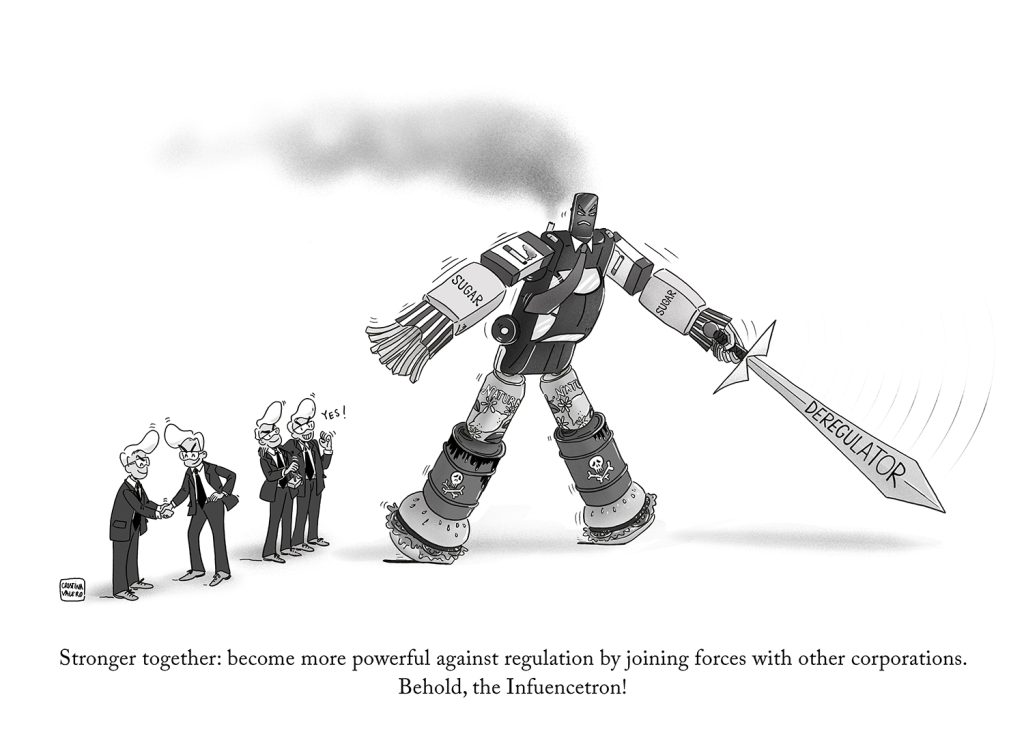
In the Corporate Influence Game, you don’t need to limit yourself at collaborating with other companies in your sector. Trade associations from one industry can join forces with trade associations from other sectors, and also with big individual corporations, to form mighty cross-industry alliances that are like a Voltron Megarobot: the Influencetron!
Cross-industry alliances work on keeping European and global markets as unregulated and corporate-friendly as possible, so that your company has barely any obligation towards the public and you can concentrate on what really matters: maximising your sacred profits!
► Featured cases_
► The Alliance of Energy Intensive Industries (AEII) helps coordinate influence work between several different trade associations in the sectors of chemical products, cement, iron and steel, oil refinement and other heavy and intensive industries. And because the reforms needed to mitigate the climate crisis could threaten the business models and profits of those companies, the AEII helps them claim in public that they are in favour of ambitious climate policy, while in private the AEII works against the implementation of the EU Green Deal.
For instance, the EU developed the Emissions Trading System (ETS) to incentivise polluting companies to reduce their CO2 emissions. And the AEII, which represents most of the corporations with the highest emissions, has been aggressively fighting for them to keep receiving as many free ETS pollution permits as possible, so that these companies don’t need to change their business models and can continue making as much money and as much pollution as usual while the climate unravels.
► Orgalim, Europe’s Technology Industries, brings together big individual companies (including non-European ones like Amazon), national associations and trade associations from “the mechanical engineering, electrical engineering and electronics, ICT [information and communication technology] and metal technology branches”.
Orgalim boasts that its members’ “technologies underpin the green and digital transition (and) enable sectors with high environmental impact to transition”. However, actually transitioning to a green economy may be expensive, and that’s why in less visible communications Orgalim pushes against EU legislation that may force its members to track dangerous substances in their products, or that could bring mandatory independent verification of what these companies are doing. Instead, Orgalim says its corporate members should be left alone by regulators: “self-assessment is just as valid a procedure, and offers the same level of compliance benefits, as any conformity assessment procedure supported by a third party”. Because when has anyone cheated when being allowed to mark their own exams?
Other examples
There are cross-industry alliances of all colours and shapes, and as a smart corporate executive or director you will surely find more than one to help your company win the Corporate Influence Game. These are a couple of examples.
► The European Bioeconomy Alliance (EUBA), which brings together trade associations from sectors like food production (including Copa-Cogeca), forestry, ethanol and bioplastics, has argued against introducing strong environmental criteria in the EU’s Sustainable Finance taxonomy, because that could affect investment in its member companies.
► The Cross Industry Initiative for better regulation in chemical management (CII), which groups different trade associations connected to chemical products (including the car-maker association ACEA, Cembureau and Eurometaux, among many others), has insisted that substances that are found to pose risks to people but are “limited to the workplace” should not be regulated in any special way beyond already existing workplace regulation. Because instead of being forced by the law to protect your workers, you as the boss should be free to decide how much risk your employees should face.
► Did you know? Your company can also benefit from the wisdom generated by companies in other industries through informal networking. You can follow the example of the tobacco, alcohol and ultraprocessed food sectors, where corporations have learnt from each other’s experiences and used each other’s proved tactics to influence policy — without the need for a legally established and visible cross-industry alliance.
Groups of corporate elites
► What are they?_
Trade associations and cross-industry alliances are great assets in the Corporate Influence Game. But what separates the Big Guys from the Really Big Important Guys is whether you can join a group of corporate elites, which are like the Avengers of corporate influence: only the most badass executives can be there.
Groups of corporate elites often behave like member-only clubs where the most important CEOs and other luminaries can become friends with each other, enjoy insultingly expensive food and drinks, and plan how to influence the political process at the most widest level. And that means keeping the EU as a place where corporations are free to do as they like, without annoying government interference or having to think of ordinary people who can’t tell the difference between Blue Lobsters and Maine Lobsters.
► Featured cases_
► The European Round Table for Industry (ERT) is a select club, by invitation only, of CEOs and chairmen — because indeed almost all of them are men — of big European corporations (Vodafone, L’Oréal, Unilever, Telefónica, E.ON, Engie, Eni, BASF, AstraZeneca, Airbus, Inditex, Philips, Volvo, Michelin, BP, TotalEnergies, Shell, Nestlé, Siemens…), who describe themselves as “united by a single ambition: to promote sustainable growth and prosperity in Europe”.
If you become a member of the ERT, then you’ll participate in its very effective efforts to promote liberalisation, deregulation and the expansion of big markets across Europe — like telecommunications, transport and energy —, all of which gives companies like yours free rein in making big money. The ERT also fights to keep reducing capital and corporate taxes, while asking for public money to fund the infrastructure required by big corporations to run their businesses. Private benefits thanks to public costs, what’s not to like?
► BusinessEurope, the Confederation of European Business, which defines itself as “the leading advocate for growth and competitiveness at European level, standing up for companies across the continent. (…) A recognised social partner, we speak for enterprises of all sizes in 35 European countries”.
However, its partner companies are all XXL rather than of all sizes, and include many from outside Europe, like Caterpillar, Philip Morris International, ExxonMobil, Google, Microsoft, Meta, IBM and Intel (all from the US); Japan Tobacco International, Mitsubishi, Hitachi and Toyota (Japan); Huawei (China); Samsung (South Korea); and Tata Consultancy Services (India). As an advanced follower of The Strategy, BusinessEurope knows that, while such global partnerships can benefit big corporations, it still sounds good to call yourself European and to insist that you represent small European companies.
Sharing the ERT’s vision and ambitions, BusinessEurope uses its privileged access to the European Commission to push consistently and very efficiently for policies that benefit big businesses “on everything from the rules of trade deals that put corporations in the driving seat, to watering down concerted climate action”. If you manage to become a member of BusinessEurope, then you’ll benefit from the work of this powerful coalition, whose “efforts often result in the adoption of business-friendly initiatives, and the blockage of more socially or environmentally progressive legislation”. Oh yes.
► Fun facts. As a corporate executive or director in Europe, you should be thankful to the ERT and BusinessEurope (which from 1958 to 2007 was known as Union des Industries de la Communauté européenne, UNICE), because they both were instrumental in making the European Single Market as friendly to big businesses as humanly possible, in the case of BusinessEurope starting its influence work as early as in the 1960s. As the premium followers of The Strategy they are, the ERT and BusinessEurope succeeded in influencing how the economic playing field and the rules of the business game were designed, so that everything is in favour of big companies, and it’s harder for regulators and the public to resist corporate influence.
In fact, the ERT is so powerful that it’s been recognised as playing the kind of political role normally given to a national government in the EU. The ERT “did not merely articulate interests. The CEOs organized themselves to become active political actors that shaped EC [the European Community] and, therefore, national policy agendas. They provided policy alternatives and informed public opinion. In short, the ERT assumed many of the roles that had previously been reserved for Member States. The ERT became a political actor in its own right”.
Other elite clubs
► The Ambrosetti Club is a cosier, less-known and more private gathering than those at the World Economic Forum in Davos or the Bildenberg Meeting, where you can rub shoulders with the coolest kids (i.e. mostly middle-aged and old white men). The Ambrosetti Club “is a permanent platform through which top management can offer insights and promote concrete changes in the country and its institutions under the banner of a pro-business, pro-industry and pro-innovation culture [in Italian in the original]”. The current listing of members includes the heads of European and international companies like Airbus, Allianz, Amazon, Apple, Bayer, BASF, Barclays, Banco Santander, Deutsche Bank, Coca-Cola, Dell, Eni, Facebook, Ferrari, Hewlett Packard, IBM, L’Oréal, Microsoft, Nestlé, Philip Morris, Siemens, Volkswagen, Volvo, Walmart, Google, GlaxoSmithKline…
The Ambrosetti Club “aims to be an independent facilitator of an informal, open, informed and continuous dialogue between top executives, policy makers and thought leaders, who can meet and discuss freely and privately priority issues for business and the economic system in light of the most important current and future market, technological, regulatory and geopolitical trends, all with a view to finding insights and promoting change” [in Italian in the original]. As such, the Ambrosetti Club helps CEOs to get private meetings with high-level EU policy-makers, for example with European Commissioner for Agriculture Janusz Wojciechowski to discuss the money the EU gives to big landlords and industrial farms.
► If you are a CEO from Portugal, Spain, France or Italy, then you may be able to join the Conseil de Cooperation Economique (CCE), a secretive club of around 60 CEOs and chairmen of big corporations from those four countries. The CCE promotes the same policies as BusinessEurope and the ERT: for regulators to leave the market alone so that big corporations can make as much money as possible regardless of anything else. For example, in 2022 the CCE told the European Commission that it shouldn’t intervene in the electricity markets after prices for consumers increased due to the Russian invasion of Ukraine. The CEE said that the impact of the war on energy prices (which also happened to increase profits for fossil fuel corporations to absurd levels) was not something bad but actually a sign of “a well-functioning electricity market”. Indeed the market was functioning well to fill corporate pockets with money!
Other types of corporate collaborations
Corporations, trade associations and cross-industry alliances can find or create other types of collaborations that will give you even more ways to play the Corporate Influence Game. Here, The Guide tells you about research organisation, think tanks and fake consumer groups. But as an up-and-coming corporate executive or director in Europe, you can think of other ways for companies to collaborate to increase their profits regardless of anything else.
► Research organisations_
Your company and its allies can found, fund or otherwise support different organisations that produce scientific research — which then your company can use as grounds to influence public policy. Most research organisations will aim to be independent, but the corporations supporting them can exert implicit and explicit influence about what type of research will be done and in which direction.
For example, the Society of Environmental Toxicology and Chemistry (SETAC) has the stated aim of “advancing environmental science and environmental management”, and it also has as its members the likes of Bayer, Cefic, CropLife Europe, Chevron, Colgate-Palmolive, ExxonMobil, Procter & Gamble, RioTinto, Shell, Syngenta and Unilever, among others. Syngenta, particularly, used SETAC to defend Atrazine, a substance suspected of causing cancer and found to harm amphibians, and also an ingredient in a highly profitable herbicide made by Syngenta. The company would have their envoys at SETAC scientific meetings, ready to harass there and then any researchers looking into Atrazine (in the next chapter, The Guide tells you more about how to harass and silence your critics).
Another case is that of Concawe, Environmental Science for European Refining, which was created “by a small group of leading oil companies [BP, Cepsa, Eni, ExxonMobil, Shell, TotalEnergies…] to carry out research on environmental issues relevant to the oil industry”. As well as doing research, Concawe also helped US giant ExxonMobil defend itself at the EU institutions, after it became public that ExxonMobil had known about the climate crisis since the 1970s and lied to people’s faces about it for for decades, so that ExxonMobil could keep making money from extracting and selling oil and gas.
► Think tanks_
Your company should definitely create or support one or many think tanks, which are explicitly designed to produce research aimed at influencing policy. While less credible than proper research organisations, think tanks can still be extremely useful to you.
A great example is the European Risk Forum, created in the 1990s as part of the European Policy Centre (EPC) under the leadership of British American Tobacco (BAT), and with the participation of companies like Bayer, Coca-Cola, DuPont, HSBC, Shell and Siemens. BAT and other corporations producing and selling products that are harmful were annoyed by the fact that the EU followed the Precautionary Principle, which asks to be cautious when regulating activities that can be damaging to people or the environment. In practice, that could result in restrictions to the business of BAT and its allies, and that’s why they used the Risk Forum to develop a weapon against the Precautionary Principle, which they called the Innovation Principle: “whenever legislation is under consideration its impact on innovation should be assessed and addressed”.
Thanks to its simplicity and the vagueness of “innovation” and “impact” as terms, which can mean anything you like, the Innovation Principle can be adapted and used in different contexts. For instance, the Risk Forum used it in 2015 to undermine the EU REACH legislation, which aims to regulate the production and use of chemical substances that may have negative effects on people and the environment, and that might disrupt the business models of big chemical corporations.
► Fake consumer groups_
These front groups offer your company and your corporate allies a fun way to influence the public conversation while remaining hidden in the shadows.
Here, you can learn from our friends in the US and the Consumer Choice Center (CCC). Headquartered in Washington, D.C., the CCC was established in 2017 by Students for Liberty, a US libertarian advocacy group funded by the Koch network, a conglomerate of companies making tons of money mostly from oil and chemicals, and spreading right-wing libertarianism across the globe: an ideology that defends eliminating government intervention and leaving the markets as unregulated as possible.
Despite such illustrious origins and admitting that it’s “been funded by [companies in the] the energy, chemical and airlines industries”, the CCC claims to represent not the oil billionaires and corporations who support it but regular people and consumers in more than 100 countries. That includes Europe, where the CCC has been very active for the last few years. For example, between May 2022 and July 2023, CCC staff published almost 50 articles on EU issues in different media outlets, criticising the EU’s pesticide reduction targets and generally any EU policy aimed at dealing with the climate crisis. The CCC also paid for adverts on Facebook “against EU plans to ban petrol and diesel cars, and against the strengthening of chemical regulations”. The beauty of it is that most people will think those ads and articles are from an innocent consumer group defending ordinary people; when the reality is that the CCC is reading the script written by billionaires and corporations from the oil, chemicals, tobacco and other such industries.
Conclusion_ Stronger together in the Corporate Influence Game
As a good corporate person, you’ve been trained to be self-interested and individualistic, and you want to beat everyone else and be the only winner yourself. However, there actually is strength in numbers, and it makes sense for you to join forces with other big companies to defend your common interests: to keep the market as unregulated as possible, so that you can be free to do whatever it takes to maximise your profit.
Your company and others can pool money and other resources to design, launch and maintain bigger and wider-reaching influence campaigns. That includes exploiting weak PR regulation to influence the public conversation — as the former chapter of The Guide explained.
And here you can start seeing why knowing about and following The Strategy is important: in 2023, research about lobbying influence in the EU showed that “interest groups with greater economic resources [like corporate coalitions] are more likely to reap the benefits of aligning with public opinion, as they have the means to cultivate expertise and generate pressure on policymakers, while policymakers will also be more receptive to their input due to their congruence with public opinion. (…) Specifically, [the researchers] discovered that affluent interest groups benefit from being in line with public opinion, while resource-limited organizations [like most civil society organisations] do not experience an increase in influence despite widespread public agreement with their position”.
As this chapter has shown, the many different kinds and big number of corporate coalitions and collaborations that exists can be overwhelming. That’s a good thing, because it means that your company will enjoy a diverse array of ways to influence every aspect of our social and political lives: from the public conversation to what becomes a political priority, to what kind of regulation gets approved. And the complexity of corporate coalitions and partnerships also makes it harder for the public, journalists and policy-makers to follow what’s really going on, and to know which companies are actually behind which attempts at influence.
In fact, corporate coalitions are so good at achieving political influence that, starting in 2017, the European Commission has been establishing quasi-official cross-industry groups that allow their corporate members direct access to policy-making. The Guide will tell you how you can exploit that opportunity in the chapter, “Tactic 10. Infiltrate the Regulatory Process”.
For now, in the very next chapter The Guide tells you about the tactic of The Strategy that is most fun to use: how to harass, menace, defame, intimidate and generally frighten critics of your business into silence!
Now, let’s keep on influencing!
This chapter was last reviewed and published on 27 September 2024.
Notes and references
– In the list below, the lines in bold are the phrases in this chapter of The Guide that the ensuing note refer to. When I consider the title or headline of a reference clear and informative enough to support the corresponding statement in the text of this chapter, I only include here the information about the citation and a link to the reference. When the reference is a long document, and/or when particular paragraphs from the reference are clearly related to the corresponding statement, then I quote such paragraphs here. I have minimally edited those quotes to delete the spaces between paragraphs in the original source, so that here they appear as one single (if long) paragraph. For the sake of simplicity, I have also removed embedded links and superscript citation numbers from the quoted paragraphs; those links and citations can be seen and followed in the text in the original reference source. When I use quotes in the text of the chapter, I may re-stylise the initial lower or upper case letters of some quotes to make them fit with their place in the paragraphs in the text.
– (Cefic), which describes itself as “the forum of large, medium and small chemical companies across Europe”
– Cefic. (2024). About Us. Cefic website, 2024. Available on https://cefic.org/about-us and on the Internet Archive (last visited on 7 September 2024)
– Cefic’s leading members are not medium or small but huge chemical manufacturers and fossil fuel corporations
– Cefic. (2024). List of Corporate Members (ACOM). Cefic website, March 2024. Available as a PDF file on https://cefic.org/library-item/cefic-corporate-members-acom and on the Internet Archive (last visited on 7 September 2024)
– titanium dioxide, a compound suspected of causing cancer by the EU Chemical Agency, is used in sunscreen, cosmetics, paint and other products
– “Substance Infocard. Titanium dioxide. (…) “Hazard classification & labelling. Warning! According to the harmonised classification and labelling (ATP14) approved by the European Union, this substance is suspected of causing cancer. (…) Properties of concern. Suspected to be Carcinogenic.”
– “Consumer Uses. This substance is used in the following products: coating products, inks and toners, fillers, putties, plasters, modelling clay and biocides (e.g. disinfectants, pest control products). Other release to the environment of this substance is likely to occur from: indoor use (e.g. machine wash liquids/detergents, automotive care products, paints and coating or adhesives, fragrances and air fresheners) and outdoor use.”
– “Article service life. (…) Other release to the environment of this substance is likely to occur from: indoor use in long-life materials with low release rate (e.g. flooring, furniture, toys, construction materials, curtains, foot-wear, leather products, paper and cardboard products, electronic equipment), outdoor use in long-life materials with low release rate (e.g. metal, wooden and plastic construction and building materials) and indoor use in long-life materials with high release rate (e.g. release from fabrics, textiles during washing, removal of indoor paints). “
– ECHA. (2023). Substance Infocard. Titanium dioxide. European Chemicals Agency (ECHA) website, May 2023. Available on https://echa.europa.eu/substance-information/-/substanceinfo/100.033.327 and on the Internet Archive (last visited on 7 September 2024)
– “Titanium dioxide nanoparticles are widely used in cosmetics, especially in sunscreens due to their capacity to absorb UV harmful wavelengths. However, their biocompatibility remains controversial. In this work, the effect of titanium dioxide nanoparticles, particularly Degussa P25 (P25TiO2NPs) under solar-simulated radiation was studied in vitro and in vivo. Cell viability and tissue integrity were affected after exposure to P25TiO2NPs and light for 6 h, showing signs of significant oxidative stress markers and reduced tissue integrity observed by TEM.”
– Vaudagna, M.V. & al. (2023). Titanium Dioxide Nanoparticles in sunscreens and skin photo-damage. Development, synthesis and characterization of a novel biocompatible alternative based on their in vitro and in vivo study. Journal of Photochemistry and Photobiology, volume 15, June 2023. Available on https://www.sciencedirect.com/science/article/pii/S2666469023000143 and https://doi.org/10.1016/j.jpap.2023.100173 (last visited on 7 September 2024)
– “Titanium dioxide, in the form of nanoparticles used to render creams and lotions transparent, is currently approved as a UV-filter in sunscreens. Are sunscreens with titanium dioxide nanoparticles safe? Do these nanoparticles behave differently than other particles of titanium dioxide? How are the risks of nanoparticles evaluated? (…) Safe, but… Breathing in nanoparticles can lead to lung toxicity and inflammation. Some tests suggest that this could also lead to cancer. In view of this, the SCCS advises not using titanium dioxide nanoparticles in applications that would lead to any significant inhalation exposure such as powders or sprayable products.”
– European Commission. (2014). Sunscreens with titanium dioxide as nanoparticles. Health risks? European Commission, Health and Consumers, July 2014. Available as a PDF file on https://ec.europa.eu/health/scientific_committees/docs/citizens_titaniumnano_en.pdf and on the Internet Archive (last visited on 7 September 2024)
– Cefic worked hard against a possible norm that would force companies to label products containing titanium dioxide as potentially carcinogenic
– “The classification of titanium dioxide by the EU as a “suspected carcinogen” would not lead to a ban, or even to restrictions on the chemical or its use, but would simply mean that products containing it need to be clearly labelled as potentially carcinogenic, to provide information to workers and consumers. This makes the clamour of industry lobbyists against classification especially shocking.”
– “The scale of industry lobbying on this file has far outweighed the voices of NGOs and trade unions who have advocated for the public interest and raised issues of human health and a safe environment. Industry’s massive resources have enabled it to deliver repeated and coordinated lobby demands.”
– “Industry has also brought on board at least two lobby firms to help with its influencing campaign. The chemical industry’s EU trade association CEFIC (which declares spending €12 million a year on EU lobbying, making it the EU’s largest lobby group) employs Fleishman-Hillard (Brussels’ largest lobby firm). According to LobbyFacts, Fleishman-Hillard has been paid at least €400,000 a year by CEFIC for activity on titanium dioxide, and examples of its work include a sign-up letter addressed to three Commissioners, sent on behalf of the producers of titanium dioxide and TDMA members. (…) The employment of these lobby firms is another indicator of the scale of the resources that industry has dedicated to opposing the classification of titanium dioxide.”
– CEO. (2019). Toxic lobbying: the titanium dioxide label debate continues. Corporate Europe Observatory (CEO) website, 1 July 2019. Available on https://corporateeurope.org/en/2019/06/toxic-lobbying-titanium-dioxide-label-debate-continues and on the Internet Archive (last visited on 7 September 2024)
– the Committee of Professional Agricultural Organisations (Copa) and the General Confederation of Agricultural Cooperatives in the European Union (Cogeca), which bring together national organisations representing the agribusiness sector in Europe
– “When Copa (the Committee of Professional Agricultural Organisations) first started out, it had 13 member organisations from the then six Member States. Today, Copa is made up of 60 organisations from countries within the European Union and 36 partner organisations from other European countries, including Iceland, Norway, Switzerland and Turkey as well.”
– Copa-Cogeca. (2024). Copa. Copa-Cogeca website, 2024. Available on https://copa-cogeca.eu/about-copa and on the Internet Archive (last visited on 7 September 2024)
– “Cogeca, now the “General Confederation of Agricultural Cooperatives in the European Union”, currently promotes the general and specific interests of some 22,000 farmers’ cooperatives, which employ some 660,000 people across Europe and represent a global annual turnover in excess of 300 billion euros.”
– Copa-Cogeca. (2024). Cogeca. Copa-Cogeca website, 2024. Available on https://copa-cogeca.eu/about-cogeca and on the Internet Archive (last visited on 7 September 2024)
– “Copa-Cogeca has used its position to oppose environmental reforms proposed by the [EU] Green Deal and Farm to Fork Strategy…”
– “A single lobby group has dominated the European Union’s agricultural policy for more than half a century. Established in 1959 at the inception of the Common Agricultural Policy, which was founded on the post-war ideal that Europe should never go hungry again, Copa-Cogeca has assumed a role as the self-proclaimed voice of European farmers and agri-cooperatives in Brussels. On the strength of its history and claim to represent all farmers, it enjoys privileged access to the EU at all levels of its policy making. In the past year, Copa-Cogeca has used its position to oppose environmental reforms proposed by the Green Deal and Farm to Fork Strategy, including successfully postponing a law to slash pesticide use, and attempting to derail a law that would restore European ecosystems. Lighthouse Reports’ investigation into the group, including interviews with nearly 120 farmers, insiders, politicians, academics and activists, as well as a survey of 50 Copa-Cogeca affiliates, casts serious doubt on the lobby’s membership strength and legitimacy in the farming community.”
– Bărbulescu, M. & al. (2023). Europe’s Potemkin Lobby. Lighthouse Reports, 29 June 2023. Available on https://www.lighthousereports.com/investigation/europes-potemkin-lobby/ and on the Internet Archive (last visited on 7 September 2024)
– it says that it represents “over 22 million farmers and their family members” (which even its spokesperson says it’s “technically speaking” not true)
– it also opposes efforts to limit huge EU subsidies to big landowners and industrial farms
– “Copa and Cogeca are the united voice of farmers and agri-cooperatives in the EU. Together, we ensure that EU agriculture is sustainable, innovative and competitive, while guaranteeing food security for 500 million people throughout Europe. Copa represents over 22 million farmers and their family members whilst Cogeca represents the interests of 22,000 agri-cooperatives.”
– Copa-Cogeca. (2024). About us. Copa-Cogeca website, 2024. Available on https://copa-cogeca.eu/about-us and on the Internet Archive (last visited on 7 September 2024)
– “Europe’s farming and cooperative movements, Copa and Cogeca, merged in the early 1960s, creating a single lobbying powerhouse that has wielded huge sway over policymaking ever since. On its website, the group claims to speak for “over 22 million European farmers and their family members.” There’s just one problem with that assertion: It isn’t true. Nor are the policy decisions Copa-Cogeca advocates for always in the interests of all of Europe’s farmers, according to interviews with nearly 120 farmers, insiders, politicians, academics and activists. (…) The 22 million people Copa-Cogeca refers to isn’t the number of members; it’s the number of people in the EU who work regularly in the food production sector, according to the European Commission. But not all of those are members of Copa-Cogeca. For a start, not all farmers’ unions support the organization. The Association of Private Farming of the Czech Republic (APF CR) left Copa in 2021, for instance. Other national associations never joined, and some farmers eschew membership of unions altogether. Even some of the lobby’s member organizations complain they don’t feel properly represented. “The decisions go through the big countries, big farmers, big unions,” said Arūnas Svitojus, president of LR ZUR, a Lithuanian union. “That’s difficult for smaller farmers, family farmers.” Take Romania, for example, where Copa-Cogeca is represented by the Alliance for Agriculture and Cooperation, an umbrella group of national unions. Together, its 3,500 Romanian members own approximately 25 to 35 percent of the country’s farmland but account for just over 0.1 percent of its total number of farms. Only nine Copa-affiliated unions, out of the 50 contacted by Lighthouse Reports, responded to requests for their most up-to-date membership figures. Where numbers are available, they depict a drop in membership by more than a fifth since 2016. Pesonen allowed that the figure on the group’s website was more of an aspiration than an actual representation of its membership. “Technically speaking, it’s less than 22 million,” he said. Exactly how many, however, he couldn’t say.”
– “First among its objections was Copa-Cogeca’s opposition to an effort to limit CAP agricultural subsidies for large farms and what it described as the group’s “scornful” unwillingness to discuss the issue.”
– Savage, S. & Win, T.L. (2023). The truth behind Europe’s most powerful farmers lobby. Politico.eu, 29 June 2023. Available on https://www.politico.eu/article/copa-cogeca-farmering-lobby-europe/ and on the Internet Archive (last visited on 7 September 2024)
– Remember all the tractors blocking European roads and squares in early 2024?
– Riegert, B. (2024). Why are farmers across Europe protesting? Deutsche Welle, 26 February 2024. Available on https://www.dw.com/en/why-are-farmers-across-europe-protesting/a-68373187 and on the Internet Archive (last visited on 7 September 2024)
– Copa-Cogeca successfully used those protests to continue blocking environmental measures
– “European farmers were therefore faced with an impossible mission: delivering an agroecological transition while producing for the lowest possible price. As a result, differences between farming organisations have clearly resurfaced. On one side, the big farmers and agribusiness organisations, linked to Copa-Cogeca, want to maintain the neoliberal orientation and have therefore asked for the withdrawal of environmental measures set in the EU’s Green Deal. On the other side, ECVC and other organisations affirm that the environmental and climate crises are real and serious and that it is vital to give ourselves the means to combat them in order to ensure food sovereignty for the decades to come. For us, it is the neoliberal framework that must be challenged, not environmental regulation. In particular, we denounce the free trade agreement between the EU has been concluding with various countries and regions. One of them is the deal negotiated with Mercosur countries (Brazil, Argentina, Paraguay and Uruguay). A final text was drafted in 2019, but it has not been signed or ratified by either side. If it comes into effect, it would be a disaster for European livestock farmers, as it will lead to increased imports of meat, among other products, from Mercosur countries. This could potentially drive down prices, putting even more economic pressure on already struggling European livestock farmers.”
– Ody, M. & Delobel, V., members of interest organisation La Via Campesina. (2024). Farmers’ protests in Europe and the deadend of neoliberalism. Opinion article in Al Jazeera, 25 February 2024. Available on https://www.aljazeera.com/opinions/2024/2/25/farmers-protests-in-europe-and-the-deadend-of-neoliberalism and on the Internet Archive (last visited on 7 September 2024)
– and help small farmers, many of whom don’t actually belong to nor feel represented by Copa-Cogeca
– “For a start, not all farmers’ unions support the organization. The Association of Private Farming of the Czech Republic (APF CR) left Copa in 2021, for instance. Other national associations never joined, and some farmers eschew membership of unions altogether. Even some of the lobby’s member organizations complain they don’t feel properly represented. “The decisions go through the big countries, big farmers, big unions,” said Arūnas Svitojus, president of LR ZUR, a Lithuanian union. “That’s difficult for smaller farmers, family farmers.” Take Romania, for example, where Copa-Cogeca is represented by the Alliance for Agriculture and Cooperation, an umbrella group of national unions. Together, its 3,500 Romanian members own approximately 25 to 35 percent of the country’s farmland but account for just over 0.1 percent of its total number of farms. Only nine Copa-affiliated unions, out of the 50 contacted by Lighthouse Reports, responded to requests for their most up-to-date membership figures. Where numbers are available, they depict a drop in membership by more than a fifth since 2016.”
– Savage, S. & Win, T.L. (2023). The truth behind Europe’s most powerful farmers lobby. Politico.eu, 29 June 2023. Available on https://www.politico.eu/article/copa-cogeca-farmering-lobby-europe/ and on the Internet Archive (last visited on 7 September 2024)
– For more information on how corporate interests claim to represent the interests of small farmers across Europe while defending and promoting policies that benefit big corporations, see also this reference below.
– “While there is a widespread agreement that European farmers are struggling, the solution to their woes is hotly debated. In this context, we sought to discover who is speaking on behalf of the farmers, and whose interests they represent. In collaboration with Splann!, L’Espresso, Frontstory.pl, The Europeans and Taz, we investigated some of the key figures claiming to represent farmers, and how they are doing that job, in France, Italy, Germany and Poland. We gathered testimony and scoured through company records to build profiles of some of the most influential figures framing the meaning of the protests. This series of investigations shows that the representation of European farmers is concentrated in the hands of a few people who bear little resemblance to the average farmer they claim to speak for. They are much wealthier, sit on the boards of multiple companies and have close links with “Big Ag” companies whose interests can be opposed to those of farmers. In addition, many of those we profile directly control or own shares in media outlets that cater to the agricultural community, allowing them to spread and amplify their messages among the farming community. Some farm unions even use unethical methods against critics and those advocating for reforms and alternative policies. Some livestock farmers with deep pockets have managed to portray themselves as “protest leaders” in international media, when they have not been elected or chosen by farmers. This investigation is a follow up on our 2023 investigation into Copa-Cogeca, the oldest, biggest, and most powerful farm lobby in the European Union which had assumed a role as the self-proclaimed voice of European farmers and agri-cooperatives in Brussels, although our findings showed otherwise.”
– Freudenthal, E. & al. (2024). Farmers Protest, Who Gains? Lighthouse Reports, 23 May 2024. Available on https://www.lighthousereports.com/investigation/farmers-protest-who-gains/ and on the Internet Archive (last visited on 7 September 2024)
– whose history of stopping pro-environmental legislation is much longer and fruitful than simply that
– “COPA-COGECA is one of the most active lobby groups in the EU. In 2021, academics analyzed data from the European Commission’s Transparency Register, finding that between 2014-19, COPA-COGECA was the eleventh most active organization of all lobbies in the EU, and the sixth most active between 2008-2010. (…) COPA-COGECA has considerable influence in the EU, and NGOs have suggested that it receives privileged access to decision making processes. In 2019, the New York Times suggested that “European leaders have historically treated [COPA-COGECA] not as mere recipients of government money, but as partners in policymaking.” The article revealed that COPA-COGECA was granted private audiences with the Council’s president ahead of important meetings held by European agriculture ministers, despite environmental groups being refused the same opportunities. (…) COPA-COGECA has been a vocal opponent of binding targets included in the EU’s sustainable food Farm to Fork strategy. In January 2021, the group suggested a number of amendments that MEPs should make to the strategy in Parliament. As well as deleting multiple mentions of the environmental harms caused by the current agricultural system, it deleted commitments to translate progressive targets on agrochemicals into legislation, which would make them legally binding. The strategy’s targets include a 50 percent reduction in use and risk of chemical pesticides, and 20 percent reduction in use of chemical fertilizers. The group has also lobbied for the reauthorization of the controversial pesticide glyphosate, which critics suggest is a carcinogen and causes widespread harm to the environment.”
– And see the rest of the article for a very informative take on Copa-Cogeca’s activities during the last year.
– DeSmog. (2024). Copa-Cogeca. DeSmog website, 2024. Available on https://www.desmog.com/copa-cogeca/ and on the Internet Archive (last visited on 7 September 2024)
– The European Automobile Manufacturers’ Association (ACEA) represents most European carmakers
– ACEA. (2024). ACEA members. ACEA website, 2024. Available on https://www.acea.auto/acea-members/ and on the Internet Archive (last visited on 7 September 2024)
– ACEA was active in the political process to regulate vehicle emissions of NOx
– which helped Volkswagen and other carmakers cheat and keep their vehicles emitting much more NOx than was allowed
– “The European auto industry trade association ACEA, along with manufacturers Daimler and BMW in particular have opposed the implementation of Real World Driving Emissions (RDE) aspect of EU NOx policy. They do this in part through seconding specialist staff to key EC committees, such as the Technical Committee for Motor Vehicles (TCMV), and through the issuance of technical papers and positions, for example, defining what constitutes a fair measure of vehicle emissions.”
– “EU NOx emissions standards and testing. ACEA which represents the largest European automobile manufacturers is deeply involved in the EU policy making process, particularly through the provision of technical resources and policy relevant material. ACEA does not appear to fully support European emissions policy which it in 2015 labeled a “regulatory burden” on European industry. In July 2015 ACEA challenged EU NOx policy on the grounds of alleged incompatibility to EU CO2 targets and potential damage to the diesel industry. It stated that “such measures make no sense from an environmental point of view” and proposed that fleet renewal was a more sensible mechanism for reducing air pollution. ACEA pledged support for a “robust but realistic RDE package” following the Volkswagen emissions scandal. However in March 2015 ACEA opposed RDE as a “piecemeal approach” in a formal correspondence to the Commission. ACEA has also potentially delayed the implementation of introducing RDE through repeatedly proposing revisions of RDE boundary requirements including the temperature, speed and mass range, which serves to create “hurdles” that bogs-down reform in technical details. In March 2014 ACEA emphasized the need for a gradual process of reform, stating: “[it] should not be rushed to part-completion simply to meet an impractical deadline or as a box ticking exercise.” It also advocated for the second phase of RDE to be delayed beyond 2020, beyond the timeline proposed by the Commission.”
– InfluenceMap. (2015). EU NOx emissions: how the automotive industry shaped policy. The Greens/EFA in the European Parliament, December 2015. Available as a PDF file on https://www.greens-efa.eu/legacy/fileadmin/dam/Documents/Studies/Car_lobby/Greens_EP_Automotive_Jan_2016_report.pdf and on the Internet Archive (last visited on 7 September 2024)
– People getting sick and thousands dying just in Europe every year due to the excess NOx in the air
– “Diesel cars have been emitting four to seven times more NOx in on-road driving than in type approval tests. These ‘excess emissions’ are a consequence of deliberate design of the vehicle’s after-treatment system, as investigations during the ‘Dieselgate’ scandal have revealed. Here we calculate health and environmental impacts of these excess NOx emissions in all European countries for the year 2013. We use national emissions reported officially under the UNECE Convention for Long-range Transport of Atmospheric Pollutants and employ the EMEP MSC-W Chemistry Transport Model and the GAINS Integrated Assessment Model to determine atmospheric concentrations and resulting impacts. We compare with impacts from hypothetical emissions where light duty diesel vehicles are assumed to emit only as much as their respective type approval limit value or as little as petrol cars of the same age. Excess NO2 concentrations can also have direct health impacts, but these overlap with the impacts from particulate matter (PM) and are not included here. We estimate that almost 10 000 premature deaths from PM2.5 and ozone in the adult population (age >30 years) can be attributed to the NOx emissions from diesel cars and light commercial vehicles in EU28 plus Norway and Switzerland in 2013. About 50% of these could have been avoided if diesel limits had been achieved also in on-road driving; and had diesel cars emitted as little NOx as petrol cars, 80% of these premature deaths could have been avoided. Ecosystem eutrophication impacts (critical load exceedances) from the same diesel vehicles would also have been reduced at similar rates as for the health effects.”
– Jonson, J.E. & al. (2017). Impact of excess NOx emissions from diesel cars on air quality, public health and eutrophication in Europe. Environmental Research Letters, 12, 18 September 2017. Available on https://iopscience.iop.org/article/10.1088/1748-9326/aa8850 and https://www.doi.org/10.1088/1748-9326/aa8850 (last visited on 7 September 2024)
– Cembureau, the European Cement Association, follows The Strategy and always says in public that it agrees with the EU’s climate ambitions
– “In its Green Deal published in late 2019, the EU recognised the cement sector as indispensable to Europe’s economy, as a supplier to several key value chains. Indeed, we agree, and believe our industry is an enabler for a Green Deal.”
– CEMBUREAU. (2024). Green Deal. The European Cement Association (CEMBUREAU), 2024. Available on https://cembureau.eu/about-our-industry/green-deal/ and on the Internet Archive (last visited on 10 September 2024)
– Cembureau works hard to make sure its members keep receiving free EU carbon credits (that allow companies to pollute for free) and to prevent legislation…
– “The association engaged on the EU Emissions Trading System (EU ETS) with a mix of supportive and unsupportive positions. In a June 2023 public consultation response, it broadly supported measures that would increase the stringency of the EU ETS post 2030, and in its 2023 Activity Report, published in June 2024, CEMBUREAU advocated for funds to be spent on a dedicated fund to decarbonize industry. However, CEMBUREAU signed a joint letter in October 2022 which supported the maintenance of free allocation of emissions allowances for an unspecified transition period. In March 2024, the association published a fact sheet, in which it advocated for the ETS benchmark for cement to be technologically neutral instead of imposing a reduction of the clinker-to-cement ratio as the only decarbonization pathway. CEMBUREAU supported the EU Carbon Border Adjustment Mechanism (EU CBAM) in its January 2024 EU Election Manifesto 2024-29. However, it appeared to advocate for export rebates in the EU CBAM in its Net Zero Roadmap, published in May 2024.”
– LobbyMap. (2024). European Cement Association (CEMBUREAU). InfluenceMap, 2024. Available on https://lobbymap.org/influencer/CEMBUREAU-The-European-Cement-Association and on the Internet Archive (last visited on 10 September 2024)
– “A large part of heavy industry carbon emissions is exempted from ETS [EU Emissions Trading System] obligations. The allocation system of free emissions allowances was designed to shield European heavy industries from the purported risk of “carbon leakage”, the alleged risk that industries will relocate their production outside of the EU to countries or regions with more lenient carbon emission policies. Whilst free allowances have helped European industries face growing international competition, they have also allowed them to keep polluting at will. This is because allowances were only distributed, within each sector, to the most polluting processes, for example blast furnaces rather than units using recycled steel. Between 2013-2021 large polluting industries received a total of €98.5 billion in free allowances – i.e. more than what EU Member States collected from ETS revenues during the same period (€88.5 billion).”
– Tamellini, L. & Amand, A. (2023). Polluting for free during a climate crisis: Update of the EU ETS free allocation rules. Carbon Market Watch, 22 December 2023. Available on https://carbonmarketwatch.org/2023/12/22/polluting-for-free-during-a-climate-crisis-update-of-the-eu-ets-free-allocation-rules/ and on the Internet Archive (last visited on 10 September 2024)
– PlasticsEurope, which includes big oil and chemical corporations from Europe and beyond
– PlasticsEurope. (2024). Membership. PlasticsEurope website, 2024. Available on https://plasticseurope.org/about-us/membership/ and on the Internet Archive (last visited on 10 September 2024)
– [PlasticsEurope] has been indefatigably campaigning against the EU regulating endocrine disrupting chemicals
– “Leaked slides from internal industry presentations from PlasticsEurope and CEFIC (the lobby group of the whole chemical industry) show that twisting and undermining the science on EDCs [endocrine disrupting chemicals], which they admit threatens their products, and getting their own ‘science’ to the EU authorities in charge, has been a key, and rather successful, strategy. (See for more background the bottom of this article). Endocrine disrupting chemicals (EDCs) are chemicals that are present in several products we come into contact with every day – from plastics and cosmetics to pesticides. Because of their ability to interact with the hormonal (endocrine) systems of living organisms, they are suspected of having serious detrimental effects on human and environmental health. According to its 2009 Pesticides Regulation, the EU is supposed to ban hormone disrupting chemicals. Because industry had lost the battle at the legislative and political level, it had to find ways to hollow out these regulations. Following a massive lobbying campaign, it has so far managed to delay and weaken the first step needed to start regulating EDCs: establishing the scientific criteria to identify them. This is what this week’s discussion will be about, once more.”
– “The first slide in the leaked presentation contains a SWOT analysis (Strengths, Weaknesses, Opportunities and Threats) for industry’s campaign against action on EDCs. In the section ‘Weaknesses’ we find: “scientific evidence showing endocrine disrupting properties of plastics”. So much for “science-based” policy-making, which industry constantly calls for.. [sic] The admission is clear: beyond the slogan, industry only cares about the evidence supporting its commercial interests. It gets worse: the “Opportunities” section mentions that scientific research “can show different results on endocrine disruptors”, and that the EDC debate is a “difficult scientific discussion”. Combined with the listed “Strengths” that industry is willing to “fund further research”, it is not hard to recognize the classic strategy of ‘manufacturing doubt’ over any scientific evidence which shows the harmful effects of industry’s products. This was a strategy that was made up by the tobacco industry in the ‘50s. The fact that industry has a “sound production base in Europe and a network of contacts” adds insult to injury: it implies that it will possible to scare politicians about job losses. (…) The second slide shows the known industry strategy to have EDCs regulated as all other chemicals, i.e. with a ‘safe threshold’ – precisely something that is not possible for EDCs. Also, loopholes are advocated that would leave certain EDCs untouched, such as including the ‘potency criterion’. This strategy should allow the industry to “avoid regulation of EDs in product and waste regulation”.”
– CEO. (2017). Leaked industry slides reveal insights on the chemical industry’s lobbying strategy. Corporate Europe Observatory (CEO), 17 May 2017. Available on https://www.corporateeurope.org/en/food-and-agriculture/2017/05/leaked-industry-slides-reveal-insights-chemical-industry-lobbying and on the Internet Archive (last visited on 10 September 2024)
– [endocrine disrupting chemicals] are linked to cancer and other harmful health outcomes
– “EDCs [endocrine disrupting chemicals] can disrupt many different hormones, which is why they have been linked to numerous adverse human health outcomes including alterations in sperm quality and fertility, abnormalities in sex organs, endometriosis, early puberty, altered nervous system function, immune function, certain cancers, respiratory problems, metabolic issues, diabetes, obesity, cardiovascular problems, growth, neurological and learning disabilities, and more.”
– Endocrine Society. (2022). Endocrine-Disrupting Chemicals (EDCs). Endocrine.org, 24 January 2022. Available on https://www.endocrine.org/patient-engagement/endocrine-library/edcs and on the Internet Archive (last visited on 10 September 2024)
– Delivery Platforms Europe (which represents Bolt, Deliveroo, Glovo, Uber Eats, Wolt, and Delivery Hero)
– DPE. (2024). The Organisation. Delivery Platforms Europe (DPE) website, 2024. Available on https://deliveryplatforms.eu/members/ and on the Internet Archive (last visited on 10 September 2024)
– Move EU (which represents Bolt, FreeNow and Uber)
– Move EU. (2024). Our Members. Move EU website, 2024. Available on https://www.move-eu.eu/our-members and on the Internet Archive (last visited on 10 September 2024)
– worked hard to prevent and undermine legislation that would force those companies to pay a salary or offer any kind of social protection to their riders and drivers…
– “In 2021, the European Commission started working on digital platforms and their working conditions with a view to drafting a European legislative proposal. This triggered a major lobbying offensive by the biggest companies in the industry – Uber and Deliveroo, as well as Bolt, Wolt, Free Now, Delivery Hero and Glovo – to influence the legislative proposal which threatened their economic model based on flexibility, low costs and few social rights for their supposedly self-employed workers. This report is based on public information and official documents obtained from the European Commission and Members of the European Parliament (MEPs). It aims to expose this lobbying offensive and to show how digital platform companies are working to shape the future European law seeking to improve working conditions in the industry”.
– Verheecke, L. (2022). Uber Files 2 in Brussels. Driving EU Lobbying. Observatoire des Multinationales, October 2002. Available as a PDF file on https://multinationales.org/IMG/pdf/eng_uber_files_2_final_single_pages.pdf and on the Internet Archive (last visited on 10 September 2024)
– [Eurometaux] funded a partial study that was used by the mining and metals industry to make sure that their economic interests came before environmental concerns…
– “The Commission also states that “several stakeholders” agree that monitoring of prices and market fundamentals “must be accompanied with forecasting of future supply needs and capacities” – a quote from more than a dozen industry respondents, including EUROMINES and its member Savannah Resources plc. Hammering this message home, the Commission elsewhere repeats that when defining critical raw materials, “several stakeholders” underline the need to take (rising) future demand into account – a message that is written in very similar ways22 by ICMM, Svemin, EUROMINES and several other industry submissions. EUROMINES – and its Swedish members, mining giant LKAB, mining association Svenmin and steel producers association Jernkontoret – elaborate that increased future demand means more mining/extraction will be needed, with reference to “the KU Leuven Study”. The study they use to support this assertion is, however, funded by metals lobby Eurometaux (of which EUROMINES is a member), and explicitly notes that future demand is uncertain and subject to change (see Box B).” – “In April 2022, KU Leuven published a study entitled ‘Metals for Clean Energy: Pathways to solving Europe’s raw materials challenge’ – a study that was commissioned by European metals lobby Eurometaux (and whose lead author is a former employee of steel giant ArcelorMittal).25 Shortly after the study was published they requested a meeting with Commission President von der Leyen’s cabinet to share the report’s key recommendations, stating that the study “quantifies the metals and raw materials needs of Europe’s climate-neutrality goal for the first time.”26 A meeting for Eurometaux and KU Leuven to present the report to the cabinet went ahead in June 2022, focusing on the “Commission’s upcoming work to prepare raw materials legislation (and where we think action should be focused to solve the Green Deal’s growing raw materials challenge).” By the time of the Commission’s public consultation on the CRM Act in autumn 2022, a whole host of mining, metals and minerals industry players – including Anglo American, LKAB, Euromines, Svenmin, Jernkontoret, and the Initiative for Responsible Mining Assurance (IRMA) – made reference to the KU Leuven-Eurometaux study as evidence of the indisputable increased future demand for CRM mining.28 Numerous industry responses to the Commission’s call for evidence did likewise, such as EUROBAT and the European Copper Institute. However, what is ignored by all these invocations of the industry- sponsored research, is that the KU Leuven study features a prominent and important disclaimer, namely that: “[This study] should not be viewed as predicting the long-term future. Clean energy technologies and societal consumption both change quickly, and some robust foresight is only available until 2030. Further developments can change the picture significantly, requiring continued attention.” What’s more, in the study’s conclusion, it notes that “Long-term technological and behavioural change will also have an impact on Europe’s metal needs, through innovation, substitution, and potential future shifts towards a shared economy.” Shifts that – despite being necessary to reduce Europe’s demand – the KU Leuven-Eurometaux study does not consider it in its modelling. The study does note that recycling is “Europe’s main opportunity to improve its long-term self-sufficiency” in metals and rare earth elements (REE).30 and that a “shared economy could also make a real difference, particularly in the transport sector which represents 60% of analysed metals demand”. However, the study states that it “does not model this impact”. It also assumes “that bigger societal demand shifts would happen only after 2030.” In other words, the industry-sponsored study does not consider the urgent need to prioritise electric public transport instead of replicating and growing the resource-intensive private car model that is incompatible with a Europe that reduces its resource consumption to a fair level within the earth’s limits.”
– Tansey, R. (2023). Mining the Depths of Influence. How industry is forging the EU Critical Raw Materials Act Friends of the Earth Europe, July 2023. Availalbe as a PDF file on https://friendsoftheearth.eu/wp-content/uploads/2023/07/Mining-the-depths-of-influence.pdf and on the Internet Archive (last visited on 10 September 2024)
– Eurometaux “appears to be highly engaged on climate policy in the EU and takes broadly negative positions on climate change policy”.
– “Climate Policy Engagement Overview: The European Non-ferrous Metals Association (Eurometaux) appears to be highly engaged on climate policy in the EU and takes predominantly negative positions on key climate legislation in the EU, although with some positive engagement on renewable energy and energy efficiency legislation. Top-line Messaging on Climate Policy: The European Non-ferrous Metals Association (Eurometaux) engages mostly negatively on climate policy in its top-line messaging, stressing concerns regarding impacts on international competitiveness of EU industry. In June 2022, Director General Guy Thiran signed an open letter which supported the European Green Deal. However, Mr. Thiran signed the February 2024 Antwerp Declaration, which does not clearly support the EU’s goal of climate neutrality by 2040, emphasizing risks of carbon leakage and deindustrialization. The declaration as well as another open letter signed by the Director General in June 2024 did not support EU Green Deal policies, advocating against prescriptive regulations. InfluenceMap did not detect positions on the UN Climate Treaty in 2022-24.”
– LobbyMap. (2024). Eurometaux. InfluenceMap, 2024. Available on https://lobbymap.org/influencer/Eurometaux and on the Internet Archive (last visited on 10 September 2024)
– FoodDrinkEurope, which brings together European and American companies…
– FoodDrinkEurope. (2024). Members. FoodDrinkEurope website, 2024. Available on https://www.fooddrinkeurope.eu/members and on the Internet Archive (last visited on 10 September 2024)
– [FoodDrinkEurope] is a tireless promoter of the ultraprocessed food made by those companies
– FoodDrinkEurope. (2023). ‘Ultra-processed foods’. Position paper. FoodDrinkEurope website, January 2023. Available as a PDF file on https://www.fooddrinkeurope.eu/wp-content/uploads/2024/03/FoodDrinkEurope-position-paper-ultra-processed-foods.pdf and on the Internet Archive (last visited on 10 September 2024)
– “Three out of five scientists on an expert panel that suggested ultra-processed foods (UPFs) are being unfairly demonised have ties to the world’s largest manufacturers of the products, the Guardian can reveal. (…) Three of the five participants on the panel have either received financial support for research from UPF manufacturers or hold key positions with organisations that are funded by them. The manufacturers include Nestlé, Mondelēz, Coca-Cola, PepsiCo, Unilever and General Mills.”
– Gregory, A. (2023). Scientists on panel defending ultra-processed foods linked to food firms. The Guardian, 28 September 2023. Available on https://www.theguardian.com/science/2023/sep/28/scientists-on-panel-defending-ultra-processed-foods-linked-to-food-firms and on the Internet Archive (last visited on 10 September 2024)
– “Common ultra-processed groceries include cookies, sodas and energy drinks, fruit-flavored yogurts, margarine, packaged pastries, plant-based meats and milks, canned soups, frozen meals, sweetened breakfast cereals, granola and energy bars, hot dogs, deli meats, and potato chips. Brands like Nestlé, PepsiCo, Coca-Cola, Unilever, Frito-Lay, Kraft Heinz, and Kellogg’s are among the world’s largest manufacturers of ultra-processed foods.”
– Conley, M. (2024). Ultra-processed foods tied to cancer, diabetes, dementia, depression, early death, and more. US Right to Know, 1 February 2024. Available on https://usrtk.org/ultra-processed-foods/cancer-diabetes-dementia-depression-early-death/ and on the Internet Archive (last visited on 10 September 2024)
– [ultraprocessed food,] which is associated to bad health
– “Conclusions Greater exposure to ultra-processed food was associated with a higher risk of adverse health outcomes, especially cardiometabolic, common mental disorder, and mortality outcomes. These findings provide a rationale to develop and evaluate the effectiveness of using population based and public health measures to target and reduce dietary exposure to ultra-processed foods for improved human health. They also inform and provide support for urgent mechanistic research.”
– Lane, M.M. & al. (2024). Ultra-processed food exposure and adverse health outcomes: umbrella review of epidemiological meta-analyses. British Medical Journal (BMJ), 2024, 384. Available on https://www.bmj.com/content/384/bmj-2023-077310 and on https://doi.org/10.1136/bmj-2023-077310 (last visited on 10 September 2024)
– “Ultra-processed foods are industrially manufactured ready-to-eat or ready-to-heat formulations containing food additives and little or no whole foods, in contrast to processed foods, which are whole foods preserved by traditional techniques such as canning or pickling. Recent epidemiological studies suggest that higher consumption of ultra-processed food is associated with increased risk of cardiovascular disease (CVD). However, epidemiological evidence needs to be corroborated with criteria of biological plausibility. This review summarizes the current evidence on the putative biological mechanisms underlying the associations between ultra-processed foods and CVD. Research ranging from laboratory-based to prospective epidemiological studies and experimental evidence suggest that ultra-processed foods may affect cardiometabolic health through a myriad of mechanisms, beyond the traditionally recognized individual nutrients. Processing induces significant changes to the food matrix, for which ultra-processed foods may affect health outcomes differently than unrefined whole foods with similar nutritional composition. Notably, the highly degraded physical structure of ultra-processed foods may affect cardiometabolic health by influencing absorption kinetics, satiety, glycemic response, and the gut microbiota composition and function. Food additives and neo-formed contaminants produced during processing may also play a role in CVD risk. Key biological pathways include altered serum lipid concentrations, modified gut microbiota and host–microbiota interactions, obesity, inflammation, oxidative stress, dysglycemia, insulin resistance, and hypertension. Further research is warranted to clarify the proportional harm associated with the nutritional composition, food additives, physical structure, and other attributes of ultra-processed foods. Understanding how ultra-processing changes whole foods and through which pathways these foods affect health is a prerequisite for eliminating harmful processing techniques and ingredients.”
– Juul, F., Vaidean, G. & Parekh, N. (2023). Ultra-processed Foods and Cardiovascular Diseases: Potential Mechanisms of Action. Advances in Nutrition, September 2021, 12, 5: 1673-1680. Available on https://www.sciencedirect.com/science/article/pii/S2161831322004628 and on https://doi.org/10.1093/advances/nmab049 (last visited on 10 September 2024)
– FoodDrinkEurope has also strongly opposed public health policies “like mandatory sugar reductions, sugar taxes, and food labels that clearly show added sugars”…
– “Trade association FoodDrinkEurope spent approximately €1 billion in a successful campaign against a mandatory EU-wide ‘traffic light’ food labelling system that is most recommended by health experts and consumer groups.”
– “Unsurprisingly FoodDrinkEurope fights against having added sugars spelled out on the label, opting instead for the status quo of only showing “total sugars””.
– “Food lobbyists from FoodDrinkEurope, UNESDA, and CEFS all made very similar complaints over their freedom to make health claims on packaging for products containing sugar and citing in support EFSA’s own controversial 2010 opinion that an upper limit on sugar consumption could not be set. This was a clear strategy by the food industry to “eliminate the concept of nutrient profiles”. As FoodDrinkEurope states, it was involved right from the start: “In 2015, [we] provided preliminary input to the EU Regulatory Fitness (REFIT) of the general food law on certain aspects of the Nutrition and Health Claims Regulation, such as nutrient profiles and health claims”.”
– “Food industry groups such as FoodDrinkEurope have welcomed the Roadmap; particularly due to its emphasis on voluntary measures and public-private partnerships for research into food reformulation (see box Reformulation: changing the recipe). These policy discussions also remove some of unwanted attention (from the point of view of industry) for measures like sugar taxes and mandatory sugar reduction in products. As EuroScientist points out, “This type of step-by-step voluntary journey is a well-trodden path. Typically, initial targets are diluted again and again by the time deadlines are met.””
– Ainger, K. & Klein, K. (2016). A spoonful of sugar. How the food lobby fights sugar regulation in the EU Corporate Europe Observatory (CEO), July 2016. Available as a PDF file on https://corporateeurope.org/sites/default/files/a_spoonful_of_sugar_final.pdf and on the Internet Archive (last visited on 10 September 2024)
– (AEII) helps coordinate influence work between several different trade associations in the sectors of chemical products, cement, iron and steel, oil refinement and other heavy and intensive industries
– CEMBUREAU. (2024). Alliance of Energy Intensive Industries. The European Cement Association (CEMBUREAU) website. Available on https://cembureau.eu/about-us/our-partners/alliance-of-energy-intensive-industries/ and on the Internet Archive (last visited on 10 September 2024)
– the AEII helps them claim in public that they are in favour of ambitious climate policy, while in private the AEII works against the implementation of the EU Green Deal
– And the AEII, which represents most of the corporations with the highest emissions, has been aggressively fighting for them to keep receiving as many free ETS pollution permits as possible
– “Despite its public embrace of ambitious climate policy and assurance that its decarbonisation roadmap is fully aligned with the Paris Climate Agreement, AEII has continued to push back against the implementation of the European Green Deal when it comes to reforms to the EU ETS. One of its goals is to ensure that the industries it represents continue to receive as many free EU ETS pollution permits as possible.”
– “AEII (2020): ‘The Energy-Intensive Industries give strong support to the development of policies to enable the transition to a climate-neutral economy by 2050, whilst keeping industry competitive. AEII (2021): ‘The […] Commission impact assessment continues to foresee marked differences in the reduction targets as well for 2030. […] This threatens the current functioning of the ETS system and the competitiveness of industry. […] Rebasing and strengthening of the Market Stability Reserve are not needed as they artificially increase the costs for the same level of climate ambition.’ (…) AEII (2021): ‘To accelerate the development and market uptake of low-carbon technologies, it is of utmost importance to increase the financial support for industry in line with the technology neutrality principle.’ (…) AEII (2020): ‘The decarbonisation of the power sector (subject to auctioning) leaves room for increasing the free allocation share and avoid the cross-sectoral correction factor.’ (…) AEII (2020): ‘As soon as comprehensive data on the full impact of the outbreak become available, we urge the Commission to take the necessary initiatives to ensure that production and emissions reductions related to the COVID-19 outbreak will not unduly reduce the amount of post-2020 free allocation.’”
– Carbon Market Watch. (2021). Survival guide to EU carbon market lobby. Debunking claims from heavy industry. Carbon Market Watch, June 2021. Available as a PDF file on https://carbonmarketwatch.org/wp-content/uploads/2021/06/Survival-guide-to-industry-lobbying_WEB.pdf and on the Internet Archive (last visited on 10 September 2024)
– the EU developed the Emissions Trading System (ETS) to incentivise polluting companies to reduce their CO2 emissions
– “The EU Emissions Trading System (ETS), in a nutshell: requires polluters to pay for their greenhouse gas (GHG) emissions; launched in 2005, it is the world’s first carbon market and among the largest ones globally; helps bring overall EU emissions down while generating revenues to finance the green transition; covers emissions from the electricity and heat generation, industrial manufacturing and aviation sectors – which account for roughly 40% of total GHG emissions in the EU; started covering emissions from maritime transport in 2024; operates in all EU countries plus Iceland, Liechtenstein and Norway, and is linked to the Swiss ETS (since 2020).”
– EC Directorate-General for Clmate Action Commission. (2024). What is the EU ETS? European Commission (EC) website, 2024. Available on https://climate.ec.europa.eu/eu-action/eu-emissions-trading-system-eu-ets/what-eu-ets_en and on the Internet Archive (last visited on 10 September 2024)
– [Orgalim] brings together big individual companies (including non-European ones like Amazon), national associations and trade associations from “the mechanical engineering, electrical engineering and electronics, ICT [information and communication technology] and metal technology branches”
– Orgalim. (2024). Members and Partners. Orgalim website, 2024. Available on https://orgalim.eu/members-and-partners and on the Internet Archive (last visited on 10 September 2024)
– “Orgalim represents Europe’s technology industries, comprised of 770,000 innovative companies spanning the mechanical engineering, electrical engineering and electronics, ICT and metal technology branches.”
– Orgalim. (2024). Orgalim represents. Orgalim website, 2024. Available on https://orgalim.eu/about-orgalim and on the Internet Archive (last visited on 10 September 2024)
– Orgalim boasts that its members’ “technologies underpin the green and digital transition (and) enable sectors with high environmental impact to transition”
– “These enabling technologies underpin the green and digital transition, and are the reason why Europe currently has an undisputed leadership in the rapidly growing green tech sector. They enable sectors with high environmental impact to transition, for instance by improving the energy efficiency of buildings, facilitating the electrification of the energy sector, and supporting the development of a circular economy.”
– Orgalim. (2024). Europe’s Technology Industries at a Glance. Orgalim website, 2024. Available on https://orgalim.eu/about-our-industries and on the Internet Archive (last visited on 10 September 2024)
– Orgalim pushes against EU legislation that may force its members to track dangerous substances in their products, or that could bring mandatory independent verification of what these companies are doing.
– “self-assessment is just as valid a procedure, and offers the same level of compliance benefits, as any conformity assessment procedure supported by a third party”.
– “Avoid full list of materials and substances. For complex products it is very difficult to create a full list of materials and substances. We strongly recommend: Before implementing new requirements on the tracking of hazardous substances, make sure that the existing ones work, are fit-for-purpose, and fulfil the needs of the relevant stakeholders.”
– “Do not extend third party verification for new products if not needed. As mentioned earlier, ensuring effective enforcement and market surveillance will be of the utmost importance for the success of the ESPR. However, identifying non-compliance is not to be confused with self or third party assessment. The first is the prerogative of the market surveillance authorities and the latter refers to options for manufacturers to check and prove the conformity of their products. We strongly believe that third party verification should not be extended to new products without a strict justification, as it will add costs to manufacturing and slow down innovation while not adding value. We strongly recommend: Mandatory third party verification should be considered only if objective data supports this option. Self-assessment is just as valid a procedure, and offers the same level of compliance benefits, as any conformity assessment procedure supported by a third party (e.g. notified body).”
– Orgalim. (2022). Position and recommendations from Europe’s technology industries on the proposed Ecodesign for Sustainable Products Regulation. Orgalim website, 1 June 2022. Available as a PDF file on https://orgalim.eu/sites/default/files/attachment/Position and recommendations from Europe’s technology industries on the proposed Ecodesign for Sustainable Products Regulation_010622.pdf and on the Internet Archive (last visited on 10 September 2024)
– (EUBA), which brings together trade associations from sectors like food production (including Copa-Cogeca), forestry, ethanol and bioplastics
– EUBA. (2024). The European Bioeconomy Alliance (EUBA) is a unique cross-sector alliance dedicated to mainstreaming the bioeconomy and achieving its full potential in Europe. European Bioeconomy Alliance (EUBA), 2024. Available on https://www.bioeconomyalliance.eu/about-us/ and on the Internet Archive (last visited on 10 September 2024)
– [EUBA] has argued against introducing strong environmental criteria in the EU’s Sustainable Finance taxonomy
– “There is ongoing lobbying by a similar group to weaken criteria in the delegated act that would currently rule out the use of food and feed crops in biofuels for transport, the manufacture of plastic and the manufacture of chemicals. After the delegated act was published, European Bioeconomy Alliance, whose members are BIC, CEFS, CEPF, CEPI, COPA-COGECA, ePURE, EUBP, EuropaBio, FEDIOL, FTP, PFP and Starch Europe, wrote to the Member State Expert Group on Sustainable Finance arguing that the “eradication of those bioeconomy outlets from the positive taxonomy is problematic”. The statement also went further, accusing the Commission of “misusing its power” in setting these criteria.”
– InfluenceMap. (2020). Lobbying on the EU Taxonomy’s Green Criteria. InfluenceMap, December 2020. Available as a PDF file on https://www.politico.eu/wp-content/uploads/2020/12/14/IM_Taxonomy_Industry_Lobbying_Dec2020_final.pdf and on the Internet Archive (last visited on 10 September 2024)
– (CII), which groups different trade associations connected to chemical products
– CII. (2024). The CII is supported by over 60 organisations: manufacturers and downstream users of chemicals, large companies and SMEs. Please find the signatory organisations listed below. Cross-Industry Initiative for better regulation in chemicals management (CII), 2024. Available on https://www.cii-reach-osh.eu/members.html and on the Internet Archive (last visited on 10 September 2024)
– has insisted that substances that are found to pose risks to people but are “limited to the workplace” should not be regulated in any special way beyond already existing workplace regulation
– “Better regulation in chemicals management requires identification, implementation and enforcement of the most effective risk management option, tailored to tackle a specific risk. When authorities identify a risk, but find that it is limited to the workplace, then workplace-specific legislation offers the most targeted, effective and proportionate regulatory risk management approach. Adding Candidate Listing and REACH Authorisation will not improve workers’ protection; it may instead have a negative impact on, or even prevent, the achievement of key environmental and other policy objectives.
– CII. (2015). Recommendations by an EU-wide cross-industry initiative for better regulation in chemicals management. Cross-Industry Initiative for better regulation in chemicals management (CII), 16 November 2015. Available as a PDF file on https://www.eurobat.org/wp-content/uploads/2021/09/cii_position_paper_2015-11-16_1.pdf and on the Internet Archie (last visited on 10 September 2024)
– the tobacco, alcohol and ultra-processed food sectors, where corporations have learnt from each other’s experiences and used each other’s proved tactics to influence policy — without the need for a legally established and visible cross-industry alliance
– “Results: We present findings via (i) profiles of individual tobacco industry directors, highlighting strategically valuable links to other actors; (ii) a quantitative comparison of interlocks across the three sectors, with no direct links between tobacco and food companies but with alcohol companies providing several bridges between them, and with food companies more extensively linked to political elites and health agencies; (iii) a case study of the board of brewing giant SAB Miller at the time of its mega-merger with AB InBev to highlight the significance to tobacco control of wider interactions enabled by interlocks. Conclusions: This account of linkages across tobacco, alcohol and ultra-processed food companies calls into question regulatory approaches that treat the tobacco industry as an exceptional case. Neglecting conflicts of interest with other unhealthy commodity producers is potentially damaging to efforts to implement Article 5.3. This highlights important opportunities for efforts to promote policy coherence for NCDs [non-communicable diseases] and advancing the SDG [Sustainable Development Goals] agenda.”
– Collin, J., Plotnikova, E. & Hill, S. (2018). One unhealthy commodities industry? Understanding links across tobacco, alcohol and ultra-processed food manufacturers and their implications for tobacco control and the SDGS. Tobacco Induced Diseases, 2018, 16 (suppl. 1), A80. Available on https://www.tobaccoinduceddiseases.org/One-unhealthy-commodities-industry-Understanding-links-across-tobacco-alcohol-and,83806,0,2.html and on https://doi.org/10.18332/tid/83806
– ordinary people who can’t tell the difference between Blue Lobsters and Maine Lobsters
– “Like oysters, lobsters used to be an abundant source of cheap protein for the poor; the wealthy were busy eating much more rare and expensive meat from animals raised on the land. Lobster was a strange creature—it looked like a bug!—and in the days before massive modern overfishing, it was so plentiful it could be pretty much scooped out of the Atlantic with your eyes closed. But by the late 1800s, chefs and cooks eventually caught wise to the fact that if you kill your lobster by cooking it fresh—rather than killing it, then cooking it days later, as was the norm—it tasted a lot better. Restaurants caught on, turning a cheap protein into an elegant-looking snack for fools who didn’t know any better. And that in turn drove up demand, which drove up the price. As lobster fishing intensified, supplies began to dwindle, which drove up the price further, and the vicious cycle continued until governments had to intervene so lobster stocks wouldn’t be wholly depleted.”
– Falkowitz, M. (2024). When Did Lobster Become Food for Rich People? Taste, 2024. Available on https://tastecooking.com/lobster-become-food-rich-people/ and on the Internet Archive (last visited on 10 September 2024)
– MMMediterranean. (2021). What is the difference between blue lobster and Maine lobster? MMMediterranean website, 13 May 2021. Available on https://mmmediterranean.com/difference-between-blue-lobster-and-maine-lobster/ and on the Internet Archive (last visited on 10 September 2024)
– (ERT) is a select club, by invitation only, of CEOs and chairmen — because indeed almost all of them are men — of big European corporations…
– “ERT is a forum for CEOs and Chairs of leading companies of European parentage in the industrial and technological sector, who share the values of freedom, tolerance, equality and openness. ERT Membership is individual, not corporate, and is by invitation only.”
– As of 10 September 2024, there were 61 members, out of which 61 were men and 7 were women (i.e. 88.5% of the total members were men).
– ERT. (2024). Members. European Round Table for Industry (ERT), 2024. Available on https://ert.eu/members/ and on the Internet Archive (last visited on 10 September 2024)
– [ERT members] who describe themselves as “united by a single ambition: to promote sustainable growth and prosperity in Europe”.
– “We are the leaders of some of Europe’s largest businesses united by a single ambition: to promote sustainable growth and prosperity in Europe.”
– ERT. (2024). Driving Prosperity in Europe (ERT homepage). European Round Table for Industry (ERT), 2024. Available on https://ert.eu/ and on the Internet Archive (last visited on 10 September 2024)
– its very effective efforts to promote liberalisation, deregulation and the expansion of big markets across Europe — like telecommunications, transport and energy —
– The ERT also fights to keep reducing capital and corporate taxes, while asking for public money to fund the infrastructure required by big corporations to run their businesses
– “The shocking plan for 12,000 kilometres of new motorways announced in 1991 – part of the EU’s megalomanic and unsustainable Trans-European Networks (TENs) scheme – was an early catalyst. We quickly discovered that the TENs had been placed on the political agenda by the European Roundtable of Industrialists (ERT), a club of some 45 captains of industry from the largest European transnational corporations. Further research exposed the far wider ambitions of the ERT for accelerating the process of European unification and the simultaneous fundamental reshaping of European societies in the interests of industry.” (page xi)
– “Since the early 1980s, the ERT has performed an agenda-setting role at the EU level, pushing for deregulation, liberalisation and other measures to increase the international competitiveness of European industry. Through its privileged access to both governments and the European Commission, the Roundtable has managed to catapult several of its projects onto the EU’s agenda. ERT members are frequently represented in high-level Commission working groups, such as the Competitiveness Advisory Group (CAG, see Chapter 3). These close contacts are consolidated through an active ‘revolving door’ phenomenon, with Commissioners regularly leaving their positions to join the private sector and vice versa.” (pages 5-6)
– “Although largely unknown to the general public, the European Roundtable of Industrialists (ERT) has been one of the main political forces on the European scene for well over a decade. Its unhampered access to top politicians at both the European and national levels is key to the Roundtable’s amazing success in helping to set the EU’s political agenda. The results of the ERT’s influence are unmistakable: a gradual shift towards European policies which increasingly favour large corporations and economic globalisation. (…) And today, the ERT continues its competitiveness crusade with the triumphant promotion of ideas like ‘benchmarking’ and ‘innovation’ as fundamental principles in EU policy making. Behind these technical-sounding concepts lies the ERT’s chilling strategy to subvert all levels of society to market forces and the increasing pressures of global economic competition.” (pages 19-20)
– “The ERT’s cherished recipe includes market liberalisation in the energy, transport and telecommunications sectors and increased public investment in transport infrastructure.” (page 30)
– “In its IGC position papers, the ERT used job creation as the carrot in its enticements for competitiveness. The Amsterdam Council faithfully adopted the highly questionable link made by the corporate lobby between the elements of competitiveness (deregulation, liberalisation and growth) and job creation. The member states are instructed to ‘promote a skilled and adaptable workforce and flexible labour markets responsive to economic change’ so that the EU can ‘remain globally competitive’. Moreover, the European Council recommends a ‘reduction in the overall tax burden’ and ‘a restrictive restructuring of public expenditure’ to ‘encourage investment in human capital, research and development, innovation and the infrastructure essential to competitiveness’. Furthermore, the Council encourages ‘training and lifelong learning’ in order to improve ‘the employability of workers’. All to the benefit of corporate Europe, and to the detriment of the worker seeking job security. The ERT’s Richardson was understandably satisfied with the focus of the Amsterdam Summit: ‘They talked about employment, the top political issue, with a clear focus on the right policies – competi- tiveness, innovation, employability and flexible labour markets.” (pages 64-65)
– “In preparation for the Kyoto Summit, the ERT’s Environmental Watchdog Group issued a glossy report outlining ‘how to choose the right policies for Europe’. In the report, the ERT calls for voluntary action by industry and market-based solutions for reducing greenhouse gas emissions. As encouragement, the report presents a number of factories in which ERT member corporations have invested in new technology and reduced CO2 emissions. However, overall figures on the status of global CO2 emissions by the TNCs united in the ERT are suspiciously absent. Based on these isolated examples, the report recommends technological development, joint implementation and tradable emission rights as the ways forward. Alarmingly, it also concludes that the market should ‘enable the further use of nuclear power as a source for carbon-free energy’.” (page 164)
– Balanyá, B. & al. (2003). Europe Inc. Regional and Global Restructuring and the Rise of Corporate Power. Second Edition. Pluto Press, 2003. Information about the book is available on https://www.jstor.org/stable/j.ctt18fs6t9 and on on https://doi.org/10.2307/j.ctt18fs6t9 (last visited on 10 September 2024)
– (BusinessEurope) which defines itself as “the leading advocate for growth and competitiveness at European level, standing up for companies across the continent. (…) A recognised social partner, we speak for enterprises of all sizes in 35 European countries”
– “Mission and priorities. BusinessEurope is the leading advocate for growth and competitiveness at European level, standing up for companies across the continent and campaigning on the issues that most influence their performance. A recognised social partner, we speak for enterprises of all sizes in 36 European countries whose national business federations are our direct members. The organisation is headquartered in Brussels at the heart of the EU institutions. We work on behalf of our member federations to ensure that the voice of business is heard in European policy-making. We interact regularly with the European Parliament, Commission and Council as well as other stakeholders in the policy community. We also represent European business in the international arena, ensuring that Europe remains globally competitive.”
– BusinessEurope. (2024). Mission and priorities. BusinessEurope website, 22 April 2024. Available on https://www.businesseurope.eu/mission-and-priorities and on the Internet Archive (last visited on 22 September 2024)
– “However, its [BusinessEurope’s] partner companies are all XXL rather than of all sizes, and include many from outside Europe, like Caterpillar, Philip Morris International, ExxonMobil, Google, Microsoft, Meta, IBM and Intel (all from the US); Japan Tobacco International, Mitsubishi, Hitachi and Toyota (Japan); Huawei (China); Samsung (South Korea); and Tata Consultancy Services (India)”
– BusinessEurope. (2024). ASGroup – our partner companies. BusinessEurope website, 4 September 2024. Available on https://www.businesseurope.eu/about-us/asgroup-our-partner-companies and on the Internet Archive (last visited on 22 September 2024)
– BusinessEurope uses its privileged access to the European Commission
– If you manage to become a member of BusinessEurope, then you’ll benefit from the work of this powerful coalition, whose, “efforts often result in the adoption of business-friendly initiatives, and the blockage of more socially or environmentally progressive legislation”
– “While the ERT subtly masterminds its grand vision of Europe in collaboration with the European Commission, another Brussels-based European lobby group is busy implementing the less glamorous but equally critical details. Whereas the ERT is quietly proactive, UNICE is a reactive, detail-obsessed, supremely efficient lobby machine. Its working groups dissect every proposal, regulation, directive and article emerging from Brussels before spitting influential position papers back into the policy-making apparatus. Its efforts often result in the adoption of business-friendly initiatives, and the blockage of more socially or environmentally progressive legislation. Despite notably divergent working styles, the ERT and UNICE [between its foundation in 1958 to 2007, BusinessEurope was known as UNICE] have a similar goal: increased industrial competitiveness in the European Union.” (page 37)
– “Both the European Roundtable of Industrialists and UNICE, the European employers’ confederation, worked strenuously to influence the revision of the Maastricht Treaty. During the 15-month period of the Intergovernmental Conference (IGC) process, which culminated in the June 1997 EU Summit in Amsterdam, both lobby groups took full advantage of their privileged access to top decision makers. Their demands were quite similar. First, the power of the EU and in particular the role of the Commission should be strengthened, as should its ‘ability to act’. Second, the EU should stick to previously-adopted schedules for Economic and Monetary Union and for enlargement towards Central and Eastern Europe. And finally, the treaty revision should avoid integrating new elements, such as environmental and social clauses, which might damage industrial competitiveness. In fact, the resulting treaty is less aggressively oriented towards unification than was its forerunner, a deliberate attempt to avoid the negative public reactions invoked with the signing of the Maastricht Treaty five years previously. None the less, the Treaty of Amsterdam does not stray from the industry-friendly path set out by its predecessor.” (pages 58-59)
– Balanyá, B. & al. (2003). Europe Inc. Regional and Global Restructuring and the Rise of Corporate Power. Second Edition. Pluto Press, 2003. Information about the book is available on https://www.jstor.org/stable/j.ctt18fs6t9 and on on https://doi.org/10.2307/j.ctt18fs6t9 (last visited on 10 September 2024)
– (BusinessEurope uses its privileged access to the European Commission) to push consistently and very efficiently for policies that benefit big businesses “on everything from the rules of trade deals that put corporations in the driving seat, to watering down concerted climate action”
– “So, what do they say they do? According to its website: “BusinessEurope is the leading advocate for growth and competitiveness at European level, standing up for companies across the continent and campaigning on the issues that most influence their performance. A recognised social partner, we speak for all-sized enterprises in 34 European countries whose national business federations are our direct members.” And what do they actually do? BusinessEurope is one of Brussels’ most powerful lobbyists. It spends over four million euros every year to influence both the overall direction of the EU and its specific policies, on everything from the rules of trade deals that put corporations in the driving seat, to watering down concerted climate action. Who’s behind it? BusinessEurope represents about 40 national business organisations (including the Confederation of British Industry, the Bundesverband der Deutschen Industrie, and the Mouvement des Entreprises de France) which are already big lobby players in their own right, as well as corporations such as Bayer, BMW, BP, ExxonMobil, Google, Microsoft, Pfizer, Shell, Total, and Volkswagen. When it comes to membership, it isn’t very fussy, with British American Tobacco, Japan Tobacco International, and Philip Morris all included. And while it claims to look out for the interests of small and medium businesses, the reality is that its policies are often driven by, and will benefit, its powerful members.”
– CEO. (2017). Brussels’ most powerful lobbyist? Step forward BusinessEurope. Corporate Europe Observatory (CEO), 21 November 2017. Available on https://corporateeurope.org/en/power-lobbies/2017/11/brussels-most-powerful-lobbyist-step-forward-businesseurope and on the Internet Archive (last visited on 22 September 2024)
– BusinessEurope (which from 1958 to 2007 was known as Union des Industries de la Communauté européenne, UNICE)
– “Following the chaos and disruption of the second World War, there was a fundamental need for a period of re-construction and co-operation in economic development throughout the continent. One aspect of this co-operation was the founding in 1949 of the Conseil des Fédérations Industrielles d’Europe (CIFE), and, within this organisational framework, the Union des Industries des pays de la Communauté européenne, begun by the national industrial federations from the six member states of the European Coal & Steel Community, initially to monitor this community. It was a natural evolution for this body to become the Union des Industries de la Communauté européenne (UNICE) on 28 February – 1 March 1958, to track the political consequences of the community created by the Treaty of Rome. The six countries of this first European Community were all represented by the eight founder-member federations, the BDI and BDA (Germany), the CNPF (France), Confindustria (Italy), the FEDIL (Luxembourg), the FIB (Belgium), the VNO and FKPCWV (the Netherlands). The Federation of Greek Industries was accepted as an associate member. At its début, the organisation was staffed by 4 employees under the supervision of a Secretary General (Ms H.M. Claessens) and under the leadership of the first President, Léon Bekaert. There were 11 Commissions and 12 working groups, with the headquarters based in Brussels, as is still the case. In 2007, just before its 50th birthday, the organisation changed its name into BUSINESSEUROPE, The Confederation of European Business, expressing more clearly what it does and where it does it.”
– BusinessEurope. (2023). History of the organisation. BusinessEurope website, 8 November 2023. Available on https://www.businesseurope.eu/history-organisation and on the Internet Archive (last visited on 22 September 2024)
– both [the ERT and UNICE / BusinessEurope] were instrumental in making the European Single Market as friendly to big businesses as humanly possible, in the case of BusinessEurope starting their influence work as early as in the 1960s
– the ERT and BusinessEurope succeeded in influencing how the economic playing field and the rules of the business game were designed, so that everything is in favour of big companies
– “Under the exemption regime of Article 81(3) and a series of notices issued during the 1960s, the Commission allowed a broad range of commercial intercompany agreements as a part of its strategy to create ‘embedded’ Eurochampions. As the next section demonstrates, initially, the business community was not convinced of the Commission’s goodwill. 4.2.3 Accommodating European Industry Opposition. The requirement to notify commercial intercompany agreements to the Commission immediately raised the opposition of the management boards of European corporations, which rendered the Commission’s relationship with European industries rather conflictridden. Although national business associations were geographically rather divided and did not deem the events at European level relevant enough for lobbying, this changed with the enactment of Regulation 17. European business associations feared losing too much of their economic freedom and urged the Commission to adopt a soft line. The Union des industries de la Communauté Européenne (UNICE) even declared competition policy one of the most important subject matters in the 1960s.” (page 164)
– “With the enhanced presence of true European transnational companies from the 1970s onwards, the European Round Table of Industrialists (ERT) appeared on the political stage of the EC. Leading CEOs of transnational corporations, Wisse Dekker of Philips, Pehr Gyllenhammer of Volvo, and Umberto Agnelli of Fiat joined forces with another forty CEOs of leading transnational corporations, the so-called captains of European industry, and launched the ERT in 1983. The ERT became one of the major driving forces of the institutionalisation of neoliberal policies within the EC. The emergence of the ERT reflected the rise of transnational corporations in developed countries that started in the 1960s. The number of TNCs increased from 7,000 at the end of the 1960s to 40,000 at the end of the 1990s. Sales of foreign affiliates increased from US $ 3 trillion in 1980s to US $ 14 trillion today, exceeding the level of world trade. As a transnational elite forum of mostly European transnational corporations, the ERT held privileged access points to the Commission, in particular to the DGs for trade, internal market, and competition. The high-level elite character of the ERT seemed sufficient to establish a dialogue with the Commission and national politicians and to set the agenda for future economic integration in Europe. As Wilks and McGowan sketched, ‘Fiat ‘wields more influence than many Italian ministries, Philips writes the briefs with which Dutch officials negotiate, and no Commission official will refuse to see the representatives of Daimler Benz. In fact, as a member of the ERT reported, the Commission was ‘extremely open to the business community, which implied that whenever necessary, businessmen had access to Commissioners.” (pages 193-194)
– “The ERT gradually started to promote more globalist views in the late 1980s. In search of ever-larger and ever-freer markets on a worldwide scale, the export-orientated corporations of the ERT mostly, resolutely required to speed up neoliberal reforms and to create an uttermost business-friendly climate unhindered by public interferences and regulatory barriers. For this purpose, the ERT closely cooperated with other corporate lobby groups, such as AmCham and UNICE. They ‘exchanged a lot of information, had joint meetings, and even published joint papers in order to strategically reinforce and supplement each others’ positions’. As a general strategy, the collaboration was kept rather non-transparent, as it was ‘more effective not to say everything together, but to have different people telling the institutions more or less the same thing’. The ERT took a leading role in advocating a new course in the enforcement of EC competition laws from very early on. It established its own competition division, the working group on competition policy, which over the years regularly responded to Commission proposals, Green Papers, as well as initiating new policy proposals in its position papers. At the European Management Forum Symposium at Davos in 1983, Wisse Dekker, later chairman of the ERT (from 1988-1992), suggested the fundamental rewriting of the EC’s competition rules. The Commission should reconsider the basis upon which it took decisions and to relax the stringency of competition rules. The quest for a relaxation of stringency concerned only interpretations with regard to the Commission’s interpretation of dominant positions and vertical agreements, i.e. issues related to corporate size and market shares. The ERT clearly favoured the removal of anticompetitive practices, such as price fixing and market allocation cartels as well as state aid, to certain industries, in other words, all practices that led to fragmented markets and that directly inhibited their market access. Moreover, the free marketers highlighted the link between competition rules and international trading relations. They urged the Commission to seek greater consistency in the application of competition laws in order to facilitate ‘the emergence of transnational industrial structures that allow them to compete on a world wide scale’.” (pages 194-195)
– “One of the key agenda setters for the SEA [Single European Act] was the corporate elite organised in the European Round Table of Industrialists (ERT). In a series of reports, reform proposals, position papers, and newspaper interviews, it voiced its discontent with EC institutions and their failure ‘to keep pace with the liberalisation which has transformed the global economy over the past 10 years’. The Commission was utterly receptive to the ERT’s initiatives. Boosted by deepening integration and confident in making use of its powers, the Commission surfaced as a major protagonist in orchestrating the neoliberal organisation of the common market.” (page 198)
– “The solid coalition between the corporate interests represented in the ERT, UNICE and the Commission explains why the Council adopted the Merger Regulation No. 4064/89 on 21 December 1989. Competition Commissioner Brittan celebrated the occasion as ‘a historic breakthrough in the creation of a single market’. As the adoption of the Regulation required unanimity by the Council, each Member State could insist on its own amendments. Commissioner Sutherland warned the Council that if it did not come up with ‘adequate agreement’ by the autumn, the Commission would simply start to review mergers under existing competition law.” (pages 204-205)
– “Both the ERT and UNICE were closely involved in the drafting of a new version of the regulation. The ERT started to press for the creation of a ‘level-playing field’ that committed companies to one merger regime only, a metaphor borrowed from the language of team sports, which entered the Eurojargon in the late 1980s. It became synonymous with the creation of free play for market forces unhindered by public authorities. This resulted in the inclusion of a one-stop-shop rule for mergers, implying that once the Commission opens up a case, no other Member State authority could intervene. Moreover, it implied that the companies involved did not have to notify to any of the EC or EEA jurisdictions any more. The one-stop-shop rule created the desired legal certainty, and henceforth, a significant reduction in the negative externalities that came forth from the multi-jurisdictional overlap that emerges with merger notifications to five or six different competition authorities of EC Member States. In a declaration, UNICE further emphasised that merger control should be exercised on the basis of ‘pre-defined, objective, economic and legal criteria’ that genuinely facilitate cross-border mergers within the common market.” (page 206)
– “In line with requests of transnational business, the Commission sought to facilitate cross-border mergers. In a review on the ‘success’ of the Merger Regulation in 1993, it suggested lowering turnover thresholds that determine the Commission’s responsibility on cross-border mergers. The Commission adopted a similar strategy to that of the introduction of the Merger Regulation in order to convince the Council of its endeavour. It consulted almost 300 companies and a range of EC industry associations, such as the ERT, UNICE, and national business organisations to gain political support. Consumer organisations and labour unions did not voice their opinion. The response was wholly enthusiastic.” (page 223)
– “The renewed emphasis on competition as a central market organising mechanism was not simply bound up with what is commonly referred to as the rationale of economic globalisation, but rather induced by social and political forces at the EC level. European business elites, heading large transnationally operating corporations, started a vigorous political campaign at the Commission in the 1980s and 1990s. Most notably, the European Round Table of Industrialists (ERT) requested the endorsement of concrete neoliberal policy positions at EC level. In addition to overall claims for more deregulation, it advocated the completion of the common market project. It considered the common market to be not half as open as that of the US, and hence a severe handicap for the development of economic growth. In search of new lucrative prospects of corporate expansion, the ERT promoted the liberalisation and privatisation of state-owned key utility and infrastructure sectors. In response, the Commission’s DG Competition endorsed so-called privatisation directives under Article 90(3), a previously unused legal provision allowing the Commission to issue directives in the field of public enterprises and state monopolies, without the approval of the Council of Ministers. Similarly, in a joint effort with UNICE and its national member business associations, the ERT successfully pushed for the introduction of a pan-European merger regulation, which was adopted in 1989.” (page 335)
– Wigger, A. (2008). Competition for competitiveness : the politics of the transformation of the EU competition regime. Radboud University, 1 June 2008. Available as a PDF file on https://repository.ubn.ru.nl/bitstream/handle/2066/69011/69011.pdf and http://hdl.handle.net/2066/69011 (last visited on 22 September 2024)
– the ERT is so powerful that it’s been recognised as playing the kind of political role normally given to a national government in the EU: the ERT “did not merely articulate interests. The CEOs organized themselves to become active political actors that shaped EC [the European Community] and, therefore, national policy agendas. They provided policy alternatives and informed public opinion. In short, the ERT assumed many of the roles that had previously been reserved for Member States. The ERT became a political actor in its own right”
– “The ERT, however, did not merely articulate interests. The CEOs organized themselves to become active political actors that shaped EC and, therefore, national policy agendas. They provided policy alternatives and informed public opinion. In short, the ERT assumed many of the roles that bad previously been reserved for Member States. The ERT became a political actor in its own right.”
– Cowles, M.G. (1995). Setting the Agenda for a New Europe: The ERT and EC 1992. Journal of Common Market Studies, 33(4), pages 501-526, December 1995. Available on https://onlinelibrary.wiley.com/doi/10.1111/j.1468-5965.1995.tb00548.x and https://doi.org/10.1111/j.1468-5965.1995.tb00548.x (last visited on 22 September 2024)
– These are some additional references about how influential the ERT was in designing the European single market in a way that’s as friendly to big businesses as possible:
– Nollert, M. & Fielder, N. (2000). “Lobbying for a Europe of big business: the European Roundtable of Industrialists”. In Bornschier, V. (ed.) (2000). State-building in Europe: The Revitalization of Western European Integration. Cambridge University Press, 2000. There is information about the book on https://doi.org/10.1017/CBO9780511559198 (last visited on 22 September 2024)
– Van Apeldoorn, B. (2003). “The Struggle over European Order: Transnational Class Agency in the Making of ‘Embedded Neo-Liberalism’”. In Brenner, N. & al. (eds.) (2003). State/Space: A Reader. Blackwell Publishing, 2003. There is information about the book on https://doi.org/10.1002/9780470755686 (last visited on 22 September 2024)
– The Ambrosetti Club “is a permanent platform through which top management can offer insights and promote concrete changes in the country and its institutions under the banner of a pro-business, pro-industry and pro-innovation culture [in Italian in the original]”
– Original quote in Italian: “Ambrosetti Club è una piattaforma permanente attraverso cui il top management può offrire spunti e promuovere cambiamenti concreti nel Paese e nelle sue istituzioni all’insegna di una cultura pro-business, pro-industry e pro-innovazione.”
– Ambrosetti Club. (2024). Il club. The European House Ambrosetti Club website, 2024. Available on https://www.ambrosetticlub.eu/il-club/ and on the Internet Archive (last visited on 26 September 2024)
– The current listing of members [of the Ambrosetti Club] includes the heads of European and international companies like Airbus, Allianz, Amazon, Apple, Bayer, BASF, Barclays, Banco Santander, Deutsche Bank, Coca-Cola, Dell, Eni, Facebook, Ferrari, Hewlett Packard, IBM, L’Oréal, Microsoft, Nestlé, Philip Morris, Siemens, Volkswagen, Volvo, Walmart, Google, GlaxoSmithKline…
– Ambrosetti. (2023). Le aziende protagoniste del Club 2022 – 2023. The European House Ambrosetti Club website, 2023. Available as a PDF file on https://www.ambrosetticlub.eu/wp-content/uploads/2023/12/elenco-protagonisti-Club-23-12-14.pdf and on the Internet Archive (last visited on 26 September 2024)
– The Ambrosetti Club “aims to be an independent facilitator of an informal, open, informed and continuous dialogue between top executives, policy makers and thought leaders, who can meet and discuss freely and privately priority issues for business and the economic system in light of the most important current and future market, technological, regulatory and geopolitical trends, all with a view to finding insights and promoting change” [in Italian in the original]
– Original quote in Italian: “Il Club vuole essere un facilitatore indipendente nell’ambito di un dialogo informale, aperto, informato e continuo tra top executive, policy maker e leader di pensiero, che possono incontrarsi e discutere liberamente e privatamente di questioni prioritarie per le imprese e il sistema economico alla luce delle più importanti tendenze di mercato, tecnologiche, normative e geopolitiche attuali e future, il tutto nell’ottica di trovare spunti di riflessione e promuovere il cambiamento.”
– Ambrosetti Club. (2024). Il club. The European House Ambrosetti Club website, 2024. Available on https://www.ambrosetticlub.eu/il-club/ and on the Internet Archive (last visited on 26 September 2024)
– As such, the Ambrosetti Club helps CEOs to get private meetings with high-level EU policy-makers, for example with European Commissioner for Agriculture Janusz Wojciechowski to discuss the money the EU gives to big landlords and industrial farms
– “On 25 June 2020, CropLife and BASF organised a mysterious closed roundtable with the Agriculture Commissioner, organised by the Ambrosetti Club Europe. Mysterious, because Corporate Europe Observatory was refused access to the invitation letters and the list of participants to this meeting, as it was claimed it would “harm the commercial interests” of the organiser.”
– CEO. (2020). CAP vs Farm to Fork. Corporate Europe Observatory (CEO), 12 October 2024. Available on https://corporateeurope.org/en/2020/10/cap-vs-farm-fork and on the Internet Archive (last visited on 26 September 2024)
– Ambrosetti Club. (2020). Briefing for Commissioner Wojciechowski. The European House Ambrosetti Club, 2020. Available as a PDF file on https://corporateeurope.org/sites/default/files/2020-10/17 – Briefing Ambrosetti_Redacted.pdf and on the Internet Archive (last visited on 26 September 2024)
– the Conseil de Cooperation Economique (CCE), a secretive club of around 60 CEOs and chairmen of big corporations from those four countries [Portugal, Spain, France and Italy]
– “The Conseil de Cooperation Economique, founded in 2002, has been for many years the most active senior business advisory board, officially consulted by EU institutions and national governments on sector specific European economic matters. On a yearly basis, 50 senior officials of EU institutions are participating to CCE task force working meetings. Strong of 60 Chairmen and CEOs from European largest industrial and financial groups, the CCE relies upon an internal permanent team and 6 practices of experts (competiveness, energy-climate, digital, environment, transport-infrastructures, finance) made of 800 high-qualified specialists selected from more than 120 world-class companies. On average every year, at least 20 dedicated task forces are active, producing at least 25-structured recommendation papers and Reports on matters of imminent institutional decision. We are also regularly called for consultation meetings by the Presidencies of the European Commission and Council and we have been associated to the preparation of the programs of the rotating Presidencies of the Council of the EU and we are sitting in various internal working groups of the European Commission. The CCE is operating on non-profit basis, within the frameworks of EU and national institutional economic policy-related decision-making processes with regard to the preparation of directives, official communications, reports and Council conclusions.”
– “Members of the CCE Chairman & CEO board are Chairman & CEOs of reference stock market indexes companies listed in France, Greece, Italy, Spain, Portugal and Cyprus (or of an equivalent).”
– CCE. (2020). Conseil de Cooperation Economique under the permanent patronage of the French, Italian, Portuguese and Spanish governments. Conseil de Cooperation Economique (CCE), 2020. Available as a PDF file on https://www.asktheeu.org/es/request/8421/response/29477/attach/4/Ares 2020 7314009 CCE Presentation EN.pdf and on the Internet Archive (last visited on 26 September 2024)
– in 2022 the CCE told the European Commission that it shouldn’t intervene in the electricity markets after prices for consumers increased due to the Russian invasion of Ukraine. The CEE said that the impact of the war on energy prices (which also happened to increase profits for fossil fuel corporations to absurd levels) was not something bad but actually a sign of “a well-functioning electricity market”
– “Key messages. The electricity price surge is not a consequence of the electricity market dysfunctionality, but the result of a global supply and demand imbalance of natural gas which manifests itself in the price setting mechanism within a well-functioning electricity market. Any hasty, politically driven short-term action justifying market intervention and changes to the market design creates a dangerous precedent; this would open ‘Pandora’s box’ and cause more problems than solutions for the internal electricity market in the mid- to long-term. Market intervention, including claw-back mechanisms, proposed by various national governments in the EU are a major concern and put at risk much needed regulatory stability for long-term investments in the green energy transition. These measures negatively impact investor confidence, damage market functioning (including cross-border trade), reduce security of supply and hinder a cost-effective transition to a carbon neutral economy. Ad-hoc, short- to mid-term market interventions must be limited to dealing with well-identified market failures. It is necessary to let markets work, accept market dynamics and further integrate EU electricity markets. It has taken a long time to implement these market dynamics and integration at EUlevel, asconfirmed by ACER’S Final Assessment of the EU Wholesale Electricity Market Design (published on 29 April 2022), is delivering significant benefits year after year which should not be put at risk. In the short term, the existing EU legislative framework, the Electricity Directive and Electricity Regulation, must be fully implemented used in the most optimal way possible, using all the relevant provisions already in place. While there is no silver bullet, a series of non-distortive measures, such as those outlined in the Commission’s “toolbox of measures” (October 2021) to cushion the effects on consumers provide sensible and sufficient support and remain valid today. They should be used actively by Member States. Without a thorough assessment on whether the manifestation of the current supply/demand imbalances under a different market design would be preferable in terms of outcome (= in terms of price impact), and an assessment if the current market design is truly fit for a decarbonized future, and considering its consequences for energy supply in Europe, the current internal market design for electricity should be maintained. The electricity market design could nevertheless be optimized in the future, to better support the EU’s decarbonization pathway and provide adequate long-term price signals for investments, especially for renewables and flexible resources.”
– CCE. (2022). Final discussion paper on electricity market design. Conseil de Cooperation Economique (CEE), 3 May 2022. Available to download as a set of PDF files in a ZIP file on https://www.asktheeu.org/en/request/meeting_between_kurt_vandenbergh_3#incoming-39991 and on the Internet Archive (last visited on 26 September 2024)
– “After posting record gains in 2022 off the back of soaring energy prices, the big five fossil fuel companies paid shareholders an unprecedented $111 billion in 2023. In the hottest year ever recorded, this figure is some 158 times what was pledged to vulnerable nations at last year’s COP28 climate summit. In total, Shell, BP, Chevron, ExxonMobil and TotalEnergies have paid $200 billion to shareholders since the invasion of Ukraine, funnelling cash to investors as more than 10,000 Ukrainian civilians were killed and millions of households across Europe struggled to keep the lights on. Conflict is at the heart of this profit and cash handout bonanza for the fossil fuel producers. Russia’s invasion of Ukraine made already high wholesale gas prices skyrocket, driving historic gains for oil and gas producers. So much so, that 2022 saw US President Biden accuse the industry of “war profiteering” while UN Secretary-General Guterres warned that the companies “have humanity by the throat”.”
– Global Witness. (2024). US & European big oil profits top a quarter of a trillion dollars since the invasion of Ukraine. Global Witness, 19 February 2024. Available on https://www.globalwitness.org/en/press-releases/us-european-big-oil-profits-top-quarter-trillion-dollars-invasion-ukraine and on the Internet Archive (last visited on 26 September 2024)
– the Society of Environmental Toxicology and Chemistry (SETAC) has the stated aim of “advancing environmental science and environmental management”, and it also has as its members the likes of Bayer, Cefic, CropLife Europe, Chevron, Colgate-Palmolive, ExxonMobil, Procter & Gamble, RioTinto, Shell, Unilever and Syngenta, among others
– “The Society of Environmental Toxicology and Chemistry (SETAC) is a not-for-profit, worldwide professional organization composed of more than 16,000 individuals and 85 partner organizations in more than 90 countries dedicated to advancing environmental science and environmental management.”
– SETAC. (2024). Welcome to SETAC – the global home for environmental professionals! The Society of Environmental Toxicology and Chemistry (SETAC), 2024. Available on https://www.setac.org and on the Internet Archive (last visited on 26 September 2024)
– SETAC. (2024). Organizational Partners. The Society of Environmental Toxicology and Chemistry (SETAC), 2024. Available on https://www.setac.org/learn-about-setac/organizational-partners.html and on the Internet Archive (last visited on 26 September 2024)
– SETAC. (2024). Become a Europe Partner. The Society of Environmental Toxicology and Chemistry (SETAC), 2024. Available on https://www.setac.org/setac-where-you-live/europe/become-a-europe-partner.html and on the Internet Archive (last visited on 26 September 2024)
– Syngenta, particularly, used SETAC to defend Atrazine, a substance suspected of causing cancer and found to harm amphibians, and also an ingredient in a highly profitable herbicide made by Syngenta. The company would have people at SETAC scientific meetings to harass any researchers looking into antrazine (in the next chapter, The Guide tells you more about how to harass and silence your critics).
– “Syngenta Crop Protection, the former producer of atrazine, made approximately 2.3 billion USD annually on its herbicides, of which atrazine is their leading product (Slater 2012). Unsurprisingly, Syngenta wanted to protect its top product, which resulted in a well‐documented smear and intimidation campaign against researchers revealing adverse effects of atrazine and Syngenta adopting questionable activities to convince the public and the US Environmental Protection Agency (USEPA) of atrazine’s safety. In this Critical Perspectives, I document this and related history surrounding atrazine, and submit that the story of atrazine represents a textbook example of manufacturing uncertainty and bending science to delay undesired regulatory decisions that must be widely familiar to both current and future toxicologists so that history does not repeat itself.”
– “Importantly, Dr. Hayes’ contract, like that of many of the other scientists Syngenta and EcoRisk hired, restricted Hayes from publishing any Syngenta‐funded research without Syngenta’s permission. While working for Syngenta, Hayes claims to have discovered that atrazine levels below 3 ppb, the USEPA maximum allowable level in drinking water, induced hermaphroditism (having both male and female sex organs) and reduced larynx size in male frogs. Syngenta and Ecorisk blocked him from publishing these results (hiding science). EcoRisk panelists highlighted that “results from the contracts are jointly owned by the company and the scientist”. “Therefore, publication is upon mutual consent” and Hayes “should be reminded of…the confidentiality of these results”.”
– Rohr, J.R. (2021). The Atrazine Saga and its Importance to the Future of Toxicology, Science, and Environmental and Human Health. Environmental Toxicology and Chemistry, 40(6), pages 1544-1558, June 2021. Available on https://setac.onlinelibrary.wiley.com/doi/10.1002/etc.5037 and https://doi.org/10.1002/etc.5037 (last visited on 26 September 2024)
– “Any scientist whose research might conceivably threaten the bottom line of powerful corporate interests risks facing an orchestrated campaign to destroy their reputation. That’s the message of a commentary, published May 17 in the journal Environmental Toxicology and Chemistry, that spins a cautionary tale about the fragility of scientific integrity by drawing on the disturbing history of a popular weed killer. The piece focuses on atrazine, explained author Jason Rohr, chair of the Department of Biological Sciences at the University of Notre Dame, because it’s “one of the most commonly used, well studied, and controversial pesticides on the planet.” The story, filled with intrigue, deception and greed, has all the trappings of a Hollywood movie. It even includes a cast of characters who drew on the same tactics the tobacco and fossil fuel industries deployed against their biggest critics.”
– “SETAC, which published Rohr’s commentary, hosts scientific meetings that Rohr described as stressful. “Syngenta would always have as many people there as possible and you’d be attacked, regardless of what sort of data you presented,” he said. Companies have a right to defend their products, he said. But such aggressive tactics make it challenging to attract young scientists to the field. “No one wants to deal with that.” What’s most concerning about the tactics, said Stephan Lewandowsky, chair in cognitive psychology at the University of Bristol, “is that not all universities and not all academics are willing or able to resist those attacks and attempts to bend science to an industry’s interest.””
– Gross, L. (2021). Fighting Attacks on Inconvenient Science—and Scientists. Inside Climate News, 24 May 2021. Available on https://insideclimatenews.org/news/24052021/fighting-attacks-on-inconvenient-science-and-scientists/ and on the Internet Archive (last visited on 26 September 2024)
– Concawe, Environmental Science for European Refining, which was created “by a small group of leading oil companies [BP, Cepsa, Eni, ExxonMobil, Shell, TotalEnergies…] to carry out research on environmental issues relevant to the oil industry”
– “Concawe was established in 1963 by a small group of leading oil companies to carry out research on environmental issues relevant to the oil industry. Its membership has broadened to include most oil companies operating in Europe. The scope of Concawe’s activities has gradually expanded in line with the development of societal concerns over environmental, health and safety issues. These now cover areas such as our transition toward carbon neutrality, safety, air quality, air and water emissions, waste, toxicology and eco-toxicology, product stewardship, occupational health, road, aviation and maritime fuels and cross-country pipeline performance.”
– Concawe. (2024). Who are we. Concawe website, 2024. Available on https://www.concawe.eu/who-are-we/ and on the Internet Archive (last vistied on 26 September 2024)
– As well as doing research, Concawe also helped US giant ExxonMobil defenditself at the EU institutions, after it became public that ExxonMobil had known about the climate crisis since the 1970s and lied to people’s faces about it for for decades, so that ExxonMobil could keep making money from extracting and selling oil and gas
– “For more than half a century, ExxonMobil has denied and downplayed climate change, has refused any responsibility for global warming and continues to fund groups spreading misinformation. Now, the company is facing the first public hearing on climate change denialism. But while global scrutiny of Exxon is growing, the oil and gas giant remains one of Brussels’ biggest lobby actors. Since 2010, the corporation has invested over €35 million to delay and weaken essential EU climate action. With a climate catastrophe looming, is it time EU decision-makers closed the door on ExxonMobil’s dirty lobbying?”
– “ExxonMobil, responsible for two per cent of global industrial greenhouse gas emissions (cumulatively 1988-2015), knew that burning fossil fuels was creating climate change as early as the 1960s. Seeing a threat to its bottom line, it mimicked tobacco companies’ strategy to deny the science underpinning the relevant studies. But following public outrage and legal challenges in the US, ExxonMobil has changed its communications strategy, now acknowledging the reality of global warming, while still funding organisations that deny climate change. The company has moved from denial to delay, promoting false ‘solutions’ that distract from measures that would keep fossil fuels in the ground”
– “But luckily for ExxonMobil, it does not lobby alone. It is also a paying member of numerous trade associations, which also lobby on its behalf: International Association of Oil & Gas Producers (IOGP): €350,000 spent on lobbying and 7 lobbyists. CEFIC (Association of the European Chemicals Industry): €12.3m and 76 lobbyists. FuelsEurope: €2.5m and 15 lobbyists. Concawe (oil industry research association): €1.6m and 16 lobbyists. American Chamber of Commerce to the European Union (AmCham EU): €1m and 26 lobbyists. BusinessEurope (employers’ federation): €4.25m and 30 lobbyists”
– “ExxonMobil itself had 27 direct meetings with the European Commission’s top officials since November 2014. Director General of DG Energy, Dominic Ristori, is the Commission representative most frequently visited by ExxonMobil, having met four times with the company. But ExxonMobil in no way limits itself to the department for energy, having visited numerous others. The company’s trade associations collectively list 457 meetings with top Commission officials (see table). Combined with ExxonMobil, this makes 484. (…) Concawe. Meetings: 2”
– “According to ExxonMobil’s entry in the EU Transparency Register, it does not partake in any of the European Commission expert groups. These influential advisory bodies have been known to draft legislation and are a key entry point for all lobbyists, so ExxonMobil’s absence would be a blow to its ambitions. Luckily, its membership in trade associations means it still enjoys a seat at the table: ExxonMobil’s Kees Bowens attends the Gas Coordination Group on behalf of IOGP. The influential group is made up of representatives from industry and EU member states, and looks at gas security and supply issues in the EU. The advisory group provides its members with privileged access to upcoming plans for new infrastructure, strategies on Liquified Natural Gas use and storage, and other Commission proposals, often allowing members first input into regulations others haven’t seen. Similarly, ExxonMobil’s Eddy Van Bouwel sits in the European Sustainable Shipping Forum on behalf of CONCAWE.”
– CEO. (2019). Climate Arson. The strategies and impact of ExxonMobil’s dangerous EU lobbying. Corporate Europe Observatory (CEO), 19 March 2019. Available on https://corporateeurope.org/en/2019/03/climate-arson and on the Internet Archive (last visited on 26 September 2024)
– “The timeline below features some of the most telling documents about Exxon’s early knowledge of climate change science. For the full collection of Exxon documents, see our Climate Files portal.”
– “1970 Imperial Oil report, “Pollution Is Everybody’s Business” This document, authored by H.R. Holland, a Chemical Engineer responsible for environmental protection in Imperial Oil’s engineering division, suggests Exxon was aware as early as the late 1960s that global emissions of CO2 from combustion was a chief pollution concern affecting global ecology.”
– “1980 API CO2 and Climate Task Force, “The CO2 Problem; Addressing Research Agenda Development”. February 29, 1980 the American Petroleum Institute hosts a meeting with its CO2 and Climate Task Force comprised of fossil fuel industry representatives from Exxon, Texaco, and Standard Oil. The meeting was largely centered around the attached report by Dr. J. A. Laurman – “The CO2 Problem; Addressing Research Agenda Development”. Dr. Laurman’s report uniquely concedes that there is “strong evidence” that the increase in atmospheric CO2 concentration is “anthropogenic” and caused “mainly from fossil fuel burning.” Further, the report dismisses uncertainties surrounding the current carbon cycle modeling and natural climate variability. Predicting a global average of 2.5 degrees C rise expected by 2038 with “major economic consequences” and a 5 degree C rise by 2067 with “globally catastrophic effects,” the report concludes that there is “no leeway” regarding the “time for action.””
– CIC. (2017). Exxon Documents. Climate Investigations Center (CIC), 2017. Available on https://climateinvestigations.org/exxonknew/ and on the Internet Archive (last visited on 26 September 2024)
– “Projections created internally by ExxonMobil starting in the late 1970s on the impact of fossil fuels on climate change were very accurate, even surpassing those of some academic and governmental scientists, according to an analysis published Thursday in Science by a team of Harvard-led researchers. Despite those forecasts, team leaders say, the multinational energy giant continued to sow doubt about the gathering crisis. In “Assessing ExxonMobil’s Global Warming Projections,” researchers from Harvard and the Potsdam Institute for Climate Impact Research show for the first time the accuracy of previously unreported forecasts created by company scientists from 1977 through 2003. The Harvard team discovered that Exxon researchers created a series of remarkably reliable models and analyses projecting global warming from carbon dioxide emissions over the coming decades. Specifically, Exxon projected that fossil fuel emissions would lead to 0.20 degrees Celsius of global warming per decade, with a margin of error of 0.04 degrees — a trend that has been proven largely accurate.”
– McCarthy, A. (2023). The Harvard Gazette, 12 January 2023. Available on https://news.harvard.edu/gazette/story/2023/01/harvard-led-analysis-finds-exxonmobil-internal-research-accurately-predicted-climate-change/ and on the Internet Archive (last visited on 26 September 2024)
– the European Risk Forum, created in the 1990s as part of the European Policy Centre (EPC) under the leadership of British American Tobacco (BAT), and with the participation of companies like Bayer, Coca-Cola, DuPont, HSBC, Shell and Siemens
– they used the Risk Forum to develop a weapon against the Precautionary Principle, which they called the Innovation Principle: “whenever legislation is under consideration its impact on innovation should be assessed and addressed”
– “With a view to maintaining control over the campaign, BAT and EPC worked to construct a closed group within the EPC, helping ensure that expansion of the coalition did not necessarily dilute their ability to manage the direction of the campaign. In 1996, the EPC created the Risk Forum, the membership of which was dominated by BAT and the other large companies that had agreed to support the campaign. Significantly, according to our interview data, even though a number of non-governmental and civil society organisations were members of the EPC at this time, they were specifically excluded from the Risk Forum throughout its existence within the EPC (indeed, two interviewees involved in the campaign reported that it was as a result of pressure to allow other members of the EPC to join the Risk Forum that the Forum left the EPC in 2007 and established itself as the independent European Risk Forum). This suggests that a ‘closed’ (invitation only) inner group was established within the broader coalition and that this approach was deemed crucial, probably because it allowed BAT and other major corporations to maintain some control over the direction of the campaign, even as support for ‘Better Regulation’ was evolving into a more institutionalised ‘advocacy coalition’, involving politicians and officials at EU and member state level. The potential for the campaign’s ideas to be interpreted in multiple ways also explains why BAT took a closely managed approach to mobilising a coalition for regulatory reform, as outlined below.”
– Smith, K.E. & al. (2015). Corporate coalitions and policymaking in the European Union: How and why British American Tobacco promoted ‘Better Regulation’. Journal of Health Politics, Policy and Law, 40(2), pages 325-372, 1 April 2015. Available on https://read.dukeupress.edu/jhppl/article-abstract/40/2/325/13750/Corporate-Coalitions-and-Policy-Making-in-the and https://doi.org/10.1215/03616878-2882231 (last visited on 26 September 2024)
– “The ERF is a think tank funded by CEFIC (European chemicals industry lobby), PlasticsEurope, BASF, Bayer, Dow, Syngenta, and Philip Morris among others. From tobacco to hormone disrupting chemicals, it goes to battle to ensure that corporations are free to make a profit free of pesky regulations. It is part of a wider industry effort to undermine the EU’s precautionary principle, which states that given the possibility that a policy may cause harm, and if there is still no scientific consensus on the issue, the policy should not be pursued.The ERF has a long history in fighting off regulation: it was originally set up by the European Policy Centre, which helped British American Tobacco and big pharma to persuade policy-makers of the importance of business-friendly impact assessment models as a way to help block regulation. In the early days it fought against bans on smoking in public places. Currently deeply engaged in the lobby battle on Endocrine Disrupting Chemicals, in 2016 the ERF covered the cost for a visit by seven scientists to Health Commissioner Vytenis Andriukaitis to echo the industry’s position on the dossier, and to press the case for weak rules and lower public health protection.”
– Lundy, D. (2017). Lobby Planet Brussels. Corporate Europe Observatory (CEO), June 2017. Available as a PDF file on https://corporateeurope.org/sites/default/files/lp_brussels_report_v7-spreads-lo.pdf and on the Internet Archive (last visited on 26 September 2024)
– “It seems clear that BAT approached the EPC, which then formed the Risk Assessment Forum (herein referred to as the Forum) on behalf of BAT and its allies, and that both BAT and EPC were then involved in recruiting further companies to join the Forum and thus the broader campaign for regulatory reform. Documents summarising the collective intention of the Forum suggest that its members hoped to promote a new approach to assessing risk that would reduce policymakers’ ability to use the precautionary principle. For example, one document explains that the Forum “should attempt to define the principles which must be applied to the process of governance of risk rather than leave it to the decision-makers”. In recruiting the EPC and expanding the coalition of corporations, BAT’s aim appears to have been to deliberately manufacture a supportive “policy network”, thereby increasing both the credibility and the size of the campaign, and obfuscating the tobacco industry’s specific interests in risk assessment. The value of EPC assuming a central role in the campaign to promote IA and RA resides in its perceived status as an independent and highly credible policy actor, which meant the campaign for regulatory reform was far more likely to seem convincing to policymakers”
– “Companies (other than BAT) Which Were Members of the EPC Risk Assessment Forum and/or Which Participated in EPC Risk Assessment Forum Events. Baxter. Bayer. Bouygues. Coca Cola. Dow. Du Pont de Nemours. Edelman. Elf Aquitaine. GCPF (Crop Protection Association). HSBC. Imperial Chemicals Company (ICI). Johnson & Johnson. Marks & Spencer. Mars. NatWest. Pirelli. Shell. Siemens. SmithKline Beecham. Solvay.”
– Smith, K.E. & al. (2010). “Working the System”—British American Tobacco’s Influence on the European Union Treaty and Its Implications for Policy: An Analysis of Internal Tobacco Industry Documents. PloS Medicine, 7(1), January 2010. Available on https://journals.plos.org/plosmedicine/article?id=10.1371/journal.pmed.1000202 and on https://doi.org/10.1371/journal.pmed.1000202 (last visited on 26 September 2024)
– “The Innovation Principle was introduced by the European Risk Forum (ERF), a Brussels-based non-for-profit think tank, in October 2013 to ensure that, “Whenever legislation is under consideration its impact on innovation should be assessed and addressed”. The Innovation Principle sets out to provide a new and positive framework for ensuring policy makers not only recognise societal and environmental needs for precaution, but also recognise the need to for innovation. The Innovation Principle is proposed to enrich and improve the quality and application of EU legislation, to stimulate confidence and investment in innovation. Its establishment in EU policy making should therefore support a more innovation friendly and environmentally responsible European policy framework.”
– Leonard, P. (2016). The Innovation Principle. Encompass, January 2016. Available on https://encompass-europe.com/comment/the-innovation-principle and on the Internet Archive (last visited on 26 September 2024)
– the Risk Forum used it in 2015 to undermine the EU REACH legislation, which aims to regulate the production and use of chemical substances that may have negative effects on people and the environment, and that might disrupt the business models of big chemical corporations
– “This “principle” is the product of the European Risk Forum (ERF), a lobby platform for chemical, tobacco and fossil fuel corporations – the risky industries, which are invariably subject to health and environmental regulation. The biggest joint interest of these dirty industries is to keep their products on the market with the least possible restrictions and regulation. Using this “principle” these industries aim to ensure that “whenever legislation is under consideration its impact on innovation should be assessed and addressed”. Documents released to Corporate Europe Observatory under Freedom of Information laws show that these industries are trying to use this principle to undermine EU laws on chemicals, novel foods, pesticides, nano-products and pharmaceuticals, amongst others, as well as legal principles of environmental and human health protection which are enshrined in the EU Treaty. The ERF, which is dominated by the chemical industry, has explicitly called for this principle to be invoked to make REACH, the EU chemicals legislation, more business-friendly. In addition, the concept is an attack on the Precautionary Principle by those who seek deregulation, displaying a cavalier attitude towards environmental hazards.”
– “But what sort of “principle” is it? It is definitely not a legal principle. As Oscar Alarik, a lawyer at the Swedish Society for the Conservation of Nature explains: “Usually important principles in European law will not be inserted in legal texts until they are well covered in international law, preceded by important declarations in international meetings in the UN context and covered in length in legal academic reports and debate. Another important way that EU legal principles are formulated is in the development of European Court of Justice court law. ‘Innovation’ has not been defined either. A 2017 paper by academics from the Catholic University of Leuven provides critical comments on the conception of the “innovation principle”. In their opinion, “the real challenge with the innovation principle, as devised by the ERF, is that it is not a qualified principle – focusing as it does exclusively on jobs, growth and competitiveness. This is out of sync and out of balance with EU primary and secondary law, which safeguards consumers and environmental needs alongside the need to foster jobs and growth.” Indeed, through an “innovation impact assessment,” any type of new or revised legislation or other types of policies, could potentially be affected. In lobby documents obtained by Corporate Europe Observatory, industry has spelt out to decisionmakers what their real target is when promoting this principle: EU legislation on chemicals (REACH), pesticides, novel foods, nano-products and pharmaceuticals, amongst others. For instance on 10 March 2015, the ERF had a meeting with DG Research, in which they complained that “some legislation e.g. REACH, deliberately ‘stigmatises’ certain product groups. This kind of legislation should trigger the Innovation Principle since it can be a major barrier to innovation.” On another occasion, Tony Bastcok, Vice-President of chemical lobby group CEFIC called REACH “a monster [that] continues to devour innovation in Europe”!”
– CEO. (2018). The ‘innovation principle’ trap. Industries behind risky products push for backdoor to bypass EU safety rules. Corporate Europe Observatory (CEO), 5 December 2018. Available on https://corporateeurope.org/en/environment/2018/12/innovation-principle-trap and on the Internet Archive (last visited on 26 September 2024)
– Headquartered in Washington, D.C., the CCC was established in 2017 by Students for Liberty, a US libertarian advocacy group funded by the Koch network, a conglomerate of companies making tons of money mostly from oil and chemicals, and spreading right-wing libertarianism, which defends eliminating government intervention and leaving the markets as unregulated as possible
– “When was the Consumer Choice Center formed? The Consumer Choice Center was launched in February 2017 as a project of the pro-liberty organization, Students For Liberty. In 2020, the CCC later fully spun off and became an independent 501(c)(4) organization based in the United States. In 2017, we held launch events in both Brussels, Belgium, and Ottawa, Canada.”
– CCC. (2024). About Us. Consumer Choice Center (CCC), 2024. Available on https://consumerchoicecenter.org/about-us/ and on the Internet Archive (last visited on 26 September 2024)
– “Students for Liberty (SFL). Koch Industries Climate Denial Front Group. $704,025 from Koch foundations, 2009-2017. Students for Liberty (SFL) is an arm of Charles Koch’s numerous recruiting, training and networking operations to develop professionals who operate under his “culture” of Market Based Management and ideology of unrestrained corporate power. SFL chapters are established on campuses across the United States or partner with existing campus groups with similar ideological goals. SFL groups have screened Not Evil, Just Wrong, a movie attacking Al Gore and consensus climate science and have repeatedly hosted career climate denier Patrick Michaels at their conferences andcampus events. Students for Liberty campus groups gain access to employees and resources from the Koch-founded and heavily funded Institute for Humane Studies, the Charles Koch Institute and numerous think tanks funded or governed by the Koch Brothers (including the Reason Foundation, the Competitive Enterprise Institute and the Cato Institute). The 2012 International Students for Liberty Conferencereceived a $10,000 sponsorship from the Cato Institute, $5,000 each from the Atlas Network and the Institute for Humane Studies, and $2,500 each from the Charles Koch Institute and the Foundation for Economic Education (more Koch-funded sponsors helped foot the bill as well). SFL is part of the State Policy Network.”
– Greenpeace. (2024). Students for Liberty (SFL). Greenpeace website, 2024. Available on https://www.greenpeace.org/usa/fighting-climate-chaos/climate-deniers/front-groups/students-for-liberty/ and on the Internet Archive (last visited on 26 September 2024)
– “Back in 1996, the president of the Charles Koch Foundation laid out a blueprint for the Koch network’s goals of social transformation — a three-tiered integrated strategy to roll back government regulations, promote free market principles, and, in doing so, to protect the industries that turned the Koch brothers into billionaires. More than two decades later, that blueprint is still being followed in a broad-scale effort to serve the Kochs’ free-market libertarian ideology, to prop up the oil and gas industries that pad their fortunes, and to forestall any political action on climate change that they believe would threaten their bottom line. In an article for Philanthropy Magazine, Richard Fink, who led the Charles Koch Foundation and served as executive vice president of Koch Industries, called the Koch network’s integrated strategy their “Structure of Social Change,” writing: “At the higher stages we have the investment in the intellectual raw materials, that is, the exploration and production of abstract concepts and theories. These still come primarily (though not exclusively) from the research done by scholars at our universities … In the middle stages, ideas are applied to a relevant context and molded into needed solutions for real-world problems. This is the work of the think tanks and policy institutions … But while the think tanks excel at developing new policy and articulating its benefits, they are less able to implement change. Citizen activist or implementation groups are needed in the final stage to take the policy ideas from the think tanks and translate them into proposals that citizens can understand and act upon.” The Kochs’ investments in all three “stages” are still impacting public policy debates, as evidenced in documents collected by KochDocs, a newly launched clearinghouse for “hard to find documents about Charles Koch and his agenda.””
– Jervey, B. (2019). Documents Show Koch Network’s ‘Structure of Social Change’ in Action. DeSmog, 19 August 2019. Available on https://www.desmog.com/2019/08/19/kochs-americans-prosperity-structure-social-change/ and on the Internet Archive (last visited on 26 September 2024)
– Despite such illustrious origins and admitting that it’s “been funded by [companies in the] the energy, chemical and airlines industries”, the CCC claims to represent not the oil billionaires and corporations who support it but regular people and consumers in more than 100 countries. That includes Europe, where the CCC has been very active for the last few years. For example, between May 2022 and July 2023, CCC staff published almost 50 articles on EU issues in different media outlets, criticising the EU’s pesticide reduction targets and generally any EU policy aimed at dealing with the climate crisis. And the CCC also paid for adverts on Facebook “against EU plans to ban petrol and diesel cars, and against the strengthening of chemical regulations”
– “As an independent nonprofit organization, the Consumer Choice Center relies on the support and funding from private donors. As described in our Code of Ethics, we strictly maintain editorial independence and do not give our funders any influence on editorial decisions. Our support comes from corporations, individuals, and foundations. We have a tiered membership model available to members who support us on a yearly basis, equaling silver, gold, and platinum status. In the past and currently, we have received funding from multiple industries such as energy, fast moving consumer goods, nicotine, alcohol, airlines, agriculture, manufacturing, digital, healthcare, chemicals, banking, cryptocurrencies, and fin-tech. In 2017, we received seed funding from Students For Liberty (SFL) to start our operations in Europe and Canada.”
– “The Consumer Choice Center is an independent, non-partisan consumer advocacy group championing the benefits of freedom of choice, innovation, and abundance in everyday life. We are a consumer advocacy group that champions smart policies that are fit for growth, promotes lifestyle choice, and embraces tech innovation for tens of thousands of our members and society-at-large, using research and educational outreach to policymakers and the broader public. Regulators on local, national, and supranational levels keep regulating more and more areas of consumers’ lives. This leads to less consumer choice and makes products more expensive. The CCC empowers consumers to raise their voice in media, the Internet, and on the streets and facilitates activism towards a more empowered consumer. The CCC represents consumers in over 100 countries across the globe. We monitor closely regulatory trends in Washington, Brussels, Ottawa, Brasilia, London, Geneva, and other hotspots of regulation and inform and activate consumers to fight for #ConsumerChoice.”
– CCC. (2024). About Us. Consumer Choice Center (CCC), 2024. Available on https://consumerchoicecenter.org/about-us/ and on the Internet Archive (last visited on 26 September 2024)
– “Consumer Choice Center, a libertarian outfit, has advocated against green regulations in the EU without being registered as a lobbying group, DeSmog can reveal. The US-based organisation – which has links to a network of fossil fuel funded think tanks and advocacy groups – has opposed climate-friendly measures in Europe, such as the phase-out of petrol cars and green farming reforms, despite being removed from the lobby register over a year ago. It appears that Consumer Choice Center’s activity puts it in breach of EU transparency rules, which require lobbyists to declare their activities on the EU Transparency Register. “Anyone who seeks to influence policymaking, or decision making of EU institutions should be on the register,” said Daniel Freund, a Member of European Parliament (MEP) for the Greens. “It makes no difference whether that’s a meeting, an email, an op ed, or a giant billboard in front of the European Parliament.” MEPs need to know “who they’re dealing with,” Freund added. However, the rules are not legally binding, and organisations in breach face minimal sanctions. According to transparency campaigners, this allows groups like Consumer Choice Center to “try and influence the Brussels bubble without respecting transparency”. Consumer Choice Center, based in Washington DC, styles itself as a consumer advocacy group that “represents consumers in over 100 countries across the globe”. However, on its website, which lists 62 staff members, the group says that it has previously been funded by the energy, chemical, and airlines industries and does not publish its current sources of finance. The group spent €250,000 on EU lobbying in 2020 and employed 16 lobbyists.”
– “The Center has paid for adverts on Facebook in recent months lobbying against EU plans to ban petrol and diesel cars, and against the strengthening of chemical regulations. It has written almost 50 articles on EU policy issues since it was removed from the lobby register, and has hosted a “cross-party and cross-committee” group in the European Parliament attended by more than 30 MEPs. Consumer Choice Center analysts have suggested that Europe should “shelve all their climate ambitions [and] refine more oil” in light of the war in Ukraine, while the group has warned that EU plans to become carbon neutral by 2050 would have disastrous economic consequences.”
– “Consumer Choice Center has been a vocal opponent of green legislation in the EU. Prior to its removal from the EU Transparency Register, the group published policy briefings that opposed plans to ban the sale of new petrol and diesel cars by 2035. It also criticised targets to increase organic farming and reduce chemical pesticides and fertiliser use. Its campaigns have also seemingly sought to turn public opinion against net zero pollution reduction targets. In late 2020, Consumer Choice Center paid for a Facebook advert to over 1 million people, which claimed that EU plans to reach carbon neutrality by 2050 would raise energy costs by 20 percent, lead to a GDP decline, and result in 500,000 job losses. The warnings were repeated in an article from the group’s public policy analyst in 2023.”
– “In April 2023, the group sponsored an advert on Facebook about the EU’s plans to ban the sale of new petrol and diesel-vehicles, stating that “Europe is favouring one type of technology over the other by banning gas-powered vehicles, when in essence the choice should be up to consumers.””
– “The same month, it sponsored Facebook adverts opposing EU plans to strengthen chemical regulations, warning, “Don’t let your favourite beauty products go away”. Since May 2022, Consumer Choice Center staff members have also written almost 50 articles (equivalent to nearly one piece per week) for media outlets on EU issues, covering subjects from pesticides reduction targets to regulations of genetically engineered seeds. The majority of these articles were published in EU outlets, including influential Brussels media such as the Brussels Times, and the Parliament Magazine. Their articles include multiple warnings that the “entire agricultural sector” is in danger from green farming reforms – policies that are facing pushback across the EU after a fierce industry-led lobbying campaign. Consumer Choice Center claims to have been featured in the media on more than 5,000 occasions during its history.”
– “Consumer Choice Center also appears to be breaking EU rules which state that organisations cannot use the logos of EU institutions “without their express permission”. Consumer Choice Center displays the European Parliament’s logo on its website, on a page about its MEP network on innovation. It did not answer questions about whether it had been given authorisation to do so. The European Commission declined to comment.”
– Carlile, C. (2023). US Oil-Linked Pressure Group Attacks EU Green Policies, Breaks Lobbying Rules. DeSmog, 12 July 2023. Available on https://www.desmog.com/2023/07/12/consumer-choice-center-koch-oil-european-parliament-lobbying/ and on the Internet Archive (last visited on 26 September 2024)
– in 2023, research about lobbying influence in the EU showed that “interest groups with greater economic resources [like corporate coalitions] are more likely to reap the benefits of aligning with public opinion, as they have the means to cultivate expertise and generate pressure on policymakers, while policymakers will also be more receptive to their input due to their congruence with public opinion. (…) Specifically, we discovered that affluent interest groups benefit from being in line with public opinion, while resource-limited organizations [like most civil society organisations] do not experience an increase in influence despite widespread public agreement with their position”.
– “This article examined the extent to which lobbying influence is determined by the highest bidder or boosted by congruence with public opinion. Theoretically, the paper argued that economic resources enable interest groups to cultivate expertise and exert pressure on policymakers. However, we posited that policymakers will be more receptive to the expertise and pressure conveyed by interest groups based on the groups’ degree of congruence with public opinion. Thus, while economic resources are a vital component for developing effective lobbying campaigns, congruence with public opinion acts as a criterion for policymakers to determine the relevance and credibility of input from interest groups. As a result, the paper argued that interest groups with greater economic resources are more likely to reap the benefits of aligning with public opinion, as they have the means to cultivate expertise and generate pressure on policymakers, while policymakers will also be more receptive to their input due to their congruence with public opinion. Our study relied on a sample of 41 EU policy issues for which public opinion polls were conducted, with extensive content analysis of 2,085 news media articles and 183 lobbyists’ online survey responses. Our findings indicate that both public congruence and economic resources play a significant role in determining an interest group’s influence, with their effects being intertwined. Specifically, we discovered that affluent interest groups benefit from being in line with public opinion, while resource-limited organizations do not experience an increase in influence despite widespread public agreement with their position.”
– De Bruycker, I. & Hanegraaff, M. The people versus the money: What drives interest group influence in the European Union? European Journal of Political Research, 63(1), pages 26-44, February 2024. Available on https://ejpr.onlinelibrary.wiley.com/doi/10.1111/1475-6765.12582 and on https://doi.org/10.1111/1475-6765.12582 (last visited on 26 September 2024)